





Welcome to Week 10 of our Patience or Panic series! Here, we look at three players with disappointing seasons thus far, analyze what’s gone wrong, and consider whether things might soon change. Should you, well, be patient, or panic?
Pete Crow-Armstrong, OF, Chicago Cubs
A year ago, Cubs outfielder Pete Crow-Armstrong seemed fated for the stars; Bound for intergalactic air rarely seen. Hitting .272/.306/.557 with 15 home runs, 50 RBIs, an .850 OPS, and a 109 wRC+, the 24-year-old was taking one giant leap forward. Articles opined on his future as baseball’s next great American face. The city seemed bewitched by his bleached hair. He was part Ziggy Stardust, part Andruw Jones.
One year later, and Crow-Armstrong is more than grounded. Through 59 games, the outfielder is hitting .237/.325/.388 with a .713 OPS and a 105 wRC+. At first glance, those numbers aren’t too far from PCA’s 2025 finish, where he had a .247 average, .287 OBP, and a .481 slug with a .768 OPS. The values aren’t all that different; it’s their inputs. Crow-Armstrong is walking more, hitting for less power, but remains an above-average bat. All is well. Except it’s not in the context of where Crow-Armstrong was and who he’s been for a whole year now. Since June 1 of last season, Crow-Armstrong has hit .234/.295/.416 with a .711 OPS and 97 wRC+.
Dansby Swanson, Crow-Armstrong’s teammate, is viewed as an offensive albatross. More glove than bat. Yet over that same amount of time, he has a 91 wRC+, only four points lower than the man once deemed a front-runner for NL MVP consideration. So, what’s the explanation for this space oddity? And what are the odds that PCA might fly again?
As for the latter, it’s an obvious yes. For as middling as Crow-Armstrong’s overall numbers have been this season, everything under the hood checks out. His engine is running fine, and his boosters still kick like a bat out of hell. Crow-Armstrong is in the 91st percentile in terms of HardHit%, 87th in average exit velocity, and 79th in bat speed. Each is an improvement compared to the year before. A 8.7 increase in HardHit%, an exit velocity up two whole ticks, and a 1.9 MPH increase in bat speed. Factor in that aforementioned development in plate discipline, and PCA still has sky-high potential.
As for the former, well, that’s a different question. Something that led to last season’s disruption and remains an issue is Crow-Armstrong’s strikeouts. From July 1 last season to season’s end, the outfielder became especially vulnerable to fastballs. His K% on the pitch went from 24.5 to 26.2 to 35.9 in September. Similar upticks came even earlier with offspeed pitches, peaking at 20% in August before plummeting in September.
This season, Crow-Armstrong’s erased this issue – at least when it comes to fastballs and offspeed pitches. His success against breaking balls is a different story. Against them, Crow-Armstrong is striking out 38% of the time and whiffing through them 35.4%. Yet against them, Crow-Armstrong is also enjoying plenty of success, hitting .247, his best average against any pitch. It’s, well, complicated. Crow-Armstrong isn’t swinging as wildly as he was a season ago. He’s actually reined it in. But the success hasn’t followed. Why?
Part of the reason is that Crow-Armstrong isn’t elevating like he used to. His GB% has increased 6.4% compared to last year, the 25th-highest jump in baseball. Conversely, his FB% is down 6.1%, the 24th-highest decline in baseball. It’s that simple, somewhat. So much of PCA’s mystique is his power. He had the juice to hit balls into and out of the outfield while having the speed to turn singles into doubles. Evident by his .285 ISO and his 14 doubles in his first 58 games last year. Take away that power, keep him ground-controlled, and suddenly, his value inerts.
Thankfully, the outfielder seems to be turning a corner and going skyward. Over his last seven games, he’s hitting .300/.382/.500 with a .882 OPS and a 169 wRC+. A pessimist might argue that much of that stems from Saturday’s game, where Crow-Armstrong went 4-5. An optimist might rebut that by saying PCA was rocking a four-game hitting streak coming into Saturday’s game. The signs of life were already there.
The Verdict: Bet on the upside. At worst, PCA is a league-average bat with power potential and elite speed. At best, he’s a dynamo, a starman. Odds are he’ll resemble the second more than the first. Stick by him, and you too might go supernova.
Austin Riley, 3B, Atlanta
Look up and down Atlanta’s offense. Stars and supreme role players abound: Ronald Acuña Jr., Michael Harris II, Matt Olson, the still-injured Drake Baldwin, Ozzie Albies, and a breakout season from Dominic Smith. It’s the perfect balance and the perfect equation. Atlanta’s offense is first in RBI, second in runs, and third in OPS. Everyone’s working in perfect harmony, except for third baseman Austin Riley. Amidst this torrential downpour of a lineup, Riley is a drip.
Through 60 games, Riley is hitting .209/.285/.364 with a .649 OPS and an 83 wRC+. Both of those final numbers are career-worsts, and the latter is running away with that label. Riley’s only real contribution is his run production, where he’s tallied eight home runs and 32 RBIs, fourth-most on the team.
To some extent, this is a shock. Back when Atlanta re-emerged with this wave of then-young talent, Riley was a brother in arms. Albies debuted in 2017, Acuna in 2018, Riley in 2019. They were triplets. And they all seemed poised for great heights. In his rookie season, Riley clubbed 18 homers and 49 RBI. Then, in 2021, he hit 33 ding-dongs, 107 RBIs, posted a .136 wRC+, and finished seventh in NL MVP voting. He’d finish sixth the year after, and seventh again in 2023. He was just as talented, just as proven as his brethren. Now, he’s the red-headed stepchild.
One cause for his isolation is Riley’s penchant for striking out. Back in his best days, his K% hovered in the mid-20s. Last season, it reached 28.6%. This season, it’s at 29.8%, qualifying him in the 11th percentile of all hitters. His Whiff% has followed a similar trajectory, increasing from 27.5% in 2024 to 29.5% in 2025 and finally 33% in 2026. Flat-out, he is swinging through far too many pitches. And when he does, he’s making worse contact than ever. His 10.3 Barrel% is his worst since his sophomore season. His Squared-Up%, meanwhile, is in the 23rd percentile of all hitters.
Usually, a change like this is for one of two reasons: One, pitchers found something to exploit; A flaw in the machine. That is the case here. Since 2024, pitchers have thrown more and more offspeed pitches to Riley. He’s gone from seeing them 8.3% of the time in 2024 to 9.8% to 13.7%. The jump from ’24 to ’25 seemed an odd one, considering Riley hit .293 against all offspeed pitches that season, but it paid dividends. In 2025, Riley hit .250 against offspeed pitches, his lowest average since his second and first seasons. More dividends have followed, with Riley hitting just .133 with a .131 expected batting average against all offspeed pitches. He’s whiffing through 43.9% of them and slugging just .233.
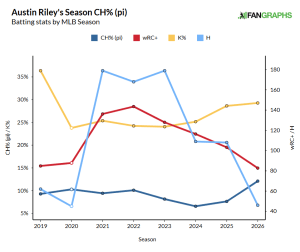
In essence, this mostly means Riley can’t touch changeups. He hasn’t seen many forkballs, splitters, or screwballs. Heck, no one’s seeing a screwball anymore. Regardless, the changeup is what’s keeping Riley so dry. He’s hitting .148 against it with a -3 run value while seeing it 11.2% of the time. This is after hitting .235 with a +2 run value on all changeups in 2025. In that sense, it’s a simple problem: Pitchers have adjusted to Riley; He hasn’t adjusted to them.
Yet it’s not just that. Riley is hitting fewer line drives than before, currently rocking a 19.9 LD%, 22nd-lowest in all of baseball. Correspondingly, his 29 line drives are the 24th-fewest in baseball. Compound that with a 45.2 HardHit%, and it’s clear Riley isn’t making contact as he used to, whether it be against offspeed or any other kind of pitch. Part of that is due to a career-worst 30.1 LA Sweet-Spot%, and a near career-high 19.1 launch angle. The bat isn’t where it needs to be.
All of this might be an aberration if not for Riley’s last three seasons. All his surface-level numbers have dropped ever since 2023. His average has basically dropped year by year. The same goes for his OBP and especially his slugging. That last mark is perhaps the greatest cause for long-term concern. In 2021 and 2023, Riley had the second-best slug amongst all regular third basemen. In 2022, he had the third-best. Now, he’s 11th, and his slugging percentage went from peaking at .531 to a current .364.
It’s all very odd. Riley is 29. His age 27-now seasons should be amongst his best. Due to his now eight seasons of MLB experience and his age, he should be hitting for more power than ever. He’s hitting for less. Injuries might provide some reason why, but they don’t fully explain why he’s become Atlanta’s black sheep.
The Verdict: Seek options elsewhere. Riley isn’t the hitter he once was. And he’s not showing any signs that will change. Over his last 30 games, he’s hitting .217. If he’s to change, let it come on someone else’s dime. Atlanta might say the same soon.
Matt McLain, IF, Cincinnati Reds
In 2023, the future seemed to be now for the Cincinnati Reds. Between the debuts of Elly De La Cruz, Spencer Steer, Christian Encarnacion-Strand, and Andrew Abbott, the Redlegs were on the rise. And that’s without mentioning their best and brightest rookie: Matt McLain. In his freshman season, McLain hit .290/.357/.507 with an .864 OPS and a 129 wRC+. He clubbed 16 home runs, collected 50 rib-eyes, and 23 doubles in just 89 games. As a result, he nabbed a well-earned fifth-place finish in NL Rookie of the Year voting.
Fast forward to now, and like many vote-getters from that NL rookie class – James Outman, Kodai Senga, Nolan Jones – and McLain isn’t the same player. He’s not even close. This season, McLain is hitting .196/.294/.320 with a .614 OPS and a 73 wRC+. McLain’s OPS is 11th-worst in baseball, his wRC+ is 13th. McLain is no longer on a cliff’s edge; He is barreling toward its bottom with a Wile E. Coyote sound.
It’s a perplexing change, and it’s not without many obvious answers. There’s a shoulder surgrey that cost McLain his 2024 season, yet that came in March of 2024. He returned and played a full 2025 season with a year of recovery behind him. Still, he hit .220 with a .643 OPS. Another year out from surgrey, and these are his numbers now.
Adding to the confusion is McLain’s development in two key areas: He’s begun to strike out far less and walk far more. As a rookie, McLain posted a 28.5 K%, then in 2025, a 28.9 K%. This season, he’s down to striking out just 23.5% of the time. It’s a remarkable, encouraging change, and the 18th-best year-to-year decrease in baseball. And as for walks, he’s gone from walking 7.7% of the time as a rookie to 11.3% now. The latter has him in the 73rd percentile. Usually, this is where hitters stall. They strike out, and they don’t walk. That’s not McLain’s issue.
So, what is? Maybe it’s remnants of his shoulder surgrey, maybe it’s not. But all of McLain’s power numbers are down. His Barrel%, Barrel/PA, HR%, exit velocity, and slug have all decreased with each season since his first. His Solid% is also down, and his Weak% is up. The only numbers not down are his ISO and his max exit velocity. The former is the same number, .124, as it was in 2025. The latter is only a 0.6 better. Neither serves as a saving grace.
That said, two things might be. McLain is finding his launch angle again. After finishing in the 94th percentile as a rookie, McLain dropped to the 43rd percentile in his second season. Now, he’s back in the 61st. That’s a strong sign, even if the results haven’t followed. As is his bat speed. It’s also up, and drastically. He’s gone from the 18th percentile in 2025 to the 47th this season. That +2.2 MPH is the fourth-biggest rise in baseball. While neither equates to success, it’s something McLain and the Reds need from him: Positive development.
The Verdict: Don’t panic in the long term; part for now. There is still a real chance that McLain becomes the player he was. When? It can’t be said. At 26, with so much baseball already under his ledger, one would hope it’d already come. It hasn’t.
