







We are in the midst of fantasy baseball draft season right now, where everybody is scrutinizing every single player they’re looking at drafting and saying, “Guys, this is totally gonna be the year” for whoever you’re in love with this year.
It’s also the time of year when everybody and their brother and their brother’s roommate from college is putting out a draft prep article, so hey, why not another one? This is one of my favorite article series I do every year—in fact, this is the seventh iteration of this article series if you can believe that (I know I can’t).
Anyways, enough rambling, let’s get to it. Here’s how this article works: I’m listing guys here who currently have an NFBC ADP of 250 or higher, meaning these are guys in your 10- and 12-team leagues that will likely be going toward the end of drafts or maybe even right at the end of the draft.
In every draft, I firmly believe that it’s important not to spend your last handful of picks on mediocre guys who will provide you with middling production, but instead on dart throws, lottery tickets, guys who could end up being major contributors for your team or could be nothing at all.
These types of picks are generally all potential upside and no downside. Either these guys pop off and end up being contributors for your team, or they’re nothing (and you’ll know that within a few weeks), and you can just drop them and replace them with someone on the waiver wire for someone else who you probably could’ve drafted at the end of your draft anyways.
Important note: I’m not saying these guys in this article are suddenly going to be league winners. Like I said, it’s possible, they could be, but we’re talking about a lottery ticket here. These are guys who I think have the opportunity and the talent to turn into fantasy assets.
Anyways, let’s dive in!
Colton Cowser (ADP: 250)
Colton Cowser had a very encouraging rookie campaign in 2024, posting a .242/.321/.447 line with 24 home runs, 77 runs, 69 RBI, and nine steals in 153 games. While plate discipline was a concern (a 30.7% strikeout rate that year was…not great), many people—myself included—thought Cowser was due for an even better season last year.
And that very much did not happen. Instead, Cowser played in 92 games and slashed a miserable .196/.269/.385, though he did manage to hit 16 home runs and stole 14 bases.
There are a few things that are encouraging to me about Cowser and why I’m targeting him later in drafts. First, Cowser will absolutely have a job as the Orioles’ center fielder because of his glove. Even if his bat is struggling, he’s an excellent fielder, so he will be in the lineup.
But I also don’t necessarily think the bat will struggle. Cowser was riddled with injuries last year—he broke his thumb in March, he had a concussion in September, and throughout the summer, he was playing with fractured ribs.
Assuming he’s healthy, the underlying metrics are there for Cowser to have a bounce-back season. Had he played a full season last year, he was on a roughly 25 home run pace, so the power was still there (as evidenced by a 14.1% barrel rate as well as a 42.7% ICR). He was also on a roughly 20 steal pace, which is a big shift from his rookie season.
All of this means that, assuming he’s healthy, I could easily see Cowser being a 20/20 guy, probably more like a 25-30 home run and 20-steal guy. Sure, the plate discipline is still a concern; he strikes out a ton, so the batting average might not be there, but everything else should be, including the counting stats, since he’ll be in what should be a strong Orioles lineup.
Noah Cameron (ADP: 263)
Noah Cameron’s rookie season was pretty phenomenal, but I’d imagine the reason his draft stock hasn’t risen more is that people are skeptical that he can repeat something similar to his 2.99 ERA through 24 starts that he had last year.
And frankly, that skepticism is a bit warranted. That ERA came alongside a 4.18 FIP, .241 BABIP, and an 84% LOB rate, all of which suggest there was certainly some luck involved in Cameron’s success.
However, there’s a lot I like about Cameron, and I still think there’s plenty of potential for him to be a really solid contributor for your fantasy team, and one that you don’t have to pay all that high a price for.
Of all the pitches in his repertoire, Cameron’s fastball is the one that is a little scary. The pitch comes in around 92 mph on average with not a lot of extension, though some decent ride, and Cameron doesn’t control it particularly well, posting a 49.7% zone rate with it last year (22nd percentile among fastballs).
Normally, if I see a pitcher with a bad fastball that he throws a decent amount, I’m concerned. Guys can make it work; there have been plenty throughout the years who have put in multiple excellent seasons thanks to their secondary stuff overcoming their bad fastballs (see: prime Carlos Carrasco).
Cameron does have great secondary stuff. His cutter was the fifth-best in all of baseball last year by PLV and posted some killer numbers, including a 33% chase rate (78th percentile among cutters), a 34.5% ICR (71st percentile), and a 47.1% groundball rate.
On top of that, he’s got a curveball that was ranked in the 81st percentile among curveballs in PLV, and posted some very solid swing-and-miss numbers with a 34.3% chase rate and 13.4% swinging-strike rate. And he’s got a very solid slider that also posted some great swing-and-miss numbers, including a 38.4% chase rate and 16.2% swinging-strike rate, and a decent changeup that works as a pitch to throw away to righties.
“But what about that bad fastball you mentioned?” Right, well, luckily, Cameron doesn’t throw it all that much. Yes, it’s his most thrown pitch, but he throws it 26% of the time, not 50%+, and that’s encouraging. Plus, it seems like Cameron knows the pitch isn’t his most effective, given he 1. doesn’t throw it a ton and 2. does a good job keeping the pitch away from the heart of the plate.
Cameron seems to have a pretty deep arsenal, as you can see by how well it graded out in PLV last year:
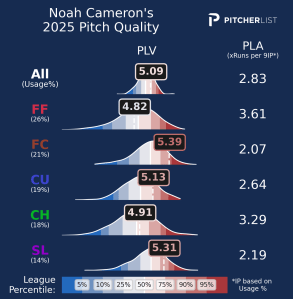
We already know the fastball isn’t great, but not a single one of those secondary pitches graded out poorly, and most of them graded out pretty well above average.
Should we expect another sub-3.00 ERA season from Cameron? Probably not. But the weapons are there, and I think he’s well worth the low price you have to pay to get him.
Andrew Vaughn (ADP: 278)
Sometimes guys just need a change of scenery.
At 27-years-old, it’s been seeming like former third-overall pick Andrew Vaughn was going to turn out to be just a pretty mediocre ballplayer, and up until early July last year, that was holding true, as he was slashing a miserable .189/.218/.314.
Then, Vaughn was traded to the Brewers, and things took off. During his time with the Brewers last year, Vaughn slashed .308/.375/.493 with nine home runs, 26 runs, and 46 RBI.
And sure, anyone can get hot for half a season, but what’s even more encouraging is that Vaughn dropped his strikeout rate from 22.3% during the first half with the White Sox to 14.6% and increased his walk rate from 3.6% to 9.4%. Vaughn also posted career-bests in barrel rate (11.7%) and ICR (43.2%) last year.
Take a look at how much Vaughn’s process improved in just about every facet once he went to the Brewers at the start of July:
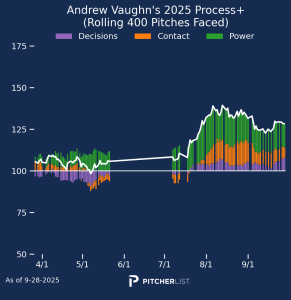
Vaughn’s likely to have a regular place in the Brewers’ lineup this year now that Rhys Hoskins is gone, meaning that we’re going to get a chance to see if the adjustments Vaughn made last year are legit. If they are, we might suddenly be talking about a guy who can hit for a good average and 20+ home runs that you can get right at the tail end of your drafts. That’s well worth a gamble in my book.
Grayson Rodriguez (ADP: 287)
As an Orioles fan, seeing Grayson Rodriguez traded to the Angels was a bummer (though I do like Taylor Ward’s potential, so there’s that). But so far in his career, Rodriguez has been all potential, a few promising results, and mostly time on the IL, as was the case last year.
But given how low his ADP is, there’s absolutely no reason not to take a swing at the potential of Rodriguez and the hope that he stays healthy. He has said he’s healthy, and even went so far as to say that the bone spurs he had removed from his elbow in August have been bothering him since he was pitching at Double-A in 2022 and were the driving factors behind his lat injuries in 2024 and 2025.
If all of that is true and Grayson Rodriguez is truly 100% healthy and ready to go out and pitch 30 starts, then getting him at the end of your draft could be an absolute steal. Let’s not forget that GrayRod has the upside of a guy with a mid-to-upper 90s fastball, two excellent secondary pitches in his changeup and slider, and potential for a 25%+ strikeout rate.
In 20 starts in 2024, Rodriguez pitched to a 3.86 ERA with a 26.5% strikeout rate. It’s not theoretical; he’s done it before, he can do it again. If you can snag him at the end of your draft, by all means. If he’s healthy on opening day, then ride out the production for as long as he’s out there. And if he isn’t healthy and suffers some kind of setback, luckily, the dart throw didn’t cost you much.
Ryan Weathers (ADP: 288)
The potential is very much there for Ryan Weathers. Now, does it feel like fantasy writers have been saying that for a long time? Yes. I’ve been one of them, basically ever since he was in San Diego. But I promise you the potential really is there. Weathers just needs an opportunity and to stay healthy.
He’ll have the former, as he’s likely to slot into the Yankees’ starting rotation and stay there as long as he’s effective, but the latter is less of a given. But, similar to what I said with Grayson Rodriguez, this late in the draft, I’m fine taking a gamble on talent with health question marks, because if you have to cut bait once he lands on the IL, the price you paid was basically nothing.
And let’s not forget the potential Weathers has. He’s got a 97 mph fastball that he controls quite well that induces weak contact at a great clip, a changeup that’s been a great out-pitch to righties, and a sinker that legitimately has 18 inches of horizontal movement to it that he could probably utilize more against lefties. The sweeper needs a little work as an out-pitch against lefties, too, but that’s doable (and it seems to be happening in spring training).
The stuff is there; Weathers just needs to be healthy. This late in a draft, I’m banking on the stuff.
Justin Crawford (ADP: 291)
Do you want speed with an average that isn’t going to hurt you? Justin Crawford might be your guy. Crawford (Son of Carl) is just 22-years-old but seems poised to end up getting the lion’s share of reps in center field for the Phillies.
There isn’t a ton of power there just yet, but there’s at least a little bit, which is more than you can say for a lot of major speed guys. Last year in Triple-A, Crawford posted a .334/.411/.452 line with seven home runs, 88 runs, 47 RBI and 46 steals.
Two things pop out to me with those numbers: Obviously, the 46 steals are one of them, and that’s honestly no surprise given that speed has been Crawford’s calling card as a prospect. He stole 42 bases between High-A and Double-A in 2024 and stole 47 between Low- and High-A in 2023, so the speed is obvious.
But what really impresses me is that .411 OBP, driven by his 11.5% walk rate, which is nearly double his 6.4% walk rate the year before. That is extremely encouraging. I love to see a guy as young as Crawford working to improve his patience at the plate as much as he did.
Assuming Crawford gets the full-time gig in Philly, could he be someone who hits in the .270s with 25+ steals and a handful of home runs? I think so, and given his price in drafts, I’m all about that.
Dylan Beavers (ADP: 303)
Dylan Beavers only got 35 games at the major league level last year for the Orioles, but it’s pretty likely that he’ll get fairly regular at-bats this year in one of two situations: 1. On the strong side of a platoon with Tyler O’Neill, given how hard O’Neill typically hits lefties and/or 2. Whenever Tyler O’Neill gets hurt, as he did many times last year. Sure, the Orioles also have Leody Taveras and Jeremiah Jackson as outfield options should they need them in O’Neill’s (likely inevitable) absence, but Beavers is almost certainly going to be the priority.
There’s a lot to like about Beavers’ potential. In Triple-A last year, he slashed .304/.420/.515 with 18 home runs and 23 steals in 94 games. He’s got a great power/speed combo, could easily be a 20/20 guy, and best of all, he’s got a pretty darn good eye at the plate, posting a 16.3% walk rate in Triple-A last year and a 19% walk rate during his time in the majors, showing excellent decision-making:
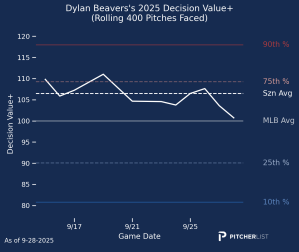
That’s not to say Beavers is flawless—he’s not as aggressive at the plate as he should be, getting into a 0-1 count 57.7% of the time last year in the majors. However, that’s something that can be learned, and given the guy is 24 and going this late in drafts, the potential is worth the price.
Matt Wallner (ADP: 304)
Matt Wallner feels like an old-school three-true-outcome type hitter. He’s got plenty of power, hitting 22 home runs in 104 games last year (roughly a 30 home run pace for a full season) and posting a 13.5% barrel rate (87th percentile in the league), he walks a good bit with an 11.7% walk rate last year (86th percentile), and he strikes out bunches with a 29.1% strikeout rate last year (11th percentile).
Wallner could be a 30-home run guy with a decent OBP given a full season, but “given a full season” is a pretty big question mark.
At the risk of sounding like a broken record, why not take a swing on talent with an injury risk late in the draft? Sure, Wallner is likely to do what power guys do, which is go on a hot streak where he looks like Baseball God Incarnate for a month before hitting .150 for the next month, but there’s a usefulness for a guy like him, especially in roto and best ball leagues. And, if you’re in an OBP league, the average that’s likely to be in the .220s or .230s won’t hurt you as much, because he’s probably going to float an OBP around .330 or .340.
Robby Snelling (ADP: 332)
Robby Snelling does not currently have a guaranteed job in the Marlins’ starting rotation, but I feel like that’s coming sooner rather than later.
Snelling’s stuff is legit. He’s got a fastball sitting around 94-95 mph with decent movement that he controls very well, and turned in a 5.56 PLV last year. For some context, if he had posted a 5.56 PLV on his fastball in the majors last year, it would’ve been the eighth-best fastball in the entire league. On top of that, he’s got some very solid secondaries in his changeup, slider, and curveball, and even better, he’s got nothing left to prove in the minors.
Last season between Double- and Triple-A, Snelling posted a 2.51 ERA with a 30.3% strikeout rate and a 166/39 strikeout-to-walk ratio. The man is ready; it’s just a matter of when, and with the trading away of Edward Cabrera and Ryan Weathers, it’s likely that Snelling will be battling it out with Braxton Garrett (who’s coming back from Tommy John surgery) and Max Meyer (who’s coming back from hip surgery) for the fifth spot in the rotation.
It’s entirely possible Snelling lands that fifth spot, but even if he doesn’t, I’d argue he’s likely to have a spot in the rotation sooner than later. If you’re someone who doesn’t like to draft guys who need to take up a bench spot (and generally, I don’t), then I can understand letting him slide if he opens the season without a job, but I think the talent is well worth the cheap price.
Reynaldo López (ADP: 356)
After falling into the bullpen and spending four years as (mostly) a reliever, Atlanta popped Reynaldo López in as a starter for 25 games in 2024, and he was incredible, posting a 1.99 ERA with a 27.3% strikeout rate on the season.
So naturally, there was a lot of conversation coming into last year on whether López could repeat something even remotely similar to that season, but ultimately that didn’t matter because he had one start and then was knocked out for the remainder of the season with a shoulder injury that required surgery. But López is back, supposedly healthy coming into this year, and theoretically should have a slot in Atlanta’s rotation.
López is another one of those guys who tries to make up for his exceptionally hittable fastball with excellent secondary offerings. He’s got a pretty nasty slider that posted a beautiful 39.3% chase rate and 21.5% swinging-strike rate in 2024, plus a very solid curveball that works well as an offering to lefties.
The nice thing is, you’ll know within the first couple of starts whether López is going to be worth hanging onto. If the secondaries are working as they did a couple of years ago and he’s looking healthy, then an end-of-draft pick is well worth the price. But if he has an injury setback or just doesn’t look like he has it at the start of the year, then you cut him loose, and thankfully, you didn’t pay much.
Graphic by Carlos Leano
