





The offseason is in full swing in both real and fantasy aspects. While many are licking their dynasty wounds after the 2026 season, others are celebrating their shrewdness in winning a coveted title. The joy of dynasty is having more power heading into the coming season. Some players you invested in last winter didn’t see much of the field and didn’t take the steps forward you expected, while other investments paid off in spades. Attention will soon turn to the first-year-player drafts, with prospect rankings and projections fueling debates everywhere. We here at Pitcher List have a heavy hand in those debates, and we hope you trust our analysis to lead you to better things in 2027, whether that means rebounding or defending your spot atop the mountain. With that, we need to wrap up 2026 and the lessons learned or narratives solidified along the way. Second base has been a popular sore spot for many dynasty managers, lacking the star power or seemingly sure things that other positions have. Here are my biggest takeaways from the past season.
10 Second Base Dynasty Takeaways from 2026
1. JJ Wetherholt is the top dynasty second baseman. But the case was not as sure as it was eight weeks ago.
It was no surprise when Martin’s latest dynasty rankings came out that St. Louis Cardinals second baseman JJ Wetherholt was in the top 30, following a stellar 2026 season. The 2024 draftee is just the latest entry into that draft class’s limited history of producing high-round picks who were ready for the big-league jump in a hurry. Heading into his age-24 season, expectations for the leadoff man will only rise, but those expectations took a bit of a tumble over the past couple of months.
Heading into August, Wetherholt was a top-10 second baseman in many respects, led by his 67 runs scored (3rd), 15 home runs (6th), and 12 stolen bases (9th). But that production dried up once the calendar turned. Through the rest of the season, he managed one home run, two stolen bases, and a .213/.310/.276 line that didn’t help many managers, no matter the scoring format. Much of that can likely be blamed on a wrist injury, one he “had been managing pain symptoms in his wrist for about a month” with, before the Cardinals placed him on the injured list on Aug. 30. It didn’t help that he was also one of baseball’s unluckiest hitters during that two-month stretch, with 70 points separating his .344 xwOBA and .274 wOBA. Either way, it pulled him out of the Rookie of the Year race he was once the favorite in and sapped his fantasy value right when managers needed it most. FanGraphs’ Player Rater Card function visualizes just how sharp the drop was, and how sustained it stayed through the close of the season.
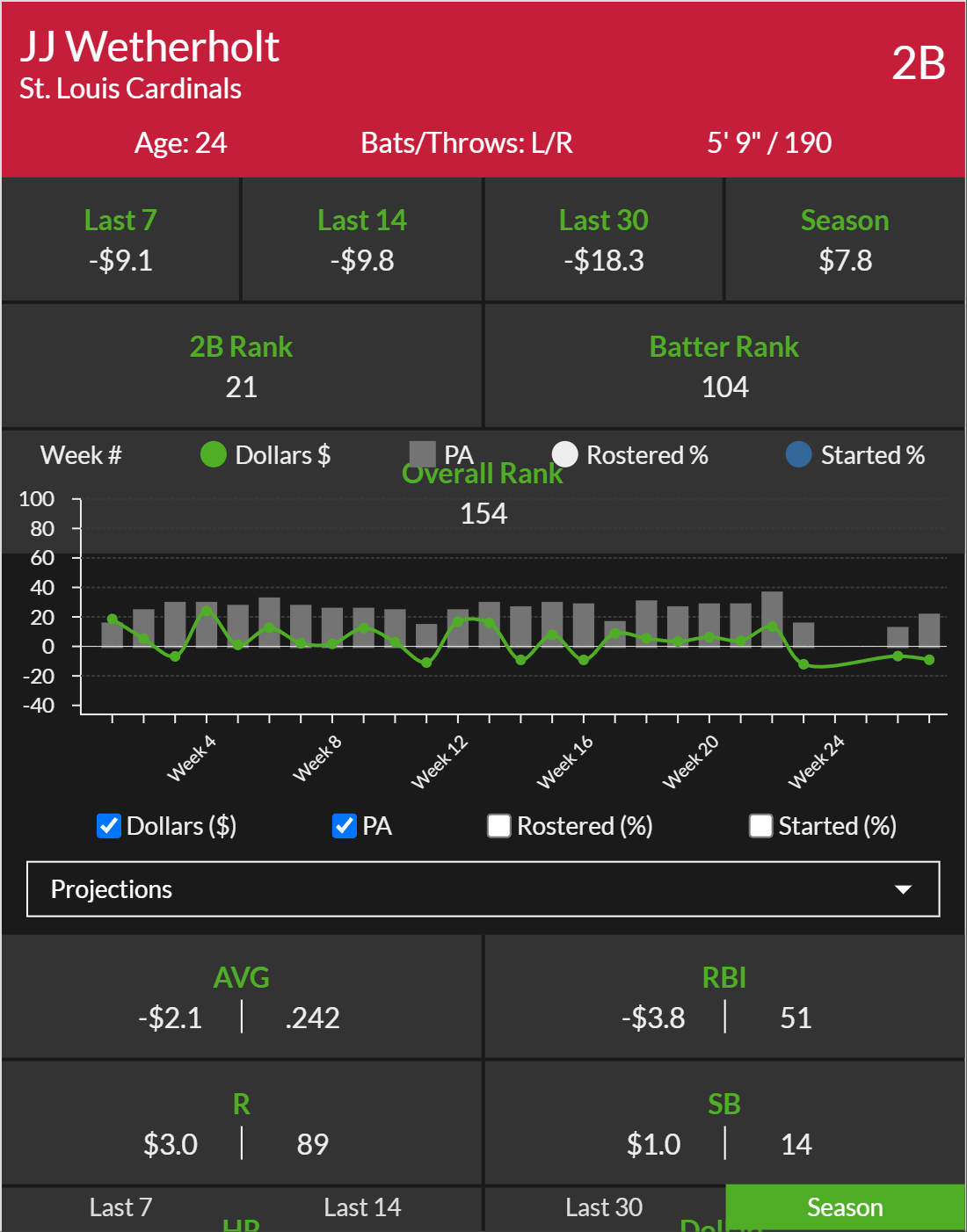
Does this mean Wetherholt has lost all dynasty shine heading into 2027? No, absolutely not, given the context. But this is an undeniable hit to the “what have you done for me lately” mindset of baseball fans. He is still the top future option at second base, a player with the defensive value and team-specific role that will keep him on the field and in the picture for a long time. But the injury did take some gleam off Wetherholt’s gem value heading into the coming season.
2. The Brice Turang believers are still reaping the benefits.
It still doesn’t feel that long ago that infielder Brice Turang was just the speedy, glove-first prospect the Milwaukee Brewers churn out on a conveyor belt. He still felt like that in 2023, when he had 26 stolen bases and 46 runs scored in 137 games but an abysmal .218/.285/.300 line to show for it. Even in 2024, when he stole 50 bags, he was a below-average batter whose limited value kept him in the position’s lower tier of outlook. But Turang turned the page on that narrative in 2025, and really showed that season wasn’t an outlier in 2026 with career highs in home runs (21), runs scored (102), and RBI (100), helping power the Brewers to the National League’s top postseason seed.
In this same article a year ago, Matt called Turang a “complete fantasy asset and should be a reliable one for dynasty managers over the next several seasons,” and his 2026 season backed that up. Heading into his age-27 season, Turang faces a hard threshold to match once again, but it’s something he has shown a knack for. His power outburst alone is enough to jump his fantasy value into one of dynasty’s best infielders, and his ability to punish sinkers and cutters in an MLB landscape leaning more and more on those pitches gives me real hope. Turang was not a perfect prospect coming into the league, and those who trusted the process are now laughing all the way to the proverbial bank for holding out on him panning out to this elite level.
3. The Fernando Tatis Jr. infield move makes the keystone so much more interesting.
Even though I said Wetherholt was the top dynasty second baseman, largely due to his carrying tools and age, Matt’s rankings had another player at the position ranked higher: San Diego Padres star Fernando Tatis Jr. The Dominican has long been a reliable fantasy producer, even as he’s shaken off the perceived issues from the 2024 season. His production was already great for an outfielder, but bringing that same output with eligibility at second base? It almost feels like a cheat code for some managers to use in 2027.
Tatis played a career-high 53 games at second for the Padres, after logging only one inning there back in 2023. The shift seemed to come out of nowhere, especially after San Diego had moved Tatis from shortstop to right field with golden rewards. But the move back to the infield, at least on a part-time basis, is something the Padres have been cooking up since spring. And Tatis, even in April, “loves it,” according to MLB.com’s AJ Cassavell.
“It’s probably a little bit, I don’t want to say I’m more focused, but it’s just more quick action in there,” Tatis said. “You’ve got double plays. You’ve got people on first, people on second. You just get more involved.”
How did more action in the infield help Tatis’s bat? Correlation doesn’t always equal causation, but the numbers suggest that being more involved on every play helped him at the plate. He posted an absurd 173 wRC+ when playing second, with 10 home runs, 16 stolen bases, and 33 runs scored in 52 games. If he kept that pace across his full 704 plate appearances, he would have recorded approximately 32 home runs, 106 runs scored, 71 RBI, and 51 stolen bases on the season. That plays in any dynasty format. San Diego will likely not make the move permanent, with Xander Bogaerts and Jake Cronenworth holding down the middle infield for the most part and Tatis serving as a complementary piece there. Still, his newfound positional eligibility unexpectedly makes Tatis an elite player to plug into the second base slot, especially for managers who already have another outfielder to use in his stead.
4. Late-season swoon, future destination will impact Jazz Chisholm Jr.’s offseason value.
The arrow was pointing straight up for New York Yankees second baseman Jazz Chisholm Jr. following the 2025 season. After a full season within the Yankees organization, it seemed the power was finally shining through, with a career-high 31 home runs and 80 RBI to go with 31 stolen bases. He looked like the complementary piece New York’s slugger-heavy lineup really needed. It helped that Chisholm performed notably better in Yankee Stadium, with a 148 wRC+ at home compared to a 101 wRC+ on the road last season. Add in the fact that Chisholm was heading into his final year of team control, and the stage was set for him to continue the trend and cash in following 2026. But Chisholm defied the idea that “the contract year remains undefeated,” a phrase coined by the late, great writer Terez Paylor, and took a real step back in both the box score and real-baseball value in 2026.
Did Chisholm end the year as a probable top-10 second baseman in re-draft leagues? Yes, absolutely. But getting moved down the lineup, and the reduced RBI and run-scoring potential that came with it, stung more than any gains he made in the stolen base department. Now, heading into his age-29 season, Chisholm feels like he’s back in the “something to prove” bucket he occupied after 2023, albeit without the age advantage helping his dynasty value this time. With free agency likely on a rushed clock as a lockout looms, where he lands will play a major factor in his value. Will he be a tweener infielder once again? Will he find a pull-friendly home the way Yankee Stadium was for him? Is he a headline piece or supporting cast? Those are all questions I’m watching this offseason regarding the former Miami Marlin, and the answers are entirely on him.
5. Alarm bells are ringing for Ketel Marte.
We are nearly two months removed from Arizona Diamondbacks cornerstone Ketel Marte’s no-show ahead of the Boston Red Sox series, and it remains a central focus of the coverage surrounding the team. It adds a different flavor hearing newly re-signed manager Torey Lovullo say this past week that he’s “going to eliminate protecting [Marte] the way I have.” A better flavor for dynasty managers would be if Marte were coming off another All-Star, MVP-consideration season as he had in 2024 and 2025. But alas, 2026 was another down year, before and after he stepped away from the team and torpedoed the Diamondbacks’ postseason chances.
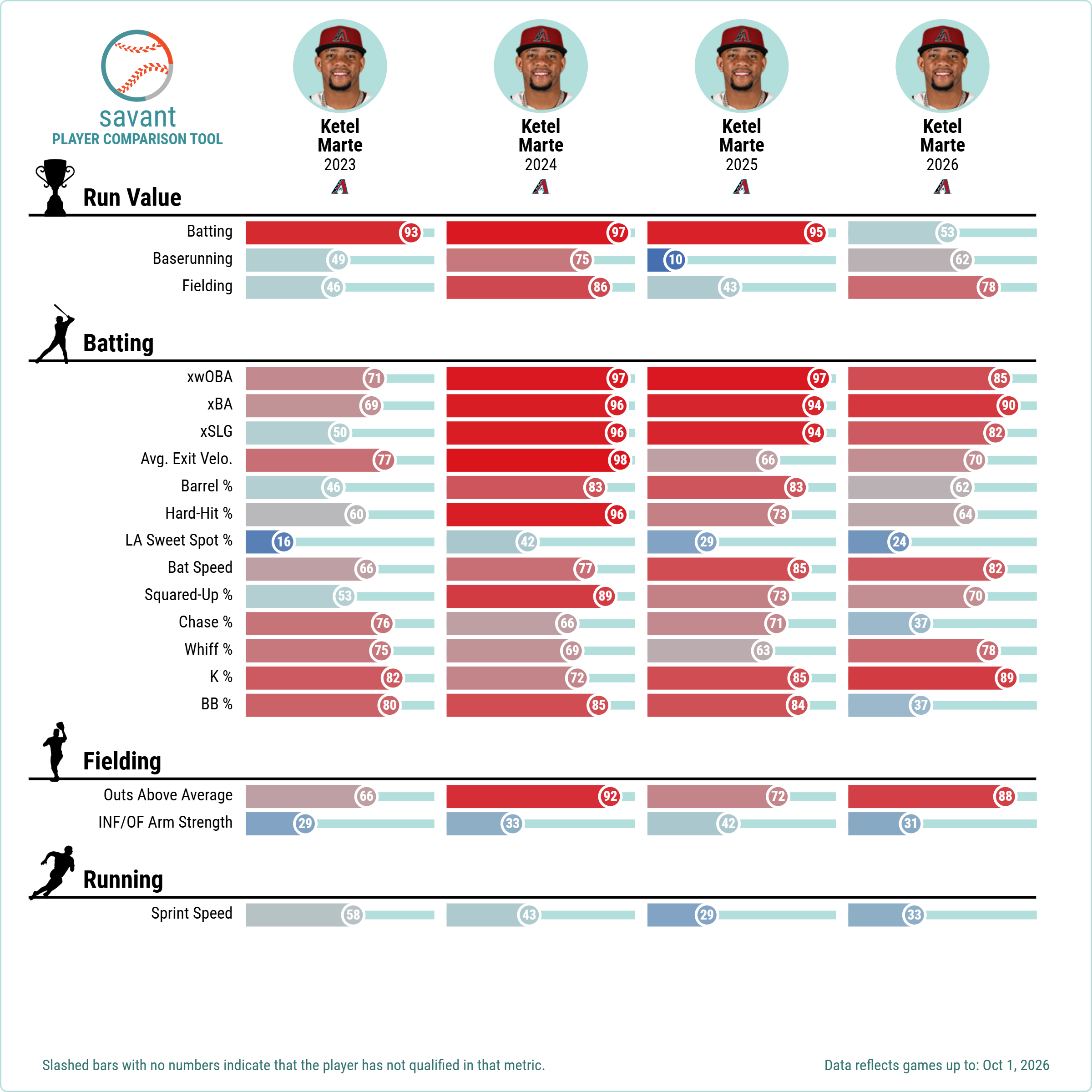
In his age-32 season, Marte was still an above-average batter by OPS+, but a far cry from the top second baseman many had come to see over the past two seasons. Marte has always carried the stigma of faltering after great seasons – see 2018-2019 – but the optimistic hope was that he had moved past that and built the MLB foundation to prevent it from happening again. It happened again, slightly. For every peak, there’s been an equal valley. This past season was his worst since 2022 in many respects, though that rebound track record should help assuage current owners’ outlook on him heading into 2027. But that’s hedging on a 33-year-old player in a funk with his current franchise finding his footing again in a meaningful way. The walks are down, the chase rates are up, and there are regressions across the board that concern me for Marte’s fantasy value. His glove is still good enough to make him an MLB regular, and possibly even a star again if he finds a new home this offseason. But will Marte ever be a top-five second baseman in dynasty again? I doubt it.
6. Sayonara to Otto Lopez, Luis García Jr., and Ceddanne Rafaela.
There are quite a few strong options at second base who are likely losing their positional eligibility after different roles in 2026. The Red Sox used Ceddanne Rafaela exclusively in center field, a testament to his sterling defense there. He didn’t dominate any one category this past season, but it’s hard not to call him a top-10 option at the position in many formats. The Marlins moved Otto Lopez to full-time shortstop this season, and he broke out in a big way on the league scale. The bat finally caught up to his glove, as he ranked top-five among second basemen in batting average, runs scored, and stolen bases, three seasons after being waived by the San Francisco Giants. Former Washington Nationals second baseman Luis García Jr.’s dynasty value hit a wall after a down 2025 season, but a move to first base seemed to coincide with him getting his swing back. He posted career bests in home runs (30), runs scored (69), and RBI (92) while unlocking more power to start the season. Now, with the Yankees on their postseason run, the lefty masher won’t be a flighty option at second base anymore.
7. Demetrio Crisantes slips in 2B prospect picture.
Only two seasons ago, Diamondbacks prospect Demetrio Crisantes was one of those prospects that carried the “buy now, or regret it later” label. The then-19-year-old had just gotten his first taste of Low-A ball and was red hot, with six home runs, 20 stolen bases, and a 146 wRC+ in 63 games. Coming out of the draft, he had a clear contact-over-power approach, but the game power seemed potent enough to elevate Crisantes into a high tier of prospect.
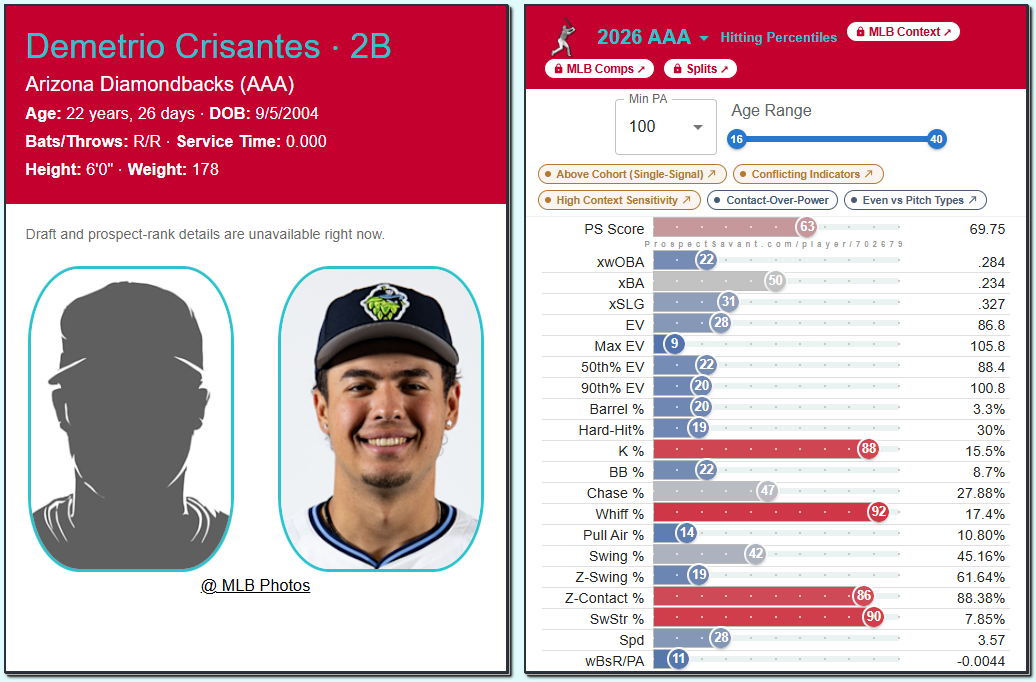
Don’t get it twisted, Crisantes is still a highly regarded prospect, but the hype and buzz that once surrounded him has certainly faded. He comes in at 328th on Martin’s latest dynasty rankings, behind fellow young infielders like Minnesota Twins shortstop Marek Houston and Seattle Mariners second baseman Cole Young. Crisantes still had a solid season from an overall prospect lens, notching ten home runs and a 106 wRC+ across 92 games split between the ACL (3 games), High-A (4 games), Double-A (35 games), and Triple-A (50 games). It was that final promotion to Triple-A that raised more questions than it answered. The 22-year-old didn’t show the raw tools that many elite, productive prospects flash at that level, and I think the work over at Prospects Savant illustrates that best.
He isn’t the biggest dropper in the overall dynasty prospect rankings, but there’s notable room now between him and the top three dynasty prospects at second base. Crisantes needs to flush the 2026 season and move on to 2027, hopefully starting strong in Triple-A right out of the gate.
8. Angel Genao proves the MLB learning curve.
At second base, if there was any prospect I was comfortable saying was ready to be an MLB contributor right from the jump, it was Cleveland Guardians prospect Angel Genao. In his age-22 season, the Dominican was lighting up Triple-A to the tune of 10 home runs, nine stolen bases, and a 135 wRC+ in Columbus. With him so far above the pack in production while still carrying 20/20 potential down the road, I was ready to see Genao in the big leagues. Unfortunately, it doesn’t seem he was quite ready for that jump into the fray.
Sure, Genao was able to slot in all over the infield for the Guardians, with at least seven appearances apiece at second, third, and shortstop, but the bat just wasn’t there, and his ball-in-play style didn’t translate into getting on base. It happens. That’s the learning curve. He wasn’t seeing a ton of pitches in the zone (43.7% zone rate, 28th percentile), and his somewhat passive approach at the plate didn’t help him make more meaningful contact on the hitter-friendly pitches he did get. His struggles against the four-seam fastball in Cleveland also fly straight in the face of where he feasted in Columbus. Those struggles deserve a deeper dive into why, what can be amended, and whether he has too large a weak spot to be a top dynasty piece, but overall, Genao looked like about as close to a sure thing as there was. Alas, that was not the case.
9. Don’t discount Cooper Flemming’s fit at second base.
One of this season’s fastest-rising prospects is in the Tampa Bay Rays system: shortstop Cooper Flemming. Last summer’s 53rd overall pick spent all year at Low-A, totaling 11 home runs, 16 stolen bases, and a 126 wRC+. Much of his helium comes from a strong finish to the season, and he’s one of those players similar to how Crisantes was viewed two years ago. But there are real questions about his long-term positional fit. He has the arm for shortstop or third base, but his athleticism covered for some lacking feel and instinct at shortstop this past season. Any young shortstop with a good arm always draws the question of whether he’s a future third baseman, but I think there’s a better path for Flemming at second base, and perhaps the Rays see it that way too.
Flemming made at least 18 starts apiece at second, third, and shortstop, with many of those second base reps coming after the calendar turned to August. From what I’ve watched, Flemming looked more comfortable at second than third, even though he logged more than 100 additional innings at the latter. That’s just the eye test, and I’m sure the organization will evaluate alongside Flemming this offseason. But he looks more like a player whose athleticism and strong arm make him a good double-play turner with range, rather than a third baseman or shortstop who needs that one tool to occasionally cover up a misstep. Should dynasty managers invest in Flemming now and expect him to be a second baseman forever? No, he’s years away from the league. But where the needle settles is still up in the air, and I think it should settle on him at second base, even if the Rays are somehow okay with a below-average batter and fielder at shortstop every day (looking at you, Taylor Walls).
10. The AL Central has some clogged second base projections.
I want to dive deeper into this another day, but the AL Central has some dynasty conundrums that will need sorting out early at second base. Looking at who is eligible at the position, four of the five teams have legitimate 1A and 1B options:
- Chase Meidroth and Sam Antonacci in Chicago
- Kody Clemens and Luke Keaschall in Minnesota
- Hao-Yu Lee and Colt Keith in Detroit
- Angel Genao and Travis Bazzana in Cleveland
The most long-term impactful situation is likely within the Guardians, as Genao looks to find his footing in MLB and Bazzana looks to build on a strong finish to the season. The former first overall pick was the buzzy player to start the season, and for good reason. But a big gap between his batting average and on-base percentage, plus limited opportunities to bring runners in or score runs himself, hampered his fantasy value in his first season.
Lee and Keith will be interesting to watch, with whoever steps up likely depending on whether pending free agent Gleyber Torres is still with the club following this offseason. Neither had a fantasy season to write home about, but I expect Keith to regain positional eligibility early next season and Lee to be the de facto 1A option in the meantime. Minnesota is a roulette wheel on who gets the lion’s share of work at the keystone, with Clemens and Keaschall logging nearly equal games there last season. Clemens brings more thump, Keaschall brings more speed and batting average. Dear Twins R&D, please find a way to fuse the two into one.
The Chicago situation might be more intriguing to the eye test than on paper. Meidroth was nearly the everyday guy there this past season, bursting out with 15 home runs and 88 runs scored. But Antonacci looked mighty good at that position too, back on the infield where he grew up. I think he’ll get enough work there to keep his eligibility, though he likely fits best in left field as long as Meidroth keeps producing.
