






Here at Pitcher List, we have a suite of PLV metrics to analyze every pitch in a baseball game. Decision Value (DV) is our hitter swing decision metric. It takes inputs like pitch velocity, location, and movement, and tells us whether the hitter made a good decision to swing or take a particular pitch. This isn’t quite as simple as plate discipline; swinging at a Logan Webb sinker and pounding it into the ground is a bad outcome even if the pitch was a strike.
Instead, Decision Value rewards hitters for swinging at pitches they should be able to hit hard, and for taking pitches they’re unlikely to do much with. The flipside is that Decision Value punishes hitters if they don’t swing at pitches they should be doing damage on or do swing at pitches that are unlikely to generate quality contact. You can find a much more thorough introduction to PLV metrics and Decision Value here.
If you had to simplify good swing decisions to their most basic form, the optimal approach is: swing at strikes, don’t swing at balls. The suite of Decision Value metrics (DV, oDV, zDV) provides a more nuanced take, but the correlation between a batter’s zDV and zone swing rate is strong. The (negative) correlation between a batter’s oDV and chase rate is even stronger. One way the DV metrics can provide us with value is by helping us better understand hitters who are more selective than you might expect, even while maintaining high DV scores.
To measure how aggressive a hitter is, I’ll use another PLV-based metric, swing aggression. Swing aggression is an estimate of how often a hitter swings relative to the expected swing rate against the pitches he has seen. Hitters like Ezequiel Tovar rank highly in swing aggression. Taylor Ward, on the other hand, has by far the lowest swing aggression in MLB this season. In general, high swing aggression hitters tend to rank well in zDV and poorly in oDV. In contrast, low swing aggression hitters tend to rank poorly in zDV and well in oDV.
The close relationship between metrics led me to wonder which hitters are more selective than average (negative swing aggression) yet still attack the right pitches in the zone (above 100 zDV). If swinging at pitches in the zone is generally good, then selectivity will tend to decrease a hitter’s zDV. A hitter who manages to have an above-average zDV despite being highly selective should be particularly good at picking their spots and swinging at only the best pitches to hit.
Of the 331 hitters who have seen at least 300 pitches this season, only 13 have a combination of below-average swing aggression and a zDV above 100. Since the median hitter has a 96 zDV this season, each of these hitters is at least a third of a standard deviation better than league average on their in-zone swing decisions. As expected, each of these hitters is also excellent at their out-of-zone swing decisions: they swing less than expected, and chasing out of the zone is almost always bad. Let’s dive deeper into four hitters who really stand out in their zDV while maintaining a highly selective approach.
Miguel Vargas: -3.6% Swing Aggression, 106 zDV
Vargas is one of the season’s biggest breakout hitters. He has maintained exactly the .234 average he posted in 2025, but has improved his OBP by 50 points thanks to an elite 15.3% walk rate. Vargas has also added 73 points of slugging percentage, leaving him with a .234/.366/.474 line and a top-25 ISO. Pretty much all of the underlying metrics think his breakout is for real. Vargas is above average in literally every single metric on his Baseball Savant page, culminating in a 95th-percentile xwOBA.
Vargas has gotten here by making elite swing decisions. His negative swing aggression is mostly driven by his outstanding 17.1%, 99th-percentile chase rate. Indeed, Vargas has gotten more aggressive in the zone this year. He’s swinging at a career-high 70.3% of strikes, similar to players like Rafael Devers and Sal Stewart. Vargas’s combination of above-average zone aggression and extreme refusal to chase is unlike anyone else in MLB. The only person who swings at as many strikes as Vargas and has an overall swing rate within 5 percentage points is Ronald Acuña Jr. Acuña only ranks this close to Vargas, swinging 2.5 percentage points more often, because he sees one of the lowest rates of pitches in the zone of any MLB hitter at 43.6%.
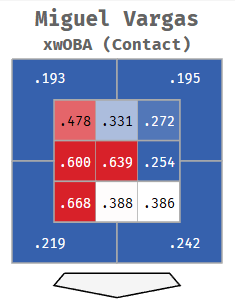
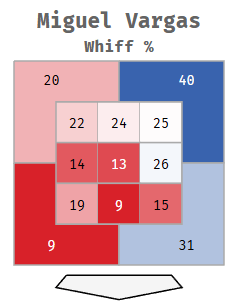
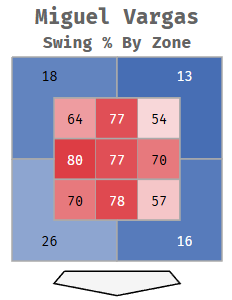
Vargas isn’t perfect at choosing what to swing at in the zone, but he does an excellent job of targeting his swings where he’s most likely to do damage. Vargas’s best parts of the strike zone are T-shaped, covering middle-middle and everything over the inside part of the plate. He also does a solid job handling pitches middle-low and low and away, although not nearly as well. His relatively weaker results on contact middle-low are offset by it being the zone where he makes the most contact. Vargas knows this, swinging most middle-in and at anything down the middle. Vargas could still improve by swinging less middle-up and middle-away, but he’s among the best hitters in baseball at picking his spots.
Christian Yelich: -2.6% Swing Aggression, 109 zDV
Yelich is an interesting case. Unlike Vargas, Yelich doesn’t have outlier-level chase rates. Yelich swings on pitches out of the zone 26.3% of the time, which is still strong. Yelich would be around the 66th percentile in chase rate if he qualified for the leaderboards. For hitters who are less aggressive than average, Yelich actually has the worst oDV, tied with Jake Cronenworth. This is hardly a criticism since all of these hitters have strong plate discipline, but it does highlight that Yelich’s negative swing aggression is coming in part from pitches in the zone.
Yelich has been swinging at strikes 67.4% of the time this season, totally normal for him in his time with the Brewers, absent the very strange and small sample 2020 season. Pitchers have been throwing him more strikes than ever, though, with Yelich seeing 53% of pitches in the zone, surpassing his career-high of 48.8% set last year. This is particularly noteworthy since the new, ABS-influenced strike zones are smaller, leading to an overall decline in strikes thrown across MLB.
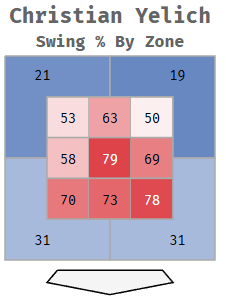
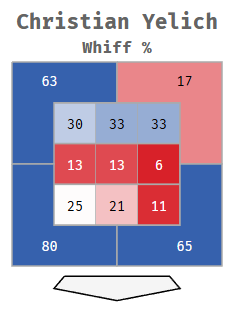
Yelich has some clear patterns in his swing decisions. He’s excellent at going after the most-hittable pitches, swinging nearly 80% of the time on middle-middle pitches. He also generally lays off anything around the top of the zone, and particularly up-and-in or up-and-away. This is wise for Yelich as he whiffs at a similar rate to players like James Wood on these pitches while being an elite contact bat in the rest of the zone. In general, he’s less likely to swing at pitches on the outside part of the plate. This season, Yelich has scorched balls along the bottom of the zone, averaging 94 MPH on pitches in the bottom third. He’s also pounding them into the ground, averaging a 0 degree launch angle. If Yelich is going to continue seeing this many pitches in the zone, he’ll need to make an adjustment either to make more contact at the top of the zone or to hit the ball in the air, at least occasionally, on pitches at the bottom of the zone.
Travis Bazzana: -4.2% Swing Aggression, 104 zDV
Bazzana has started his MLB career on a tear, hitting .302/.407/.458 over his first 27 games. He has maintained an elite walk rate like his minor league numbers would suggest, taking a free pass on 13.3% of his major league plate appearances. Perhaps most surprising, he’s also cut his strikeout rate from his generally solid minor league numbers to a very strong 16.8%. Bazzana’s walk and strikeout numbers most closely resemble Freddie Freeman’s start to the season, with Freeman posting a 13.0% walk rate and a 16.5% strikeout rate. One place they differ is that Freeman is a more aggressive hitter, swinging at 4.5% more pitches than expected.
Bazzana’s discipline has shown up in a very strong 20.3% chase rate. Bazzana swings at fewer pitches in the zone than Yelich and Vargas, though, at 62.2% of strikes. The nearly 40 percentage-point difference in zone swing vs chase rate is still very strong for Bazzana, but we begin to see why he’s a few points lower in zDV than the previously discussed hitters.
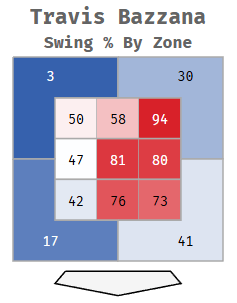
Bazzana’s plan at the plate is obvious: swing at nearly everything middle-in and try to avoid swinging at anything away. In their preseason rankings, the Fangraphs prospect team wrote that Bazzana’s “swing is geared to generate lots of pull-side launch,” and his approach at the plate seems designed to maximize that aspect of his swing as well. The Fangraphs prospect team also criticized Bazzana’s perceived passivity at the plate in their scouting report. While he’s certainly swinging less than expected at pitches this year, zDV indicates that he’s managing to do so in a way that still gives him an opportunity to do damage when he does swing.
Austin Martin: -6.0% Swing Aggression, 103 zDV
Martin fits the archetype of a middle infielder (now corner outfielder) making the most out of relatively limited athleticism. While Martin has maintained a Vargas-ian 17% chase rate this season, he does so by overall limiting his swing rate, swinging at only 39% of pitches this season. This doesn’t look like an early-season outlier, either, as Martin swung only 40.2% of the time in 2025 as well. Restricting how often he swings has been fairly successful for Martin, however, as he’s maintained a 12.6% walk rate against only a 16% strikeout rate over the 2025 and 2026 seasons.
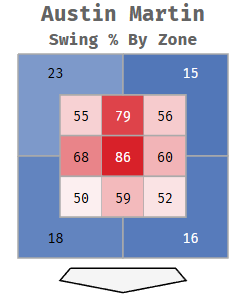
Martin’s standout skill is swinging at middle-middle pitches. Despite the lowest swing aggression of any of these four hitters, he swings the most frequently at pitches in the center of the zone. Martin’s selectivity within the zone has paid dividends in contact quality. While Martin doesn’t swing hard, he does get the most out of his swings, posting a 92nd percentile squared up rate of 34.3%. Despite poor barrel and hard-hit rates, Martin’s excellence in choosing when to swing suggests he’s likely to keep pinging the ball around the diamond. With his excellent discipline and lack of power, the main question for Martin going forward is whether pitchers will attack him in the zone more often and force him to swing the bat more frequently.
