





As more minor-league arms make the leap to The Show, savvy dynasty managers know they can’t afford to react late. Staying ahead of the curve means leaning on more than just box scores—and thanks to the power of Statcast and the brilliant team at Pitcher List, PL Pro tools make that possible. With PLV and thousands of data points tracking every pitch and batted ball, we get an ever-evolving look at what each pitcher or hitter might offer—not just today, but for the long haul. Whether you’re eyeing a stash-worthy breakout or scouting for long-term upside, this data gives you the edge. So let’s dive in: from high-profile debuts to top-tier fastballs lighting up the minors, here are some arms you need on your radar.
Be sure to head over to the dynasty team page for all of the latest breakdowns and rankings to help take your team to the next level in 2025!
Want to find these numbers and much more? Visit the PL Pro Tools Hub, a page containing all the tools exclusive to PL Pro members for quick access.
Checking in on Some Big Name Prospects:
Bubba Chandler, 22, Pittsburgh Pirates
Season Stats: 6 GS/ 25.1 IP/ 1.42 ERA/39.6% K%/7.7% BB%/0.67 WHIP
Weekly Stats: 1 GS/ 5.0 IP/ 1.80 ERA/52.9% K%/5.9% BB%/0.80 WHIP
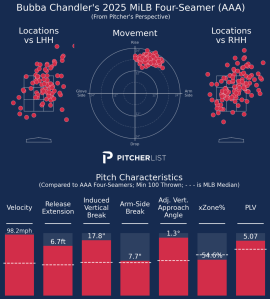
The Pittsburgh Pirates are sitting on a treasure trove of pitching talent, and right-hander Bubba Chandler might just be the mother-of-pearl at the center of it all. His fastball explodes into triple digits on radar guns nationwide, backed by 17.8 inches of induced vertical break and 1.3 degrees of HAVAA. That mix of raw power and movement has Triple-A hitters flailing, as shown by his eye-popping 38.4% CSW% to start 2025.
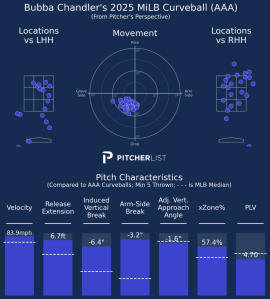
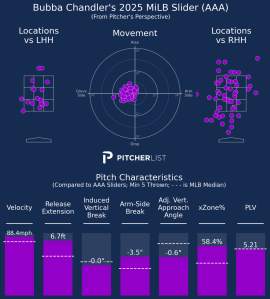
The command is fine—not elite—but his pitch quality does most of the heavy lifting. Still, I’ve got two reasons to tap the brakes on the four-seamer hype. First, Chandler leans on it heavily, throwing it 54.1% of the time. Second, it’s the pitch getting hit the hardest: a .277 xwOBA and 60% hard-hit rate, both his worst marks among all offerings—including a middling slider and below-average curveball. He typically elevates the fastball, working the upper third of the zone, but that’s prime hunting ground for major league hitters. And while it’s only been put in play 15 times this year, six of those have come off the bat at triple-digit exit velocities. That’s a red flag.
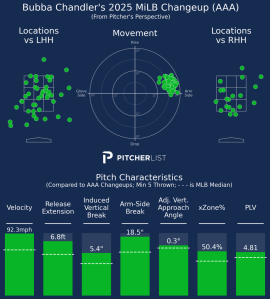
Now, if you’re looking for real results, his changeup might be the gem in his arsenal. With 18.5 inches of arm-side break, it would rank top 10 among qualified MLB changeups, outpacing even fellow Pirates Paul Skenes and Mitch Keller. Opposing hitters haven’t recorded a single hit off it this season, and its .069 xwOBA is elite. The 32.3% CSW% is strong, though it still functions more as a complementary pitch than a putaway weapon. That said, when hitters do make contact—just 21% of the time—they’re rolling over for weak grounders and rally-killing double plays. That kind of impact in leverage situations is valuable all on its own.
These aren’t major red flags—they’re nitpicks for someone who might be the top undebuted arm in baseball. Parsing the fine details is part of what separates a future ace from a high-octane rotational piece. In today’s game, it’s not enough to just light up the radar gun—you’ve got to dominate within the zone, too. Chandler has the tools to be the crown jewel. Whether he reaches that ceiling or settles in as a high-leverage gem, one thing’s clear: Pittsburgh is better with him in the pipeline.
Take a look under the PLV hood here:
Logan Henderson, 23, Milwaukee Brewers
Season Stats: 5 GS/26.0 IP/2.42 ERA/35.0% K%/11.0% BB%/0.96 WHIP
Weekly Stats: 1 GS/6.0 IP/1.50 ERA/28.6% K%/0.0% BB%/0.67 WHIP
Milwaukee Brewers prospect Robert Henderson delivered a sensational MLB debut in April, tossing a quality start against the A’s while striking out 42.8% of the batters he faced. So while it wasn’t shocking to see the Brewers option him back to Triple-A Nashville, it was still a little deflating. That said, Henderson hasn’t missed a beat since returning—stacking back-to-back quality starts and fanning five and six batters on April 26 and May 2, respectively. Sure, his outings haven’t been flawless, but what more does Henderson have to prove in Triple-A? He’s not some one-dimensional arm that needs projection or polish. He carries himself with poise, has the stamina to handle a big-league workload, and shows a full starter’s arsenal.
Let’s zoom in on that May 2 start against the Gwinnett Stripers. Henderson held them to just four hits and one earned run across six innings, allowing only five hard-hit balls. He tossed 96 pitches—his highest pitch count of the minor-league season—eclipsing the 85 he threw back on April 3. While his 25.5% whiff rate may not jump off the page relative to his talent, the Stripers couldn’t barrel a single pitch and managed just a .244 xwOBA against him. When a 29.1% CSW% feels underwhelming, you know a pitcher is ready for the next level. Henderson’s command, composure, and ability to keep hitters off-balance suggest it’s time for the Brewers to make room in their rotation. He’s done his part—now it’s Milwaukee’s move.
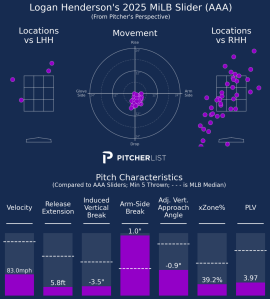
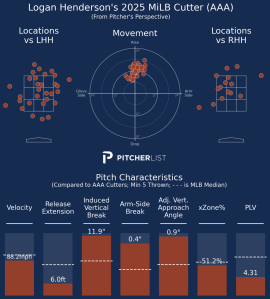
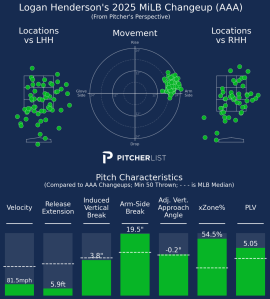
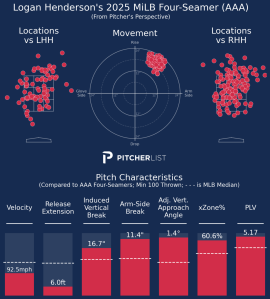
Henderson hasn’t tried to break his pitching mold this season, and why should he? He is still a four-seam fastball/changeup guy, sprinkling in a cutter and slider when the time is right. It astounds me that Henderson has thrown his changeup 108 times and not a single barrel and a miniscule .178 xwOBA on that pitch. Take a look at the PLV chart below, and you will see why it is so effective. The fastball is a beast all by itself, and even though the slider and cutter do not grade well in PLV, they round out his arsenal and are only occasionally deployed.
Take a look under the PLV hood here:
Weekly Four-Seam Standouts
This section could be a combination of Zebby Matthews (122 on Apr. 27), Jacob Misiorowski (137 on Apr. 27), Andrew Painter (109 on May 1), or Chandler week in and week out. Those pitchers are among the cream of the prospect crop, and their fastballs are a large part of their success. Instead of honing in on the player’s managers many already know, here are some other above-average offerings and what makes them worth noting.
Mick Abel, 23, Philadelphia Phillies
Weekly Four-Seam Grade: 120 in Apr. 29, 2025 start
Season Stats: 6 GS/34.1 IP/2.88 ERA/25.2% K%/9.1% BB%/1.25 WHIP
The 2020 MLB Draft has been a forgettable one for so many franchises, but there are some moderate hits from that group. One such player has been right-handed pitcher Mick Abel, whom the Philadelphia Phillies selected 15th overall. The then-high schooler has been a fringe top 100 prospect since then, and 2025 feels like the year he makes his MLB debut.
Abel’s game-level results this season have been solid. Pitching for Triple-A Lehigh Valley, he hasn’t allowed more than four earned runs in a start since Opening Day, logging innings and racking up a respectable number of strikeouts. But the underlying metrics tell a less flattering story. His four-seam fastball and slider—supposedly his best weapons—aren’t grading out well in PLV. In fact, his curveball is the only offering the model sees as above average.
Maybe early-season adjustments are starting to stick, helping fuel a jump in Fan4+. Possibly. His latest outing featured a fastball that looked genuinely above average, a step in the right direction. If Abel can lock in those tweaks, he might shed the “organizational depth” label and finally tap into the potential the Phillies saw on draft night.
Jake Bloss, 23, Toronto Blue Jays
Weekly Four-Seam Grade: 137 Fan 4+ in May 3, 2025 start
Season Stats: 4 GS/23.2 IP/6.46 ERA/20.9% K%/11.3% BB%/1.94 WHIP
Right-handed pitcher Jake Bloss had a rough welcome to the majors in 2024. He made three starts for the Houston Astros, never lasting more than four innings and allowing at least two runs each time. A five-run, four-homer outing against the A’s in July proved to be the final straw. Not long after, the Astros sent him to Toronto in a midseason deal—part of a three-prospect package—for a much-needed reset.
But the fresh start hasn’t translated at Triple-A Buffalo. Whether it’s the new environment, a shift in team philosophy, or just nerves, Bloss has struggled to find consistency. His fastball has been the lone bright spot this season—consistently above average—but control remains spotty. His May 3 start was a step back: four runs, three walks, and just 3.1 innings of work. That line was a letdown after two strong outings with 12 strikeouts, one walk, and no earned runs combined.
Bloss’ biggest problem isn’t the heater—and his Fan4+ mark backs that up. The concern lies with his curveball and changeup. Right now, neither secondary pitch is fooling anyone. With inconsistent command and only two reliable offerings, Bloss remains a work-in-progress that the Blue Jays need to sort out soon.
Eury Pérez, 22, Miami Marlins
Weekly Four-Seam Grade: 123 Fan4+ in May 1, 2025 start
Season Stats: 2 GS/2.2 IP/0.00 ERA/40.0% K%/10.0% BB%/0.75 WHIP
It’s been nearly two years since fans last saw towering Marlins right-hander Eury Pérez on a big-league mound. Following Tommy John surgery in April 2024, the highly touted righty has begun a rehab assignment with Low-A Jupiter. He’s still a long way from returning to Miami, having been limited to just 19 and 26 pitches in his first two outings.
“Specific date to come back, I don’t have it, but the plan is to get at least eight outings out there in the Minor League level: three [at Single-A Jupiter], and then I will go to [Triple-A] Jacksonville after that,” Pérez said via interpreter Luis Dorante Jr in early May.
Early returns on Pérez’s rehab stint have been encouraging. He’s flashing strikeout stuff against minor leaguers who may match him in age but lag far behind in pro experience. After all, Pérez made his MLB debut at just 20 years old in 2023, holding his own across 19 starts for a playoff-bound Marlins squad. His 3.15 ERA and 28.9% strikeout rate didn’t just impress—they set a high bar. That success was fueled largely by a dominant four-seam fastball, and the fact that pitch already looks sharp in rehab is a promising sign for Miami and dynasty managers alike.
Welcome to the Bigs
Gunnar Hoglund, 25, Athletics
Minor League Season Stats: 6 GS/2.43 ERA/1.04 WHIP/26.1% K%/6.1% BB%
Major League Debut Pitching Line: 6.0 IP/1 ER/1.00 WHIP/7 K/0 BB/81 P
The Athletics‘ fall from grace over the past ten years will make for a great book someday. The franchise was always a cheapskate, much to the chagrin of baseball fans everywhere. The 2014 Wild Card Game loss seems like the apex moment for the team that formerly called Oakland home. Now seeming like squatters in a minor-league ballpark, only the unaware or unphased will marginally fill the stands for an Athletics game. And yet, on Friday night, a surprisingly loud crowd gathered behind the A’s dugout—just one pocket of the 8,864 in attendance. The group was nondescript, looking like any large group one could expect at an evening spring game. They had plenty to cheer for in a 6-1 win, but their roars hit another gear when a new face took the mound.
That face belonged to Gunnar Hoglund.
The right-handed pitcher made his first trip to an MLB mound against the Miami Marlins and tossed six innings of spectacular ball. The 25-year-old did not look nervous or out of place at all in the victory, and his skipper noticed.
“Outstanding performance by the young man,” A’s manager Mark Kotsay said. “From pitch one, seemed to be really focused. You couldn’t really tell if there [were] any nerves or not. He came right out and attacked … and any time you get a guy that can go six innings in a game and have a quality start the first time out, that’s pretty impressive.”
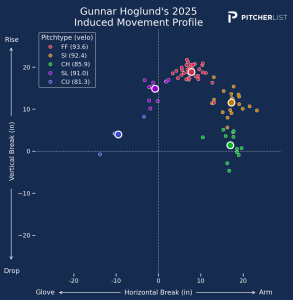
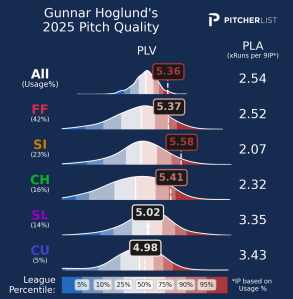
While Hoglund had plenty of help in the field and wasn’t facing a top-tier opponent, Athletics fans and dynasty managers shouldn’t overlook this initial performance. The box score is impressive enough, but his stuff looks like a rotational mainstay rather than a future bullpen project. Hoglund’s fastball doesn’t light up the radar gun from the right side, but his exceptional control makes his above-average 6.8″ of extension and 18.8″ iVB play up. On top of that, Marlins batters couldn’t put the bat to that pitch, recording a 42.9% whiff rate on the four-seamer alone.
Hoglund showcased four other pitches on his first start, tossing his slider and sweeper minimally. His sinker, primarily the secondary offering to righties, and his changeup, the secondary option for lefties, both shone on Friday. The sinker didn’t have the same swing-and-miss results as Hoglund’s four-seam and changeup combo (which combined for six of his seven strikeouts), but the Marlins only had a .130 xwOBA on that sinker. Much like his four-seam, Hoglund has exceptional command of the sinker and above-average arm-side break. He dotted up the lower half of the zone with that pitch and induced plenty of groundballs for the infield to gobble up.
Hoglund’s debut won’t fix the franchise’s broken identity, but it’s a start. With the A’s somehow sporting a winning record, the rookie deserves another look. His slider, in particular, shows some interesting shape—I’d love to see more data on it in future starts.
But in dynasty leagues, results rule. And so far, so good for the Florida native.
Take a look under the PLV hood here:
Other pitchers that made their MLB debuts this past week:
Chase Petty, 22, Cincinnati Reds
Noah Cameron, 25, Kansas City Royals
AJ Blubaugh, 24, Houston Astros
Tyler Owens, 24, Detroit Tigers
Luis Mey, 23, Cincinnati Reds
