





Here at Pitcher List, we have a suite of PLV metrics to analyze every pitch in a baseball game. Decision Value (DV) is our hitter swing decision metric. It takes inputs like pitch velocity, location, and movement, and tells us whether the hitter made a good decision to swing or take a particular pitch. This isn’t quite as simple as plate discipline; swinging at a Logan Webb sinker and pounding it into the ground is a bad outcome even if the pitch was a strike.
Instead, Decision Value rewards hitters for swinging at pitches they should be able to hit hard, and for taking pitches they’re unlikely to do much with. The flipside is that Decision Value punishes hitters if they don’t swing at pitches they should be doing damage on or swing at pitches that are unlikely to generate quality contact. You can find a much more thorough introduction to PLV metrics and Decision Value here.
The trade deadline has come and gone, with a quiet period leading up to an explosive day of movement. In addition to the normal rental starters and middle relievers, quite a few everyday hitters changed teams as well. In today’s edition of PLV DV Weekly, let’s take a look at what their new teams can expect from them. I’m omitting Liam Hicks from this list because I wrote about him a month ago, but the quick update to that article is that he’s been back to making excellent decisions at the plate recently. I also covered Taylor Ward in both our 2027 AL Free Agency Preview and the Swing Decision All-Stars. Last week’s edition featured Luis Arraez as a likely trade candidate.
Adley Rutschman – 104 DV
Rutschman was moved to the Red Sox for three of the Red Sox’s top five prospects, although the Sox did manage to keep hold of Franklin Arias in their midseason shopping. Rutschman burst onto the scene with two seasons of roughly 30% better-than-league-average performance at the plate in 2022-23, but took steps back amid injury in 2024 and 2025. One thing that has remained constant for Rutschman, however, is exceptional strikeout-to-walk rates. Rutschman has never had a strikeout rate above the 18.3% he posted in his rookie season, nor a walk rate below the 9.1% of 2024. In the midst of a bounce-back season, Rutschman is walking 10.6% of the time and striking out in 14.1% of his plate appearances. Both of those rates are just below his career averages, as Rutschman is putting the ball in play more frequently than in any other season of his career.
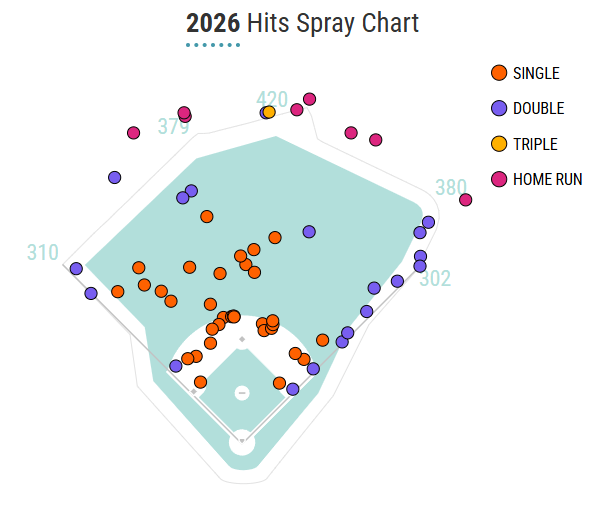
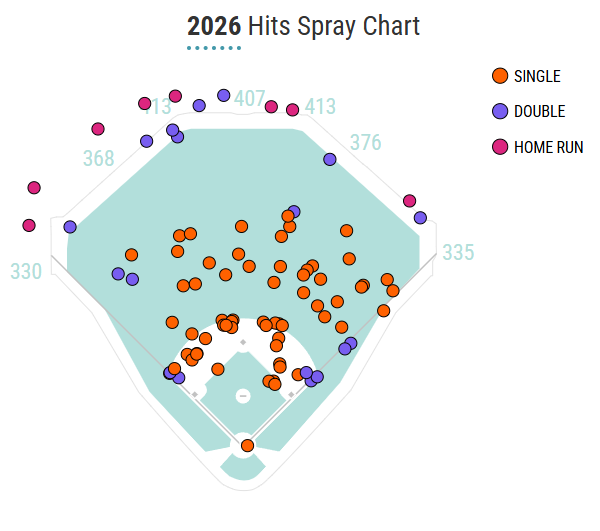
Rutschman is a fairly passive hitter, swinging at around 41% of pitches this season. His above-average 104 DV is weighed down by a 92 zDV, reflecting Rutschman’s selectivity in the zone. Rutschman swings at just 57.8% of strikes, a rate that has declined every season he’s been in the majors. He’s not as passive as former teammate Taylor Ward, but he’s not far off either; Rutschman’s zSwing ranks 226th of the 242 hitters with at least 250 plate appearances this season. That’s not to say you can’t be successful with this type of approach, of course. Fellow selective catcher Gabriel Moreno is 241st on that same list, and has a .298/.380/.438 line for the season. The difference between Moreno’s line and Rutschman’s still-good .251/.333/.431 is that Moreno has much more success when putting the ball in play. Neither catcher hits the ball all that hard, with all of their Statcast hard-hit metrics sitting around the MLB median. Their spray charts (shown below, Rutschman on the left and Moreno on the right) reveal a pretty significant difference in approach. Moreno sprays the ball all over the field, while Rutschman is pull-focused. That could be an asset in Fenway, with short distances down the lines but a deep center field.
Brenton Doyle – 87 DV
Doyle broke out in 2024, posting a line that was nearly league average at the plate with elite center field defense. It hasn’t worked out as well for him since then, though, with Doyle managing just a 65 wRC+ in 2025 and a 50 thus far in an injury-plagued 2026. More concerningly, his defensive metrics have fallen off as well this season, leaving him more than half a win below replacement in just 46 games. Doyle has improved his walk rate this year despite chasing more than ever before. That’s probably due to the shrinking strike zone under ABS, since Doyle is also being more aggressive in the zone and swinging at a career-high 52.6% of pitches. Nothing looks particularly out of order in Doyle’s contact quality metrics, but his launch angle has declined over the past two years leading to a mirrored decline in his expected wOBA on contact. Ultimately, though, the main question for Doyle’s viability as a major league center fielder is whether he can recapture the defensive wizardry of his first few seasons; the bat is secondary.
Jo Adell – 87 DV
Adell could not be more different at the plate than new teammate Steven Kwan. Even setting aside the physical tools, the two Guardians outfielders could hardly have more different approaches. Adell is aggressive to the point of it being a detriment at the plate, swinging at 36.2% of balls and 74.3% of strikes. That’s a very good zSwing-oSwing split, but Adell’s aggression has caused him to have a 2nd percentile walk rate. Among qualified hitters, Adell ranks 10th in zone swing rate, while Kwan is dead last. Adell swings the bat incredibly hard (77 mph on average), so you want him to put the ball in play more than your average hitter. More importantly, he seems to have ironed out some of the contact issues from earlier in his career. Adell’s zone contact rate has steadily improved over the course of his career to reach a new high of 86.1% this season. Putting that together with his aggressiveness in the zone, the probability that Adell puts a strike in play is nearly 64%, 18th in baseball.
Marcelo Mayer – 104 DV
If there’s one thing Mayer has had going for him at the plate in his young career, it’s making good swing decisions. Mayer’s an aggressive hitter, swinging at 73% of pitches in the zone and 29% outside of it. That’s an excellent 44% zSwing – oSwing. Combined with his 74 mph bat speed, it’s easy to see why Mayer was so highly regarded in prospect circles and why many are puzzled at the Red Sox’s decision to bail on him for minimal return. Looking at his pitch-type splits, though, Mayer has mostly flailed against anything soft in his time in the majors. Mayer has nearly 20% career swinging strike rates on every non-fastball pitch type but swings at roughly similar rates against each pitch type. If Mayer can figure out how to turn his career .493 OPS on pitches other than four-seam fastballs or sinkers into something closer to his .762 OPS against those pitches, the Red Sox will regret selling low on him.
Lars Nootbaar – 109 DV
Nootbaar is another low-swing rate hitter like Rutschman, only more extreme. His zone DV sits at just 77, while he has a 114 oDV courtesy of an 18% chase rate and a 53% zone swing rate. Nootbaar’s zDV has cratered this year in part due to him cutting an already-low zone swing rate, but in particular due to what he’s stopped swinging at. In past seasons, Nootbaar swung at 56% of strikes, but 63% of pitches in the Statcast-defined heart of the zone. This season, he’s cut 3 percentage points from his swinging strike rate, and all of the reduction is from pitches in the heart of the zone. Nootbaar has above-average bat speed and 85th percentile average exit velo. He and the Diamondbacks would benefit from him being more aggressive in the zone, especially with a career 87% zone contact rate.
Heliot Ramos – 96 DV
Ramos is just slightly below average in all things swing decision-related. He’s extremely aggressive at the plate, chasing 37% of the time but also swinging at 71% of strikes, leading to a 98 zDV as well as a 98 oDV. This is a marked change from 2025, a season in which Ramos chased under 30% of the time and swung at 66.1% of strikes. Swinging this often has kept Ramos’s walk rates low, with this year’s 5.2% representing a career low. Two years ago, Ramos’s profile wasn’t too different from Adell’s, as a 75 mph average bat speed led to a 17.3% HR/FB rate. Over the past two seasons, though, Ramos has lost three ticks on his bat speed. He’s still hitting the ball as hard as ever, but I’m skeptical about the long-term viability of this approach if he can’t regain the bat speed.
Luis García Jr. – 78 DV
Garcia is another entry into our hyper-aggressive hitters list, joining his compatriot Ramos on the Yankees. Unlike Ramos, Garcia won’t see much benefit from changing parks, as Nationals Park and Yankee Stadium have similar park factors (although Yankee Stadium does more to encourage homers). Garcia has swung at 70.8% of strikes this season, but paired it with his worst chase rate since 2022 at 39.9%. Garcia makes remarkable amounts of contact outside the zone for someone who isn’t just swinging at balls near the plate, giving him an 83.7% contact rate overall. His bat speed is moving in the opposite direction of Ramos’s as well, adding over 2 ticks since 2024 while maintaining his excellent contact rates. Garcia’s hitting the ball harder than ever before, while also lifting it more than ever before (still just a 12-degree launch angle), which should make Yankees fans very happy to see him in pinstripes.
