





We had partied like it was 1999. We had survived the Y2K bug. We were using Napster to pirate music, including the #1 song on the Billboard Top 100 (‘Smooth’) from the artist Carlos Santana.
It was January 1, 2000.
We were not yet addicted to our phones. Donald Trump was seeking the Presidential nomination of the Reform Party and had named Oprah Winfrey as his ideal running mate. Thankfully, we had never heard of COVID.
The Yankees were amid a three-peat. Paul Skenes and Bobby Witt Jr. were not yet born. The smooth-fielding, one-time Pittsburgh Pirate first baseman Carlos Santana had not hit any of his 335 and counting career home runs.
Nearly ten thousand days later, the Red Sox and Cubs have broken storied curses. Much to the delight of Pope Leo XIV, the White Sox ended an even longer, if less ballyhooed, World Series drought than the Red Sox (RIP Bobby Jenks). Steroid-fueled hitters feasted on early 2000s pitching like mosquitoes at a nudist colony. Pitchers responded by increasing their velocity, leading to baseball fans knowing the names of orthopedic surgeons like Dr. James Andrews and Dr. Neal ElAttrache (some referring to the latter as Dr. ReAttache due to the volume of Tommy John surgeries he performs).
The All-Star game returned to Atlanta for the first time since the 2000 Midsummer Classic at Turner Field. Yes, folks, it really has been twenty-five years. And so it is time to name the full AL and NL Quarter Century All-Star Teams. Today, we select the NL Team after naming the AL Team earlier this month. We will include fun facts for every player, sprinkle in some helpful Immaculate Grid tips for those who play, and finish with some predictions for the next quarter-century team.
For those who read the AL Quarter-Century All-Star Team earlier in July (and if you didn’t, you really should), you may recognize that we have been using the same intro and format. However, in the spirit of continuous improvement, we will take things to the next level by adding a few new roles to the team.
A reader of the AL Quarter Century All-Star team suggested adding a manager and a front office executive (either a GM or a President of Baseball Operations, since responsibilities can vary across teams). In the spirit of a make-up game, we will add in a manager and general manager for the AL as well. Those selections are below, and will also give you a sense of the type of fun facts you can expect for the players as well. And yes, we do recognize the irony that both managers now lead teams in the other league.
Also, in honor of the exciting first-ever All-Star Game decided by a Home Run Swing-Off, we are going to have a little fun by choosing three Swing-Off batters at the end of the hitting section. At the end of the pitching staff, we will then select a Swing-Off BP pitcher for each league, flipping the All-Star selection process on its head by selecting a pitcher known for ruining fans’ days by giving up gopher balls. Similar to the manager and front-office executive, we will make up ground by also noting our choices for the AL.
Managers
American League – Terry Francona: 2 World Series Championships, 3 AL Championships, 11 playoff appearances.
Fun Fact – Earlier this month, Francona became the 13th manager in MLB history to reach 2,000 career wins as a manager. In the typically humble fashion that helps him be such an effective manager and leader of men, Francona explained, “I don’t think I’ve ever tried to delude myself. I mean, some of those names up there are kind of like baseball royalty. If there’s an adjective for baseball lifer, it’s me. I’m not overly smart… I just love the game, probably too much.”
The grammar police might quibble whether Francona being the epitome of a baseball lifer is a noun or an adjective, but nobody would argue the sentiment. Tito’s sense of humor and authenticity make him one of a kind.
Note to reader — Some links in this article, such as the preceding one sharing a good example of Tito’s sense of humor, are to short, relevant, and often fun YouTube videos.
National League – Bruce Bochy: 4 World Series Championships (2010, 2012, and 2014 with the Giants and 2023 with the Rangers). His 2,093 career wins are 10th in MLB history, one of three managers to win a World Series in both leagues – Sparky Anderson and Tony LaRussa are the others.
On the other side of the ledger, Bochy’s teams have finished over .500 in just 11 of the 23 seasons he has managed since 2000 and have only won 90 games three times, with a high of 94 in 2012. His winning percentage as a manager this quarter century is surprisingly under .500 (.494). These numbers, however, are heavily influenced by four straight losing seasons at the helm of the Padres between 2000 and 2003, when the team’s front office seemingly adopted the stars and scrubs strategy often used by fantasy baseball managers, surrounding Hall of Famers Trevor Hoffman and Tony Gwynn with floatsam and jetsam. Even a James Beard award-winning chef cannot make pan-seared Chilean sea bass from rice and beans.
Despite these thorns on Bochy’s rose, in the end, flags fly forever, and if he so chooses, Bochy can wear World Series rings on all four fingers of his left hand.
Fun Fact – In 2014, Bochy became the first major league manager ever to give the ball to his son to pitch in a game for him. Seven other managers, most notably Cal Ripken Sr., who managed both Cal Ripken Jr. and his brother Billy, have managed their sons before, but their sons were all position players.
Bruce did not exactly insert his son Brett into a high-leverage situation with the Giants trailing the hated Dodgers 14-0 in the sixth inning. Between 2014 and 2015, Bruce gave the ball to Brett for the only seven MLB games of his five-year professional baseball career. After the 2015 season, the 27-year-old Brett retired from baseball, went to graduate school, and then worked as a real estate agent in San Diego (there are certainly worse places to make a living) before the Rangers hired him as a scout in 2023.
Front Office Executive
American League – Theo Epstein: We will keep this one short and sweet. Epstein was the general manager for the 2004 team and the Cubs’ 2016 team that ended the two most storied World Series droughts in World Series history. While Billy Beane deserves consideration for the Moneyball revolution he started in baseball, to paraphrase the player valuation scene from the Moneyball movie, his defect is that his teams never won in the playoffs.
Fun Facts – In football, analysts often refer to a legendary coach’s coaching tree (e.g., the Bill Walsh coaching tree). The Theo Epstein MLB executive tree is similarly impressive. Three current GMs (Mike Hazen, Ben Cherington, and Craig Breslow) worked under Epstein, and another Epstein protégé, Jed Hoyer, was promoted in 2020 from General Manager to President of Baseball Operations when Epstein stepped down from that role.
National League – Andrew Friedman: Friedman was both instrumental in establishing the ‘Rays Way’, the innovative data-driven approach which helped the, shall we kindly say, frugal Rays make the playoffs four times in his tenure from 2006 to 2014, and including an American League pennant in 2008. Friedman left Tampa for the Dodgers after the 2014 season, but the Rays Way established the foundation for Tampa making the playoffs four more times between 2019-202,3, including a 2020 World Series appearance.
Moving to the Dodgers after the 2014 season just added rocket fuel to Friedman’s already ascendant career. The Dodgers have made the playoffs in all ten of Friedman’s years in Los Angeles (and twelve straight overall) with their current roster; it is easy to foresee them shattering the record Atlanta set between 1991 and 2005. Atlanta, though, only won one World Series title, much to the disappointment of Morgan Wallen and his beloved ’98 team. The Dodgers were starting to be compared to Atlanta until they won the 2020 World Series* and then a non-asterisked 2024 World Series in large part thanks to former Atlanta first baseman Freddie Friedman.
Fun Fact – Friedman often gets lumped in with the new post-Moneyball generation of ‘nerds’ who rely heavily, if not exclusively, on analytics. Many people don’t know he played center field at Tulane, though injuries limited his collegiate playing time.
The Players
A few notes on methodology for selecting players:
- We will only consider performance and statistics from the year 2000 onwards.
- We will largely mirror the composition of recent All-Star game rosters, complete with a super utility player and a setup man.
- We will place players who played in both leagues in the league where they experienced greater success, requiring a judgment call in some instances.
- Except for the super utility spot, players will be put at the positions where they played the most games (e.g., Jim Thome as DH instead of first base).
- We are ignoring PED use, since we do not truly know who was and was not using before testing, and maybe even since.
- We will, at times, choose peak performance over long-term accumulation of stats (e.g., Johan Santana over Mark Buehrle, even though the latter has a higher career WAR and 75 more career wins).
- Please do not fret — Jacob Misiorowski will not be on the NL pitching staff even though ‘Nobody Beats the Miz’ in the fewest career starts ever needed to make an All-Star team.
Hitters
Starting Lineup
1) Shohei Ohtani – DH
2) Barry Bonds – LF
3) Albert Pujols – 1B
4) Bryce Harper – RF
5) Nolan Arenado – 3B
6) Chase Utley – 2B
7) Carlos Beltrán – CF
8) Buster Posey – C
9) Jimmy Rollins – SS
Reserves
Yadier Molina, Freddie Freeman, Joey Votto, Troy Tulowitzki, Manny Machado, Matt Holliday, Andruw Jones, Giancarlo Stanton, Ryan Braun, Andrew McCutchen
Last Cuts
Paul Goldschmidt, Scott Rolen, Jim Edmonds, Adam Wainwright, Cole Hamels
Catcher
Starter
Buster Posey – Gerald Dempsey “Buster” Posey was a winner. He was the undisputed leader of three World Champion Giants teams (2010, 2012, 2014). Posey shone in each of those seasons, winning Rookie of the Year in 2010, MVP in 2012, and a Silver Slugger in the 2014 season (6th in MVP voting). Posey was a seven-time All-Star, five-time Silver Slugger winner, and added a Gold Glove to his mantle in 2016. Posey was also remarkably durable during his prime. He played in 146 games or more (and 100 or more at catcher) in five consecutive seasons, and this was before the NL adopted the DH.
Fun Facts – Many fans don’t know that Posey once played for the Red Sox. That might be because he played for the Cape Cod Baseball League’s Yarmouth-Dennis Red Sox. Buster was named an All-Star at shortstop in 2006 and an All-Star at catcher in 2007 and helped lead Yarmouth-Dennis to back-to-back championships.
The Cape League remains the country’s pre-eminent wooden bat collegiate summer league. The last six collegians drafted No. 1 are all Cape League Alumni, including Skenes and Adley Rutschman. In 2024, 32% of all MLB draftees were Cape League alumni. In the 2025 MLB Draft, 17 first-rounders (including competitive balance picks) once played in the Cape League.
Reserves
Yadier Molina – Molina is generally regarded as one of the top defensive catchers of all time. From 2008-2015, Molina won four Platinum Gloves (awarded to the best defender at any position) and eight straight Gold Gloves. A two-time World Series champion (2006, 2011) and a 10-time All-Star, Molina ranks second all-time among catchers in Defensive Runs Saved. He caught over 40% of runners attempting to steal and added another 55 pickoffs for good measure. Molina was not a one-dimensional defensive catcher, batting over .300 five times, driving in over 1,000 runs in his career, and winning a Silver Slugger.
Fun Fact – To say Molina comes from a baseball family would be an understatement. His father, Benjamin Molina Sr., is in the Puerto Rican Baseball Hall of Fame. Brothers Bengie and Jose both played more than a decade in the majors, and the Molinas are the only three brothers in MLB history to all win a World Series. Nine sets of brothers in MLB history, including the Molinas, have both won a World Series. The only other brothers to accomplish the feat this century are the Drew brothers (J.D. in 2007 and Stephen in 2013, both with the Red Sox).
Lin-Manuel Miranda, best known as the creator of the Broadway smash hit ‘Hamilton’, announced in April 2025 that he intends to make a movie about the Molina brothers.
First Base
Starter
Albert Pujols – Pujols has a compelling case for being the best hitter of the past quarter-century. ESPN, Sports Illustrated, and The Sporting News (RIP) all named him the player of the decade for the 2000s. He is a three-time MVP, six-time Silver Slugger, and 11-time All-Star. He won Rookie of the Year and two World Series (2006, 2011). Pujols ranks fourth all-time in home runs (703) behind only Barry Bonds, Hank Aaron, and Babe Ruth, and second all-time in RBI (2,218) behind only Aaron.
Fun Fact – As great as Pujols was, he is still a cautionary tale for signing players on the wrong side of 30. His career OPS with the Cardinals (including his capstone 2022 All-Star season) was 1.031. He signed with the Angels at 32 and over the next decade with the club, his cumulative OPS sank to .758. The significant declines of Pujols, Josh Hamilton, and Anthony Rendon illustrate that signing with the Angels is a career move akin to rolling a bowling ball into a pond.
Reserves
Freddie Freeman – Driven: The Freddie Freeman Story premiered on MLB Network on July 17th, chronicling Freeman’s resilience in overcoming adversity to become a generational talent. The signature moment of Freeman’s career, a walk-off Grand Slam off Nestor Cortes to win Game 1 of last year’s World Series, was the salt on the rim of the glass of an already outstanding margarita.
Freeman led both Atlanta in 2021 and the Los Angeles Dodgers in 2024 to World Series titles. The aforementioned grand slam to win Game 1 was one of Freeman’s four World Series home runs, coupled with twelve RBI that helped him capture World Series MVP honors. Only three players have surpassed Freeman’s home run total, and those series all lasted at least six games, versus Freeman’s five. If Freeman were not widely known for his humility, he could also boast about a 62.5 career WAR, a 142 career OPS+, an MVP* (2020 strikes again), three more top-five MVP finishes, nine All-Star game selections, three Silver Sluggers, two Gold Gloves, and a partridge in a pear tree. (Ok, so he has only won one Gold Glove, but the joke worked much better with two.)
For trivia buffs, the three players tied for the record for most home runs in a series at five are:
- Reggie Jackson in 1977, which included perhaps the most iconic game a hitter has ever had in a series when he blasted three home runs on three consecutive pitches from three different pitchers in the Yankees’ clinching Game Six.
- Chase Utley in the Phillies’ 2009 loss to the Yankees (more on Utley when we get to second base)
- George Springer in the Astros’ 2019 World Series loss to the Nationals
Fun Fact – The MLB Network does not do 90-minute documentaries on many players, even those with accomplishments similar to the ones above for Freeman. What makes Freeman special is all the adversity he has overcome to reach these heights. When Freddie was ten years old, his mother Rosemary passed away from melanoma. In July 2024, Freddie Freeman’s three-year-old son, Maximus (‘Max’), got a viral infection, possibly at the 2024 All-Star game in Arlington. The infection triggered Guillain-Barré syndrome, a rare condition in which the body’s immune system attacks its nerves, and in Max’s case, caused full paralysis and required ventilation.
As any parent reading this article will likely agree, Freeman said after his return to the Dodgers, “I would gladly strike out with the bases loaded in the bottom of the ninth inning in Game 7 of the World Series 300 million times in a row than see that again. But he’s on his way. He’s on his way. It’s going to be a long road,” Freeman said, describing his son’s brush with paralysis. “We’re one of the lucky ones who got Guillain-Barré, so he might have a full recovery. There are kids out there who are fighting for their lives right now. It just puts everything in perspective”.
The fact that Freeman went on to win the World Series MVP is the stuff of, well, documentaries. And in the best and most important news you will read in this article, while Max is still on the path to a full recovery, Freddie’s wife, Chelsea, shared in March that Max had made an 80 percent recovery and was back above his pre-diagnosis weight.
Joey Votto – One of the biggest insights from Moneyball that seems obvious in hindsight was the importance of simply getting on base and not making outs. Scott Hatteberg became the poster child for on-base percentage. Hatteberg’s career OBP was .361. In his seven seasons with enough plate appearances to qualify for the batting title, his highest OBP was .389.
Votto’s career OBP was .409.
Votto led the league in OBP seven times, topped only by Ted Williams (12), Barry Bonds (10), Babe Ruth (10), and Roger Hornsby (Ty Cobb is tied with Votto at 7). The aforementioned names, sans Bonds solely due to PED use, are all enshrined in Cooperstown. While Votto is often not seen as a slugger (he only hit 30 home runs in three of his 17 MLB seasons), his .511 career slugging percentage ranks 86th all-time. Toss in 62.9 career WAR, the 2010 MVP, second and third place MVP finishes, six All-Star selections, and a Gold Glove, and Votto comfortably makes it onto the Quarter-Century team.
Fun Fact – Votto holds the record for most games played in history (2,056) by a player born in Canada. Votto was born in Toronto, the 51st state’s only city with an MLB team (kidding!).
During the COVID-19 pandemic, Votto picked up chess playing exclusively online (even baseball stars needed something to do during COVID). He took up chess with the same passion and determination that powered his baseball career. Votto was so excited that he made his new hobby public. Then, in an April 2022 game at Busch Stadium, someone told Votto that Garry Kasparov, the Russian grand chessmaster and World Chess Champion from 1985-2000, was in the house (the Chess Hall of Fame is in St Louis).
“Before they could finish their sentence, I was sprinting to the field as if beating out an infield single,” Votto wrote about Kasparov. “Shaking hands with the greatest chess player of all time, he looks at my phone and asks, ‘Oh, you’re playing a match? Let me see!’ Then proceeds to immediately sacrifice my queen.”
Kasparov, of course, went on to win the game despite Votto’s skepticism of his opening move. Kasparov’s chess prowess, unfortunately, did not transfer to Votto. Later that year, he played his first live chess tournament and reported, ‘I got flattened by a nine-year-old’.
Votto has a strong case to be enshrined in Cooperstown when he is first eligible in 2029. He has work left to do to be enshrined in St. Louis.
Second Base
Starter
Chase Utley – Fans and analysts often judge NBA players as to whether they can be the best player on a championship team. SGA’s lonely remaining critics crawled back into the corner when the Thunder won the NBA title in June. Baseball players, however, are seldom judged on this criterion because there are more players on the field at the same time, batters have to take turns, and starters pitch at most every fifth day.
But what if we applied this criterion to the World Champion 2008 Phillies? Crusty old-timers who long to “Make Triple Crowns Great Again” and scoff at the new-fangled alphabet soup of metrics might be saying, ‘Now you just wait one minute there, young man. Ryan Howard led the league in home runs and RBI. The challenge with that argument is that he was the baseball version of Luka Doncic; he giveth on offense and he taketh away on defense.
Jimmy Rollins was more in the mold of prime Jrue Holliday — a lockdown defender (four Gold Gloves at short) and a good but somewhat limited (power) offensive player.
Utley was more in the mold of Giannis — a strong two-way player. In that magical year for the Phillies, he both won the Silver Slugger and led the majors with 30 defensive runs saved (10% more than the second-place finisher Adrián Béltre). He capped the year by hitting three home runs and driving in nine runs in the World Series. So he passes the NBA’s test of greatness.
Unlike basketball, baseball places greater emphasis on a player’s complete body of work when judging greatness. And Utley’s career arc resembled a cheesesteak at the Philly landmark Pat’s – a very tasty ribeye sandwiched between two somewhat soggy pieces of bread.
Utley did not become a full-time starter until he was 26, and injuries plagued him for much of his 30s. From his age-32 season on, he only reached 500 plate appearances in three out of eight seasons. The years in between, from age 27 to 31, though, were real. And they were spectacular.
When you put the whole sandwich together, Utley totaled 64.6 career WAR (more than Votto and ahead of Freeman’s current number). He was a six-time All-Star, a four-time Silver Slugger, and ranks 81st all-time in Defensive Runs Saved. And similar to Dustin Pedroia on the AL team, Utley’s aggressive style of play and leadership spark the entire team.
Fun Fact -In the 2015 NLDS, Utley’s hard takeout slide against Rubén Tejada resulted in a broken leg for Tejada and sparked controversy and the rule changes around sliding into second base.
Reserve
None. Other positions have more deserving candidates.
Shortstop
Starter
Jimmy Rollins – J-Roll combined with Utley to form the top NL middle infield duo of the past quarter century. J-Roll combined defense, speed, and some pop to amass 47.9 career WAR. He was the 2007 MVP, won four Gold Gloves, a Silver Slugger, and was a 3x All-Star. Along with Utley, he was also a key cog in the Phillies’ 2008 World Championship.
Rollins led the NL in steals in 2001 and stole more than 40 bases four times. His 470 career steals rank 46th all-time. He trails only Juan Pierre, José Reyes, Ichiro, and Carl Crawford since 2000. He was also remarkably durable, playing in 154 or more games every year except one from 2001 to 2009.
Fun Fact – In 2007, Rollins became the fourth member of the 20-20-20-20 club by tallying 38 doubles, 20 triples, 30 home runs, and 41 stolen bases. He joined Frank Schulte (1911), Willie Mays (1957), and Curtis Granderson (also in 2007) as the only ones to achieve this rare milestone. Rollins and Mays both paired this feat with winning the Gold Glove (Mays in the first year the Gold Glove award was given).
Immaculate Tip – After spending his first 15 seasons with the Phillies, Rollins closed his career by playing for the Dodgers in 2015 and the White Sox in 2016.
Reserve
Troy Tulowitzki – Tulowitzki was almost the antithesis of Rollins in that he was a bat-first player and would not exactly be described as durable. His 5,415 career plate appearances were just over half of Rollins’ more than 10,000, but he only trails Rollins in career WAR, 47.9 to 44.8.
When Tulo played, Tulo mashed. He made five All-Star teams, won two Silver Sluggers, and had an OPS+ of at least 130 five out of six years from 2009 to 2014. While not quite the magician, Rollins was with the leather. Tulowitzki also won two Gold Gloves.
Tulowitzki loses out to Rollins for the starting nod, both due to durability and the inflationary effect of Coors Field on his offensive stats. Tulo’s home OPS was approximately 160 points higher than his road OPS during his time with the Rockies.
Fun Fact – When San Francisco Giants broadcaster Mike Krukow insinuated that Tulowitzki’s high home batting average was due to sign stealing, Tulowitzki changed his walk-up song to Ace of Base’s ‘The Sign’ with its catchy refrain ‘I saw the sign, it opened up my eyes, I saw the sign’, as a way to defuse the situation.
Third Base
Starter
Nolan Arenado – Unlike most players on this team, Arenado’s resume starts with defense. He owns an NL record 10 Gold Gloves and five Platinum gloves for the best defender at any position. He is certainly no slouch on offense either, though even if some of his early career numbers were boosted by playing at Coors Field. He led the league in home runs three times, RBI twice, won five Silver Sluggers, was a seven-time All-Star, and finished in the Top 10 in MVP voting six times.
Fun Fact – If MLB had a bicycle club for those who have hit for the cycle twice, Arenado would be one of its thirty members. A walk-off home run capped his first cycle with the Rockies.
Note that there would be six members of a similarly defined tricycle club, including AL Quarter Century All-Star Adrián Béltre.
Reserve
Manny Machado – The AL’s version of Manny being Manny was visiting the Green Monster to use the restroom. The NL’s version (who spent a good portion of his career in the AL) just keeps cranking out one outstanding season after another to compile 61.7 WAR. He is only 32. Machado flies a little under the radar because he has not had a signature season or moment. He has finished second, third, fourth, and fifth but never first – always a groomsman but never the groom. He has never had a 40 home run season, but has had seven 30 home run seasons. His postseason OPS is just .684, and he has never won a World Series championship.
It was a close call between Machado and Rolen, but Rolen missed work too much. In Rolen’s last nine seasons, the most games he played were 142. In Machado’s last nine seasons (2020 exempted), the fewest games he played were 138. Dependability matters. Showing up matters.
Fun Fact – Machado’s presence on the NL team would likely help keep Dustin Pedroia on the AL team’s bench if these teams ever played a game. Pedroia’s career was never the same after a controversial slide by Machado into second base.
Left Field
Starter
Barry Bonds – When the 2000s began, Bonds had already played 14 seasons, and would have been on the 1999 Quarter Century NL All-Star team after winning three MVPs. Most players’ careers are winding down when they hit their mid-30s, as Bonds did at the start of the century.
We did say at the beginning that we were not factoring in steroid use, and as we sometimes say to our children, the rules are the rules. We could put ChatGPT into an endless loop listing all Bonds’ career accomplishments, but suffice to say that Bonds’ career WAR is more than 3/4 of the combined career WAR of all the players in our Quarter Century NL infield, sans Pujols (Posey, Utley, Rollins, and Arenado). On the flip side, those players’ shoe sizes are not rumored to have grown from size 10 1/2 to size 13 towards the end of their careers.
Fun Fact – Only player ever to be intentionally walked with the bases loaded during a 2004 game with the Diamondbacks.
Reserve
Matt Holliday – The seven-time All-Star, four-time Silver Slugger, 2011 WS Champion, and 2007 batting champion is just one of five players in MLB history with nine consecutive seasons of at least 20 home runs, 30 doubles, 75 RBI, and 80 runs scored.
Fun Fact – Matt’s son, Ethan, was selected fourth by the Rockies in the recent 2025 MLB draft. While the picture below of four-year-old Ethan in a Rockies uniform holding a bat has gone viral, there is a second picture, if you click the arrow on the right, of Matt holding Ethan as a baby in a Rockies uniform that is equally adorable. We found no such pictures of Matt holding Ethan’s brother Jackson in Orioles swag.
Immaculate Tip – Played with the A’s in 2009 and the Yankees in 2017.
The A’s acquired Holliday in the 2008-2009 offseason from the Rockies and then flipped him to the Cardinals on July 24th as the trade deadline was approaching (where have we heard that story before with the A’s).
Ryan Braun – Braun won the MVP in 2011, finished second in 2012, and third in 2008. He was the 2007 Rookie of the Year. He was named to six All-Star teams and won five Silver Sluggers. He also played his entire career in Beer City, so he is criminally underrated.
His career slash line of .296/.358..532 is better than every starting infielder on this team save for Pujols. He led the league in slugging and OPS twice. He pummeled 30 or more home runs in six seasons and swiped 30+ bags twice. In 2011, he joined the 30-30 club and in 2012 added the 40-30 club with 41 HRs and 30 steals.
Braun’s career was then derailed by a 65-game PED suspension when he was caught in the Biogenesis scandal. Before 2013, he was great; after 2013, he was merely good.
Fun Fact – Braun has the most home runs of any Jewish player in major league history (352), topping Hall of Famer Hank Greenberg (331) and Shawn Green (328).
Center Field
Starter
Carlos Beltrán – We looked at Beltrán’s very impressive Baseball Reference page for so long that an Adam Wainwright curveball dropped in for strike three. Not even the sound of a bat hitting a trash can caught our attention in time.
The nine-time All-Star, three-time Gold Glover, two-time Silver Slugger combined power, speed, defense, and postseason heroics to earn the starting nod over fellow studs Andruw Jones and Jim Edmonds. The Wainwright at-bat aside, Beltrán was a clutch postseason performer, slashing .307/.412/.609 and slamming 16 home runs, including eight in the 2004 postseason. His 56.6 WAR paced all NL center fielders since 2000 (we are counting the time he spent in the AL, but remember the Astros were in the NL when Beltrán played in Houston).
Fun Fact – There are more than 150 players who have hit 300 career home runs. There are also more than 150 players with 300 career steals. But there are only eight with 300 or more of both. Beltrán is one of eight members of this very exclusive 300-300 club. The others are Barry Bonds, his father Bobby Bonds, Willie Mays, The Hawk Andre Dawson, Alex Rodriguez, and a couple of surprises in Steve Finley and Reggie Sanders.
Reserves
Andruw Jones – Jones established himself as a star in the late 90s, popping 57 combined home runs and winning two Gold Gloves in 1998-1999. He took things to the next level once the 2000s began. Jones won eight straight Gold Gloves from 2000-2007, made five All-Star teams, added 354 more home runs for a career total of 434, notched five seasons with an OPS of at least 120, helped Atlanta make the playoffs six straight years, and finished as the runner-up for the 2005 MVP when he pounded a league-leading 51 home runs and 128 RBI.
Jones should have a plaque in Cooperstown.
Immaculate Tip – After spending a dozen years with the Braves from 1996-2007, Jones bounced around from 2008-2012 playing for the Dodgers, Rangers, White Sox, and Yankees.
Fun Facts – Jones will serve as the manager for the Netherlands in the 2026 World Baseball Classic. Jones hails from Curaçao. Curaçao is a constituent country within the Kingdom of the Netherlands. This means it has its government and a high degree of autonomy, while also being part of the larger Kingdom with the Netherlands, Aruba, and Saint Maarten.
Jones played for the Netherlands in 2006. He served as the bench coach in 2017 and 2023 for manager Hensley ‘Bam Bam’ Meulens. This has to make his nickname for the 2026 WBC, ‘Pebbles’.
Right Fielder
Starter
Bryce Harper – When you are anointed on the cover of Sports Illustrated as ‘Baseball’s Chosen One’ as a 16-year-old Las Vegas high-schooler, you carry the burden of high expectations. Like higher than fellow high schooler Jeff Spicoli in the 1980s coming-of-age comedy Fast Times at Ridgemont High. Harper amazingly has lived up to them and then some.
Harper immediately lived up to the hype. After just 130 minor league games, Harper won the NL Rookie of the Year as a 19-year-old, playing against men who were on average nine years older than him. Harper is a two-time MVP (2015, 2021), four-time Silver Slugger, and eight-time All-Star, with a 143 career OPS+, which includes the single-season highest OPS+ for any National Leaguer since 2000 not named Barry Bonds.
Fun Fact – Harper’s feats as a youth remain the stuff of legends. He supposedly hit a ball 570 feet and threw up to 98 mph as a 16-year-old. Unlike Carlos from the movie Benchwarmers, Harper was indeed twelve when he stood 6’1″ and weighed 170 lbs.
By the time he was 16, Harper had filled out to 6’3″and 205. He left high school after his sophomore year to enroll in the College of Southern Nevada, in part to be battery-mates with his brother Bryan. Harper was a catcher in high school and college before the Nationals converted him to an outfielder after they drafted him to accelerate his path to the majors.
Reserve
Giancarlo Stanton – While he primarily plays DH at this stage of his career, Stanton had his best years as a right fielder for the Marlins. Stanton leads all active sluggers with 433 home runs (Mike Trout is second with 395). He slammed 59 home runs with the Marlins in 2017 en route to the MVP. He finished as the MVP runner-up in 2014, and his trophy cabinet holds Silver Slugger awards from both years. Stanton has also come up big in the postseason for the Yankees with 18 home runs in 41 games and a .993 OPS.
Fun Fact – Stanton’s 18 postseason home runs are tied for third in Yankees history behind only Bernie Williams (22) and Derek Jeter (20). It took Williams 121 games and Jeter 158 games to amass their totals, and Mantle 65, whereas Stanton needed just 41. For all the grief Stanton’s Yankees teammate Aaron Judge has gotten for his postseason woes, Judge has hit 16 home runs in 58 career postseason games to rank fifth on the list, one ahead of Babe Ruth with 15 in 36 games.
Designated Hitter
Starter
Shohei Ohtani – Shohei had a 2024 for the ages, becoming the founding member of the 50-50 club (54 home runs and 59 steals) en route to his third MVP award in just eight major league seasons (plus one runner-up finish). He has made five straight All-Star teams and led the league in OPS each of the past two seasons (and everyone except his former translator Ippei is betting he will lead the league in 2025 as well).
Just for good measure, as a pitcher, he has added a fourth-place Cy Young award finish, 11.3 strikeouts per nine innings, a .667 career winning percentage, and a career ERA south of three (2.97).
Fun Fact – Ohtani’s WAR per 162 games of 5.8 as a pitcher is higher than his 5.6 WAR per 162 games as a batter.
Reserve
Andrew McCutchen – We are going to bend the rules a bit here since the NL has only had the DH since 2022 (there was a temporary universal DH in 2020). Since 2022, McCutchen has played far more games at DH than any other position, but he made this team for the prime of his career when he roamed center field at PNC Park. From 2012 to 2015, McCutchen finished third, first, third, and fifth, respectively, in the NL MVP voting, winning the Silver Slugger all four years and a Gold Glove in 2012.
In 2013, McCutchen led Pittsburgh to their first and only playoff appearance since Sid Bream slid into home plate in 1992 to crack the Steel City’s heart into a million tiny pieces. He played on the USA’s only gold medal-winning World Baseball Classic team in 2017. And last month, he moved into third place on the Pirates’ all-time home run list, passing Roberto Clemente.
Fun Fact – Speaking of Clemente, McCutchen is one of only two Pirates to win the Roberto Clemente Award. Willie Stargell won it in 1974, and McCutchen took it home in 2015. He says it is the first award you will see displayed in his house. At 29, McCutchen was the third-youngest player ever to win the award, trailing only Clayton Kershaw (24) and Anthony Rizzo (28). He founded Cutch’s Crew to assist inner-city youth in Pittsburgh and has supported organizations like Make‑A‑Wish, Habitat for Humanity, and pediatric hospitals in both Pittsburgh and his hometown of Bradenton, FL.
Super Utility
Placido Polanco – Ben Zobrist is the first name that comes to mind as a super-utility player, even in the National League, due to his time with the Cubs, especially in 2016. However, Zobrist only accumulated 6.9 of his 44.7 career WAR in the NL. Surprisingly, Polanco’s WAR since 2000 of 43.2 nearly matches Zobrist’s.
As is the case with many super utility types, most of Polanco’s value came on the defensive side of the ball. Polanco won Gold Gloves at second base in 2007 and 2009 for the Tigers and then added one at third base for the 2011 Phillies. Polanco did log one appearance at first base and five in left field during his career, but spent most of his time on the dirt bopping between second, third, and shortstop. He was not known for his offense but did manage to capture a Silver Slugger in 2007, post a .297 career batting average, and strike out in under 7% of his plate appearances.
Fun Fact – Polanco is just one of two MLB players to have won Gold Gloves at more than one position. Polanco won at second base and third base, while the Angels’ Darin Erstad won in left field (2000), center field (2002), and first base (2004) with the Angels.
AL Swing-Off Batters – Judge, Ramirez, Ortiz
NL Swing-Off Batters – Bonds, Ohtani, and Harper
Pitchers
Clayton Kershaw – Kershaw leads the NL Staff thanks to his three Cy Young Awards (2011, 2013, 2014), bookending those Cy Youngs by winning the pitching Triple Crown in 2011 (21 wins, 2.28 ERA, 248 K) and the MVP in 2014. Kershaw’s MVP was the first by an NL pitcher since Bob Gibson in 1968. His incredible 2014 season (21-3, 1.77 ERA, 219 K) included a no-hitter against the Rockies with 15 strikeouts. This marked the third-highest pitching game score in a nine-inning game in MLB history, trailing only Kerry Wood’s 20-strikeout one-hitter in 1998 and Max Scherzer’s 17-strikeout no-hitter in 2015.
He recently joined Randy Johnson, C.C. Sabathia, and Steve Carlton as the only southpaws with 3,000 career strikeouts. He is a two-time World Series Champion (2020, 2024) and an 11-time All-Star. He has also won hardware off the field, becoming the youngest recipient of the Roberto Clemente Award.
Fun Fact – Kershaw’s career 2.52 ERA trails only Jacob deGrom’s 2.51 among pitchers this century (minimum 1,000 innings). Kershaw has achieved his mark in nearly double the innings pitched of deGrom (Kershaw nearly 2,800 versus deGrom’s nearly 1,500).
The forty-five pitchers ahead of deGrom primarily played in the 1800s or the first half of the 1900s (deGrom and Kershaw, for example, trail Babe Ruth’s 2.28 mark). deGrom and Kershaw rank 46th and 48th, respectively. The next highest pitcher since 1970 is Tom Seaver, whose 2.86 mark ranks 129th, followed by 151st-ranked Pedro Martinez (2.93).
Kershaw ranks ahead of luminaries such as Cy Young (2.63), Sandy Koufax (2.76), Bob Gibson (2.92), the colorfully named (or nicknamed) Bullet Rogan, Whitey Ford, Spud Chandler, Lady Baldwin, Pud Galvin, Sparky Lyle, and Doc Crandall, all of whom crack the Top 150.
When using ERA+ instead of ERA (which takes into account the era they pitched), deGrom and Kershaw rank first and second all-time among AL/NL pitchers with respective career ERA+ of 156 and 155.
Jacob deGrom – Let’s put deGrom next, given all the references to him above. In addition to all of the above, deGrom won consecutive Cy Youngs in 2018 and ’19, posting an NL Century best 218 ERA+ in 2018 (min 130 IP) and following that up by leading the league with 255 strikeouts in 2019.
He incredibly took things to a new level in the following two seasons. His K/9 climbed from 11.3 in 2019 to 13.8 in the COVID-shortened 2020. He logged a 1.08 ERA (373 ERA+) in 92 IP in 2021, and a ridiculous 14.3 across 156.1 innings combined in 2011-2022. In those half-lost 2021 and 2022 seasons, deGrom posted an absurd 248:19 strikeout-to-walk ratio and a .634 WHIP.
As those inning totals illustrate, deGrom’s brilliance started getting derailed by a persistent string of injuries. Limiting him to a total of 105.1 innings from 2022-2024 before already topping that total so far in 2025 with a 2.32 ERA and still sparkling 113:24 strikeout-to-walk ratio.
Fun Fact – With all of the brilliance above, it is surprising that deGrom has fewer than 100 career wins — 94 to be exact at the time of this writing. His career win-loss is just 94-59, as he often received terrible run support during his time with the Mets. Most noteworthy was his 2018 season, where he finished just 10-9 despite all of the above accolades.
DeGrom’s career will be a referendum on how much HOF voters still cling to wins as a measure of a pitcher’s success. The last pitcher to be a full-time starter and make the Hall of Fame with fewer than 200 wins was Sandy Koufax. Koufax won three Cy Young awards, but had his career cut short by injuries at 30. His 165 career wins, though, will far surpass deGrom’s career total. Given the shift in focus away from wins for Cy Young voting over the last decade, the bet here is he gets into the HOF with flying colors.
Max Scherzer – Scherzer’s trophy case is so full he may need to rent a storage locker. He has won three Cy Young awards, led his league in wins four times and strikeouts three times, and tied the all-time MLB strikeout record in a nine-inning game with 20 against his former team, the Tigers. He is one of five pitchers to throw two no-hitters in the same season (2015), the latter including seventeen strikeouts and no walks. He ranks 11th all-time with over 3,400 strikeouts. His 75.4 WAR trails only Verlander and Kershaw among active pitchers. He ranks 30th all-time among starting pitchers in WAR, just ahead of Hall of Famer Tom Glavine.
Facts – Scherzer is one of three pitchers with three career immaculate innings (Chris Sale and Sandy Koufax are the others – Koufax fired one as part of his first career no-hitter, making him the only player in history with both an immaculate inning and a no-hitter in the same game.
Scherzer has a condition called heterochromia iridis, which causes his eyes to be different colors. His left eye is brown and his right eye is blue. This condition is relatively rare in humans but more common in animals, particularly dogs and cats. Scherzer has embraced his unique feature and even joked about it, wearing custom-made goggles with different colored lenses after big wins. Other celebrities with the condition include actors Dan Akroyd, Kate Bosworth, Demi Moore, Elizabeth Berkeley, and the stunning Alice Eve.
Randy Johnson – The Big Unit was 36 when the clock struck midnight on January 1, 2000. His next three years were one of the most dominant stretches by a starting pitcher in modern baseball history. He captured the Cy Young Award in all three seasons, led the Diamondbacks to a 2001 World Series Championship, winning three games in the Series, including Game 7 on zero days’ rest (clearly, he subscribes to Bill Belichick’s No Days Off philosophy). Johnson led the NL in strikeouts all three seasons, including a century-high 372 in 2001, won the pitching Triple Crown in 2002, and had over 2,500 strikeouts in the decade of the 2000s alone.
In 2004, Johnson led the majors with 290 strikeouts 200, finished as the runner-up to Roger Clemens in the Cy Young voting, and became the oldest pitcher to throw a perfect game that season at age 40.
Fun Facts – Despite being 36 when the decade of the 2000s started, Johnson led the majors in strikeouts for the decade from 2000-2009 with 2,182. The surprise runner-up was Javier Vazquez, whose 2,001 strikeouts topped third and fourth place finishers Johan Santana (1,733) and Pedro Martinez (1,620).
Johnson’s nickname, The Big Unit, is one of the more colorful ones in baseball history. So, how did he get it? The name came about when Johnson, as a young pitcher with the Montreal Expos and nearly collided with Hall of Famer Tim Raines during batting practice, leading Raines to exclaim, ‘You are a big unit!’ The nickname stuck, given Johnson’s size and imposing mound presence.
Curt Schilling – Johnson’s running mate on the 2001 Diamondbacks, Schilling was a three-time All-Star from 1997 to 1999 but had his three best years this century, finishing as the Cy Young Award runner-up in 2001, 2002, and 2004. Since 2000, Schilling’s regular-season ERA of 2.97 bested pitchers considered for this team, including Chris Carpenter, Adam Wainwright, and Cole Hamels.
Schilling shone his brightest under the postseason lights. Post 2000, he compiled a postseason mark of 11-2 with a 2.23 ERA. He played a pivotal role in three World Series Championships (Schilling won Game 2 of the 2007 World Series for Boston in addition to his more well-known performances in 2001 and 2004).
Fun Facts – Schilling is most remembered for his iconic bloody sock.
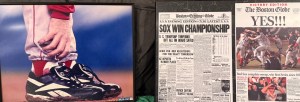
Photo credit – Adam Steinmetz
Less well known is that the Red Sox drafted Schilling in the last MLB Winter Draft held in January 1986. He was traded along with Brady Anderson two days before the deadline in 1988 for Mike Boddicker.
After logging 35 games with the Orioles in 1990, all out of the bullpen, Schilling was dealt along with Steve Finley and Pete Harnisch to the Houston Astros for Glenn Davis on January 10, 1991. Houston also used Schilling exclusively out of the bullpen for 56 games in 1991.
Schilling was then traded to the Philadelphia Phillies for pitcher Jason Grimsley on April 2, 1992. He emerged as a stud starter that year, leading the league in WHIP at .99, and the rest, as they say, is history. Unfortunately, some of that history also includes Schilling’s troubling post-retirement behavior, such as defaulting on a $75 million loan from the state of Rhode Island, tweets comparing Muslims to Nazis, and revealing Tim Wakefield’s cancer diagnosis against the Wakefield family’s wishes.
Zack Greinke – Greinke was able to do it all on a baseball field. As a pitcher, he will likely go into the HOF, but he also won six consecutive Gold Gloves from 2014-2019 and Silver Sluggers in 2013 and 2019. Greinke captured the 2009 Cy Young (with the Royals) and two ERA titles (2.16 ERA in 2009 and 1.66 ERA in 2015). He is a 6x All-Star, ranks 21st all-time with 2,979 strikeouts, and is one of only five pitchers to strike out 1,000 different batters, joining Nolan Ryan, Randy Johnson, Roger Clemens, and Greg Maddux. And among active pitchers, only Justin Verlander has more wins (263) than the recently retired Greinke (225)
Off the field, Greinke inspired many by being one of the first MLB players to talk about his struggles with mental health openly. Greinke left the Royals in Spring Training in 2006, saying he felt ‘miserable’ and believed he might be done with baseball. He was diagnosed with social anxiety and clinical depression and began treatment with therapy and medication. He later shared the role medication played in his recovery, noting, ‘The medicine (Zoloft) is the greatest thing ever… ‘ It’s amazing. I wish I had known about it before.
Fun Facts – In Game 5 of the 2021 World Series, Greinke, then with the Houston Astros, pinch hit for Framber Valdez in the 4th inning. He hit a single to right field off Atlanta Braves reliever Jesse Chavez, with a Statcast-recorded exit velocity of 105.9 mph. This made him the first pitcher to record a pinch-hit in the World Series since Jack Bentley in 1923.
It was not a fluke. Greinke had a career .225 with nine home runs and nine steals. Greinke’s nine home runs in 600 career plate appearances give him a higher home run percentage (1.5%) than 2025 Hall of Fame inductee Ichiro Suziki (1.09%), and Hall of Famers Tony Gwynn (1.32%), Wade Boggs (1.10%) and his nine steals equal the career total of Hall of Famer Stan Musial and exceed the career totals of Tony Perez (8) and Mel Ott (7).
Madison Bumgarner – With apologies to former Indianapolis Colts coach Jim Mora, we are going to talk playoffs.
Bumgarner has a strong argument for being the best postseason pitcher ever. His postseason mark of 8-3, 2.11 ERA, and .89 WHIP is stellar. In 36 World Series innings, Bumgarner allowed one earned run for a .25 ERA. His five-inning save in Game 7 of the 2014 series on two days’ rest stands the test of time as a legendary postseason performance. So much so that his complete game four-hit shutout win in Game 5 is largely forgotten, let alone his seven innings of one-run ball in a Game 1 victory.
Bumgarner led the Giants to three World Series championships. In 2010, as a 21-year-old rookie, he threw eight shutout innings in Game 4 of the World Series against Texas. In 2012, he tossed seven shutout innings in a Game 2 win versus the Tigers to help propel the Giants to a sweep. And of course, he saved his best for last, hurling a postseason record 52.2 innings in 2014.
To make Jim Mora feel better, Baumgarner was also a fine regular-season pitcher, cracking four straight All-Star teams from 2013-2016. He was also a threat at the plate, belting nineteen career home runs, the most by a pitcher in the DH era, and having seasons where he slugged .471, .470, and .468.
Fun Fact – The Royals’ only run in twenty-one innings against Bumgarner in the 2014 World Series came on a Salvador Perez home run in Game 1. Bumgarner got his revenge by getting Perez to pop out in foul territory to end the seventh game after the much-debated decision by Royals Third Base Coach Mike Jirschele not to send Alex Gordon home because Perez was coming to the plate. After the game, Bumgarner was credited with the Game 7 victory before the official scorer changed course later and gave the win to Jeremy Affeldt, who pitched the fourth inning.
Relievers
Craig Kimbrel – Kimbrel shot out of the starting blocks as a rookie in 2011, leading the league in saves and being unanimously voted Rookie of the Year. He also led the league in saves the next three years and was named an All-Star seven times in his first eight seasons. Kimbrel’s 440 saves rank fifth all-time; he was twice named Reliever of the Year (NL 2014, AL 2017), and won a World Series with the Red Sox in 2018. Some of Kimbrel’s tougher recent years may make fans forget how good he was. Batter’s career slash line against Kimbrel, even with the recent downturn, is .169/.266.282 for a .547 OPS, and his 14.1 K/9 ranks second to Aroldis Chapman among relievers all-time (min. 500 innings).
Fun Fact – Kimbrel was initially drafted in the 33rd round in 2007 out of Wallace State Community College in the bustling metropolis of Hanceville, AL (pop. 3,324). He did not sign, but Atlanta persisted, selecting him in the third round the following year. Notable alumni of Wallace State include fellow pitcher AL pennant winner Derek Holland and country singers Kip Moore (‘Something about a Truck’, ‘Hey Pretty Girl’) and Jimi Westbrook of Little Big Town (‘Girl Crush’, ‘Pontoon’).
Immaculate Tip – Kimbrel pitched in 24 forgettable games with the Chicago White Sox in 2021 after a midseason trade from the Cubs (5.09 ERA and one save). As hard as it may be to believe now, just four years ago, the White Sox were making a playoff push, and the Cubs were sellers.
Kenley Jansen – Jansen ranks fourth all-time in saves (464), just above Kimbrel, and is still climbing the list with the potential to pass Lee Smith for third. Jansen is Kimbrel’s statistical doppleganger. Like Kimbrel, the 37-year-old Jansen is a 16-year MLB veteran who debuted in 2010, and the two have nearly identical career ERA (2.60 versus Kimbrel’s 2.59), winning percentages (.578 versus .583) and WARs (23.1 versus 22.4), Reliever of the Year Awards with two each (Jansen has NL 2016 and 2017) and one World Series ring (2020* with Dodgers).
Kimbrel has the edge in top-five Cy Young finishes with two to one (plus a sixth-place finish), league leadership in saves (4x versus 2x), and K/9 (14.1 to 12.5), while Jansen has been the better postseason performer (20 saves to 10 and 2.20 ERA versus 4.50.
Aroldis Chapman – Like Kimbrel (May 7th) and Jansen (July 24th), Chapman made his MLB debut (Aug. 31st) in 2010 at the age of 22. His career WAR of 22.8 places him right in between Jansen’s 23.1 and Kimbrel’s 22.4. Chapman also has a World Series title with the 2016 Cubs on his resume as well, despite the best efforts of Rajai Davis.
Unlike his statistical siblings, though, Chapman may be having his best season yet in 2025 with career bests in ERA (1.34) and K/BB (6.0 due to a still robust 13.4 K/9 and a career low 2.2 BB/9).
Lest you think Chapman has morphed into a crafty lefty, he still throws gas. Among pitchers in 2025 with over 100 plate appearances against, Chapman ranks seventh in average fastball velocity (99.1), which is also top among all lefthanders, eighth in whiff percentage (38.4%), and 17th in fastball percentage (76% of his pitches are fastballs). And oh yeah, only Mason Miller has thrown a faster pitch this year than Chapman’s 103.8 mph.
Fun Fact – Chapman has not completely defied the aging process. The 103.8 mph fastball on May 7th is down two mph from his all-time high of 105.8 mph in his 2010 debut season. He owns nine of the dozen fastballs of 105 mph or more all-time (Jordan Hicks (2) and Ben Joyce have the other three).
Billy Wagner – Billy the Kid was inducted into the Hall of Fame wearing an Astros cap on Sunday, July 27th, after surpassing the 75% threshold in his 10th and final year on the ballot. He only received between 10% and 17% of the vote during his first four years on the ballot. His vote total steadily climbed to within five votes of induction with 73.8% in 2024 before finally being granted baseball’s highest honor this year.
Wagner’s credentials make him Hall of Fame worthy. He ranks eighth all-time in saves with 422. His career WAR of 27.7 exceeds the three prior relievers on this team so far (Kimbrel, Jansen, Chapman). He racked up six different seasons with an ERA below two en route to a career 2.31 ERA. Among pitchers in the live ball era with more than 900 innings, only the incomparable Mariano Rivera has a better career ERA (2.21).
He made six All-Star teams (five since 2000). He accumulated four 100-strikeout seasons, including 104 in his final year in the majors with Atlanta in 201,0, and had a career K/9 of 11.9.
Fun Fact – Wagner’s 10.5% vote total in his first year on the ballot is the second lowest ever for an eventual HOF inductee. Only Scott Rolen had a lower first-year vote percentage at 10.2%. Wagner will become the eighth primary reliever to be inducted into the Hall of Fame, joining Hoyt Wilhelm, Lee Smith, Rollie Fingers, Bruce Sutter, Trevor Hoffman, Mariano Rivera, and Goose Gossage. Dennis Eckersley and John Smoltz had very successful second careers as relievers, but we are not counting them due to significant accomplishments as starters.
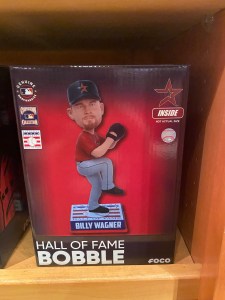
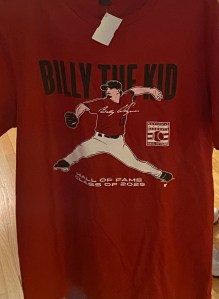
Billy Wagner merchandise for sale at the HOF Museum Store ahead of his induction into Cooperstown. Photo credits – Adam Steinmetz
Trevor Hoffman – Hoffman’s 368 saves in the 2000s would tie Jonathan Papelbon for 11th all-time. He did that while pitching eleven years for teams that won a total of zero postseason games (two appearances in 2005 and 2006, but swept both times). When you add in his 233 saves in the 90s, he ranks second all-time behind Rivera with 601 saves.
Limiting our focus to the 2000s, Hoffman trails only Rivera (him again) with six 40-save seasons, including a league-leading 46 in 2006 when he finished second in the Cy Young voting to Tom Glavine. He made five All-Star teams, and his entrance to Hell’s Bells was a sign to the opponent that it was Trevor Time and that the game was all but over.
Fun Fact – In addition to being a great closer, Hoffman was known as a great mentor and teammate. This story from former teammate and setup man Doug Bochtler helps illustrate why.
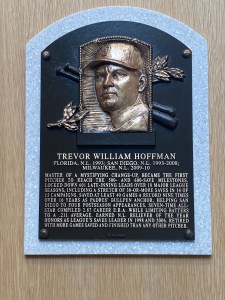
Photo credit – Adam Steinmetz
Tony Watson – Watson is by far the least known member of this team, but we wanted to include a setup man to reflect the growing importance of bullpens in baseball and to mirror recent All-Star teams.
Watson leads all MLB relievers all-time in holds with 246, topping Arthur Rhodes, Joe Smith, Tyler Clippard, and Joaquín Benoit. Watson was far from dominant with 7.9 K/9, but he got the job done, making an All-Star team in 2014 when he led the league in appearances (78) while posting a 1.63 ERA. The following year, he tied the single-season holds record of 41 (set by Joel Peralta in 2013) and again kept his ERA under two (1;91).
Fun Fact – On July 31, 2017, the Pirates traded Watson to the Los Angeles Dodgers for minor leaguers Angel German and Oneil Cruz. In 24 appearances for the Dodgers, he was 2–1 with a 2.70 ERA. In the postseason, he pitched in all three rounds of the playoffs and was the winning pitcher in two games of the 2017 World Series. Oneil Cruz currently leads the NL in SB and is the Pirates’ most dangerous hitter, breaking his record earlier his year for exit velocity on a batted ball with a 122.9 mph home run into the Allegheny.
All-Star Game HR Swing-Off Pitchers
This is a reverse All-Star honor given to a pitcher known for giving up home runs in bunches to ruin fans’ days. They would pitch for their league in the Swing-Off and would be able to throw meatballs over the plate without even having to make a special effort.
American League – John Wasdin earned his nickname ‘Way Back’ from the home run call of then Red Sox radio broadcaster Gerry Tropiano, who would scream ‘way back, way back’ for home runs (or just as often popups to short). Wasdin somehow won 39 career games, but his career HR/9 of 1.5 makes him a worthy Swing-Off pitcher for the American League. Wasdin did somehow manage 39 career wins, but with a career ERA over 5 and a WHIP over 1.4.
National League – Jose Lima somehow managed to pitch enough to give up 48 home runs in 2000 with Houston (which was in the NL at the time), and followed that up by throwing 35 gopher balls in 2001. The 48 home runs followed a 1999 season where Lima finished fourth in the Cy Young voting and won 21 games. The 2000s, though, were not as kind to Lima, who added on 30+ home runs allowed seasons in 2004 and 2005. In those four 30+ home runs allowed seasons, his HR/9 were 2.2, 1.9, 1.7, and 1.7. Lima would make the NL the clear favorites to win the Swing-Off just as they did at the 2025 All-Star game.
We’ve Got Next
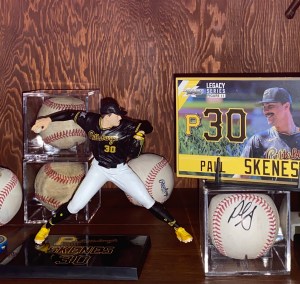
My nine-year-old son Jackson’s shrine to Paul Skenes. Photo credit – Adam Steinmetz
As noted earlier, we will close with a few predictions of current National League players who will be on the next NL Quarter Century All-Star Team in 2050. Why not make some predictions where nobody will know if they are right for 25 years? (Or so we thought two weeks ago when we did the AL predictions and chose Emmanuel Clase).
SS – Elly De La Cruz
OF – Juan Soto
OF – James Wood
OF – Pete Crow-Armstrong
SP – Paul Skenes
DH/P – Shohei Ohtani
The first five names illustrate the ongoing evolution of baseball, while the last reminds us that some things never change. Who knows, maybe both Carlos Santanas will still be doing their thing in 2050.
