






Welcome to the PLV Power Report! Here, we examine hitter performance by utilizing Power+, a PLV+ metric that indexes a player’s power based on the characteristics of the pitch, i.e., count, location, velocity, induced vertical break, height-adjusted vertical approach angle, and other factors. Essentially, we’re searching for players with upside who are adding power based on the expectation of the individual pitches they see.
For example, say a hitter hits a well-located fastball on the outside corner that might typically coax a weak line drive, but instead, they belt a home run the opposite way; they’ll get a much better power grade for that outcome. Conversely, if that hitter sees a hanging changeup over the heart of the plate, or another pitch that would normally be crushed, and instead pops up to short, they’ll get a much lower score for the outcome. The power metric is unique because it provides a more intuitive way to assess player performance by accounting for the quality of each pitch they see. In other words, it’s a good way to check if a player is over- or underperforming by adding context. Note that Power+, like PLV+ metrics, is normalized to 100 and generally becomes more meaningful after around 75 BBE (batted ball events).
If you’re new to the PLV metrics, you can find Nick’s primer here.
As we head into the final month, let’s hit the rewind button and review the performance of the bats taken in the top three rounds of fantasy drafts. I’ll be using NFBC ADP as a reference with a cutoff around pick 50 to give us a round number. Again, these aren’t rankings, but general reflections/musings/ramblings based on this past year’s ADP and player performance with an emphasis on home runs.
Note: PLV metrics are current through Sunday, August 24th.
Top Picks
| NFBC ADP | Power+ (BBE) | Power+ Δ vs. 2024 | |
|---|---|---|---|
| Shohei Ohtani | 1.40 | 154 (344) | -1 |
| Bobby Witt Jr. | 1.78 | 115 (407) | -13 |
| Aaron Judge | 3.19 | 149 (299) | -9 |
| Elly De La Cruz | 4.34 | 106 (365) | -8 |
| José Ramírez | 5.12 | 94 (423) | -2 |
| Juan Soto | 7.27 | 137 (350) | -12 |
| Gunnar Henderson | 7.87 | 104 (349) | -17 |
| Kyle Tucker | 8.55 | 100 (385) | -20 |
| Corbin Carroll | 9.32 | 127 (334) | +31 |
| Fernando Tatís Jr | 11.42 | 104 (381) | -19 |
Ohtani and Judge continue to be the cream of the crop.
It looks like Bobby Witt Jr. might fall short of his third consecutive 30-30 season. His Power+ is down nearly a standard deviation. Does that matter? Probably not, but it’s at least notable.
NFBC emphasizes speed, so Elly De La Cruz was drafted accordingly. His power has fallen a little relative to last year, but his Contact Ability has risen from 93 to 101, so that’s good. Here’s to hoping he can improve his splits against left-handers (66 wRC+).
No one is complaining about Gunnar Henderson’s .283 average and .354 OBP. But, yeah, 16 home runs is underwhelming. Hey, Anthony Volpe has three more in 13 fewer PAs. Gasps. Yes, I know home runs aren’t everything, and Volpe is hitting .208. It was a joke! Kind of. Anyway, Henderson’s Power+ is down about a standard deviation compared to last year. That’s not to say I wouldn’t expect his power to rebound, but at the same time, you’d figure his ADP is due for a market correction with just one elite season under his belt.
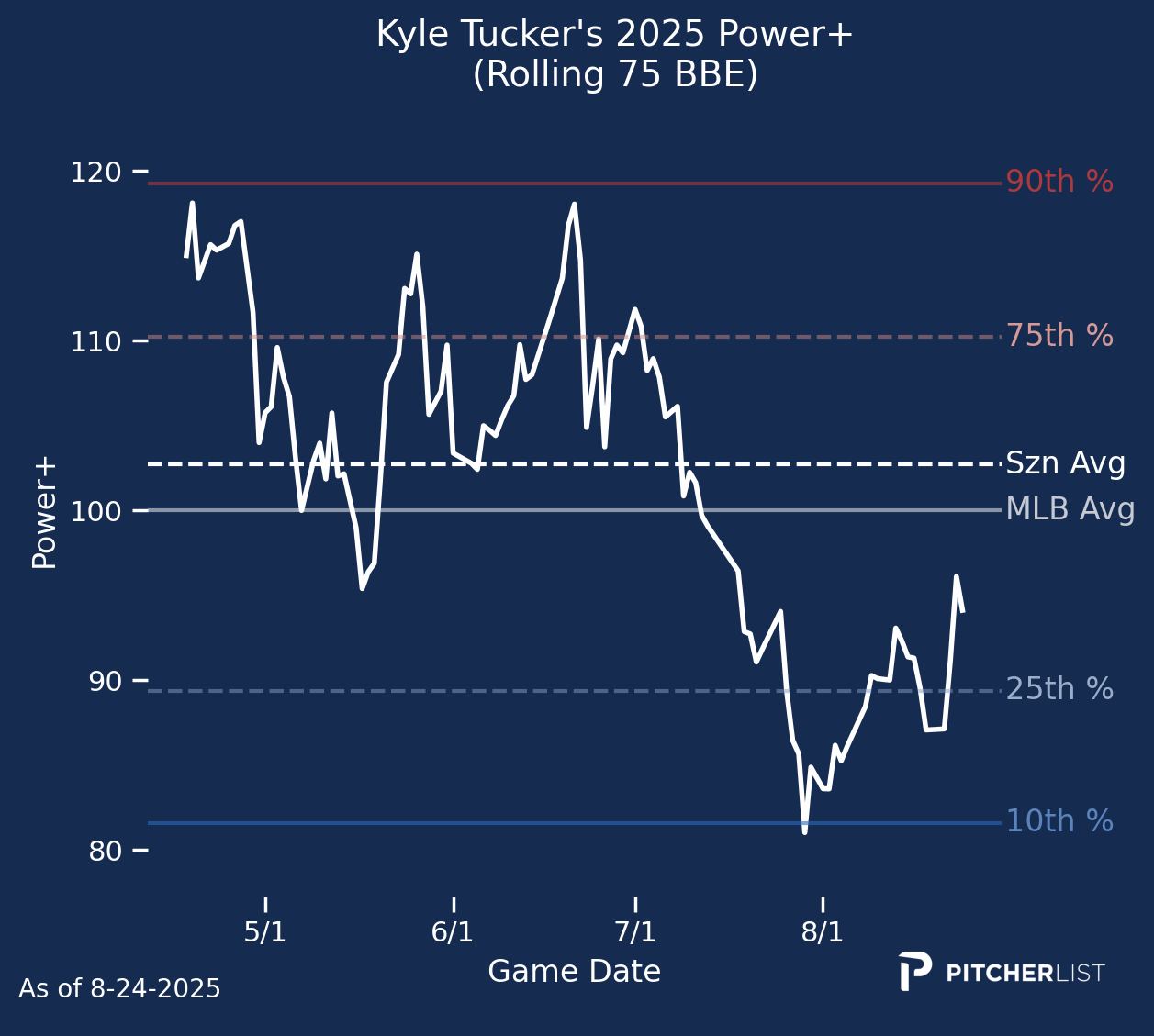
At least the mystery behind Kyle Tucker’s power outage has been solved. I’m always stunned when injuries pop up weeks later. Either way, his rolling chart is pretty telling. A decent September might buoy his stock next year, but even if he is quiet down the stretch, the rest of his profile supports his case for a bounce-back (131 DV+, 103 Contact Ability+, and 116 Process+).
Fernando Tatís Jr.’s Power+ has dipped substantially (-19) this season, enough that I’d be at least a little leery of buying him next year at the same price.
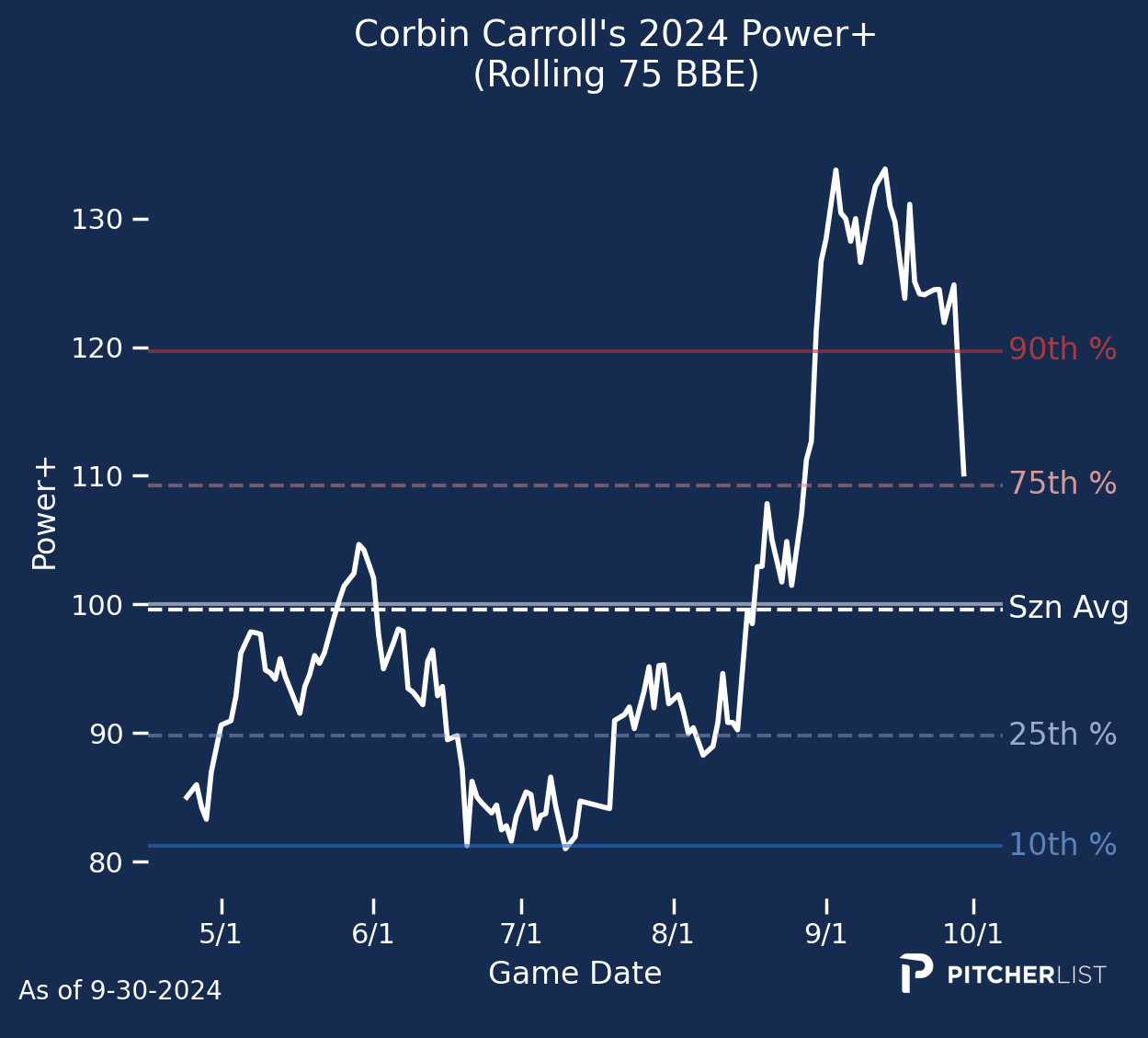
Corbin Carroll is steaming ahead to his first 30-HR season. Sure enough, his Power+ has climbed two standard deviations compared to last year. Speaking of 2024, do you remember that weirdness? Pat yourself on the back if you gambled on Carroll’s breathtaking finish. Seeing is believing.
Picks 12-24
| NFBC ADP | Power+ (BBE) | Power+ Δ vs. 2024 | |
|---|---|---|---|
| Mookie Betts | 12.64 | 87 (423) | -13 |
| Vladimir Guerrero Jr | 12.93 | 115 (391) | -10 |
| Julio Rodríguez | 13.87 | 112 (404) | -10 |
| Francisco Lindor | 14.32 | 100 (415) | -19 |
| Jackson Chourio | 16.61 | 100 (352) | -6 |
| Yordan Alvarez | 16.78 | 116 (83) | -14 |
| Bryce Harper | 21.23 | 124 (297) | +7 |
| Jarren Duran | 21.84 | 104 (374) | -1 |
| Jazz Chisholm Jr./td> | 22.38 | 120 (241) | +15 |
| William Contreras | 24.66 | 94 (375) | -19 |
Mookie is one of the year’s biggest fallers. The 2018 AL MVP is hitting .248 with 13 home runs and a 93 wRC+, all career lows. It’s a mystery, and not a case of bad luck, with his Power+ having dipped about a standard deviation below average. I have no idea what happened. Perhaps a silver lining here is that Contact Ability+ has risen from 123 to 133. Regardless, Mookie plummeting at least a round, if not more, feels like a certainty, especially with him stuck on eight stolen bases.
Francisco Lindor’s numbers might not look all that different on the surface; he’s hitting .265 with a 124 wRC+, and he’s just eight home runs shy of matching last year’s 33. However, if you happened to stumble onto his Savant page, you might’ve noticed his xwOBA is down 40 points compared to 2024. His bat speed is down from 72.4 to 70.7 mph, too. And, yep, his Power+ is down a lot. Of course, Lindor’s do-it-all profile and track record are incredibly valuable. The better bargain next year might be Zach Neto, who offers a similar power-speed profile, albeit without the track record, but with far better batted ball data (120 Power+).
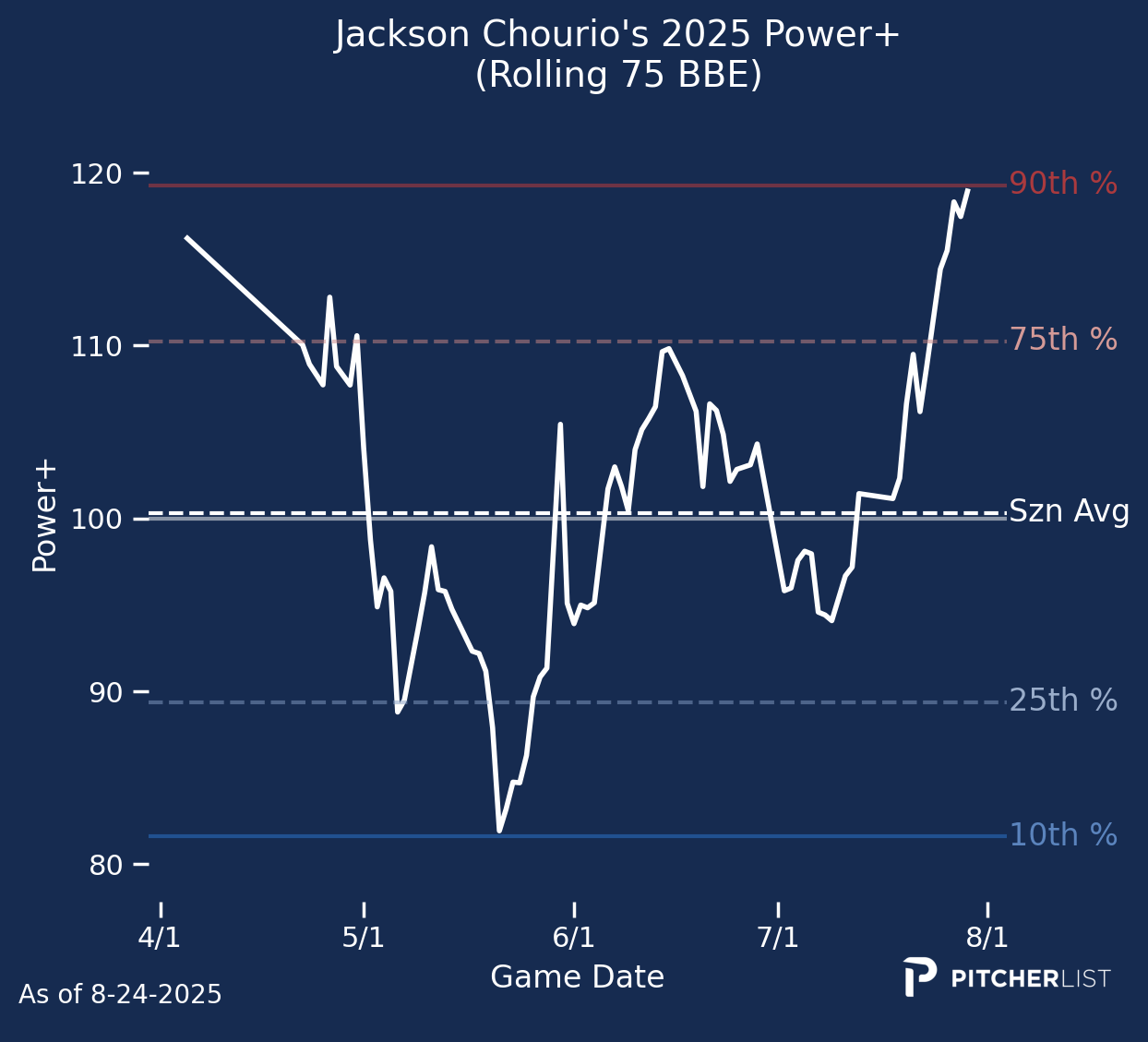
The good news is that Jackson Chourio might return this weekend. His Power+ has dipped a few points compared to his rookie year, but he was headed in the right direction.
I look forward to recapping this year’s rookies/breakouts in the coming weeks. But I’m obliged to mention Junior Caminero (114 Power+); he’s on the verge of the second 40-HR season in Tampa’s franchise history, the other belonging to Carlos Peña. He is also eight away from tying Hall of Famer Eddie Mathews for the most by a third baseman in his age-21 season (he turned 22 on July 5th). Side note: Eddie Mathews led the league in IBB in 1953 and didn’t turn 22 until October. Imagine that. Anyway, where do you think Caminero goes next year? I feel like he has to be one of the first picks in the second round. Maybe even higher? His NFBC ADP was 79.93 this past season.
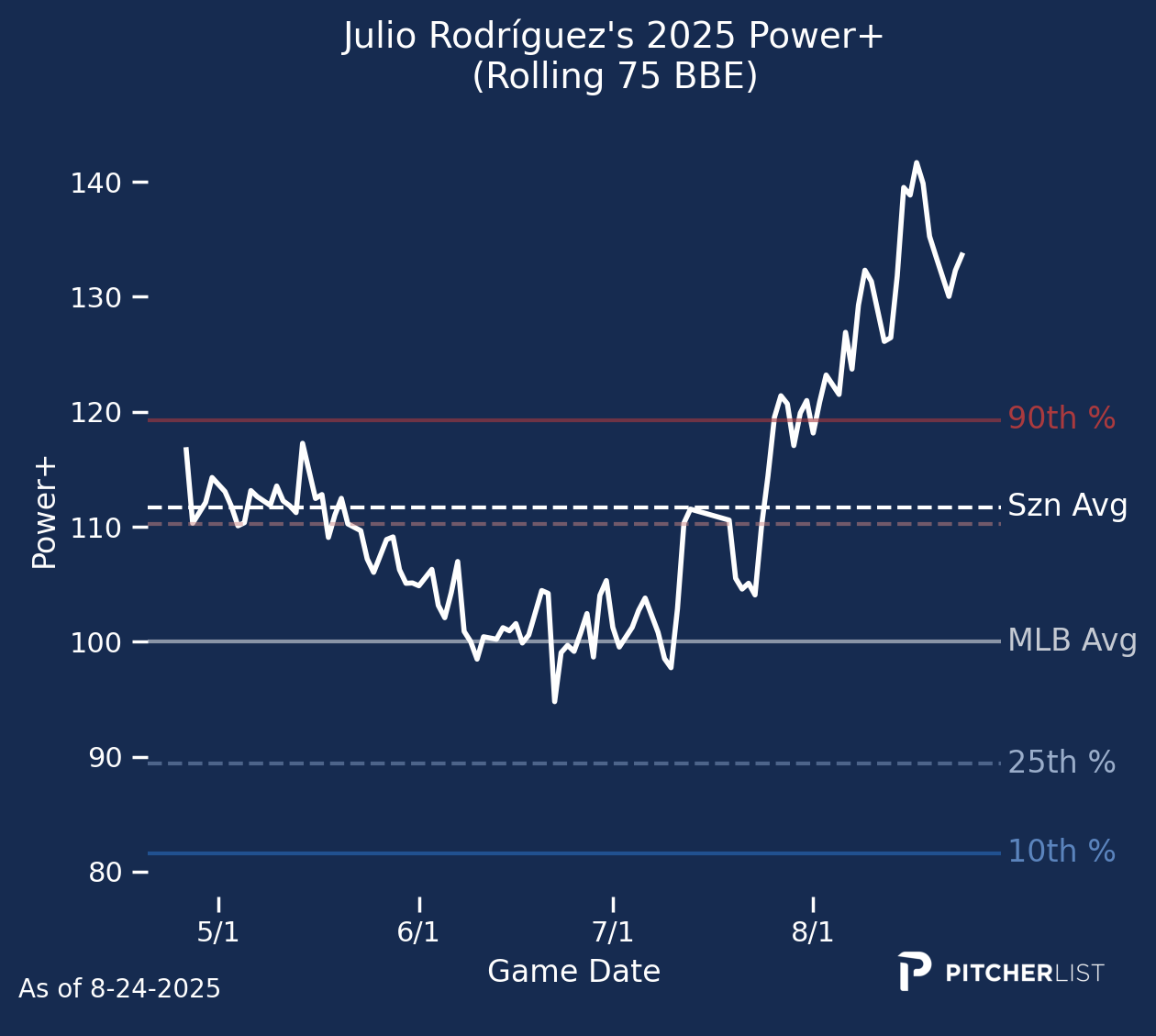
J-Rod has long since solidified himself as a top-tier talent, so the dip in Power+ might not mean much. And besides, he is going on one of his juggernaut runs.
Jazz Chisholm Jr. hit his 25th of the year Monday night, upping last year’s 24 in 211 fewer PAs. His Power+ has improved by about a standard deviation in his first full season in the Bronx.
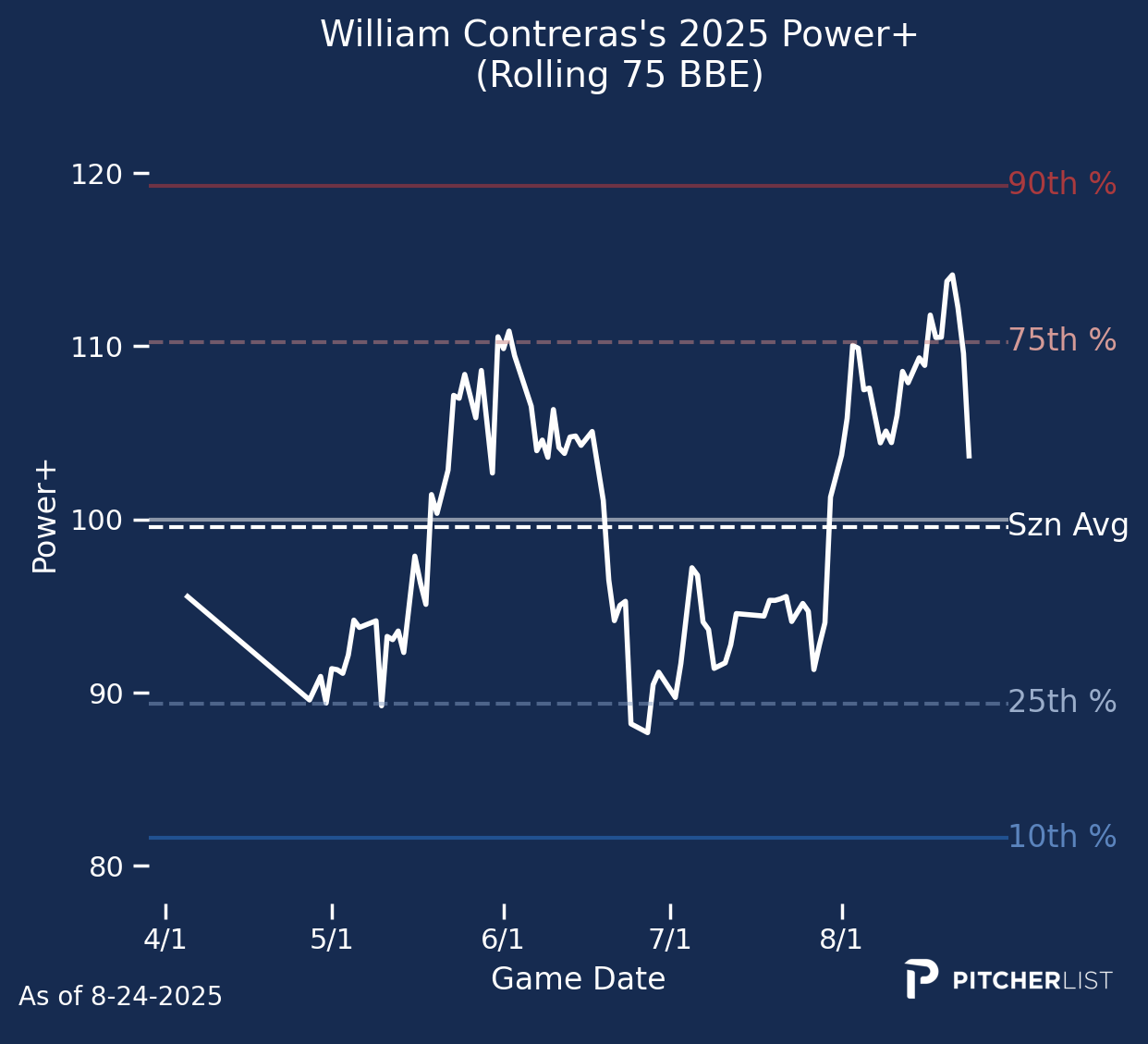
William Contreras‘ .356 OBP has helped buoy his value; he’s second among catchers with 72 runs scored. However, his Power+ is down well over a standard deviation, as you might’ve surmised by his 80-point dip in OPS. His Power+ rolling chart isn’t all gloom; he has spiked above-average at times, particularly since August. Regardless, last year’s ADP as the first catcher off the board seems like a fever dream in the wake of Cal Raleigh (129 Power+).
Picks 24-50
James Woods’ struggles since the ASB have been a big story. The strikeouts are a concern. I get it. But a 22-year-old posting a 129 wRC+ who is four home runs shy of a 3o-HR season is the more important picture, to me, at least. At the very least, it is good to see his Power+ having increased seven points, even if the results haven’t been there lately. It feels like the last five weeks or so could swing his ADP a ton, maybe more than anyone on this list.
Ronald Acuña Jr.’s return has been at least one positive takeaway from Atlanta in 2025. His 130 Power+ leaves no doubts about him rising back up the ranks next year.
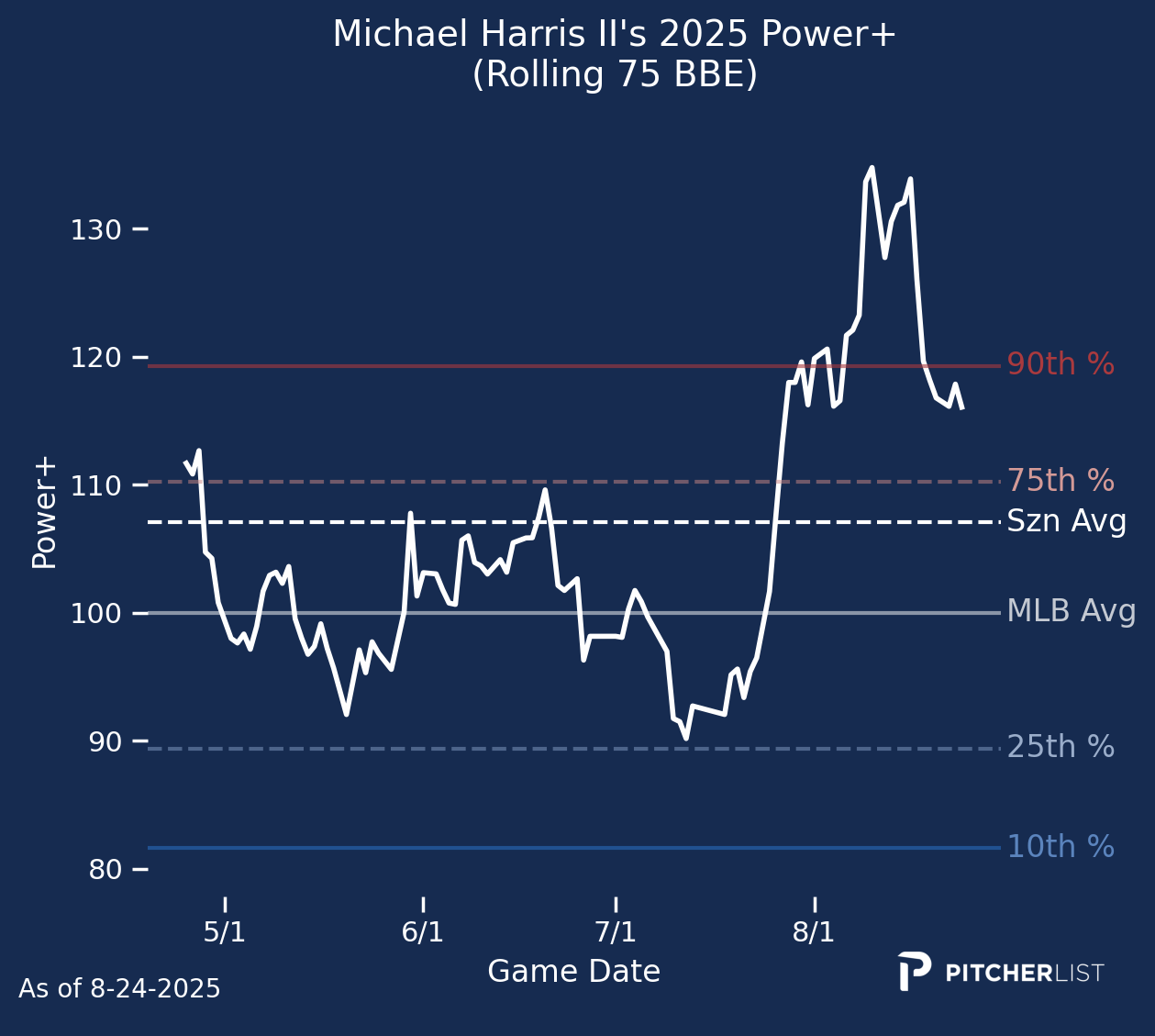
I can’t say the same about his teammate, Michael Harris II. Just about everyone, including myself, was ready to write him off after he hit .210 with a 47 wRC+ in the first half. He’s done a 180 in the second half, hitting .349 with a 180 wRC+. Questionable swing decisions (65 DV+) are part of the reason behind the extreme peaks and valleys.
Pete Crow-Armstrong is, of course, one of the year’s biggest breakouts, his Power+ having surged from 96 in 2024 to 113 this season. He will certainly land in the top three rounds next year, and probably higher. But, like Harris, there’s serious volatility to his game thanks to his ultra-aggressive plate approach (16.5% swing aggression and 66 DV+).
Fantasy managers who banked on a big breakout from Wyatt Langford have been a little disappointed; his .773 OPS is only marginally better than last year’s .740, and is offset by his K rate climbing from 20.6% to 27.1%. Still, his 107 Power+, 103 DV+, and 106 Process+ are pretty decent, leaving the door open for a third-year breakout.
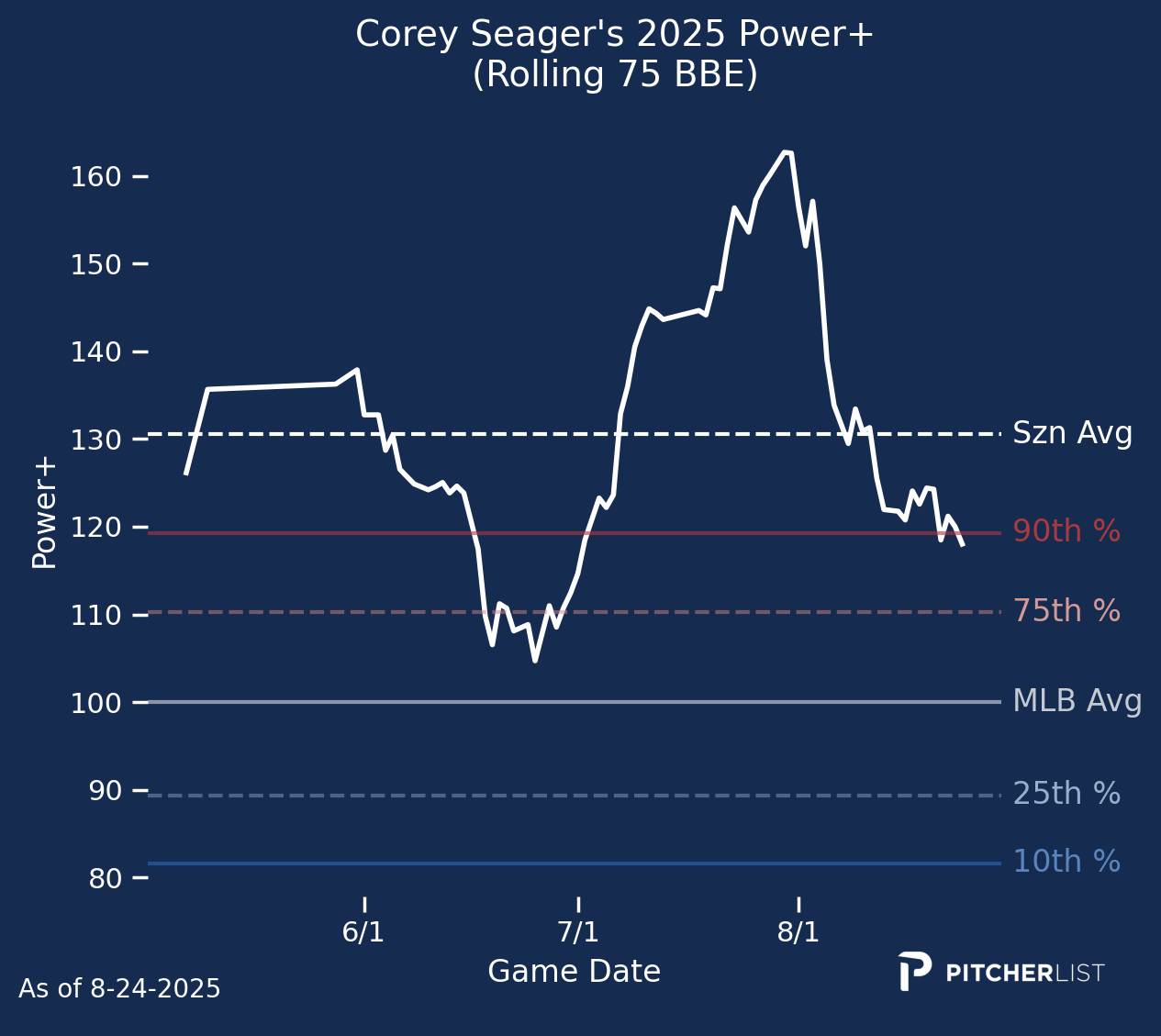
Corey Seager’s rolling Power+ looks about the exact opposite of Wood’s. Sports hernia surgery suppressed Seager’s ADP last season. This year, two stints on the IL with a hamstring strain have limited him to 100 games thus far. He’ll probably fall short of his fourth consecutive 30-HR season, but PLV says we should buy if there is any sort of discount next year.
Just nine home runs in 386 PAs indicate that Jackson Merrill’s ADP is headed south next year, and even worse, he’s hurt. Get well soon. However, his Power+ being just about the same as last year has me optimistic about him rebounding.
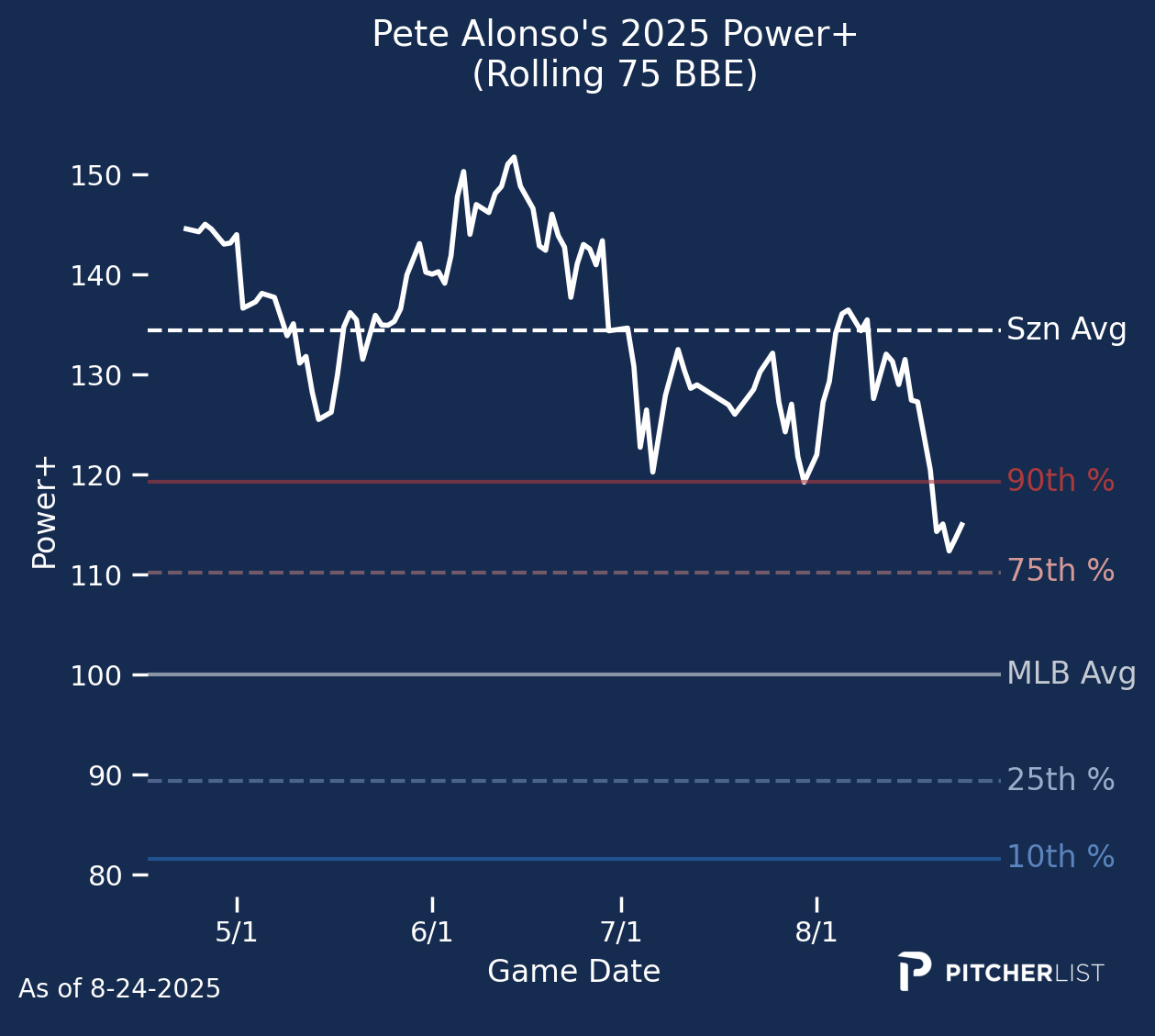
Pete Alonso has cooled significantly in the second half (eight home runs and 82 wRC+ in 148 PAs), but those who bought him near the end of the third round in 15-teamers profited well. I’m guessing his ADP should rise. Although maybe just a few spots, especially if this slump lingers. Speaking of first base sluggers, I’ll be fascinated to see where Nick Kurtz lands. If his 141 Power+, which is fourth-best among players who have faced at least 400 pitches, is any indication, he might land in the second round.
Adapted by Kurt Wasemiller (@kurt_player02 on Instagram & Threads
@kuwasemiller.bksy.social on BlueSky)
