





In the span of 24 hours, the future of the Minnesota Twins was invariably altered with the selling of 9 players on their active roster. After a disappointing start to the year and being particularly sluggish out of the All-Star break (including dropping a series to the Rockies), the Twins threw in the towel and the whole shower along with it. After making a total of one move at the deadline the last two years, the Twins took all the headlines by selling basically everyone with value that wasn’t extremely young or Joe Ryan. Here’s a full autopsy of the Twin Killing that commenced this Thursday.
Blue Jay Way
The Twins ended their absurd postseason losing streak by winning the wild card series against the Blue Jays in 2023, and took a game from the Astros before being defeated in a relatively close 4 games. The Twins traded some major pieces in 2021, and despite the additions of Carlos Correa (more on him later) and Sonny Gray in March and Tyler Mahle in July, the Twins fell apart in the second half, with abysmal pitching getting the best of them. To alleviate these troubles, the Twins acquired Pablo López, who – with Joe Ryan and Bailey Ober establishing themselves as major rotation pieces – helped the 2023 Twins to have the second-best rotation in baseball by both ERA and fWAR.
Despite falling short in October, the Twins looked to be on the upswing. However, news would come out that the Twins were cutting payroll. While they were able to retain Correa (after the most bizarre free agency saga in recent memory), Gray signed with St Louis, Jorge Polanco was traded, and Michael A Taylor’s services were to be replaced with Manuel Margot. The Twins ended up cutting about $25 million in payroll, and bet on the young talent of ’23 and developments in the farm to replace the lost talent.
That plan… did not work
A major factor for the Twins’ success in 2023 was the offence going from slightly below average to one of the league’s best in the second half, and much of that was due to these young players getting a larger share of plate appearances. Wallner, Lewis, Julien and Kirilloff combined for 11.6% of PAs in the first half, which jumped to 26.6% in the second. Not coincidentally, the Twins team wRC+ went from 95 in the first half to 122 in the second, a jump from 21st to 3rd.
In 2024, the production for all but Wallner fell off considerably, with Lewis dropping 180 points of OPS and Julien dropping nearly 250 points himself. While the Twins were still strong offensively, that was primarily because of strong seasons from Buxton and Correa, both of whom were relatively minor contributors to the ’23 team. It’s telling that despite gaining about 6.5 net WAR from Buxton and Correa, the Twins were less productive overall offensively.
That regression hit especially hard when the pitching matched the backslide. Pablo López struggled to find his footing, while the rest of the pitching staff couldn’t fill Sonny Gray’s shoes. The Twins only went from 87 wins to 82, but it was a serious disappointment for a team that looked to be really kicking into gear.
25 and… not alive
For years, Twins fans have been hoping Byron Buxton would finally be able to put it together and have a full season. After a decade of shortened seasons and setbacks, Buck is currently pacing to have by far his best season in the majors. He may not play 150 games, but he’s currently pacing to easily clear 120 games played, and has an outside chance of beating his PA record of 511 for a single season. With a 145 wRC+ and 17 stolen bases while playing exclusively CF, Buxton has been worth 3.9 fWAR as of writing – pacing to have likely his best season as a Twin.
It’s a shame that he had to have this season while the sky is falling around him. The young players that were so critical to the ’23 squad have continued to have their values dissolve, being worth a total of 0.7 fWAR and Kirilloff now a realtor in Fort Myers (seriously). Other additions have not been able to compensate. Top prospect Brooks Lee has faltered on every front in the big leagues, being below 20th percentile in Batting, Fielding and Baserunning Run Value. Jose Miranda, who looked to maybe have a resurgence in ’24, has been banished to Saint Paul after having an OPS+ of 12. Injuries put the nail in the coffin for this season. Lopez went down for several months with a shoulder strain, Ober has been pitching through injury and has recently been shut down, and a high-ranking prospect, Luke Keaschell, played just seven games before hitting the IL.
As a result, the Twins are sitting at 51-57, over ten games back in the division, and despite an excellent bullpen and a breakout year from Joe Ryan, the offence is 19th in both fWAR and wRC+, with the rotation around Ryan falling apart. The Twins have been trying to replace Sonny Gray for two years now and have come up with nothing. K/BB darling Zebby Matthews has failed to prevent runs, while David Festa’s career ERA sits at 5.12. Simeon Woods Richardson has been tolerable with a 4.20 ERA across the last two years, but it is hardly enough to fill Gray’s shoes. That starting rotation that had the second-lowest ERA in 2023 ranked 22nd in 2024 and currently sits at 18th (thank you,u Joe).
The Twins were in an awkward position this past offseason as they were in the midst of what should have been an ownership change. When that fizzled out, the twins scrambled to make whatever additions they could. Despite what ended up being some savvy additions of Harrison and Danny Coloumbe, it was hardly enough to mask a complete failure in developing sustained big league talent, and with Correa having a sluggish year, the team around Buxton completely fell apart. Below average in all facets of the game, the Twins pulled the plug.
BRING OUT YER DEAD
The following are two tables cataloging the carnage that occurred in the past week as the Twins roster was dressed like a deer:
Pretty much everyone with both a pulse and an expiring contract was shipped off, but the complete dismantling of the bullpen was a real shock. FIVE relievers were shipped off, and incredible, 4 of the 5 have an ERA below 3 (Jax’s 4.5 ERA is offset by a 2.00 FIP). While Coloumbe was on a one-year deal and wasn’t a shock, the other 4 arms traded all had several years of team control left, with Varland in particular being incredibly surprising, as he had another five years left before he was to test free agency.
So what did they get for almost half an MLB roster? A whole lotta who knows:
| Player | Position | Level | Age |
|---|---|---|---|
| Taj Bradley | RHP | MLB | 24 |
| James Outman | OF | MLB | 28 |
| Hendry Mendez | OF | AA | 21 |
| Matt Mikulski | Trade Fodder | A+ | 26 |
| Kendry Rojas | LHP | AAA | 22 |
| Garrett Horn | LHP | A | 22 |
| Alan Roden | OF | AAA/MLB | 25 |
| Ryan Gallagher | RHP | A | 22 |
| Sam Armstrong | RHP | AA | 24 |
| Geremy Villoria | RHP | DSL | 16 (!!) |
| Mick Abel | RHP | AAA/MLB | 23 |
| Eduardo Tait | C | A+ | 18 |
| Enrique Jimenez | C | A | 19 |
So, let’s break this down.
Taj Bradley – Likely the most recognizable name here, certainly for readers of this website. Bradley is a former top prospect who had a good 2024 and hasthus farr had a bad 2025. His stuff has diminished this year, and it’s difficult to explain in a short bl, but TLDR the fastball has lost some zip and the splitter has gotten worse. He’s still young and obviously talented, but he’s at a low point value-wise
James Outman – Remember when he had a 4 WAR season in 2023? Outman nowadays is a defensive substitute whose contact skills have been reduced to almost nothing. He’s an excellent athlete who may be a decent platoon/pinch-hitting option under team control for years to come, but is a 4th outfielder at best
Hendry Mendez – now ranked 26th in the Twins system Mendez, acquired for Harrison Bader, has done quite well for himself in his two years in the Phillies system. After hitting a total of six home runs in his previous two years in the minors, Mendez has hit eight so far this year, and hasn’t sacrificed swing and miss or walks to do it. Slashing .290/.374/.434 in AA, he might rise up in prospect lists if he keeps this up.
Matt Mikulski – you have to actually trade for someone, so Mikulski, welcome to Cedar Rapids.
Kendry Rojas – One of the most eye-raising prospects in this list, Rojas started the season in A ball but climbed his way to make a start in AAA before being shipped to Minnesota. A 22-year-old lefty, Rojas has struck out 37% of batters while walking just 6% – albeit against fairly unimpressive competition. He’s dealt with injuries on his way through the minors (perfect for the Twins!), so a full season’s workload we haven’t seen yet. MLB Pipeline has him 7th in the Twins system, and he will be someone to keep a close eye on over the next two months in St. Paul
Garrett Horn – A sixth-round pick in 2024 (and born exactly 4 days after me), Horn was doing very well in A – although as a 22-year-old old it’s hardly the most impressive resume. With 22 professional innings under his belt and without one standout trait, it’s hard to say too much about him. He seems better than a pure lottery ticket, maybe a scratch off?
Alan Roden – Roden might land in the perfect spot here because he should be given a lengthy runway to see if he can catch up to big league pitching. While he was old at every level, Roden cruised his way through the minors before finally getting a spot in the show and completely failing to make an impact. A lefty without much pop, he struggled to hit balls hard and anywhere but the dirt. He showed some defensive skill and speed, so despite the stocky frame, he’s got big league athleticism; whether or not he has big league quality of contact has yet to be determined
Ryan Gallagher – Taken 13 picks before Garrett Horn, Gallagher is sort of the right-handed version of Horn. With similar builds and velocity, the difference is that Gallagher had 14 deep starts at high A, before dipping his toes into AA. Through two starts, he’s treaded water there, and with an arsenal reportedly built around a strong changeup – a rarity – he’s got some interesting qualities. Completely off the radar prior to this year, he ranks as the Twins’ 16th prospect after the trades.
Sam Armstrong – Every pitcher named Armstrong should automatically get +5 to every scouting grade they get. Unfortunately, even with that buff, he might be a 40 grade prospect. At 24 years old and failing to make an impact at AA, Armstrong’s ceiling may be a low-leverage reliever.
Geremy Villoria – HE’S SIXTEEN. HE WAS BORN IN 2008. HE WAS NOT ALIVE BEFORE BARACK OBAMA WAS ELECTED PRESIDENT. Anyway, Villoria is tall and has some velocity for someone his age. It’s rather ridiculous to do an analysis on someone who can barely drive a car, but for whatever it’s worth, he’s done very well at the DSL level.
Mick Abel – Oh yeah, here we go. Abel has had his stock fluctuate quite a bit, breaking into the top 100 as a first-round pick back in 2021. He moved into the top 50 by ’23 but has slipped down to 91 as he’s failed to make the adjustments to bring him to the next level. That doesn’t mean he’s a lost cause, but it means there’s work to do. Abel’s got stuff – even in a few short appearances with the Phillies, he had a 109 stuff+, with a good fastball that has both ride and velo, and some decent-looking breaking stuff. Unfortunately, it hasn’t translated to strikeouts and whiffs, and Abel pretty much has no offspeed offering. He might want to incorporate a splitter, which may work better with his lower arm angle. There are some things to like with the frame and stuff, but if Abel wants to be a big leaguer, there needs to be some work done. Thankfully, he’ll be 24 in September, so he’s still got some time to develop
Eduardo Tait – The other player received for Jhoan Duran, Tait is a lefty catcher who, despite being just 18, has played pro ball for three years. He’s thus far treaded water at every step up, not quite looking overmatched through 7 A+ games on his most recent promotion. He’s got some pop for his age, and slotting in as the Twins’ #2 prospect, he’s got a lot of upside if he can stick at catcher. For reference, there have been just 3 players aged 18 to play in A+ ball: Tait, #3 prospect Leo De Vries, and Jhocsuanth Vargas, the latter of which has played 4 games in A and A+ ball total and has gone 1-13 at those levels.
Enrique Jimenez – Traded for Chris Paddack and Randy Dobnak, Jimenez is a switch-hitting catcher who, like Tait, has treaded water thus far in his career. Standing just 5’9, it’s not likely he turns into a power bat, although he’s demonstrated an ability to elevate at the complex ball level. Jiminez is, if nothing else, an interesting organizational piece that may one day be something, but we are four years away from any real evaluation.
It’s a lot of high-end org depth and a few notable prospects that are either in or on the fringe of the top 100. The Twins traded mainly relievers and rental bats that don’t significantly move the needle, so it wasn’t realistic to expect a true haul. Regardless, it is a total uprooting of the team from a couple of years ago, and a clear message that the Twins are changing gears completely.
Oh yeah, and there was this.
Houston, We Have A Problem
In what was the most shocking move of the day, Carlos Correa was shipped back to the Astros in the third bizarre transaction involving him and the Twins. The first was a glorified one-year deal after a lockout prevented Correa from getting a real long-term deal, a deal he would eventually get, not from the Giants or Mets but from the Twins again. Two and a half years later, Correa waived his no trade clause for only the Astros, and needing someone to play third base, the Astros brought back their former franchise player with the twins retaining $33 million of the $103.42 million left on his 6/200 million deal – although it should be noted the Twins are not on the hook for the several vesting options on the tail end of that deal. Correa had a very poor first half but closed out July with a few strong weeks, finally getting his wRC+ back to above league average.
Correa is still a solid player, if not a 5-6 WAR star, he once was. There are valid concerns about his longevity, but it’s hard not to feel kicked in the teeth after the biggest free agent signing in team history is shipped off less than three years after signing. The poor return of… nothing isn’t very surprising, as Correa’s contract was by this point well above market value and with his injury concerns, he was hardly a valued item – especially since only one team was allowed to bid. Still, it’s embarrassing to give away one of your top players for nothing and to retain a good portion of the salary.
You could realistically convince yourself that the Twins are very optimistic about Kaelen Culpepper slotting in at short, but as we touched on earlier, relying on young talent to make up for veteran departures is hardly a safe bet – especially young players that haven’t yet reached AAA (even if Culpepper looks good). It is especially puzzling because the Twins still have valuable assets in Buxton, Ryan and Lopez. All of whom are tied up for another couple of years. The Twins now find themselves in a bit of an awkward position where they sold off their entire bullpen and their franchise SS, yet still have some veterans. Your guess is as good as mine if Lopez and Ryan are Twins by Opening Day next year, but the Correa trade makes the message loud and clear that the Twins are not counting on playoff contention in 2026 at minimum.
Conjoined Twins
I could spend the rest of this article going over the Twins’ farm system, but this was the culmination of an ownership group refusing to invest in a Twins team that was two games away from their first ALCS appearance since 2002. Sonny Gray walking in free agency was not the worst move, as Gray netted the Twins a comp pick for declining the qualifying offer, and he well outperformed his peripherals in ’23, but the Twins replaced Sonny Gray with nobody. The 32 Gray starts in 2023 were replaced in-house with 30 combined starts from Chris Paddack and David Festa, who combined for an ERA just a hair short of 5. The Twins’ failure to develop their young talents is a big part of their decline, but not supplementing the roster with significant depth in the offseason is also a major contributing factor.
This past offseason, the Twins postponed making any signings until the ownership situation was resolved. That situation was the Pohlad family, who have owned the Twins for decades, put the team up for sale in October. However, after a few potential buyers either moved elsewhere or had their bids declined, as spring training rolled around, it became clear that the Pohlads were going to be in charge yet again.
This was a catastrophe for the Twins. Not only were they able to make almost no real meaningful additions, but it also meant that the direction for the team was totally up in the air, as their future was conjoined to the ownership situation that had been in flux for years.
When Pablo López went down in May, it ended up being the nail in the coffin for the ’23 squad. Joe Ryan is currently in the midst of a career year, yet the back end of the Twins rotation has been dismal,l and the lineup sans Byron Buxton has been especially poor. The full story on the happenings of deadline day will eventually come out, but the Twins are now a zombie team that has been stripped for parts. Even among deadline day fire sales, the Twins made the ’21 Cubs dressing look like a normal weekend garage sale.
It is eternally frustrating that the future of a team can be dictated by who is paying the bill and how stingy they want to be with their money. The Pohlad family purchased the Twins for $40 million in 1984; they have seen their franchise value grow exponentially, and with it their personal valuation. The Pohlads are some of the wealthiest owners in baseball, so cries of small-market struggles should fall on deaf ears. Furthermore, Billy Porter did an excellent breakdown of the financial situation the Twins are in, and notes that while the Twins carry some long-term debt, that is largely a result of the construction of Target Field, not the year-to-year operation of the Twins. Even such, the Pohlads have declined bids of 1.5 billion, which you may recall would still make a profit of $1.46 billion on the franchise sale alone.
The Twins’ fire sale is the result of general misfortune, poor player development, and incompetent ownership. It is likely the wise decision to cut loose this sputtering, sinking team and build something toward the future, but it’s still sad to see a roster decimated for parts. However, if that comes with a new ownership group… good riddance.
9/13 EDIT
Well this piece was supposed to end on a bittersweet note about a silver lining of a potential new ownership group. Then, the day before this article was supposed to come out, the news came that the Pohlads were not selling after all.
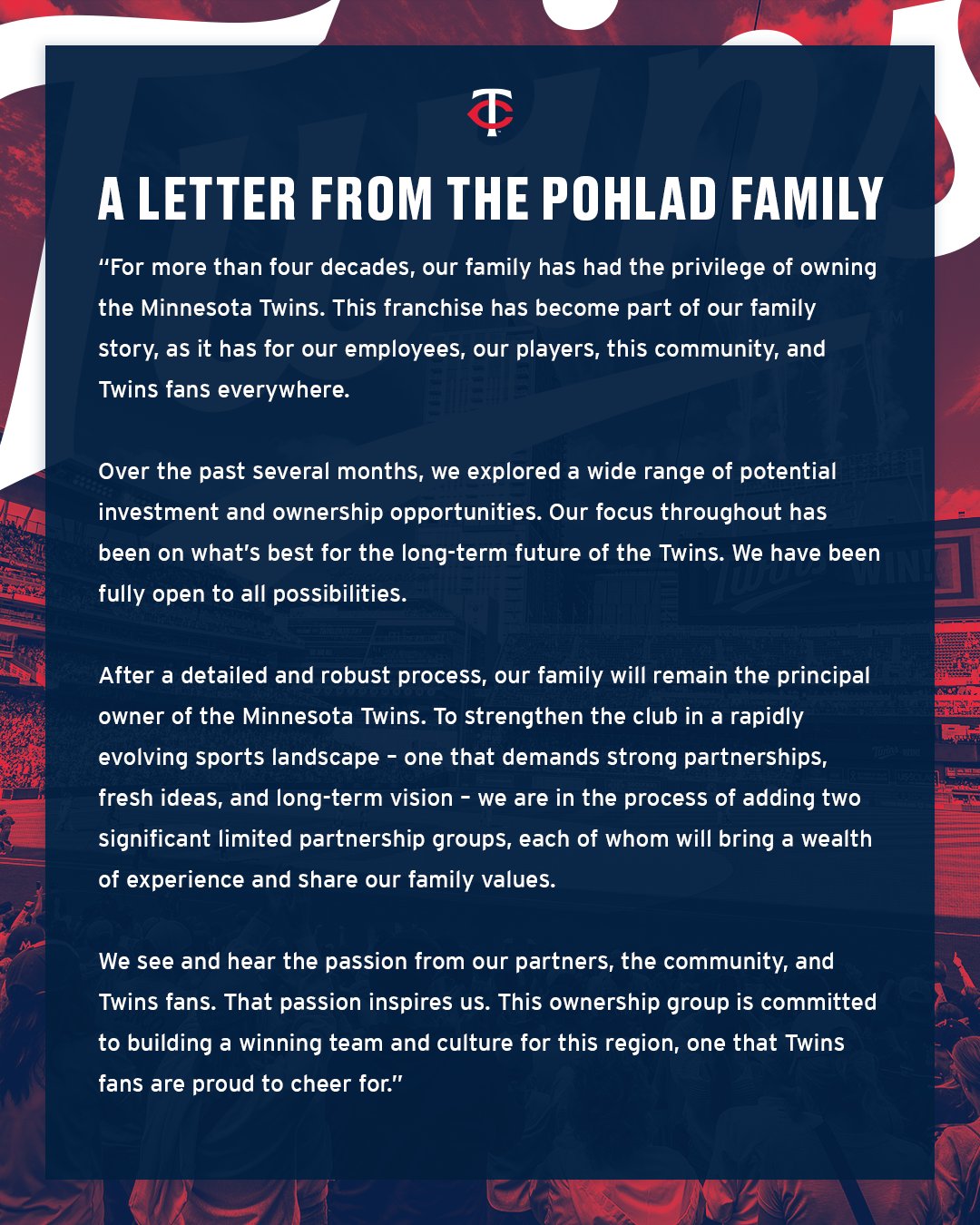
Preaching “family values” (did you know that the Twins’ payroll has never been higher than ninth in MLB, which is almost entirely because of Joe Mauer’s contract), the Pohlads released a nonsensical statement that they were keeping ownership while adding two supporting groups for input (whatever that means).
This sucks.
In case it wasn’t obvious enough, I am a Twins fan, so this is more personal. Writing this has made me appreciate that 2023 team more, despite falling short, and it saddens me that a team with such a bright-looking future got squandered and then purged. But this is probably the worst outcome. The team was sold off, yet the ownership group, which has clouded the last two years of competition, has remained.
If there is any silver lining here, it’s that it gives the Twins a pretty clear direction: to suck.
That’s not inherently a bad thing. The Twins have the #2 farm system in baseball, and if they want, they could get a hefty return for Joe Ryan and probably Pablo López, too. With less money and less talent to work with than the ’23 Twins, it doesn’t make sense to compete for a playoff position, even with a weak AL Central. That is, if the owners let them truly gut the team. We’ve seen owners be apprehensive about full-scale rebuilds before because operating costs for baseball teams, even garbage ones, are a net profit. That, plus the ever-rising franchise values, makes owning an MLB team one of the better investments for the super wealthy. If they are complacent with a teardown, the Twins can commit to developing their farm for hopefully a bountiful harvest just in time for a new owner to come in. If they want to keep Joe Ryan for no reason, the Twins are in a truly dismal state.
