




A few years ago, I made one of the more difficult decisions a dynasty manager can make: trading away José Ramírez. He had just finished a near 40-40 season at 31 years old, and his value couldn’t have been higher. But I had a hunch that the decline phase of his career was approaching, and I also had Junior Caminero waiting in the wings as a suitable replacement. I pulled the trigger, swapping Ramírez straight up for Fernando Tatis Jr. It felt like an even-value deal at the time.
The trade didn’t pay off in the first season, but I still managed to win a league championship for a variety of reasons. And, in a decision I still regret, I didn’t keep Caminero. Big mistake on my part! Fast forward to the 2027 offseason, and Tatis is carrying two-position eligibility while coming off a strong second half that I’m hoping carries over into next season. The trade may not have worked out exactly as planned, but it was a reminder that dynasty managers need to think beyond the next season’s stat line when evaluating their most valuable assets.
Every offseason, fantasy managers face a choice about how to guide their keeper and dynasty rosters. Do you hold on to the players who got you here, or do you sell before their production and trade value begin to erode? The obvious candidates are usually the veterans, but what exactly qualifies as a veteran—and when does the decline phase really begin?
Looking at the 2026 MLB hitter population (1,879 players with at least 10 plate appearances), the age curve offers a useful framework for identifying when a player’s value may be approaching its peak.
The mode was 26 years old
The median age was 27 years old
The average age was 27.7 years old
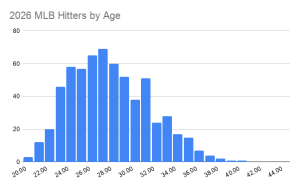
2026 MLB Hitters by Age
Rather than treating every 30-something hitter as an automatic sell, I’m breaking the aging curve into three stages:
The Crest: Ages 28-29, when hitters are generally near the peak of their value.
The Drop: Ages 30–31, when the decline becomes steeper, and the risk of losing production begins to grow.
The Valley: Age 32 and beyond, when more hitters begin to experience the cumulative effects of aging.
With those ranges in mind, we’ll look at three groups of aging hitters who may be approaching the point where dynasty managers should consider capturing maximum value by selling now.
Veteran Hitters to Sell in Dynasty
5 Players Approaching The Valley
Players over 32 who have put up good seasons, giving them a higher return value in any trade. 33 players fit this range with at least 10 plate appearances and a wRC+ greater than 100.
Aaron Judge OF New York Yankees
Painful as it may be to move on from a generational talent, the time has come for dynasty managers to seriously consider cashing in on Aaron Judge.
Judge is trending in the wrong direction across every category tracked for this article. Power, discipline, contact, speed, and luck were all worse this season than over the previous three seasons. The most glaring red flags are declining bat speed, fewer barrels, more chase, higher strikeouts, and a depressed walk rate. For a hitter whose fantasy value has been built on overwhelming power and elite production, that’s a concerning collection of trends.
There are, however, a couple of reasons not to panic just yet. Judge maintained the same level of contact despite the slower bat, and his home-run-to-barrel ratio remained consistent with previous seasons. That second point is particularly encouraging: when Judge squares the ball up, the power is still there. If he can stay healthy, he could approach his previous home run totals. If only!
The easiest explanation for some of Judge’s statistical slippage is the time he has missed due to injury, but his growing list of ailments is becoming difficult to ignore. Calf strain, first rib stress fracture, elbow flexor strain, hand injury, torn ligament in his big toe, hip strain. About the only thing he hasn’t experienced yet is a hamate bone injury. Oops! Let me bottle up that thought before I put any bad vibes into the air.
The bigger dynasty concern is what happens as Judge ages. With his nine-year contract running through 2031, the Yankees have every incentive to preserve what remains of their superstar, potentially shifting him into the DH role more frequently as his career progresses. They’ve already moved him from center field to right field, and another reduction in defensive responsibilities is not difficult to envision. Keeping him off his feet could help manage the wear and tear, but it won’t eliminate the physical demands of swinging a bat, particularly with a history of injuries involving his calf and ribs.
That leaves dynasty managers with a difficult question: Does Judge follow the path of David Ortiz and Nelson Cruz, remaining a devastating hitter well into his later years? Or does he eventually resemble one of his hitter comps, Paul Goldschmidt—a respected, productive veteran whose declining value and roster spot can complicate the transition to a younger player?
Judge is obviously capable of making this sell recommendation look foolish. Generational power doesn’t simply disappear overnight, and his home-run-to-barrel ratio suggests there’s still plenty of thunder in that bat. But dynasty value is about more than what a player can do when healthy. It’s about how often he can take the field (tangent: his CF defensive stats are deteriorating, and he will likely be a full-time RF), how long his skills will hold up, and what another manager is willing to pay for the name on the back of the jersey.
If someone is still valuing Judge as the perennial MVP-caliber force he has been, I’m willing to explore a deal. You don’t have to believe the decline is imminent to recognize that the risk is growing—and that his name value may give you one last chance to cash in before the market catches up.
Corey Seager SS Texas Rangers
A new statistic was created in 2023 after Corey Seager helped the Texas Rangers win a World Series, highlighting his exceptional ability to make decisions at the plate. Seager excelled at attacking hittable pitches while laying off offerings outside the zone, a combination that made him one of baseball’s most dangerous hitters. Unfortunately, his decision-making has been far more reliable than his availability. In addition to a concussion and back inflammation, Seager underwent offseason surgery to address a bone spur in his right elbow. Even if he arrives at spring training fully healthy, there are reasons to question whether his hitting production can rebound after recent declines across several key categories.
The concerning part is that the power is fading alongside his plate discipline and contact skills. Worse yet, the results have been working against him, with his lowest wOBA, xwOBA, and home-run-to-barrel rate of the last three seasons. For a hitter who offers no stolen-base production, that combination leaves little room for error. Seager is a four-category contributor at best, and he’s no longer providing the batting-average production that once helped justify his profile. He’s swinging and missing more often while generating less power, creating a troubling combination for a player whose fantasy value depends almost entirely on his bat.
The frustrating part is that Seager’s name recognition may not be enough to generate a meaningful return in dynasty leagues. Managers are being asked to pay for the hitter he has been, not necessarily the one his recent performance suggests he could become. And the downside is ugly: another injury-riddled season that leaves you with fewer than half a season’s worth of plate appearances.
If you can still find a manager willing to buy into a rebound, explore the market. Otherwise, Seager is a hold-or-sell-at-a-discount decision—not someone I’d count on to anchor a dynasty lineup.
Francisco Lindor SS New York Mets
Overall, 2026 was a disappointing season for managers rostering Francisco Lindor. Hamate bone surgery compromised his first half, limiting him to just three home runs before the All-Star break. The damage extended beyond his power production, as Lindor attempted only four stolen bases in the first half and six attempts all season. The running game that once helped make him a perennial 20-20 threat appears to be fading, while his defensive metrics are also trending in the wrong direction. The combination raises questions about how much of Lindor’s athleticism is left—and whether his grip on the leadoff spot could eventually loosen with suitable alternatives such as AJ Ewing and Carson Benge waiting in the wings.
Wow. That’s a pretty pessimistic outlook for a premium-position player who has long been projected to age gracefully into another three seasons of 20-20 production. But strip away the name recognition and positional value, and the underlying numbers paint a concerning picture. Lindor’s plate discipline is slipping, with strikeouts climbing as he swings and misses more frequently and chases more pitches outside the zone. His on-base percentage opened 2026 on solid footing but steadily deteriorated before finishing at .309, the lowest mark of his career. Much of that decline can be traced to his lowest career batting average, which coincided with a career-low contact rate. There are a lot of “lowests” and “worsts” attached to Lindor’s 2026 season. That creates a potential buying opportunity for managers who believe the hamate injury was the primary culprit and that a healthy offseason after undergoing surgery can get him back on track.
The second half provides some ammunition for that argument. Lindor rediscovered his power, launching 18 home runs from July onward. He converted an unusually high share of his barrels into home runs, a rate he probably won’t sustain, but the surge does support the idea that he was still recovering from the hand surgery during the early months. The power never completely disappeared; it simply took time to show up in the box score.
There are legitimate reasons for optimism, too. Lindor’s hard-hit rate, barrel rate, and bat speed held steady, suggesting the raw ingredients for an impactful swing remain intact. In fact, his monthly bat-tracking data showed that Lindor recorded his fastest average bat swing ever in September 2026—a month in which he hit seven home runs. If the bat speed is still there, a rebound in contact quality and overall production is not out of the question.
But here’s the catch: Lindor slashed .208/.288/.434 in September, producing a wRC+ of 100. Even while delivering his highest home run total of the season, he was merely an average offensive producer. That’s a sobering reminder that home runs alone can’t compensate for a deteriorating hit tool and declining on-base skills. The power metrics suggest Lindor still has plenty of life in his bat, but the broader fantasy profile is changing. With single-digit stolen bases a realistic possibility and the contact and plate-discipline concerns becoming harder to dismiss, Lindor may no longer be the well-rounded 20-20 cornerstone managers expect from an elite shortstop. To further complicate things, his defensive metrics are falling off.
I wouldn’t sell him at any price. The retained bat speed and second-half power make a rebound plausible, particularly if he enters 2027 fully recovered. But if another manager is still paying for the established 20-20 version of Lindor, I’d seriously consider moving on. The name and positional pedigree remain valuable; the question is whether the production will continue to justify the price.
Bryce Harper 1B/OF Philadelphia Phillies
Of all of the players selected for this section, Bryce Harper has the strongest case for aging gracefully and maintaining a spot on your roster. He is coming off a season where he played every single game, while now qualifying at two positions (1B, OF). The fact that he stayed healthy while returning to the outfield for the first time since 2022 is a clear signal that Harper has a great wellness routine to maintain the highest level of athleticism in his body possible.
Impressively, Harper has also maintained a keen eye at the plate. While the swing-and-miss is high, he has sustained the same level of strikeouts while chasing less and accepting more walks. Similarly, the contact is lower than his career highs, but not with a dramatic dip. Harper is still slightly above-average in batting average while providing a decent power output.
Speaking of power, Harper has maintained a high bat speed, something that keeps the barrel rate, hard-hit rate, and expected slugging percentage high.
In fact, his home run-to-fly-ball rate has held steady across the last three seasons, giving him a realistic chance at 30 home runs every season. Nothing about his hitting game seems lucky or overrated.
Will a 34-year-old Harper play 155+ games again in 2027? There isn’t a reason to doubt him besides the supporting evidence of baseball history that says the opposite should occur. Assuming he puts up a high number of plate appearances as the three-hitter behind Trea Turner and Kyle Schwarber, the RBI potential is sky-high. One downside that has appeared is that his athleticism is slipping. Harper is unlikely to steal more than 7-9 bases with the six times caught stealing in 2026. Furthermore, the defensive metrics show a player who is actively hurting his team, something that the Phillies, as a team, will need to address one day. Harper has demonstrated that we should trust his eye and bat, making him someone you could sell at full value.
Ketel Marte 2B Arizona Diamondbacks
The off-field issues surrounding Ketel Marte may ultimately overshadow his mediocre performance on the field. Despite playing in the most games since 2023, Marte posted one of the lowest wRC+ marks of his career. To make matters worse, the off-field drama—including his placement on the restricted list after failing to show up for a game in Boston—added another layer of uncertainty to a season in which the Diamondbacks missed the playoffs by a slim margin. Without clarity on everything that was going on, it’s difficult to know how much the circumstances affected his performance. But Marte’s season left the impression of a player caught in a self-defeating cycle, with both his production and his standing with the team taking a hit.
Discipline
On the bright side, Marte remains a strong contact hitter, even as he has changed his approach and started swinging at more pitches outside the zone. That strategy hasn’t led to a meaningful increase in strikeouts, but it has made him less patient and more focused on putting the ball in play. The contact skills are still there, which is important for a player whose fantasy value has long been built around a combination of batting average, power, and speed.
The problem is that the quality of that contact has deteriorated. Marte still generates excellent bat speed, but the ball isn’t coming off his bat with the same authority, and the results have suffered. His slugging and expected slugging percentages were at their lowest since 2023. The second-half power outage was especially concerning: Marte hit just five home runs from July on, compared to 17 in the first half. The bat speed hasn’t disappeared, but the impact contact that once made him such a dangerous hitter has become less consistent.
Marte’s power decline wasn’t necessarily caused by a dramatic change in his batted-ball profile. His fly-ball and pull rates remained similar to recent seasons, suggesting he was still putting himself in position to do damage. The difference was that more of those long drives and fly balls landed for doubles instead of clearing the fence. That’s a meaningful distinction for fantasy managers, particularly when the power output is already trending downward. And with 2026 potentially representing a high point in games played and plate appearances, there isn’t much room to project a significant increase in production for 2027.
At 32 years old, Marte isn’t necessarily entering a steep decline phase, but the warning signs are piling up. The combination of reduced power, questionable availability, and off-field uncertainty makes him a difficult dynasty hold. Long-time managers may feel compelled to hang on because of the lack of reliable second-base alternatives, but scarcity alone isn’t a reason to ignore the risks. If you have a Travis Bazzana, Curtis Mead, Angel Genao, or another lower-tier option who can fill the position, consider using Marte to address a more pressing roster need. His name and track record may still carry more trade value than his current outlook warrants.
5 Players at The Drop
Players in their age 31 season, who have some value and have not fully fallen off yet. 44 players fit this range with at least 10 plate appearances and a wRC+ less than 120.
Ian Happ OF Free Agent
Ian Happ has been a reliable fantasy selection for the last few years, especially given the initial blandness of his projections deflating his ADP. However, 2026 was unkind as cracks in that value started to appear. In addition, Happ is now a free agent, which adds uncertainty to his role, lineup position, and 2027 projections. Looking back, Happ did not generate much value despite playing virtually every day, 156 games. The level of production that is slipping is slight, but noticeable nonetheless.
Happ didn’t make as much contact as usual; at the same time, the quality of contact went down. It appears that Happ was fortunate to generate the amount of home runs that he did, a sign that his bat is not slowing down. Happ’s next set of projections will likely revolve around more power since he has maintained a similar bat speed and has a skill at squaring up the ball.
Yet, the average and on-base percentage will suffer as the strikeouts pile up. The spike in strikeouts comes as he is swinging less often, signalling that Happ may be trying to do the Corey Seager thing by hitting “his pitch.”
In conclusion, Happ is no longer the reliable contributor that veteran fantasy managers have become accustomed to happily drafting as their 4th or 5th outfielder. He also hasn’t fallen off yet, so your opponent may be viewing him at full value. Happ also can no longer be counted on for steals. And depending on his new team, his lineup order could deflate some of the generous run totals he has compiled with a well-stocked Cubs lineup the last three seasons. He has steadily moved down from leadoff in 2024 to fifth or sixth in 2026.
Brent Rooker DH (OF 5 games only) Athletics
Brent Rooker enters the offseason with designated-hitter-only eligibility, and that could become a significant problem for his fantasy value. The Athletics have several players returning from injuries who will need DH at-bats to keep them healthy. Shea Langeliers (meniscus surgery), Nick Kurtz (thumb), and Tyler Soderstrom (hip) could all cut into the playing time that once belonged almost exclusively to Rooker. Considering Rooker has been a below-average outfielder for the last three seasons, there’s little reason to expect him to make up those at-bats in the field. He’s also coming off knee surgery to repair cartilage damage, further complicating any path back to regular defensive work. In other words, Rooker faces a potentially crowded DH rotation at the exact time he needs to reestablish his offensive value.
The playing-time concerns would be easier to overlook if Rooker had delivered his usual power production in 2026. Instead, he fell short of expectations despite swinging the bat as fast as ever. His hard-hit rate dropped substantially, and his expected outcomes deteriorated alongside it. In an apparent effort to launch more home runs, Rooker increased his attack angle, but the adjustment produced more fly balls at the expense of line drives. The added lift didn’t translate into the power output fantasy managers were hoping for.
Worse, the swing changes appear to have come with additional costs. Rooker’s increased bat tilt coincided with more strikeouts, while his chase and swing-and-miss rates climbed. That combination of declining contact quality and deteriorating plate discipline is a troubling foundation for a rebound. Bat speed alone can only carry a hitter so far when he’s making less damaging contact and struggling to put the bat on the ball consistently.
To be fair, Rooker’s season-ending surgery provides a legitimate explanation for some of the decline. His May and June production was average, leaving open the possibility that he was beginning to turn things around before the injury derailed his season. With an extremely hitter-friendly home ballpark working in his favor, a healthier Rooker could still recapture some of his previous power. The problem is that we’re left projecting a rebound rather than pointing to one that actually happened.
That leaves dynasty managers in an uncomfortable spot. Rooker has enough power upside to make selling at a reduced price feel premature, but his DH-only eligibility, crowded path to at-bats, knee recovery, and deteriorating underlying metrics create a concerning amount of risk. I wouldn’t give him away simply because of one disappointing season, but I would absolutely explore the trade market. If another manager is willing to bet on a healthy return to form, I’d listen. Otherwise, Rooker is a difficult hold: the upside remains enticing, but the path to realizing it is getting narrower.
Bryan Reynolds OF Pittsburgh Pirates
Bryan Reynolds just turned in his best season since 2021, when he posted a 6.3 WAR. The 17 home runs may not jump off the page, but 102 runs and a .261 average at pick 196 in 2026 made him a terrific value, especially considering he didn’t miss a single game. The Pirates’ offense was on fire in the first half, and Reynolds was right there with them. He launched 14 home runs and chipped in seven steals before his production cratered from August on, when he managed only two homers and two steals. That second-half decline is what makes Reynolds an interesting case heading into 2027. Was it the beginning of the end for a 31-year-old veteran, or did his first half reveal a player who still has plenty left in the tank?
Reynolds made meaningful strides in his plate discipline, swinging and whiffing less while drawing walks at a career-high rate. He was more selective, chased fewer pitches, and made more contact when he did swing in the zone. That improvement also coincided with a greater use of his fast swing, giving him a better combination of patience and impact. The result was a hitter who not only got on base more often but also made harder contact. His barrel rate and hard-hit rate both reached career highs.
If Reynolds was smoking the ball in the first half, what happened after the All-Star break? The underlying swing metrics offer few obvious answers. Bat speed, squared-up contact, and attack angles remained relatively similar. His barrel rate actually increased, while his ground-ball rate declined. He did have a rough August in which he chased more frequently, but those rates returned to normal in September. In other words, the quality of his swing didn’t suddenly disappear.
The most notable change may have been his luck. Reynolds’ HR/FB% fell from 17.1% in the first half to just 4.6% in the second. That is a dramatic drop for a hitter whose bat speed, barrel rate, and hard-hit rate remained strong. It’s hard to attribute the entire second-half power outage to bad luck, but the underlying metrics suggest that his home run production was worse than the quality of his contact warranted.
The data suggests Reynolds may age more gracefully than expected, making him one of the few players on this list who deserves serious consideration for another roster spot. His first half was so productive that it made the second-half collapse look even worse. He did leave a game with a groin strain on June 19th, but still hit seven home runs and stole four bases afterward. More encouragingly, Pitcher List Process+ was trending upward as the season came to a close.
Reynolds doesn’t need to rediscover his 2021 peak to be a useful fantasy player. The improved plate discipline, career-best power indicators, and full-season availability all point toward a veteran who still has a solid foundation. The question is whether the first half represents a new level of production or simply a hot stretch that won’t carry over.
Could—and should—you hold onto Bryan Reynolds as part of a resurgent Pirates offense? At his age, the risk of decline is real, but the underlying metrics make him a more appealing hold than his second-half numbers might suggest. If the market is treating him like a fading veteran, there may be an opportunity to buy back into a player whose skills are holding up better than his recent results.
Will Smith C Los Angeles Dodgers
Will Smith fits comfortably into a strong Dodgers lineup as the primary catcher. On a different team, he would easily accrue another 20-30 games of plate appearances as the designated hitter. With that option blocked through the life of his luxurious ten-year contract, Los Angeles will have to count on him for around 120 games a year. The question for fantasy managers is whether that sample size is sufficient as a hold for his age-32 season and beyond.
His standout category is definitely the contact skills. More contact in the zone, more contact overall, and very little whiff or chase in his bat. Although he didn’t generate as many hits.
Smith doesn’t have the prototypical power bat, but has posted strong power numbers across the last few years. He has a long swing and rarely swings his fastest. Yet, the barrel rate and hard-hit rates are near career highs. Right on pace with his previous totals, he hit 10 home runs.
Despite missing two months, Smith did return in September to smack four home runs and slash .290/.400/.548. He answered the question about his health in a big way and may have put to bed any doubts about his ability to stay a quality hitter into his older years. With Dalton Rushing unable to capitalize on Smith’s absence, Smith has a clear runway at primary catcher while hitting in the 3- or 4-hole of a potent lineup.
Mauricio Dubón SS/OF Free Agent
Mauricio Dubón is a different kind of player than the others on this list, but he was a valuable fantasy contributor in 2026, particularly in 15-team leagues. His ability to fill in at four positions made him a useful roster piece, and Atlanta was pressed into using him as its starting shortstop from the jump. Dubón responded with the highest plate appearance total of his career, a double-double, and a .276 batting average. For a player who wasn’t expected to carry much fantasy value, that was a meaningful return.
Dubón’s contact skills were once again a strength. For the second straight season, he made contact on 92% of pitches in the zone. He reached that level despite chasing pitches outside the zone at a ridiculous 40% rate. Even with all that chasing, he rarely swings and misses. It’s an unusual profile: Dubón can expand the zone and still put the bat on the ball, giving him a path to a respectable batting average despite an undisciplined approach.
The power, however, is another story. Dubón was extremely fortunate to see a high percentage of his barrels clear the fence for home runs. With subpar bat speed and a poor barrel rate, he simply doesn’t have the underlying power metrics to sustain this level of production. The double-double was a career-year outcome, not a new baseline. Without a meaningful change in his quality of contact, expecting a repeat would be chasing last year’s results.
His free-agent status adds another layer of uncertainty. It’s highly unlikely Dubón lands with a team that plans to use him as a full-time starter, which would make it difficult to replicate his 2026 plate appearance total. His versatility should keep him in the mix, but that doesn’t necessarily translate into everyday at-bats. Unless he signs with the Athletics or Reds, where the ballpark could provide a boost to his inconsistent power metrics, Dubón looks like a classic sell-high candidate. The batting average and positional flexibility are useful, but the power and playing-time combination that made him valuable in 2026 is unlikely to hold.
5 Players on The Crest
Players aged 29-30, who you can try to get some value back on before the decline. 77 players fit this range, with at least 10 plate appearances and a wRC+ below 120.
Cody Bellinger OF New York Yankees
This is a group of players for whom the sell case is going to be a little more difficult to make. And no one needs to be reminded that Cody Bellinger is a household name. But did you realize he has been playing professional baseball since 2013? I hadn’t considered just how lengthy his career has been, especially since he didn’t make his MLB debut until his fifth season as a pro in 2017.
Fast forward to this season, and Bellinger has delivered exactly what the Yankees hoped for when they signed him to a five-year contract. He’s pulling the ball in the air at elite rates, with all 17 of his home runs landing in right field. Unfortunately, a hamstring injury cost him a month of playing time, so the power totals could have been even higher. On the surface, it looks like a productive season from a veteran who has found a comfortable home in the Bronx.
The prolific power projections that followed his 2019 breakout have been tempered by a more modest reality: Bellinger simply doesn’t swing the bat that hard. His bat speed, exit velocities, barrel rates, and hard-hit rates all point to a hitter who isn’t consistently generating big-time power. Those high-20s home run totals are more a product of running into one over the course of 150 games than an elite power profile. He hasn’t posted an HR/FB% above 14% since 2020, when his barrel rate, hard-hit rate, and exit velocities were all considerably higher.
And if Bellinger isn’t the power threat he once was, his fantasy profile starts to lose some of its shine. The speed component is worth questioning, too. Sure, he finished the season with 12 steals, but he was caught six times, giving him the worst stolen-base success rate of his career. Even more concerning, he attempted just two steals after returning from the injury in July. The combination of declining power indicators and a running game that may be slowing down is a warning sign.
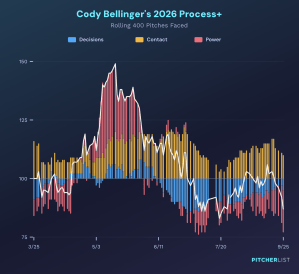
Bellinger is still a productive player, and that’s precisely what makes this a sell opportunity. The name, the Yankees uniform, and the home run totals may still carry more weight in the trade market than the underlying metrics justify. The athleticism may be waning, and dynasty managers should consider moving him before the power and speed both fall further away.
Ozzie Albies 2B Atlanta Braves
Ozzie Albies has been in decline for some time, and his standing among the top 10 second basemen may have more to do with the weakness of the position than his own production. His longstanding platoon splits have also drawn plenty of attention, particularly his subpar numbers against left-handed pitching. Albies opened 2026 on a hot streak, but his production quickly levelled off into a mediocre season. The profile no longer offers reliable batting average or speed, leaving fantasy managers increasingly dependent on the occasional power surge.
Even that power has become difficult to trust. Albies posted a dismal EV90, barrel rate, and hard-hit rate, all pointing to a hitter who is struggling to generate impact. He rarely employs a fast swing, instead prioritizing contact over power. That approach isn’t entirely without merit, as it has helped him limit strikeouts and maintain solid contact rates. But when the contact isn’t producing enough average or speed to support his fantasy value, the trade-off becomes a problem.
Albies also benefited from an inflated home run rate in 2026, a result that is unlikely to translate into a meaningful power increase in 2027. He expanded the strike zone by chasing more frequently while squaring up fewer pitches.
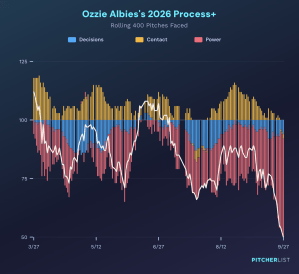
The combination of declining power indicators and a rising strikeout rate points toward further regression unless something changes. There is always the possibility that the Braves encourage him to abandon one side of his switch-hitting, but that would be a significant adjustment—and hardly a guarantee of improvement. For now, Albies looks more like a name-brand second baseman whose reputation is outpacing his underlying production.
Kazuma Okamoto 3B Toronto Blue Jays
It was the best of outcomes for Kazuma Okamoto in 2026. He arrived in Toronto from the Yomiuri Giants after posting a high batting average and a respectable home run rate, only to see a season-ending elbow injury deflate his value heading into free agency. As the Blue Jays’ everyday third baseman, Okamoto bounced between the third and sixth spots in the lineup. The expectation was that he would bring a more disciplined approach to the plate, but instead, he struck out at the highest rate of his career.
Okamoto chased and whiffed at high rates, making less contact than he had in the Nippon League. Without the benefit of a deep historical data set, we can turn to his monthly splits for a closer look. July was his worst month, featuring his highest chase and whiff rates—and, perhaps not coincidentally, his longest swing of the season. But Okamoto made adjustments, reined in some of the swing-and-miss, and continued to produce quality power the rest of the way.
That power is the foundation of Okamoto’s year-to-year projections. He maintained a strong barrel rate from month to month while improving his contact rates in the second half. Still, the quality of his contact was at its best early in the season, when his squared-up and blast contact rates were highest. That helped fuel his 22 first-half home runs, as he consistently demonstrated an ability to pull the ball in the air. The power remained, even as the underlying contact quality shifted.
It’s also worth remembering that Okamoto is hardly a rookie. He enters his tenth year of professional baseball, and while his strikeout rate was high for the season, he brought it back under 25% in the second half. The ability to make in-season adjustments without sacrificing his power is an encouraging sign.
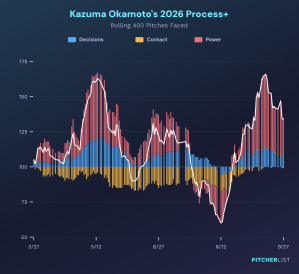
Okamoto may still have some growing pains as he adjusts to MLB pitching, but his second-half improvements suggest he can smooth out some of the swing-and-miss while maintaining the power that makes him an intriguing fantasy option. So, this is a lukewarm recommendation to move on from Okamoto, especially given his primary position at third base.
Cal Raleigh C Seattle Mariners
For the first time in his career, Cal Raleigh entered a season with the full weight of expectations on his shoulders. After launching 60 home runs, the hope was that he could deliver another monster campaign and cement himself as an elite fantasy catcher. Instead, an oblique strain sidelined him for a month, and the season quickly turned into a disappointment. But while the narrative around Raleigh’s 2026 campaign has been largely negative, there were some encouraging signs—and not just during his time on the injured list. In five rehab games, he blasted five home runs, then broke out of his cold streak with nine homers in August. There are still concerning indicators, but things aren’t quite as bleak as they looked at his lowest points.
Raleigh maintained top-tier bat speed throughout the season, swinging at a pace in the 90th percentile among all hitters. His overall barrel rate declined, but it remained strong by almost any standard. The bigger issue was the quality of contact. Raleigh wasn’t striking the ball with the same authority, posting lower exit velocities and weaker contact quality. The second half, however, offered a much-needed rebound, with both blast and squared-up contact rates improving considerably. That’s a meaningful development for a hitter whose fantasy value is built around power.
The biggest culprit behind Raleigh’s disappointing season may have been May, when he chased 49% of pitches outside the zone. His O-Swing rate was elevated throughout the season, but it was especially problematic early on. That stretch helped drag down his overall production and put him in a hole that was difficult to climb out of. If Raleigh can maintain his elite bat speed while returning to something closer to his previous level of swing-and-miss, there’s reason to believe the 2026 results were worse than the underlying talent.
Raleigh was also a victim of some bad fortune. He was never going to be a reliable batting-average contributor, but he finished at a career low despite only minimal declines in contact. He wasn’t going to match his historic 81 barrels in 2026, but he was on pace to hit the same number of home runs if he had remained healthy for the full season. The power is still there, and the second-half improvements offer some optimism that he can rebound.
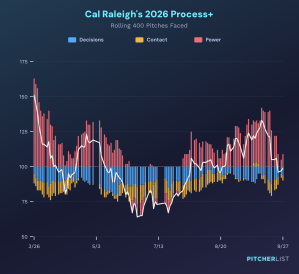
The catch, of course, is that catchers have a difficult time staying on the field. It’s hard to expect Raleigh to continually deliver 150+ games in a season, so his projections need to account for a more modest number of plate appearances. That makes him a high-risk, high-reward fantasy asset. If your roster can absorb an extremely low batting average in exchange for a greater than 50% chance at 30+ home runs, roll with Raleigh. If you need more balance from your catcher spot, this may be the time to consider moving off him while his power upside still carries significant trade value.
Kyle Tucker OF Los Angeles Dodgers
It’s an open question whether the Dodgers will ever win another championship during the life of the Shohei Ohtani contract. They’ll become the Yankees of the 1980s and early 90s, gleefully overpaying for free agents while blocking their rising young arms with overhyped veterans. And that’s before the deferred-contract scheme crumbles their financial structure. What does any of this have to do with Kyle Tucker? Well, I was one of the early 2026 drafters who bought into the idea of Tucker as an upside play in a loaded Dodgers lineup. But what if it’s on the decline? The return for Tucker’s ADP was unacceptable as a first- or second-round pick: 17 home runs, 12 steals, and a .233/.330/.385 slash line. And he did it in a mostly healthy season, playing 154 games.
Tucker’s power metrics fell off a cliff. His swing got slower and shorter, and he made less authoritative contact as the season wore on. With a robust sample size, he posted some of the worst exit velocities of his career. There was a glimmer of hope in September, though, when his production trended upward. It was his best offensive month, with six home runs, three steals, and a .262 average.
That late-season surge can be traced to a more discerning approach at the plate. His swinging-strike rate plummeted below 8%, while his zone contact rate surged to 91–92% and above. Despite posting some of the worst strikeout and chase rates of his career, those final months demonstrated that Tucker still possesses an elite ability to identify a hittable pitch. The question is whether that improved approach can translate into more consistent production.
After coming over from Houston, it’s fair to wonder how much his former home ballpark contributed to his power numbers. His home run totals appear a tad lucky. Sure, 20 home runs may be the floor, but can you really project him beyond 25? Nothing in the monthly underlying swing metrics suggests he figured it all out in September, aside from a 22-degree launch angle. A better month is encouraging, but it’s not necessarily evidence of a power rebound.
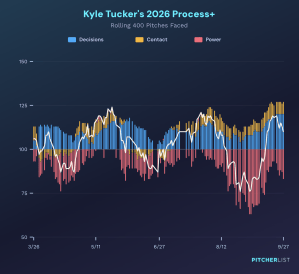
With lowered expectations for both speed and power, Tucker can no longer be assumed to be a 30-30 threat—or even a guaranteed 20-20 player. Maybe the new baseline is 20-10. His plate discipline is aging well, and that allows him to make a ton of contact, but the power ceiling is no longer what we thought it was. The directive is clear: sustain more Septembers, get more loft in the swing, and find a way to improve the power output at home in Los Angeles, where he managed only five home runs and a 69 wRC+. Until that happens, Tucker is a player whose name and reputation may still outpace his fantasy production.
Adapted by Kurt Wasemiller (@kurt_player02 on Instagram & Threads @kuwasemiller.bksy.social on BlueSky)
