







Out Rate or Out% is a statistic we developed at PitcherList to discover which pitchers were the best at inducing outs. Beyond that, we can also determine which of their individual pitches are the best at inducing outs. And with just two months remaining in the season, league average Out Rates have mostly stabilized, so we can measure a pitcher’s Out% on each pitch against league average.
This gives fantasy managers an edge in analyzing pitcher performance. Analyzing Out% in concert with other data points will help fantasy managers make start/sit and drop/add decisions. Out% is an essential tool in analyzing the effectiveness of a pitcher for fantasy baseball purposes.
For first-time readers, this article will provide some tips on how to analyze Out%, how you can use it to determine who the best pitchers are at inducing outs, what to look for, and how to make decisions based on Out%.
Check out our app to help track Out%: https://pl-out-percentage.streamlit.app/ – here you can search by pitcher and see leaderboards by pitch type.
You can read more of the intricacies of the stat here, where I reflect on what we learned from Out% last season and how to use it in fantasy, as well as the real-life implications.
For the purposes of this article, we will focus more on how to use this stat for fantasy baseball and how it can help you make fantasy-relevant decisions in-season.
Here is where the league-average Out% stands on each type of pitch as of writing on Saturday, August 2 (they will fluctuate as the season goes on):
- Fastball – 16.4%
- Cutter – 16.2%
- Sinker – 17.8%
- Splitter – 21.2%
- Slider – 18.5%
- Sweeper – 18.4%
- Curveball – 16.6%
- Changeup – 19.4%
A few notable pitchers sit atop the leaderboards for each pitch, including
- Tarik Skubal – Fastball 20.8%
- Chris Bassitt – Cutter 21.2%
- Miles Mikolas – Sinker 25.2%
- Logan Gilbert – Splitter 29.8%
- David Peterson – Slider 26.5%
- Noah Cameron – Curveball 22.9%
- Garrett Crochet – Sweeper 34.3%
- Ranger Suárez – Changeup 25.8%
For the sake of this article, my analysis will primarily focus on starting pitchers. Currently, the leaderboards (especially fastball and fastball adjacent pitches like cutters) are dominated by relievers because of their small sample size.
Fastball Out% Highlight
Jacob deGrom – SP TEX
636 different pitchers have thrown a fastball this season. The average number of fastballs thrown by pitchers is 335. Among the pitchers who have averaged at least 335 fastballs thrown this season, Jacob deGrom owns the fifth-highest fastball Out Rate at 19.3%
A pitcher having a high Out% is not necessarily an automatic signal of success, but it gives pitchers an edge over those with low fastball Out Rates. Pitchers with high fastball Out Rates keep batters guessing because they do not use their fastballs as waste pitches or setup pitches. And those pitchers with a high fastball Out% combined with multiple other above-average out pitches typically are pitchers with low ERAs.
Jacob deGrom is one pitcher who fits this bill. Not only does he possess an elite fastball, but an elite slider as well. And considering those pitches make up about 85% of his pitch usage, this is great news for deGrom and his fantasy owners.
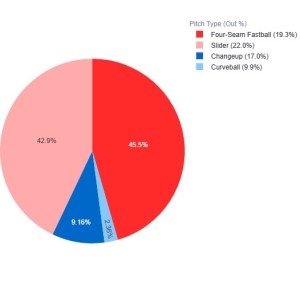
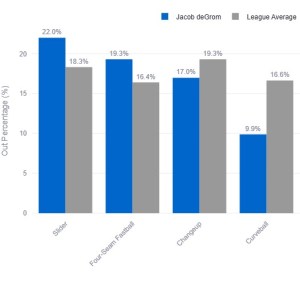
DeGrom’s slider is arguably his best pitch, and if he improves his changeup location slightly, he could end up with a third elite out pitch. But his fastball is absolutely filthy.
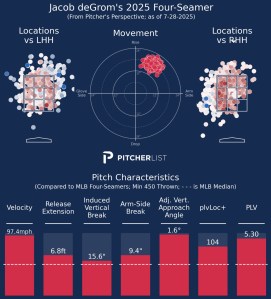
According to PLV, deGrom’s fastball features elite velocity, approach angle, and location. It also has above average extension, vert, and horizontal break. All of that leads to a near Quality Pitch grade. That has allowed his fastball to turn in a .201 batting average against, a 23% whiff rate, a 25% K rate, and a 21% putaway rate.
DeGrom’s 9.4 K/9 rate this season is about one strikeout lower than his career average, but it could improve if he continues to develop his changeup into a better out pitch. He has a 2.55 ERA, nearly identical to his 2.52 career ERA. His 3.20 xFIP, 3.23 SIERA, and 2.85 PLA are not far off from his ERA and point towards continued success for deGrom as the season continues.
Out% Pitchers To Buy
Quinn Priester – SP MIL
Apparently all that Quinn Priester needed for success was to leave Pittsburgh (and Boston). After being traded to Boston in 2024, he barely saw the field. But the Milwaukee coaching staff has worked wonders, restructuring his arsenal and adjusting his pitch mix.
Milwaukee clearly saw something in his sinker, slider, and cutter because his usage on all of those increased from last season. He decreased his curveball usage, though it is one of his most dominant pitches. Along with his curveball, Priester’s slider and sinker all grade as above league average in Out%.
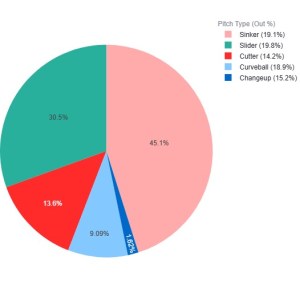
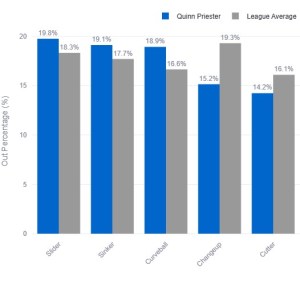
This is great for Priester, as his sinker, slider, and curveball make up 80% of his usage. His sinker acts like a fastball would for other pitchers, so having a heavily used sinker that can get batters out has been a major key to Priester’s success this year.
Priester’s slider has been his most potent weapon against righty hitters, while his curveball has been most effective against lefties. It is a nasty 12-6 curveball that also grades well according to PLV. Take a look at it in action:
Quinn Priester, Dirty 81mph Curveball. 😨 pic.twitter.com/qjuKehcMu4
— Rob Friedman (@PitchingNinja) May 24, 2025
Here is what his curveball PLV looks like:
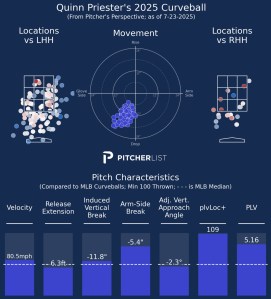
Priester tosses his curve with above-average velo, drop, and horizontal break. But the biggest key for him has been location. Priester has pounded the strike zone more than ever, which has allowed him to fool batters out of the zone with nasty breaking pitches like his curve. It has an insane 40% whiff rate, a .189 BAA, a 38% K rate, a 55% GB rate, and a 21% putaway rate.
Priester’s curveball has a one degree launch angle, contributing to a 4 degree launch angle overall. His curveball, along with all of his other adjustments, has led to an improved K/9 rate and a 57.8% GB rate overall. If he had enough pitches to qualify, that would be the fifth-best GB% in baseball.
Priester is emerging as a legit fantasy option and someone that should be added in every format as soon as possible.
Eric Lauer – SP TOR
Eric Lauer has had a career resurgence in Toronto, turning in his best statistical season outside of an 11-inning 2020 campaign. Lauer owns a 2.68 ERA on the season, with a 3.25 ERA as a starter (19 of his innings were in relief). His 9.12 K/9 and 2 BB/9 rates are career bests, along with a .97 HR/9 rate and an 82% LOB rate.
Much like with Priester, a move to a new team seems to have done the trick. Lauer has tinkered with his pitch mix as a Blue Jay, and it has clearly paid off.
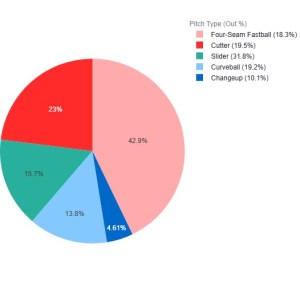
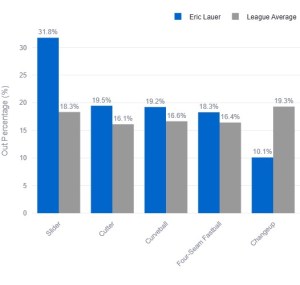
Lauer increased his fastball and curveball usage slightly, and both pitches have performed significantly better than in his 2023 campaign, his last in the majors. He also dramatically decreased his cutter usage while dramatically increasing his changeup usage. Both of those pitches have performed better as well. This shows in his Out Rates, as he features four pitches with above average out rates, with those pitches making up about 95% of his usage. Essentially, he can get batters out with just about anything.
For opposing batters, Lauer has been nearly unhittable. All of his pitches except his changeup have a sub-.200 BAA. All five of his offerings feature whiff rates between 20-32%. Lauer’s cutter, curveball, and slider have putaway rates of 25%, 25%, and 28%.
Lauer’s best out pitch has been his slider, but his best pitch overall is a nasty cutter that PLV grades as a near quality pitch:
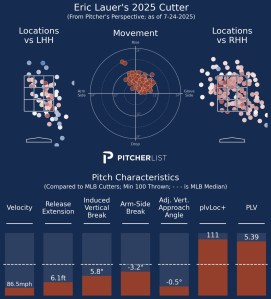
Despite some lacklustre speed and extension, Lauer’s cutter boasts elite location. This has been his calling card all season – his ability to locate his pitches well, to make up for some of the low velocity. Take a look:
Eric Lauer, Painted 87mph Back Door Cutter. 🖌️🎨 pic.twitter.com/xGy0QlKPhV
— Rob Friedman (@PitchingNinja) July 9, 2025
Lauer has a high 55% zone rate, but because he is able to paint the corners like in the video above, he can get by without giving up too much damage. His ability to locate well also means that when he goes outside of the zone, he is able to fool batters and either induce whiffs or get them looking.
Fantasy managers should continue to rely on Lauer as a starter as long as the Blue Jays do. He has a 3.87 xFIP and a 3.53 SIERA, but he could potentially finish the season with an ERA better than both thanks to some improved stuff and sequencing.
Out% Pitchers to Sell
Patrick Corbin – SP TEX
One pitcher to avoid going forward is Patrick Corbin, who is having a resurgence of his own after being statistically one of baseball’s worst, if not the worst pitcher, since 2021. Not counting 2020, his current 3.78 ERA would be his best ERA since 2019, and the first time it would be under 5.00 at the end of a season, if the season ended today. But that comes with some caveats.
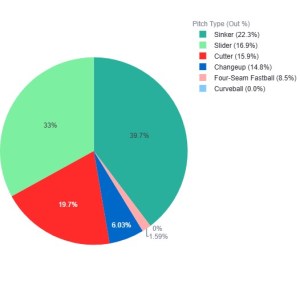
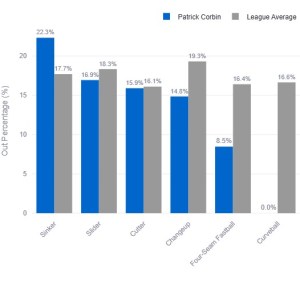
The biggest issue here is that Corbin features just one pitch that has an Out% above league average. Granted, it is his most-used pitch, but most of his pitches do not result in outs often enough. This means batters can sit on his sinker and wait for other pitches that end up catching too much of the zone. Plus, Corbin has his highest zone% since 2015, and a lower whiff% than his career average. This means he likely is not fooling batters with stuff outside the zone, and is a major reason why his Out Rates are so low.
Unlike Lauer, who has multiple pitches with BAAs under .200, all of Corbin’s pitches have BAAs of .244 or worse. He also only features one pitch – his sinker – with a whiff rate of 20% or better, which lines up with his Out%. And while Corbin has been excellent against lefty hitters, he has been significantly worse against righties. Take a look at the difference in his PLA against batters of each hand (vs LHB on the left, vs RHB on the right):
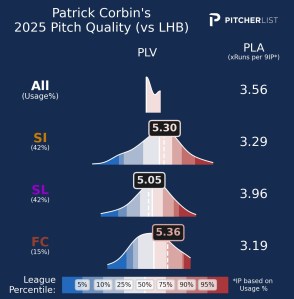
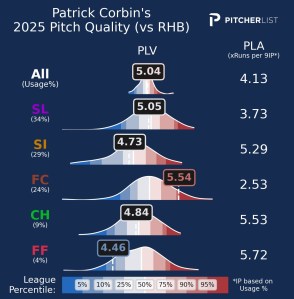
Corbin is over half a run worse against righty hitters than lefties, according to PLA. His overall PLA is 3.98.
The only thing saving Corbin’s ERA right now is that he has not given up home runs at the same rate he had in the past. His 11.4 HR/FB rate is the lowest it has been since 2018. He also has the worst groundball rate of his career at 38%. These are all reasons why his ERA does not match his PLA, his 4.01 xFIP, or his 4.20 SIERA. And while other pitchers may have the stuff to outpitch their metrics, it does not appear Corbin does.
Cade Horton – SP CHC
Cade Horton has pitched well so far in 2025 and has some legitimate upside. He was a high strikeout pitcher all across the minors, but has just a 6.4 K/9 rate in 73 innings for the Cubs. Horton features a sweeper and curveball with Out Rates above league average, and has the potential to turn a few more pitches into effective out pitches. This may not be the year he figures it out, though.
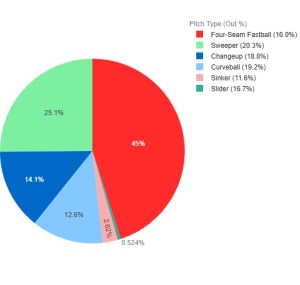
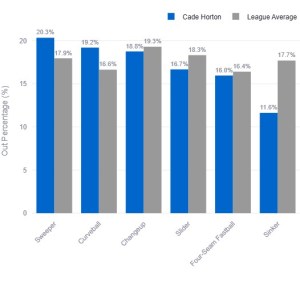
Horton’s curveball and sweeper make up a little over a third of his pitch usage, which means a significant portion of his pitches thrown will provide a low chance of inducing outs. This is especially problematic because his fastball is not a high-quality out pitch, considering it is his most-used offering. Now, if that turns into a higher Out% as the season continues, he could turn into a pitcher I’d like to roster. At the moment, though, he would be on my drop list if another pitcher that I liked more were available.
As far as his curveball and sweeper, PLA actually backs up that those are solid pitches, albeit just barely above league average:
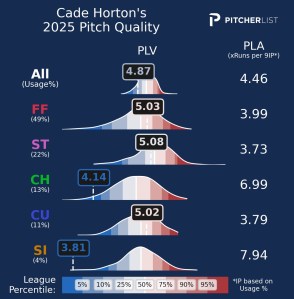
Horton uses his changeup a decent amount, and that pitch quality is far below league average. The same goes for his sinker. This means he does not truly have an out pitch against lefty batters – a pitch that moves away from them. Much like Corbin being better against LHB, Horton is much better against batters who are righties like him.
Also similar to Corbin, Horton features just one pitch with a 20% putaway rate or better – his changeup. His changeup has a 54% whiff rate and a .118 BAA, but its low PLA grade and low Out% are tell-tale signs that both location and sequencing are problems. If he can improve his sequencing and location, he has a shot to be better and reach those high strikeout rates he was used to seeing.
Even if he does improve those things, his upside may be limited as Horton has a notably low HR/9 and HR/FB rate. As those things regress, his ERA is likely to climb. And while some pitchers have stuff as a mitigating factor, Horton is not quite there yet.
Horton’s 4.46 PLA, 4.49 xFIP, and 4.57 SIERA are all warning signs that struggles may be on the way.
More Out% Pitchers to Buy
This will focus mostly on pitchers who may be on waivers in various league sizes, with trade deadlines likely over.
- Bailey Falter
- Andre Pallante
- Jake Irvin
- Drew Rasmussen
- Tanner Bibee
- Matthew Liberatore
- Michael McGreevy
- Taj Bradley
- Miles Mikolas
- Zack Littell
- Noah Cameron
- Slade Cecconi
- Janson Junk
- Mike Burrows
- Andrew Heaney
More Out% Pitchers To Sell
These are pitchers to consider dropping in exchange for players on the waiver wire.
