






As we close in on the end of the fantasy baseball season, league average Out% or Out Rates for each pitch have been mostly set. They still may fluctuate by 0.1-0.2%, but for the most part, we have a clear picture of the best out pitches in baseball, and which pitchers are the best at inducing outs.
At this point, you can use Out% for multiple purposes in your fantasy league such as deciding whom to start or sit, or whom drop and add. Out% is an essential and important tool in analyzing the effectiveness of a pitcher for fantasy baseball purposes. Basically, it cuts through the noise of other stats and simply tells you which pitchers get batters out at the highest rates.
For first-time readers, this article will provide some tips on how to analyze Out%, how you can use it to determine who the best pitchers are at inducing outs, what to look for, and how to make decisions based on Out%.
Check out our app to help track Out%: https://pl-out-percentage.streamlit.app/ – here you can search by pitcher and see leaderboards by pitch type.
You can read more of the intricacies of the stat here, where I reflect on what we learned from Out% last season and how to use it in fantasy, as well as the real-life implications.
For the purposes of this article, we will focus more on how to use this stat for fantasy baseball and how it can help you make fantasy-relevant decisions in-season.
Here is where the league-average Out% stands on each type of pitch as of writing on Saturday, August 16:
- Fastball – 16.5%
- Cutter – 16.2%
- Sinker – 17.8%
- Splitter – 21.2%
- Slider – 18.5%
- Sweeper – 18.2%
- Curveball – 16.6%
- Changeup – 19.4%
A few notable pitchers sit atop the leaderboards for each pitch, including
- Tarik Skubal – Fastball 20.5%
- Chris Bassitt – Cutter 21.7%
- Miles Mikolas – Sinker 25.4%
- Logan Gilbert – Splitter 28.7%
- David Peterson – Slider 26.4%
- Noah Cameron – Curveball 23%
- Sonny Gray – Sweeper 32.8%
- Ranger Suárez – Changeup 26%
For the sake of this article, my analysis will primarily focus on starting pitchers. Currently, the leaderboards (especially fastball and fastball adjacent pitches like cutters) are dominated by relievers because of their small sample size.
Fastball Out% Highlight
Clay Holmes – SP NYM
As a pitcher who has transitioned from a relief role to a starting role this season, the Mets appear to have started limiting Clay Holmes‘ innings. He has pitched into the sixth inning twice since June 13th. This makes him a pitcher to avoid in leagues that reward quality starts, but someone to start in leagues that reward wins. Despite the limited innings, Holmes has some solid stuff that should make him a great fantasy asset down the stretch.
Holmes has tossed under the league average amount of fastballs, but he is elite at inducing outs. It has the third-highest Out% for fastballs overall, and should be a pitch he tosses much more often.
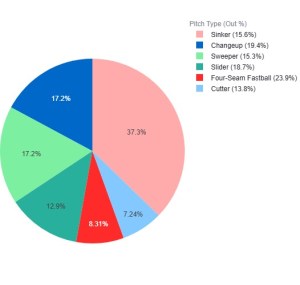
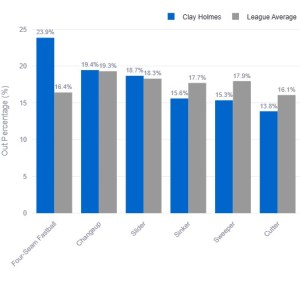
Holmes features a changeup and slider that he uses to get lefty and righty batters out, respectively. Having those weapons as out pitches is great, but having a fastball to get batters out is even better.
Fastballs are typically set-up pitches for breaking or offspeed offerings, so Holmes is able to keep batters honest with his fastball. Batters cannot take a pitch off because he can throw it for outs. Frankly, he should swap his sinker and fastball usage because of how good it is compared to the sinker.
Holmes’ fastball has a .088 BAA, a 21% whiff rate, a 36% K rate, and a 19% putaway rate. All but his fastball’s putaway rate ranks better than the corresponding data points on his sinker.
Keep an eye on Holmes’ innings the rest of the way, but thanks to his fastball, slider, and changeup performing so well, he should be a set-it-and-forget-it pitcher in your lineup.
Out% Pitchers To Buy
Dustin May – SP BOS
Dustin May appears to have already felt the Andrew Bailey effect after his trade to Boston. He tossed a six-inning, eight-strikeout, no-walk gem in his second game for the Red Sox. His sweeper and fastball have looked great this season, and Bailey knows how to get pitchers to lean on their best stuff.
The Red Sox are already making significant changes to Dustin May. His pitch mix over the first two starts
FB 29.7% -> 20.6%
Cutter 29.7% -> 19.6%
Sinker 14.3% -> 22.8%
Sweeper 26.4% ->37.0%Also, the velo was up across the board
👀👀
— Martin Sekulski (@M_Ski22) August 13, 2025
Bailey has increased May’s sweeper usage (his best pitch) and decreased his cutter usage (his worst pitch).
It has clearly helped May, and the good times should continue to roll.
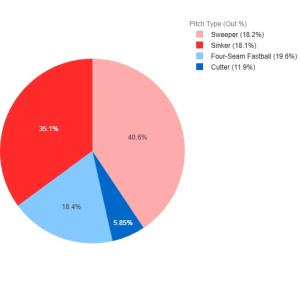
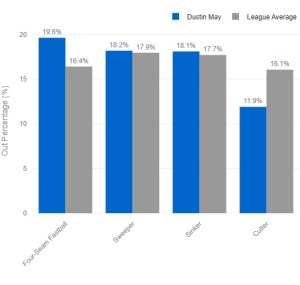
May overwhelmingly uses a fastball, sweeper, and sinker in his arsenal. Occasionally, he throws a cutter, but could do with not throwing it at all. It has a .412 BAA and an Out% far below league average.
May’s 19.6% fastball Out Rate grades as elite, and makes him a pitcher to target, considering he has two other top-notch out pitches. He uses his sweeper and sinker relatively evenly against righty and lefty batters, which means that batters can see any pitch at any time. That makes it difficult to gameplan against, and makes May dangerous to opposing batters.
May’s sweeper is arguably his best pitch. It has his second-highest Out%. It also has a .227 BAA, a 28% whiff rate, a 34% K rate, a 43% GB rate, and a 25% putaway rate. When you can start the pitch outside of the zone and end outside of the zone, while still getting batters to swing, you know you have a good pitch. Take a look at this:
Dustin May, Wicked 85mph Sweeper. 🤢 pic.twitter.com/lCR42hXpc8
— Rob Friedman (@PitchingNinja) August 7, 2025
May has been pounding the zone this season, which has allowed him to fool batters outside of the zone. He has a 55% contact rate on pitches outside of the zone, which is better than his career norm.
The 4.67 ERA looks ugly, but if the trends continue like they have in Boston, May should see his ERA improve. He should be in consideration as a waiver wire target wherever he is available.
Landen Roupp – SP SF
Landen Roupp surpassed 100 innings just once in his career, in the minors in 2022. He experienced some elbow inflammation and landed on the shelf at the end of July. His first game back was a rough outing against the Rays, where he allowed five earned runs in three innings. Still, Roupp’s stuff makes him a prime waiver wire target, and should outweigh any fatigue that may come in the last few weeks of the season.
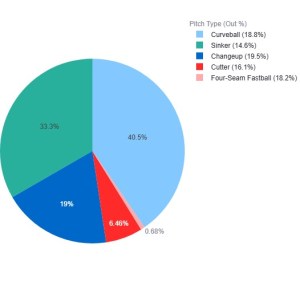
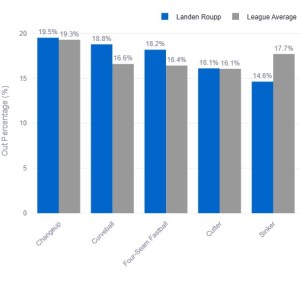
Roupp owns four pitches that rank as league average or better according to Out%, including his changeup, curveball, fastball, and cutter. Even with his sinker being a heavily used pitch, he has a fastball and a cutter that he can toss to work around the deficiencies of his sinker. And similar to Holmes, Roupp should be tossing his fastball more and his sinker less because of how effective his fastball is compared to the sinker.
Roupp’s changeup and curveball have been his best pitches by far. They have .197 and .192 BAAs, plus 30% and 35% whiff rates, respectively. He has leaned on his changeup to induce grounders – it has a 56% GB rate – which has helped him to an impressive 45% GB rate overall. Roupp’s 3.7 BB/9 rate leaves a bit to be desired, but having a pitch like his changeup to induce grounders and double play balls has kept Roupp’s LOB% from plummeting.
Arguably, Roupp’s best pitch overall this season has been his curveball. Its 24% putaway rate is the best of his arsenal, and PLV likes it a lot too:
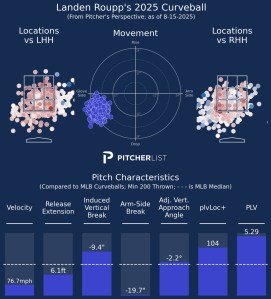
Roupp gets a crazy amount of horizontal break on his curveball, which makes up for the below-average velocity and extension. Among pitchers who have thrown at least 250 curveballs, Roupp’s has the most horizontal break compared to comparable curveballs. It also has the most induced break compared to all righty pitchers that have thrown at least 250 curveballs.
Not only that, but he has tossed it with elite location, which has led to an above-average PLV score. It is no wonder why it has been so effective at inducing outs. Take a look at it from earlier in the season:
Landen Roupp, Filthy 79mph Curveball. 😷 pic.twitter.com/KmCkj9nT3o
— Rob Friedman (@PitchingNinja) July 12, 2025
Roupp should be a primary target for fantasy managers going forward.
Out% Pitchers to Sell
Casey Mize – SP DET
Casey Mize has a 12-4 record, along with a 3.63 ERA, which looks good on the surface. He has wins in three straight games, despite giving up nine earned runs across 17.1 IP. He also has just five quality starts since May 8. On top of that, Mize has just two above-average out pitches that make up less than half of his overall pitch usage.
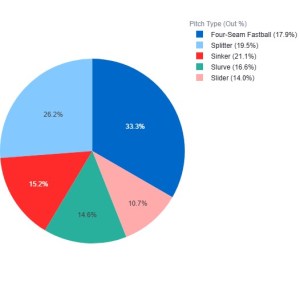
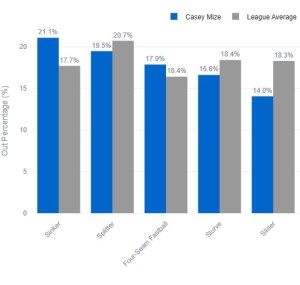
Mize’s fastball and sinker are his two best out pitches. Yes, having a fastball as an out pitch gives a pitcher a leg up on batters. But Mize’s biggest issue is that he does not really have an effective out pitch against lefty hitters. He tosses his sinker mostly to right-handed batters, but it has just an 11% whiff rate and a 14% putaway rate. It’s high Out% likely comes due to groundball contact. Mize’s sinker has a 56% GB rate, a five-degree launch angle, and a .292 BAA. So while it is a good pitch in terms of quality, it carries some risk if his defense is not playing their A-game.
While PLV likes Mize’s sinker, grading it as an above-average pitch, his fastball grades much worse.
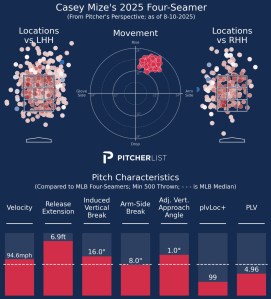
Mize has poor location on his fastball and average movement and velocity, which hurts his overall pitch quality. It also carries a higher xBAA and xSLG than BAA and SLG, and has a below-average Stuff+ of 96. This all suggests his fastball may be outperforming its background data, and we may see the Out% start to dip, which would leave him with just one effective out pitch.
One trend for pitchers across the league has been to attack the zone this season. Zone% has climbed from last season, and the same goes for Mize. His 54% zone rate is the highest of his career. For some pitchers, that allows them to work outside of the zone too, and fool batters with breaking and offspeed pitches. That has not been the case for Mize, whose 62% contact rate on pitches outside of the zone is the worst of his career. It shows that he has not been getting batters to bite on pitches because they know they can wait for his fastball to land in the zone.
Mize also features a splitter and slurve that carry 30% whiff rates, but also .296 and .259 BAAs, respectively. His other pitch, a slider, has a .229 BAA, but only a 17% whiff rate and a 13% putaway rate.
Perhaps Mize could do with better sequencing, but his pitch quality and Out% do not line up on most of his pitches, and that is a worrying sign going forward. His xFIP sits at 3.97 and his SIERA at 3.95, both higher than his ERA. He may be in for some rocky starts in the near future.
Ryan Pepiot – SP TB
Like Mize, Ryan Pepiot’s stats look promising on the surface, but there are many signs that show regression could be on the way. Some of those issues have presented themselves in recent games. Across 28 IP in his last five starts, Pepiot has allowed 18 ER, 24 hits, and nine walks against 13 strikeouts. And while he features three pitches with above-average Out Rates, they make up less than half of his pitch usage.
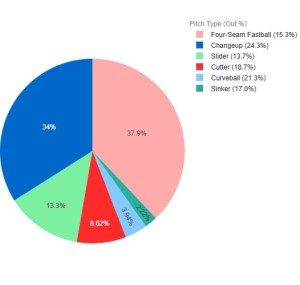
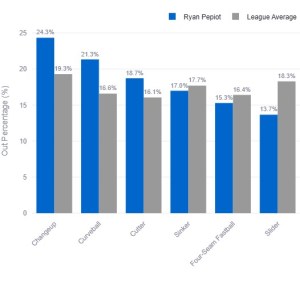
Pepiot’s changeup is his second most used pitch, and owns an elite Out%. He also uses his cutter and curveball around 11% of the time combined, and both also carry elite Out Rates. One issue is that of those three pitches, only his changeup has a PLV grade as an above-average pitch. In fact, it nearly scores as a Quality Pitch.
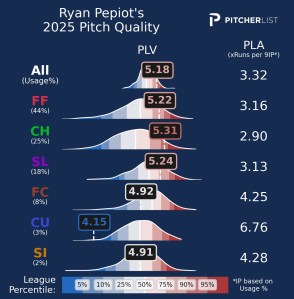
According to PLA data, Pepiot’s fastball, changeup, and slider are his best pitches. Despite that, his fastball and slider have Out Rates below league average. Pepiot’s slider has an incredibly low 8% putaway rate, meaning he may not be throwing it in situations that could lead to an out. It also has a .276 BAA and a .302 xBAA, which shows that batters are picking up on it and could be making even more contact. His fastball should be performing better as an out pitch, but similarly, it could be a sequencing issue where he is using it more as a setup pitch.
On the flip side, Pepiot’s curveball has an elite Out%, but has the worst PLV grade of all his pitches. It has a 75 plvLoc+, and yet a 34% whiff rate. This likely means he has gotten a bit lucky inducing swings and misses with it, especially considering it has a .111 BAA, but a .236 xBAA. In fact, every pitch aside from his fastball has a higher xBAA than BAA.
For Pepiot, he really needs to flip the script. It is two of his least-used pitches, one of which happens to have terrible pitch quality, that are getting outs at the highest rates. That is problematic, especially considering his K/9 rate has dropped from last season, and his GB% is league average. He has allowed a 10% barrel rate and a 42% HardHit rate, while also walking 3.1 batters per nine innings.
If Pepiot does not start using his slider and fastball more effectively, he will likely see his 3.86 ERA climb closer to his 4.03 xFIP or 4.00 SIERA.
More Out% Pitchers to Buy
This will focus mostly on pitchers who may be on waivers in various league sizes, with trade deadlines likely over.
- Bailey Ober
- Eric Lauer
- Janson Junk
- Bailey Falter
- Miles Mikolas
- Michael McGreevy
- Colin Rea
- Michael Wacha
- Andrew Heaney
- Nick Martinez
- Kumar Rocker
- Tomoyuki Sugano
- Shane Baz
- Zack Littell
- Noah Cameron
- Jameson Taillon
- Slade Cecconi
- Cade Horton
- Clayton Kershaw
- Quinn Priester
- Emmet Sheehan
- Michael Lorenzen
- Kyle Freeland
- Jake Irvin
More Out% Pitchers To Sell
These are pitchers to consider dropping in exchange for players on the waiver wire.
- Ryne Nelson
- Eury Perez
- Spencer Arrighetti
- Andre Pallante
- Mitchell Parker
- Luis Severino
- Patrick Corbin
- Eduardo Rodriguez
- Sandy Alcantara
- Jacob Lopez
- Brady Singer
- Taijuan Walker
- MacKenzie Gore
- Logan Allen
- Mike Burrows
- Jose Quintana
- Jeffrey Springs
