






Anyway, here is your Out% update article for the last week of games.
Below, you will find our latest Out rate update. The data has been accumulated over the course of the season and is updated as of Friday, 8/28.
Here are a few basics relating to Out rate:
- Out% = how often a pitcher’s pitch results in an out
- Good Out% = how many of the outs were on batted balls that had an expected batting average below .250, plus strikeouts
- Lucky Out% = how many of the outs were on batted balls that had an xBA of .250 or higher
You can use Out rate to help you make tough decisions about your pitching staff, including whom to drop or add, and whom to trade for or away. Out rate is also a reasonably effective predictive tool, considering its modest “stickiness.” So, pitchers with multiple high Out rate pitches will tend to do better in terms of ERA, especially pitchers with high fastball Out rates.
For a little more info on the basics of Out rate, read this.
For some more specifics on good and lucky outs, read this.
And to view our Out Rate Leaderboard Google Doc, click this.
League Average Out Rates
Below are the league average out rates for each pitch type as of Friday, 8/28. This is how we measure a pitcher’s Out Rate performance.
- Fastball – 16.5%
- Cutter – 16%
- Sinker – 17.5%
- Splitter – 20%
- Slider – 18%
- Sweeper – 17.6%
- Curveball – 16.7%
- Changeup – 19.3%
A few notable starting pitchers sit atop the leaderboards for each pitch (min. 40 pitches thrown, not counting injured pitchers), including
- Hayden Wesneski – Fastball 25.8%
- Nick Martinez – Cutter 22.2%
- Braxton Ashcraft – Sinker 25.6%
- Foster Griffin – Splitter 25%
- Anthony Kay – Slider 29.3%
- Sonny Gray – Sweeper 27.3%
- Tarik Skubal – Curveball 28.6%
- Clay Holmes – Changeup 27%
Fastball Out% Highlight
Parker Messick has made a name for himself this season, after an impressing 39-inning debut in 2025. The signs were there last year hinting towards Messick being an ace, and this year has confirmed that status. Helping him achieve that status are three pitches that all grade above average in Out Rate – his changeup, sinker, and fastball.
His fastball has a 19% Out Rate, which is a huge key to his success. Pitchers using their fastballs like Messick, to get outs, not just to set up other pitches, tend to perform better in ERA. Messick uses his fastball about 40% of the time, so he leans pretty heavily on it, and for good reason. Batters just cannot seem to figure it out – it has a 27% whiff rate and a 33% K rate, along with a 25% putaway rate and a .153 BAA.
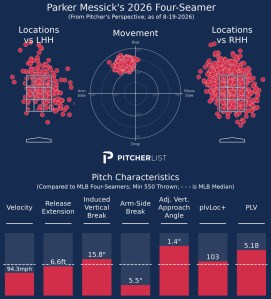
Messick’s fastball gets a good deal of movement, both in vert and glove side break. He also locates his fastball better than average. It grades above average in terms of PLV, and supports why it has been so effective at getting batters out.
Messick also features an elite changeup, with a 22% Out Rate. He uses it heavily against righty batters, and it has been decently effective in two-out counts, with a 21% putaway rate. It is his best strikeout pitch, with a 34% K rate. Messick’s changeup and sinker both tie for his best groundball-inducing pitches, with a 53% GB rate apiece. This is important because he has multiple ways to get batters out. Just take a look here at Messick using his changeup for a strikeout:
Parker Messick, Filthy 86mph Changeup 👌
7th K pic.twitter.com/YSxw0bRaRS
— Rob Friedman (@PitchingNinja) August 8, 2026
If Messick can take another step next season, he could turn into one of the best pitchers in baseball. He is starting to enter that conversation now.
An Out Rate Pitcher to Target
When Clay Holmes hit the IL, fantasy managers seemed to jump ship, and have not quite caught back on, but Holmes should be much more widely rostered. He owns the best changeup among non-IL starting pitchers who have thrown at least 80 of them, in terms of Out%. It also happens to be the fifth best pitch in Out% using the same parameters. Not only that, but he also features a curveball, cutter, and sinker that all rank above average in Out Rate.
Holmes’ changeup arguably is his second best pitch overall, even though it may be his best out pitch. It has generated a .200 BAA, a 29% whiff rate, and an 18% putaway rate. He uses it most effectively, though, to induce grounders, as it has an insane 65% GB rate. This has lead to nearly a 20% Good Out rate, which means all but about 7% of his outs on his changeup have been earned. Here he is using it for two strikeouts earlier in the season:
Clay Holmes, 2Ks in the 5th pic.twitter.com/GuDzaAM8WT
— Rob Friedman (@PitchingNinja) April 29, 2026
Holmes’ curveball has also been lights out, with a 20% Out Rate. He has thrown it 83 times, and it has been hit just once, for a .056 BAA, a 25% whiff rate, and a 45% GB rate. It is also his second best strikeout pitch, with a 40% K rate.
An Out Rate Pitcher to Avoid
Foster Griffin started the season on fire, but he has struggled of late as some of his stuff has lost its luster. Several of his pitches have dipped below league average in Out%, including his sinker, fastball, curveball, sweeper, and changeup. Only his cutter and splitter have maintained an Out% above league average, with his cutter being his most used pitch, and his splitter his least used pitch.
Griffin’s 3.21 ERA is not particularly concerning on the surface, but he has a 3.96 ERA in August, and only made it through the sixth inning once during the month. His xFIP sitting at 3.81 and a 3.87 SIERA suggest that this perhaps is not the worst that it could get for Griffin, and fantasy managers should beware.
Griffin’s above average out pitches – his cutter and splitter – are only moderately helpful for him for a few reasons. He uses his splitter only 6% of the time. So, even though it has a 25% Out Rate, he does not use it enough for it to matter. On the other end, his cutter earns his heaviest usage at 32%, but he does not use it in two-strike counts enough to get batters out. It has just a 15% putaway rate, and has just a 14% K rate. It has lead to some grounders for Griffin, with a 44% GB rate, but that has not helped him enough. If he was using it more efficiently, the 19% Out Rate on it would be more impactful, or even inch higher.
His changeup, sweeper, fastball, curveball, and sinker make up over 60% of the rest of his pitch usage, and those are all pitches that induce outs at a below average rate. That is a huge problem. Just take a look at his pitch quality data:
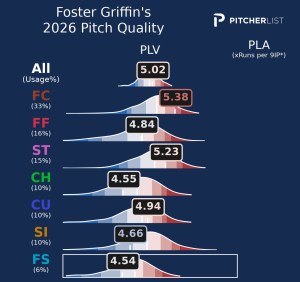
His best pitches are his near-quality-pitch cutter and his sweeper. His sweeper has also performed well by standard metrics like whiff rate and putaway rate (31% and 23% respectively), but it sits a tick below league average in Out Rate because batters have still been able to make contact with it often enough.
If he adjusted his pitch mix to lean on his splitter more often, and his cutter more often in two-out counts, he could reverse course and finish strong.
Other Out Rate Pitchers to Buy/Add
- Anthony Kay
- Kyle Leahy
- Zac Thornton
- Randy Vasquez
- Keider Montero
Other Out Rate Pitchers to Sell/Drop
