





Welcome to the PLV Power Report! Here, we examine hitter performance by utilizing Power+, a PLV+ metric that indexes a player’s power based on the characteristics of the pitch, i.e., count, location, velocity, induced vertical break, height-adjusted vertical approach angle, and other factors. Essentially, we’re searching for players with upside who are adding power based on the expectation of the individual pitches they see.
For example, say a hitter hits a well-located fastball on the outside corner that might typically coax a weak line drive, but instead, they belt a home run the opposite way; they’ll get a much better power grade for that outcome. Conversely, if that hitter sees a hanging changeup over the heart of the plate, or another pitch that would normally be crushed, and instead pops up to short, they’ll get a much lower score for the outcome. The power metric is unique because it provides a more intuitive way to assess player performance by accounting for the quality of each pitch they see. In other words, it’s a good way to check if a player is over- or underperforming by adding context. Note that Power+, like PLV+ metrics, is normalized to 100 and generally becomes more meaningful after around 75 BBE (batted ball events).
If you’re new to the PLV metrics, you can find Nick’s primer here.
First and foremost, I hope you were able to pick up some useful information from my ramblings on the PLV Power Report this year. With that, we’ll wrap up the 2025 season by reviewing the top Power+ performers at each position. I’ll also pick a breakout player at each position next year. I should note that I’m not considering next year’s rookie class, but focusing on players whom we saw this season. Without further ado, let’s swing for the fences one last time.
Catcher
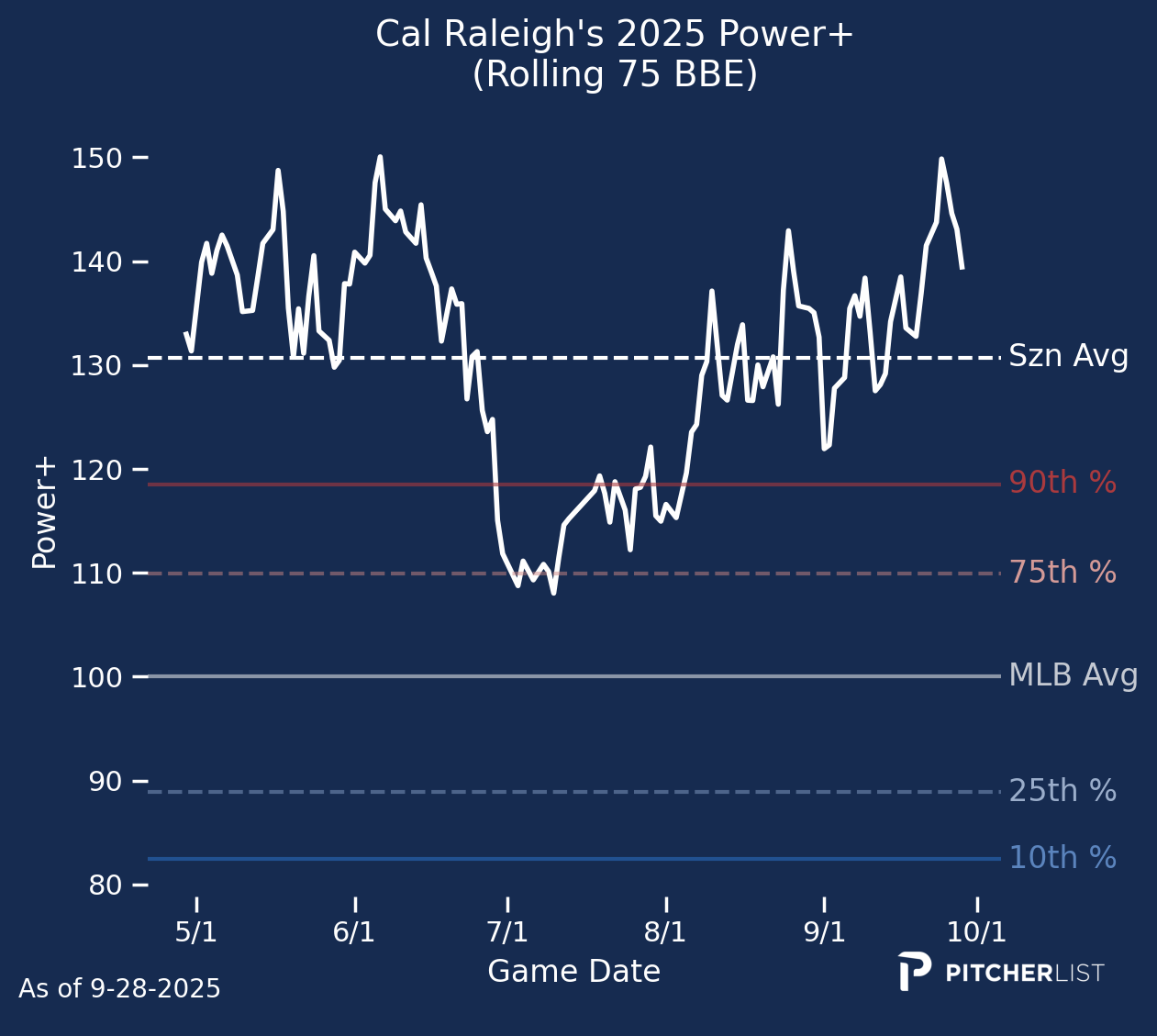
Cal Raleigh | 131 Power+
Runner-Up
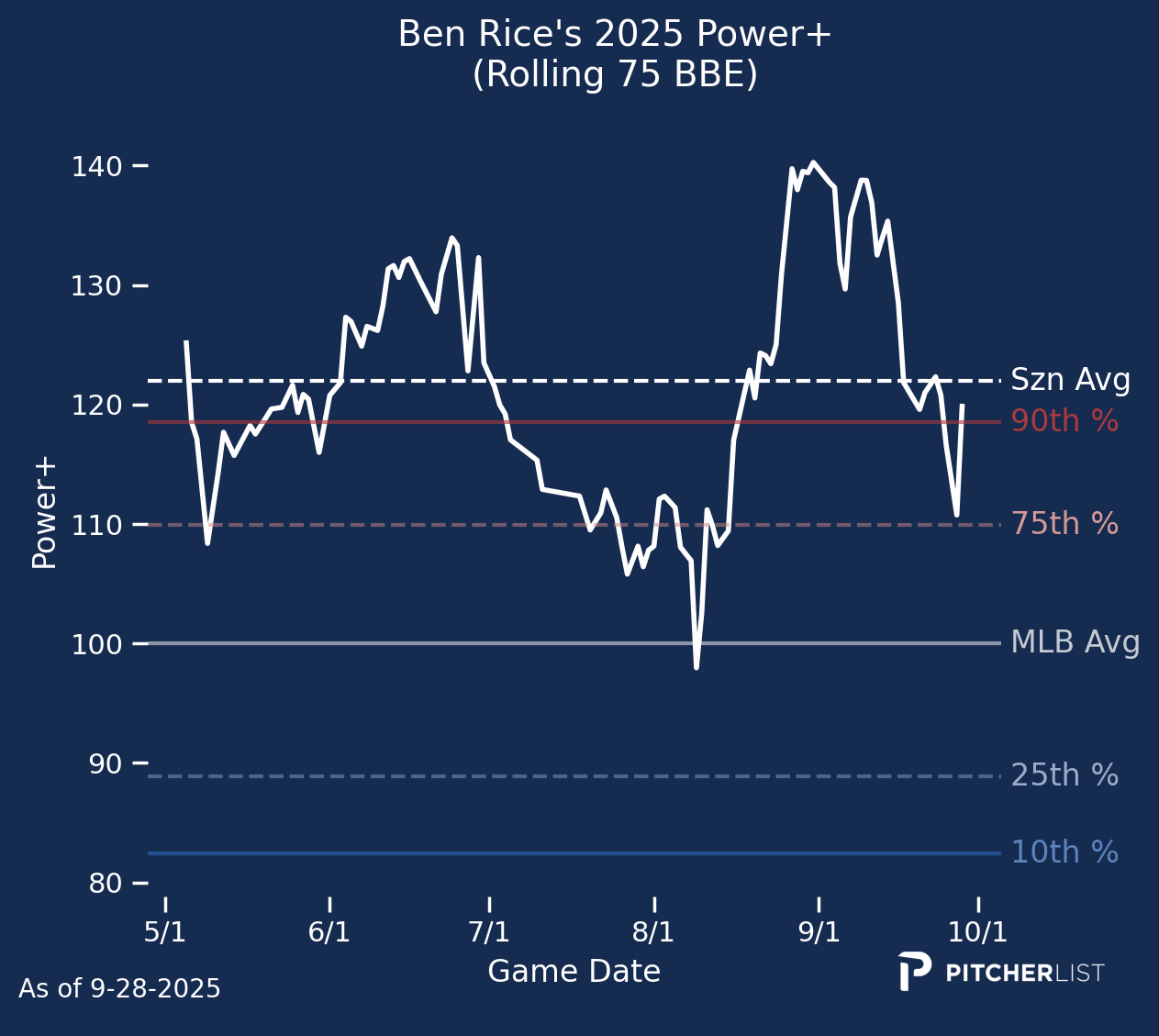
Ben Rice | 122 Power+
Win, lose, or draw, Cal Raleigh had a season for the ages. He bested Mickey Mantle’s 54 home runs for the most by a switch-hitter in a single season. And he hit 49 of his 60 while catching, besting the 42 Javy Lopez hit in 2003 for the Braves. His 161 wRC+ ranked fourth among qualified hitters. And he led the AL with 125 RBI. Save for a brief dip around the midway mark, his power was breathtaking.
Ben Rice busted out with a 133 wRC+, which would rank second among qualified catchers, though that would be misleading since he only started 26 games behind the dish. Regardless, he had an uneven season, going ice-cold in June, before ending the year on a high note; the fluctuations might have you scratching your head a little. What do we do with this guy? But worry not, PLV loves him. If you have lingering doubts, consider his 122 Power+ and 135+ Process+ while knowing he’ll likely be hitting in front of or behind Judge against right-handers. That sounds pretty good to me.
Potential Breakout
It has been said a bunch already, but it seems like, for the first time in a while, there are quite a few catchers that you can get excited about. Rookies Agustín Ramírez (107 Power+) and Drake Baldwin (107 Power+) were fantastic. Alejandro Kirk (107 Power+) has unique batting average upside, and I think he has another level to reach; he’s still only 26 years old. Gabriel Moreno (107 Power+) missed much of the year, but showed juice, too. There are up-and-comers Samuel Basallo, Carter Jensen, and potentially Moisés Ballesteros as well.
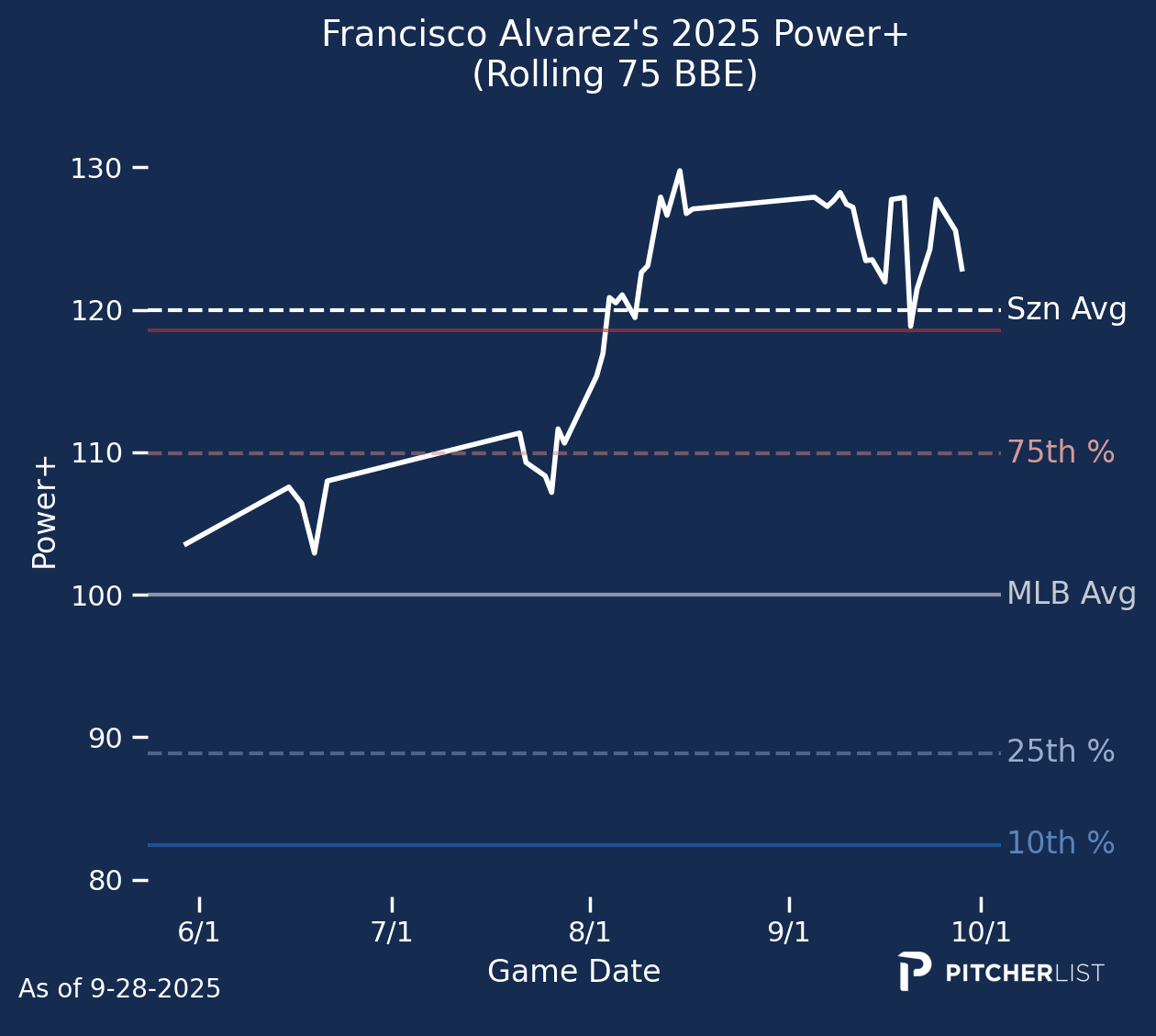
But I’ll try and pick one. I know what you’re thinking. You think I’m going to pick Kyle Teel because of the cover. Nope! I’m going to throw a curveball and highlight someone who has a very similar profile to the White Sox rookie, and that’s Met catcher Francisco Alvarez. First, Teel makes a ton of sense as an impending breakout; he has the pedigree and should also get extra at-bats at DH while occupying a prominent spot in the White Sox lineup. However, I think Alvarez might be a little more overlooked because he’s been around longer, and you know, post-hype fatigue, and all.
Teel has the edge in context-neutral runs added (Results+), but they were otherwise pretty similar last year. If we are comparing just their home run ceilings, they were more or less neck and neck. They were nearly identical in wRC+ as well, with 125 for Teel and 124 for Alvarez, both in just under 300 PAs. What I like especially about Alvarez is that we saw his potential just two years ago when he banged 25 home runs as a 21-year-old rookie. A UCL injury ended his season prematurely, but there’s no mistaking it: Alvarez was making a ton of noise. If he keeps it up, I think he has an outside shot at leading NL catchers in home runs.
I want to mention Willson Contreras quickly, as his losing catcher eligibility will send him tumbling down draft boards. However, his 124 Power+ has my bargain senses tingling.
Second Base
Brandon Lowe | 120 Power+
Runner-Up
Jazz Chisholm Jr. | 115 Power+
It feels like we didn’t hear Lowe’s name too often this year. Or maybe my perception is off. Either way, he had a terrific bounce-back season, reaching 500 at-bats for the first time since 2021, and he blasted 31 home runs, eight away from his career-high while tying Chisholm Jr. for the most among second basemen. The at-bats were a surprise, but the production wasn’t, considering Lowe showed great last season with a 125 Power+.
I think Jazz did exactly what most people expected him to do in his first full season in the Bronx. You are right, I should amend that; becoming the third Yankee to go 30-30 is no small feat. Still, we knew he always had a ton of talent. You have to think it must have felt a little different for him, not being the focal point like he was in Miami, and he took advantage of good opportunities with pitchers dialing in on Judge and Stanton. OK, that’s a little bit of a narrative on my part. Either way, it was a terrific showing from Jazz, and with his Power+ having jumped from 105 to 115, the show should continue without a hitch in 2026.
Potential Breakout
Colt Keith slashed a modest .256/.333/.413 across 468 PAs. It wasn’t the breakout some hoped for as Gleyber Torres (113 wRC+) and Spencer Torkelson (118 wRC+) pushed Keith into a strict platoon. However, his 111 Power+ hints at the thump that made him a big prospect. The Tigers thought enough about Keith to sign him to a six-year extension before the 2024 season, so I wouldn’t be terribly surprised if they give the 24-year-old a chance to grow into a more prominent role in year three.
Shortstops
Corey Seager | 128 Power+
Runner-Up
Zach Neto | 124 Power+
Seager’s 128 Power+ mirrored 2024. He is a little unconventional for fantasy, given that shortstops typically carry stolen base equity, but, at the same time, it sometimes causes him to slip in drafts. Either way, he undoubtedly remains the best overall hitter at the position.
Neto followed last year’s 23-30 output, going 26-26 in about 50 fewer PAs. It was a pretty exciting season for Neto, as we saw his Power+ jump over a standard deviation, from 106 to 124. He struck out a little bit more often, but this version of Neto is a legitimate threat for 30 home runs.
Potential Breakout
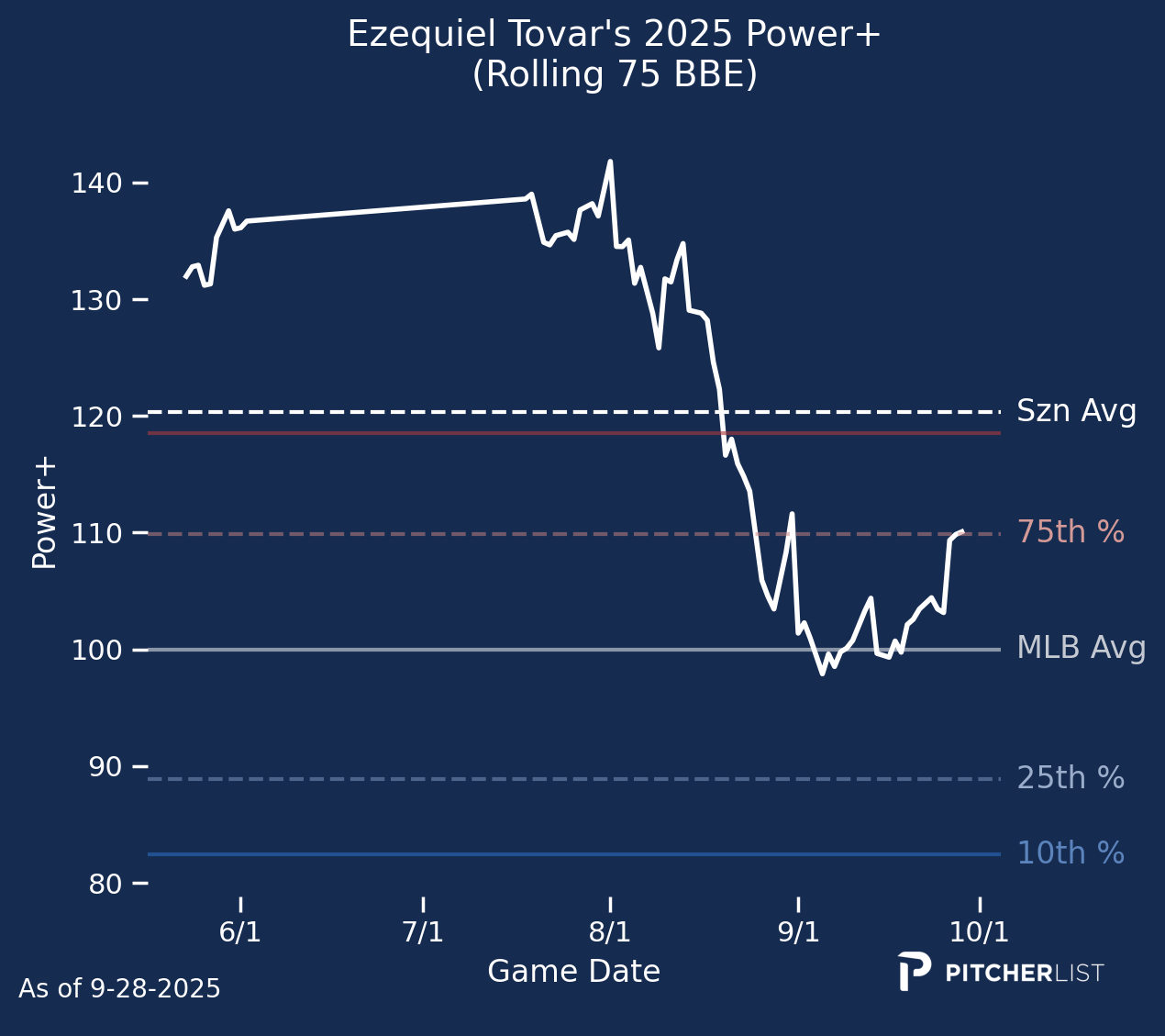
After banging 26 home runs in 2024, Ezequiel Tovar looked like an interesting gamble heading into year three. However, he hit just nine home runs in about half a season. The unexciting results and his being on the Rockies will send him tumbling down draft boards. However, Tovar’s 118 Power+ suggests better days ahead. As you can see, he flashed good power early, but faded late. He still has a ceiling worth going after.
Outfield
Aaron Judge | 152 Power+
Are you surprised? Judge led baseball with a 202 wRC+ and a .331 batting average, the latter 20 points ahead of Bo Bichette and Jacob Wilson. We also saw the reigning AL MVP cut his K rate to a career-low 23.6% supported by a small bump in Contact Ability+ from 92 to 95. There’s not much you can say. Just an all-time season from one of the best right-handed hitters any of us will ever see.
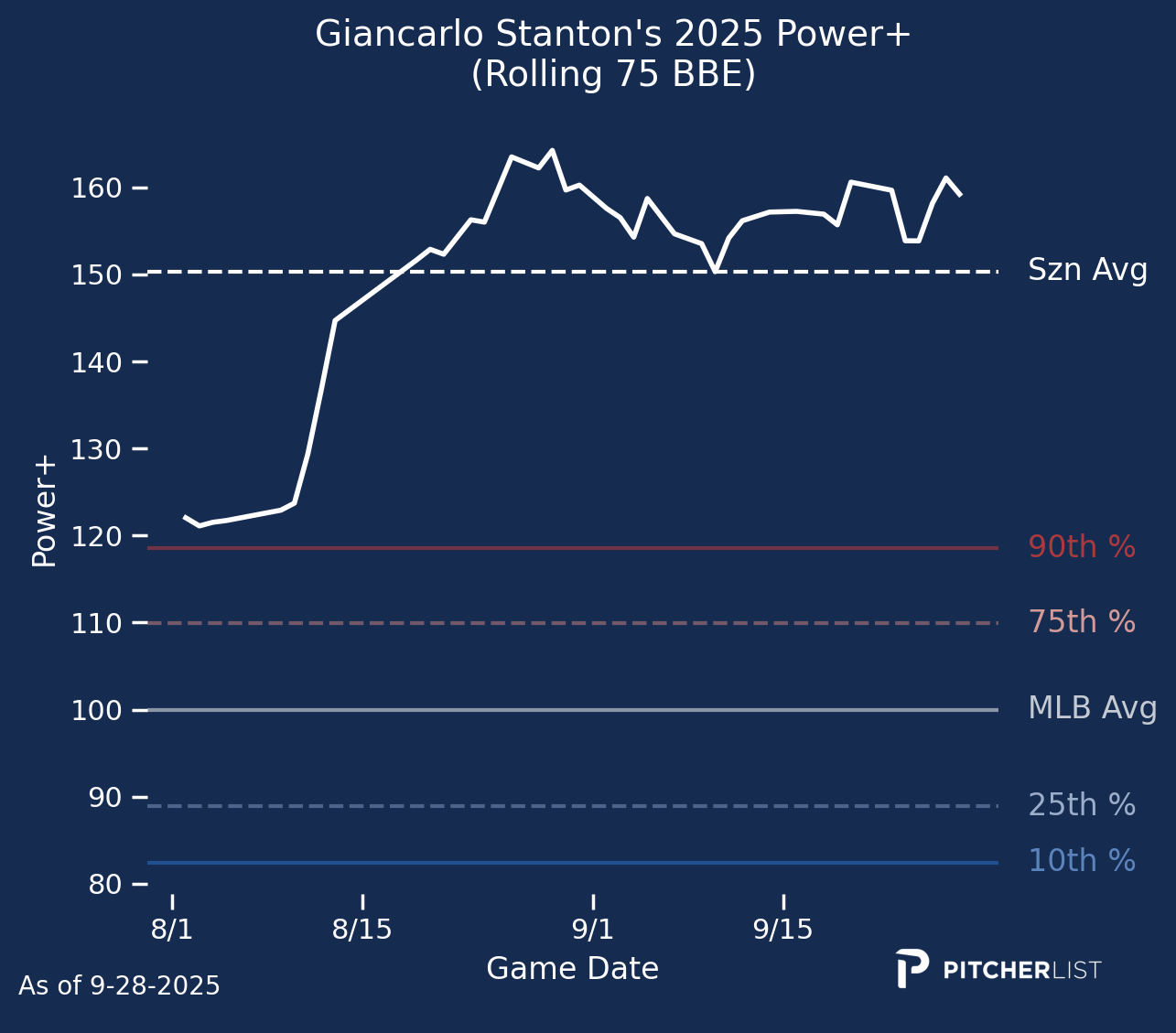
Giancarlo Stanton | 139 Power+
Stanton seemed like almost an afterthought; he entered the year on the IL with significant elbow injuries while also having hit just .212 over his previous three seasons combined (1,326 PAs). But give the man credit; he returned and started 20 games in the field, something he hadn’t done in two years. And he wasn’t just reasonably productive, like you might expect from a borderline Hall of Famer on the back end of his career, but he was his vintage self; his 158 wRC+ matched the mark from his 2017 NL MVP season. The only blemish was a career-high 34.2% K rate.
Juan Soto | 138 Power+
Remember that slow start? Soto ended April, hitting .241 with three home runs. So much for that! He ended 2025 with 43 home runs, two more than his lone season in pinstripes, and channeled his inner Ricky Henderson with 38 stolen bases. What!? Soto’s 138 Power+ was actually down compared to the 149 he posted in 2024. This probably isn’t worth much, but I always find park factors interesting; according to Savant, he would have hit 36 home runs had he played all of his games in the Bronx and 41 had he played all of them in Queens. Life is a range of outcomes.
Runner-Up(s)
Kyle Stowers | 130 Power+
James Wood | 129 Power+
Riley Greene | 129 Power+
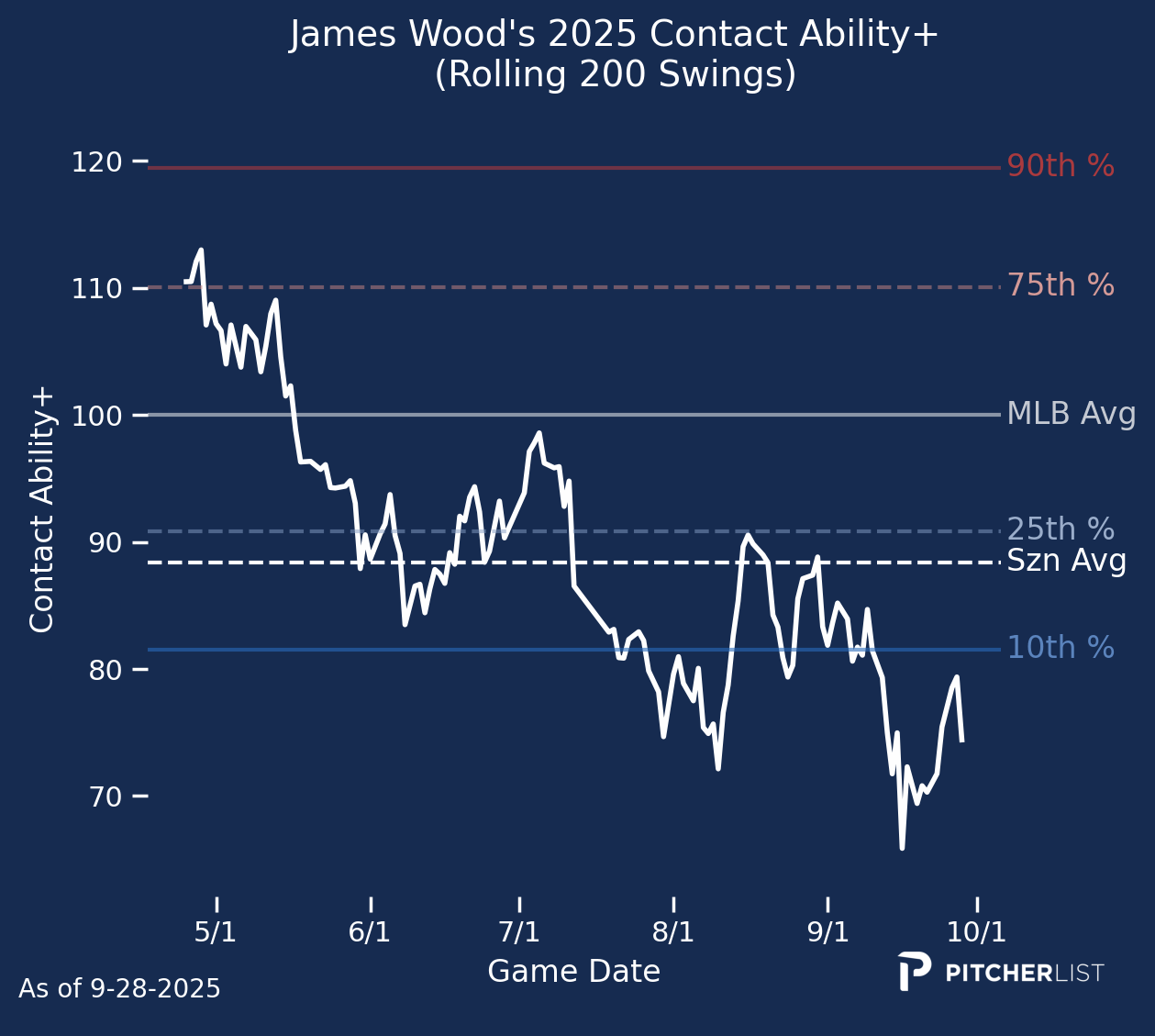
Three of this year’s biggest breakouts —Stowers (+11 Power+ vs. last year), Greene (+9), and Wood (+8) —unsurprisingly, all showed notable gains. Perhaps equally as unsurprising were their issues with swings and misses. My guess is that Wood is the most polarizing of the three, considering how his results fell off a cliff in the second half (93 wRC+) while pushing for the single-season strikeout record. I think, for the most part, you have to view Wood’s season as a success, considering he just turned 23. Still, he undoubtedly has work to do this offseason to prove he can push back, so to speak, against his late-year struggles.
And, yes, in case you were wondering, post, post (post?) hype breakout Jo Adell was not far behind with a 127 Power+.
Potential Breakouts
First and foremost, I’ll cross off Roman Anthony because he’s inevitable, and like we briefly discussed last week, he was absolutely on fire. Injuries stink.
Let’s consider Daulton Varsho. He missed more than half the season, first while recovering from shoulder surgery, and later with a strained hamstring, so there’s a chance he might slip under the radar. The former D’Back hit 20 home runs in only 271 PAs, and his 123 Power+ indicates it was not a fluke. If he brings that sort of thump to the table again, he could vie for his first 30-home run season and be next year’s Trent Grisham.
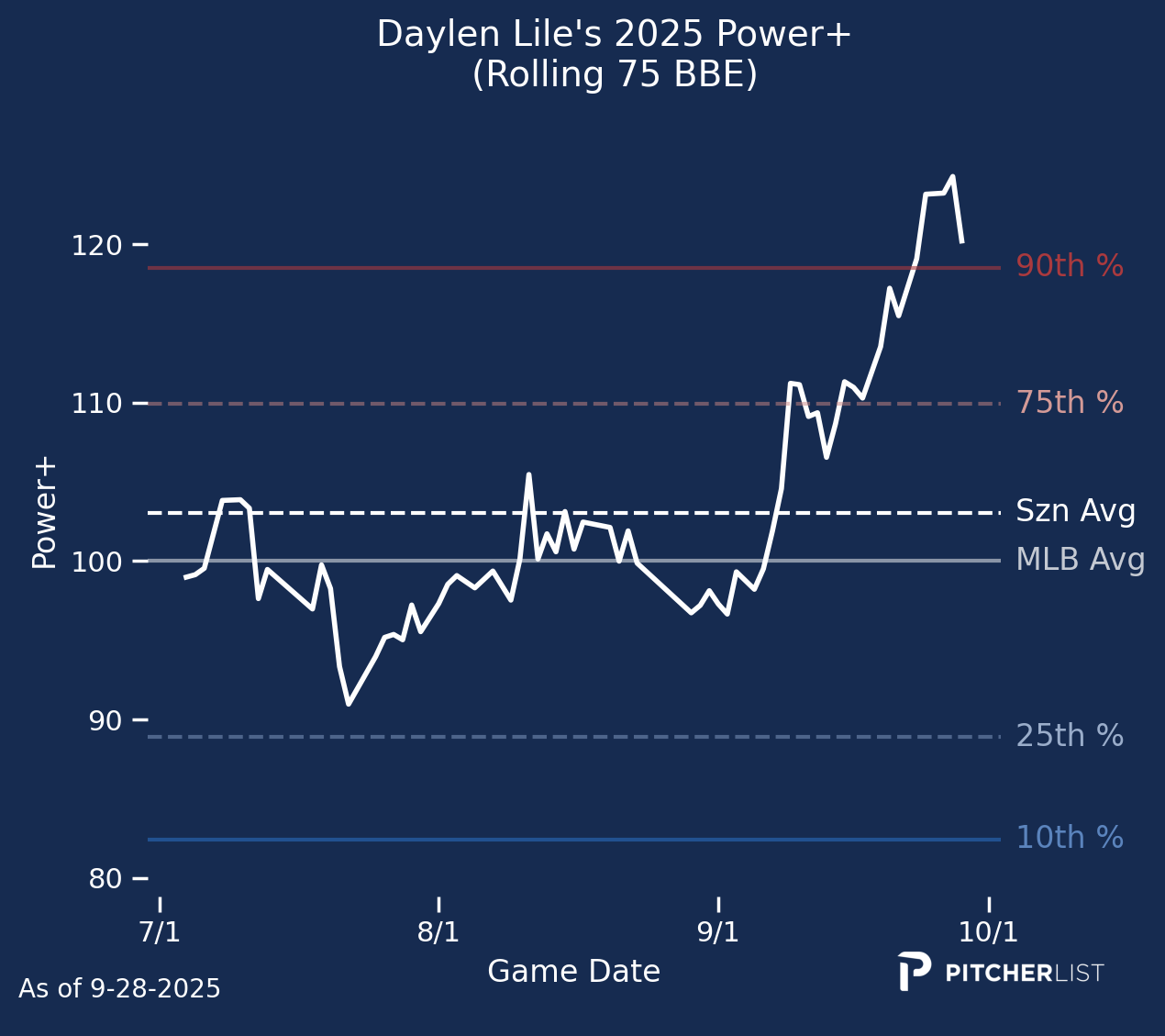
Daylen Lile is another interesting dice roll. Lile emerged as a late-season hero, slashing an impressive .299/.347/.498 with a 132 wRC+; the latter ranked fifth among qualified rookies. His 102 Power+ pales in comparison to Varsho. However, the 22-year-old lefty brings a more well-rounded skill set, with batting average upside (109 Contact Ability+) and some stolen base ability. He also made pretty decent swing decisions (109 DV+). Lile might slip through the cracks, considering he didn’t really take off until September or so, and, you know, he’s on the Nats. Nonetheless, he ended the season riding high. All-in-all, there are plenty of reasons to believe he is more than a September flash-in-the-pan.
Wilyer Abreu impressed last season, hitting 22 home runs across 115 games, but the full-fledged breakthrough fell incomplete, thanks to two stints on the IL; the second sidelined him until the last week of the season. Regardless, his 118 Power+ and 117 Process+ lend credence to the 119 wRC+ he produced in the first half, and I think he becomes more of a household name next year with a chance to approach 30 home runs across a full season of work.
Admittedly, Abreu didn’t have great results against same-handed pitching (85 wRC+ vs. LHP), so there’s a chance he could lose some at-bats. But it was a very short sample of 68 PAs, and he only struck out at a 20.6% clip. What I also really like about Abreu is that he’s a sensational outfielder, and that is a very good way to earn additional at-bats.
Potential Bouncebacks
Mike Trout reaching 550 PAs but finishing with a career-low 120 wRC+ was probably the opposite of what most people expected. The three-time MVP’s bottom line was ultimately marred by a career-worst 32% K rate supported by a dip in Contact Ability+ from 94 to 79. I can’t dispute that it is a huge red flag, and perhaps it’s a reflection of injury/age taking its toll. Still, if you’re willing to take a shot on him recovering some lost contact, his 124 Power+ indicates his home run ceiling remains Rookerian (yes, it’s a new word; I made it up!).
Jackson Merrill stealing only one base was odd. Maybe it had something to do with him not being 100 percent, having spent time on the IL with ankle and hamstring issues. Or maybe he just isn’t much of a base stealer. Either way, his 123 Power+ indicates upside that hasn’t disappeared despite last year’s disappointing results.
Third Base
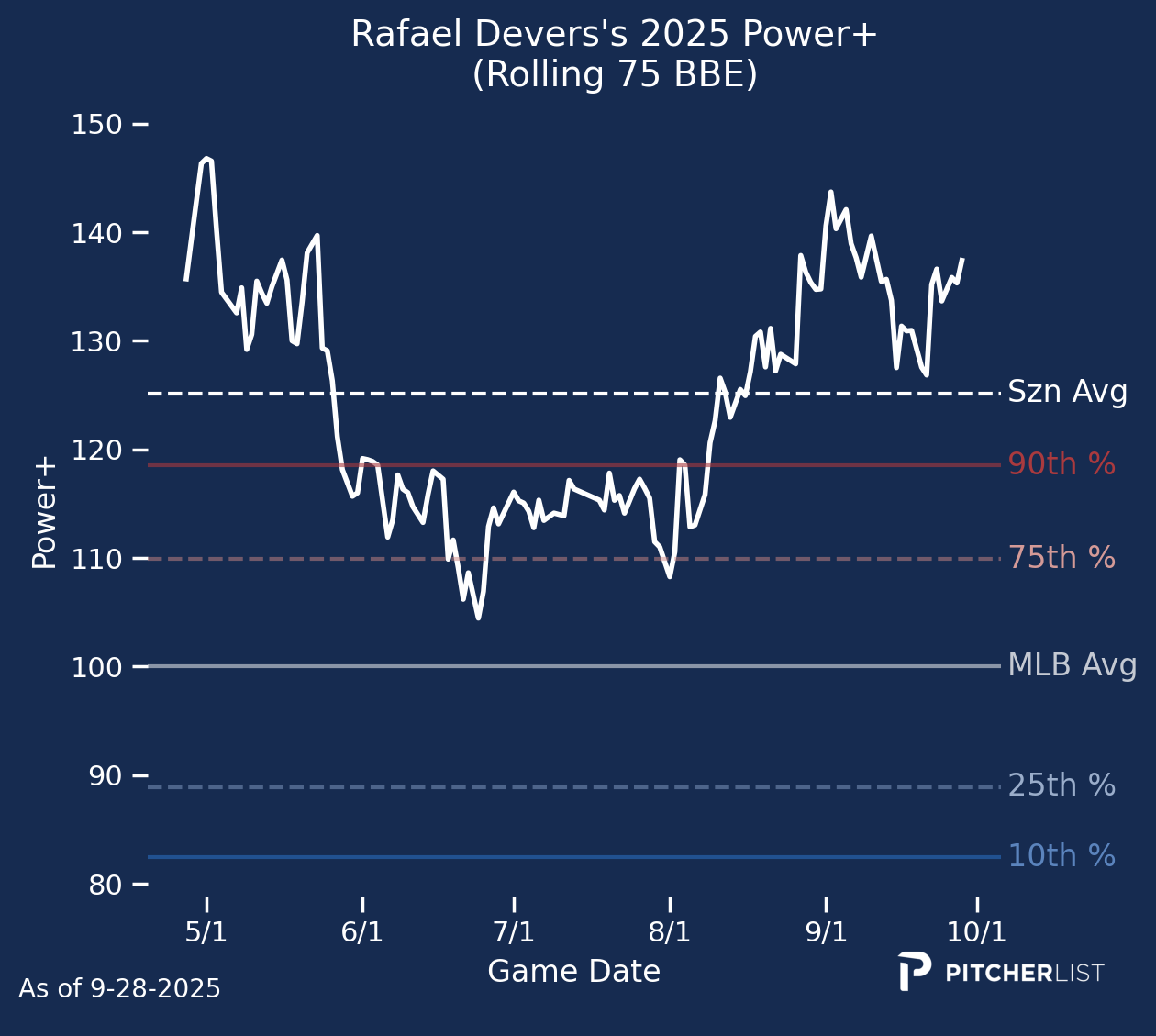
Rafael Devers | 125 Power+
Runner-up
Austin Riley | 121 Power+
No surprises here. Devers didn’t tally great results with the Giants, hitting .236 with an .807 OPS after being traded. Still, his rolling chart showed he ended the year hitting the ball just like we have to come to expect.
Riley, meanwhile, makes all the sense in the world as a buyback after an injury-mired year.
In case you were wondering, breakout star Junior Caminero’s Power+ of 117 ranked fourth among third basemen, trailing Yankee nine-hole hitter Ryan McMahon’s 118. Hey, could McMahon finally hit 25 home runs!? Maybe. But at what cost?!? Look at his Contact Ability! No, you can’t make me. Perhaps we should check his bat for holes.
Potential Breakout
Lost amidst the Mets’ tragic collapse was the burgeoning bat of their left-handed hitting third baseman, who entered the year as an afterthought. That would be Brett Baty. The soon-to-be-26-year-old slashed .291/.353/.477 with a 135 wRC+ across 172 PAs following the ASB. His 100 Contact Ability+, 111 Power+, 105 DV+, and 113 Process+ are what you like to see. His swing decisions in particular trended up in a big way. You can kind of sense that he was really getting comfortable. And then he got hurt on the final Friday of the season. Life ain’t fair. Still, I’m very bullish about Baty. And, yes, he did lose at-bats against lefties at times. However, he wasn’t all that bad against them, hitting .249 with a 94 wRC+ and a 22.9% K rate across 83 PAs.
Designated Hitter
Shohei Ohtani | 155 Power+
Runner-up
Kyle Schwarber | 146 Power+
Ohtani finished atop the leaderboard, just a few points ahead of Judge. Like Hunter Greene and Connor Phillips experienced Tuesday night, the soon-to-be four-time MVP’s power is on another planet.
Kyle Schwarber, meanwhile, had a pretty decent season, finishing two home runs shy of matching Ryan Howard’s single-season Phillies’ record. Sure enough, his Power+ surged ahead ten ticks this year, from 136 to 146.
Breakout
Designated hitter is a weird spot to pick a breakout, so I’ll cheat and say Marcell Ozuna pulls an Undertaker. Yes, Ozuna’s Power+ fell two standard deviations from 139 to 109. The drop was so steep that you have to wonder how much the hip injury affected him. Regardless, he had some things working in his favor, including a 120 DV+ and a 117 Process+. There’s enough here to make me think he can still be an impactful bat. Now, where he ends up is another story.
First Base
Nick Kurtz | 141 Power+
Runner-up
Pete Alonso | 131 Power+
No surprises here; we gushed over Kurtz last week. After slashing a ridiculous .290/.383/.619 as a 22-year-old rookie, we might see Kurtz as the second first baseman off the board after Vladdy. That could be a mistake, considering Alonso comes without the risks in whiffs (100 Contact Ability+ vs. 74 Contact Ability+). But at the same time, I get it.
Potential Breakout
I’m cheating here with Jonathan Aranda; he already broke out this season, slashing a sublime .316/.393/.489 across 422 PAs before being done in by a wrist injury on a collision at first base. Still, his 130 Power+ suggests he has a ceiling greater than the 14 homers he delivered this past season. The Rays love to platoon, so Aranda might lose some at-bats, but I think he has a shot to assert himself as a top-ten option.
Adapted by Kurt Wasemiller (@kurt_player02 on Instagram & Threads
@kuwasemiller.bksy.social on BlueSky)
