





The stove is heating up, and we’re already seeing signs that a busy offseason is upon us. The Cubs surprised the baseball community by letting their ace, Shota Imanaga, walk away from a team-friendly team option. Jack Flaherty, Alex Bregman, Pete Alonso, and more all entered free agency as well. While they go through the process of finding new teams, MLB decision-makers are working to fill the holes on their roster to gear up for a potential 2026 playoff run.
Dynasty managers should be doing the same. The offseason serves as a prime time to identify areas for improvement and an opportunity to work out deals with fellow managers to fill them. In any trade, there is a delicate balance of risk versus reward. These players are more on the “risky” side, and are equally likely to be bench players as they are All-Stars (well, except one). Fantasy managers considering making a move for one of these players should proceed with caution, but taking the risk could pay off big time next season.
MLB Risky Dynasty Trade Options
MLB Stats: .213 AVG | .629 OPS | 19 HR | 2 SB | 30.8% K% | 5.3% BB%
O’Hoppe wasn’t the most desirable asset entering 2025. He was the 21st-ranked catcher per NFBC’s ADP, behind unproven backstops like Kyle Teel (#14) and Carter Jensen (#18). Still, he entered the season as Los Angeles’ clear #1 option at catcher, and was coming off a season in which he hit 20 home runs with a 2.1 fWAR. Fantasy managers could be forgiven for taking a flyer on him, despite the clear bat-to-ball issues (29.7% K%) and lack of defensive prowess. Instead of paying dividends, O’Hoppe rewarded those who had faith in him with the third-worst fWAR by a catcher in 2025, posting a -0.8.
In the first few months of the season, it looked like O’Hoppe was in the midst of a breakout season. Between Opening Day and May 31st, the 26-year-old backstop launched 14 homers and had a 122 wRC+. Even then, the warning signs of regression were there. Over those two months, O’Hoppe struck out nearly 35% of the time, with a walk rate under 5%. Four of those home runs came in the hitters’ haven of Sacramento over three days. Another four came in four straight games, which was followed by nearly three weeks without another blast. That streakiness leaked into his overall production. After that strong start, he hit just .155 in 18 June games.
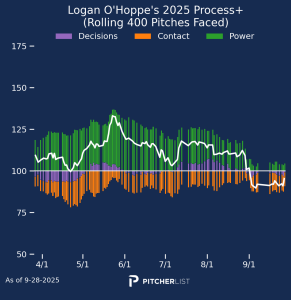
Despite the streakiness, O’Hoppe’s Process+ sat above the league average mark for most of the season (that peak was likely during the aforementioned A’s series). Finding consistency will be key going forward for O’Hoppe because he has the tools to be a productive MLB hitter. His 90.9 mph AVG EV, 13.3% barrel rate, and 46.9% Hard-Hit rate are all in the 70th percentile or higher. His 72 mph swing speed is two full marks higher than it was during his 2023 campaign, which could lead to O’Hoppe eclipsing the 20+ mark next season. The only thing limiting that power is the contact ability. His 69.9% contact rate is low, and isn’t helped by his near-16% swinging-strike rate. Fixing a swing to make more contact is easier said than done, but it’s a necessary move for O’Hoppe to leap to consistent production.
On paper, the Angels have built a decent young core. Zach Neto looks like a franchise cornerstone, and Nolan Schanuel put together a nice season. Even Jo Adell, who had once been cast off as a bust, turned a corner and hit 37 homers in 2025. With Christian Moore and Denzer Guzman poised to join the fray, six starters next year will be 27 or younger. O’Hoppe should still make it into the lineup, but his seat is getting increasingly warm. If O’Hoppe had a strong defensive acumen to fall back on, his issues at the plate would be more excusable. That said, if you want to stick as an MLB catcher, you have to either hit well or field well. O’Hoppe, as of now, does neither. However, if adjustments can be made that keep the swing-and-miss in check, the power he possesses could vault him into being a productive bat. O’Hoppe isn’t a “must-buy” going into 2026, but he has the potential to be a top-15 catcher if his offensive production rebounds.
MLB Stats: 88 IP | 3.07 ERA | 22.0% K% | 7.7% BB%
There’s been a lot of buzz around baseball regarding certain pitchers making the switch from the bullpen to the starting rotation. Most of that buzz has revolved around the Padres’ plans for Mason Miller and/or Adrian Morejon, but it could prove to be a leaguewide trend. Garrett Crochet, Michael King (more on him later), and Clay Holmes are all recent examples of successful bullpen-to-rotation transplants, and more names are rumored to make the transition every offseason. While his name may not immediately come to mind, Fangraphs is currently projecting Kyle Leahy to be the fifth starter in St. Louis in 2026.
On paper, it doesn’t make much sense. Leahy hasn’t been a full-time starter since 2022, and it wasn’t pretty (5.29 ERA in 28 games). Since 2023, he’s operated primarily out of the bullpen and has grown into a solid weapon for the Cardinals (3.64 ERA in 98 appearances). However, Leahy’s last appearance of the season was as the opener in a bullpen game. He went three innings, allowing just one hit en route to retiring the minimum with a strikeout. That alone is not enough to be considered an indication that he’s going to start next year, but it’s easy to imagine his skillset translating to the rotation.
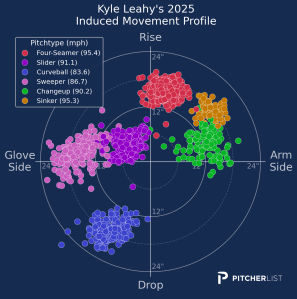
Leahy’s pitch mix is unique for a one-inning leverage arm. His arsenal is anchored by a solid fastball (5.03 PLV, .358 xwOBA), which is used against both sides of the plate. From there, he uses two different pairings of pitches based on the handedness of the hitter. Against righties, the slider (5.32 PLV) and sweeper (5.42), separated by five miles an hour, and 10 inches of horizontal break. For lefties, the curveball (4.72) and changeup (4.96) are the main secondaries. Leahy also mixes in a sinker (13% usage vs. RHH) to bring that mix to four pitches. The curve generates the best results of the bunch (.141 AVG, 35.1% Whiff), but there’s room to grow with all of the offerings.
The versatility of the pitch mix makes Leahy an intriguing weapon. The Cardinals could keep the same attack plans and optimize them towards a starter’s usage, or adjust the plan to make Leahy more unpredictable. Leahy’s familiarity with the starting role, as well as that versatility, could make him a contender for a rotation spot next season. Leahy’s floor is a high-leverage bullpen arm for the Cardinals. His ceiling is a difference maker of a starter for a St. Louis team looking to leap back into contention.
MLB Stats: 63.2 IP | 3.96 ERA | 30.1% K% | 9.4% BB%
After a disastrous 2024 season that saw Detmers post a 6.70 ERA, the second-worst mark in the majors (min. 80 IP), the Angels moved their former #10 overall pick to the bullpen for 2025. After making some adjustments to Detmers’ pitch usage and arsenal, he impressed in his new role. He pitched to a 3.96 ERA (3.52 xERA) with a career-best 11.31 K/9 and 0.85 HR/9. Despite the overall success, Detmers struggled to establish himself as a dependable bullpen arm, allowing 14 ER in 16 high-leverage innings. Due to a mix of departing arms and the lack of success as a leverage weapon, Angels GM Perry Minasian has announced that Detmers will be back in the rotation for 2026.
Has Detmers’ stint in the bullpen unlocked something that can allow him to be an effective starter next year? Anything is possible, but my guess would be no. A major reason for the improved stats in 2025 was that he wasn’t seeing hitters a second time through the order, where his splits get noticeably worse.
Weirdly, some of Detmers’ best numbers come in the third time through the order. However, the ERA jump is still noticeable compared to the first time through the order. These numbers are consistent with how Detmers was used by the Angels last season. The southpaw faced exactly one hitter more than once in one game in 2025, who singled.
It’s not all bad, though. The Angels made an effort to clean up Detmers’ arsenal in order to be more effective as a reliever. Instead of a four-pitch mix to righties and lefties, he now utilizes two offerings nearly 80% of the time to left-handed hitters, and three pitches to right-handed hitters.
The new plan worked. Detmers was much more effective against right-handed hitters, dropping his BAA by 70 points (.223 in ’25). Lefties were able to hit .292 off of him, but Detmers allowed just one extra-base hit. Like many other fastball/breaking-ball reliant arms. Detmers attacks the top of the zone with the heater, and around the knees/below the zone with the slider and curve. When he locates, it’s effective. However, when the fastball doesn’t stay up or the breakers catch too much of the zone, he gets into trouble. That’s not rocket science, but Detmers doesn’t have the elite stuff that other arms do to bail him out if he misses his spot.
At 26, Detmers’ chances of a MLB career revival are not over. That said, those hoping he could be a buy-low option that blossoms into a reliable starter should probably pursue the other two pitchers featured instead.
MLB Stats: .234 AVG | .717 OPS | 16 HR | 6 SB | 17.6% K% | 9.8% BB%
The 25-year-old is arguably my favorite “buy-low” option of the season. For a team as bad as the White Sox are, they have some intriguing players that fall into the “underrated” category. Chase Meidroth was an on-base machine with sneaky power in the minors. With a full offseason as a big leaguer under his belt, he could be a viable fantasy option. Brooks Baldwin’s 23 homers between AAA and MLB are indicative of his potential impact, but his role going into next season is still not clear. In the middle of the order, there’s a player who posted a 101 wRC+ who might not have reached his peak yet.
Miguel Vargas doesn’t have the power upside of the elite third basemen in the majors. He won’t threaten the 30-homer mark or drive in 120 runs. That said, his game is well-rounded, and he’ll be able to make a fantasy impact in a number of different ways.
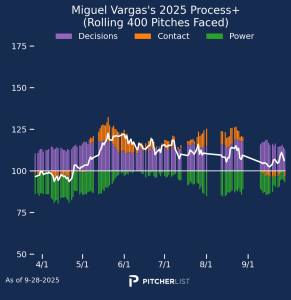
The first standout trait in Vargas’ game is his swing decisions. Vargas’ chase rate is among the lowest in the majors (21.6%), and his zone contact rate is impressive (86.5%). Pitchers struggle to beat Vargas over the plate (8.1% SwStr), and Vargas is able to fight off close pitches (66.7% O-Con). When Vargas does make contact, he squares up the baseball at a high rate (29.6%, 82nd percentile), despite not having elite exit velocities (89.7 AVG EV, 40.5% HardHit). Those marks could go up next season, though. Vargas’ bat speed jumped just under a full mark between 2024 and 2025. While his 70.6 mph average swing speed is still below league average, a full offseason to continue to grow on it could boost his all-around production.
Vargas’ approach at the plate gives him a solid base to build on, and he has youth on his side when it comes to developing the swing speed and exit velocities that could lead to a power surge. Given the team he’s employed by, he’ll have plenty of chances to build on a solid 2025 next season. Vargas is projected (per Fangraphs’ RosterResource) to be the White Sox’s Opening Day third baseman and hit cleanup. With Colson Montgomery, Kyle Teel, and Edgar Quero emerging as offensive weapons, Vargas should have more protection to build on his 60 RBI from last year. The 26-year-old has the offensive foundations and the circumstances to break out into a legitimate fantasy option for 2026.
MLB Stats: 73.1 IP | 3.44 ERA | 24.7% K% | 8.4% BB%
“One of these things is not like the other”. Michael King is a completely different player in comparison to the other four featured in this article. King has a 3.24 ERA with a 27% strikeout rate in 161 career appearances (64 starts). Over the last two seasons, King has blossomed into a top-tier starter for a San Diego team that has won 183 games over the last two seasons. Now, after five years in the Bronx and two on the West Coast, King enters free agency for the first time after turning down his $15 million player option. This section is going to be a little different. There’s no question that King, in a vacuum, is worth trading for, but the team he signs for could drastically impact his value and production for 2026 and beyond.
King’s free agency will be an interesting one to follow. He’s positioned himself as one of the top starting pitchers on the market, but hasn’t proved himself as a true ace. King was the Opening Day starter, but Nick Pivetta was excellent as well, and Dylan Cease arguably had more “name-brand” recognition as the team’s ace. Spotrac projects King’s market to land in the $22-23 million range. That’s a steep price to pay for a player with under 70 career starts who is coming off an injury. For comparison, the other top arms on the market, Cease (188) and Framber Valdez (166) have both started over 150 games. King’s performance as a starter has been strong. His 3.10 ERA is in the top 15 among SPs since the start of 2024 (min. 240 IP), but his injury history and shorter resume may make higher-payroll teams hesitant to expand their chequebooks even further.
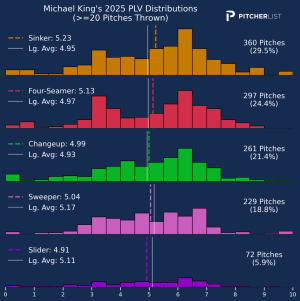
Despite the question marks, King’s arsenal and peripherals stand out. The four-seam was hit hard last season (.814 SLG), but PLV still considers it a plus pitch. The best offering is the sinker, which generated solid results (.232 xBA, .300 xwOBA), more often against right-handed hitters. King’s changeup doesn’t look to be his best offering, but it dominated in 2025. He allowed just two extra base hits in over 250 pitches (mostly vs. LHH) with a 28.7% whiff rate and .256 xwOBA. Despite his strengths, King’s not without his flaws. He struggles to prevent pulled fly balls (21.3% PullAir) and allows a high rate of barreled balls (11.4%).
The best fit for King in terms of fantasy value would be a contending team with established arms to pair up with. The 30-year-old thrived with San Diego alongside two other All-Star-level pitchers. If he’s tasked with being the ace on a .500 or below team, the drop-off in quality of the team behind him could lead to a jump in ERA and a drop in wins. Teams like the Nationals and Orioles have exciting young cores and have money to spend, but neither team has a strong track record with pitching success as of late. On the flip side, the Cubs, Red Sox, and his previous team, the Padres, all have room in their rotation, but may not have the funds necessary to strike a deal in that aforementioned range. King has the skills to be a top-of-the-rotation arm, but his shortcomings and future home could drop his value to below that tier in 2026 and beyond.
Bonus: MiLB Risky Buy Options
Esmerlyn Valdez
MiLB Stats: .286 AVG | .896 OPS | 26 HR | 3 SB | 24.6% K% | 10.6% BB%
Beware the hype and headlines that come out of the Arizona Fall League. Valdez has been one of, if not the best, hitters in the competition (8 HR, 1.530 OPS), which only adds to the buzz he generated after a dominant season between High-A and AA. Valdez’s 156 wRC+ was third in the Pirates organization, behind only #1 prospect Konnor Griffin and fellow breakout star Edward Florentino. His best attribute, as demonstrated by the 34 homers between the regular season and the AFL, is his power. Valdez routinely hits balls over 100 miles an hour and excels at hitting fly balls to the pull side (52% Pull, 42.5% FB).
All of those numbers indicate that Valdez’s power is legit and will stick at the next level. He handled the adjustment to AA well this year, hitting 14 extra-base hits with a .772 OPS in 51 games. Those marks are a sharp decline from his time in High-A, but they should regress upward now that he’s been exposed to the competition level. The main concern is the swing-and-miss issues. Valdez struck out over 30% of the time in Single-A in 2024, with a 34% whiff rate. While those numbers have come down significantly, and the contact rate has increased (’24: 69.5% / ’25: 72.4%), there’s still reason to be worried as he progresses into the upper minors.
Success in the AFL doesn’t directly translate into MLB success, but it’s not rare to see a fall standout become a star in the majors. Nick Kurtz (1.058 OPS) stood out in last year’s competition, as did Andrés Giménez (.999) and Royce Lewis (.976) in 2019. At the same time, Liam Hicks (1.075 in 2023), Niko Kavadas (1.162 in 2024), and Nelson Velasquez (1.192 in 2021) couldn’t carry their strong performances into the majors. This isn’t to say that Valdez isn’t worth trading for, as he has the power potential to be a 25-homer bat in the majors. However, be cautious not to fall into the trap of overpaying for him because of his recent notoriety.
Adam Serwinowski
MiLB Stats: 111.2 IP | 4.03 ERA | 28.5% K% |11.2% BB%
When the Dodgers acquired Serwinowski at the trade deadline, I put a post out on X which said that they won the trade because they acquired the 6’5″ lefty. I still stand by that, as Zack Littell was average for the Reds and is now a free agent (the less said about Hunter Feduccia and his 39 wRC+, the better). However, the Dodgers’ track record of developing reliable arms, especially in their rotation, has been less than stellar over the last few years.
Again, not rocket science, but having good acquisition and player development teams often leads to long-term success. However, when you’re as good at acquiring and developing players as the Dodgers are, problems can emerge. On the hitting side, Alex Freeland and Dalton Rushing are ready to be MLB contributors, but because of LA’s elite lineup, there’s no room for them. It’s an even bigger problem on the pitching side. The five rotation spots are going to be locked up for the foreseeable future because even if one of the stars gets hurt, the Dodgers have an army of young arms to take their place. Free agency notwithstanding (although adding a starter is well within the realm of possibility), the Dodgers have more than enough depth to handle the strain of another 170+ game campaign that could run deep into October.
For Serwinowski, that means that his role with the organization is in limbo. He has the frame and track record to be a starter. 24 of his 25 appearances last season were as the opener, and he went at least five innings in 11 of them. The biggest concern will be rounding out his arsenal. Serwinowski’s fastball sits 94-96 from the left-hand side, with a wipeout slider. However, he’s yet to truly showcase a third or fourth offering. That, in tandem with the high walk rate, may spell a destiny in the bullpen.
Personally, I think Serwinowski projects more as a #3-4 starter in the rotation, and he has the building blocks to get there. However, the Dodgers’ track record with pitching worries me, which makes Serwinowski a volatile asset during this offseason trade period.
