





We at Pitcher List try to think ahead. Not just to the fantasy playoffs, or the MLB postseason, or even the looming lockout. But all the way to 2027. Our staff joined together for an early 12-team mock draft, a baseline for how this season’s results will frame next season’s expectations. Individual names may rise and fall, but trends and strategies are already taking shape. Sooner or later baseball will return, and this is our first attempt at what the fantasy landscape may look like when that time comes.
League Format
12 Team H2H Categories Standard 5×5
C, 1B, 2B, 3B, SS, OF, OF, OF, UTIL, UTIL
23 Players per Roster
Two Ohtanis (DH and SP)
Draft Order
- Esetevão Maximo
- Jacob Milham
- Anthony Tucker
- Scott McDermott
- Asher Dratel
- Jeffrey Farek
- John Ke
- Mark Steubinger
- Martin Sekulski
- Rick Graham
- Jake Crumpler
- Scott Chu
Draft Board
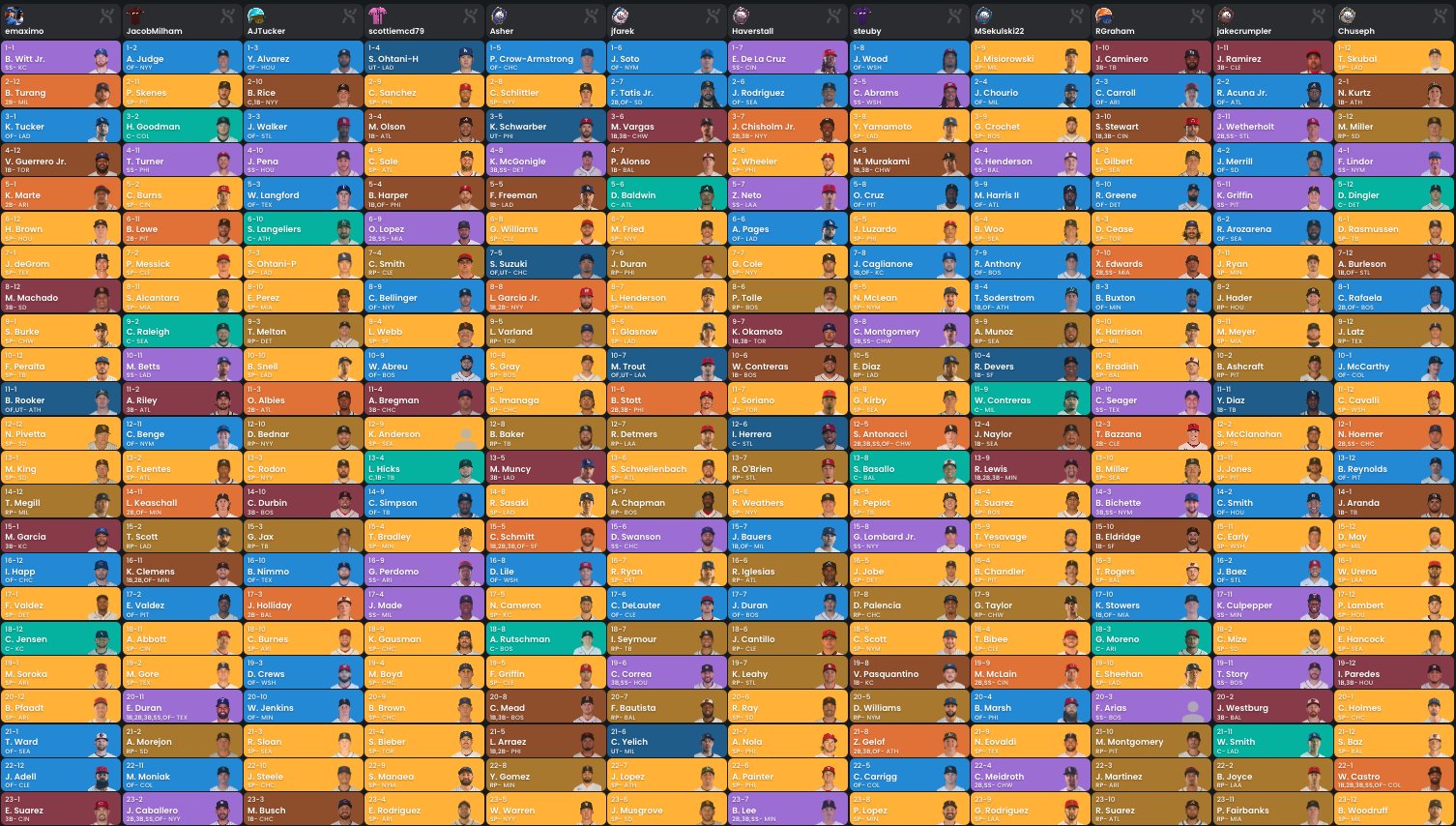
(Courtesy of @IAmRickGraham on X)
Note: Those who would like to see the results in a simple list format can do so here.
Early Rounds (1-5)
Our drafters shared a common thought about how the first 5 rounds went down – pitching was not a priority for many. Or, as Scott Chu succinctly put it, “9/12 teams had 0-1 SP after 5 rounds. About half of that group had 0.” Only 11 SP and 1 RP (Mason Miller) were taken in the opening rounds, as consistently elite and breakout 2026 bats dominated the draft’s attention. Elite options at typically thinner positions, such as C, 2B, and 3B, were highly sought after by those, including John Ke, who eschewed SP. “I think people are going to knock the Jazz Chisholm pick, but he’s been a flag-plant guy for me for ages. 30-30 potential at a premium position (2B) – I’m always going to want a top 3 second baseman on my teams, and Jazz does that.” Young rising stars in the sport like Miguel Vargas, Sal Stewart, and JJ Wetherholt went in the 3rd Round. After some recent lack of depth, 1B is in a much stronger place, with 9 primary 1B taken before the 6th Round.
On the flip side, there was value for those who waited on SP. As Mark Steubinger said, “It makes sense with pitching injuries being so rampant and the start of the season being ~7 months away, but I was surprised that some both established and breakout SPs went as late as they did.” Perhaps some arms dealing with injuries in 2026, like Shohei Ohtani and Gerrit Cole, will climb the ranks as we get more clarity on how they look at the end of their shortened campaigns.
Admittedly, there is an inherent bias in a website called Pitcher List that waited to take SP. Many managers feel confident finding value later in the draft. Martin Sekulski drafted Jacob Misiorowski and Garrett Crochet in his first 3 picks but also noted the excellent pitching depth. “It’s easy to forget how good [SP] is when so many guys are banged up right now, but will return in 2027.” With so many injuries at the position, embracing the churn-and-burn strategy doesn’t mesh with spending more than 1 early pick on an ace. Most of our participants trusted they could find enough value later on, but other leagues may not feel as confident and be more aggressive on draft night.
Other potential risers continued a trend of embracing young talent. These could include 5th overall selection Pete Crow-Armstrong, who is flirting with a 40-40 season and has Top 3 overall potential. Ben Rice, 22nd overall, will lose his C eligibility next season, but was a target for many managers. His 133 Process+ is 10th among all hitters this season. Kevin McGonigle and Konnor Griffin were highly sought after and went in the 4th and 5th rounds, respectively.
Middle Rounds (6-14)
The pitching run started with Scott Chu taking Drew Rasmussen to lead off the 6th Round. Including Rasmussen, 28 of the first 60 picks in this stretch were spent on SP. Including the 7 closers also drafted in Rounds 6-10, over 50% of resources went to fortifying our managers’ pitching staffs. The position cliffs at C, 2B, and 3B hit hard in this section. Cal Raleigh was the only catcher taken in a 58-pick span, no 2Bs were taken in Rounds 8-10, and no 3Bs were taken in 51 picks until Manny Machado closed the 8th Round.
By the end of Round 14, all managers had between 5 and 7 pitchers on their rosters, and only Scott Chu had fewer than 4 SP. Scott Chu was also the only manager without a primary 3B, while 3 other managers were still looking for a 2B. I was the only manager without a SS through 14 Rounds.
Personal preferences became a more significant factor in this stage of the draft. Many of our participants’ favorite selections took place at this point, envisioning repeat performances from breakouts and bounce-back seasons from forgettable 2026 seasons.
Asher Dratel: “I think Luis Garcia Jr. in the 8th may be a steal. Career .268 hitter who can also [contribute] double-digit steals and now plays 81 games a year at Yankee Stadium?!” Garcia will lose his 2B eligibility next season, but his 19.1% pull-air rate in 2026 is a career high and a good match for the Yankee Stadium short porch in RF.
Jake Crumpler: “Jared Jones. I think he’s going to ascend with a longer leash in 2027.” A normal Spring could do wonders for Jones after missing both 2025 and 2026 due to injury. He was one of the last reliable SP options for strikeouts to come off the board.
Scott McDermott: “[I] was really pleased with my 10th through 13th round picks of Wilyer Abreu, Alex Bregman, Kade Anderson, and Liam Hicks. These guys were all on my board.” A little behind-the-scenes here, but our draft took place in August. Both Abreu and Bregman took off during our draft, both exceeding a .900 OPS that month. Late-season pushes may make it difficult to repeat this impressive run from Scott McDermott.
Late Rounds (15-23)
While managers filled the gaps in their rosters, this section of the draft saw our most creative selections. Players returning from injury were a common theme, especially as late-round fliers, such as Corbin Burnes and Trevor Story. Many managers chose to end their draft with an injured arm, giving them a free roster spot to work with to start their season.
After the successes of pre-draft hyped rookies JJ Wetherholt, Kevin McGonigle, and Konnor Griffin this season, several managers took a stab at their 2027 sequel. River Ryan, Jesus Made, and Kaelen Culpepper all went around pick 200.
Low-ceiling, high-floor players were also a priority. I attempted to plug my hole at SS with a combination of Dansby Swanson and Carlos Correa, which doubled my chances after punting at the position earlier. Consistent names, such as Brandon Nimmo and Geraldo Perdomo, are good prices this late for managers that need some stable options behind an injury concern or high-upside play earlier in the draft. Of course, this late in the draft is about picking the guys you believe in. So let’s hear from our managers about who they feel most confident about.
Martin Sekulski: “My favorite pick was Grant Taylor in round 17. I think he gets that role and easily saves 30 games next season.” Taylor is in the 95th percentile or better in K%, xwOBA, and xERA this season for a White Sox team that could be at the start of their competitive window.
Scott Chu: “Curtis Mead by Asher in Round 20. I intentionally chose not to draft him to see how the rest of the league would value him. The skills we saw were real, and he could be dope as heck.” Before Mead fractured a bone in his hand in his debut with the Red Sox, he had a 126 Process+ and 17 HR this season. His 22.5% pull-air rate is an excellent fit to take advantage of the Green Monster next year.
Asher Dratel: “Assuming the surgery recovery goes well for Casey Schmitt, I do not see him lasting until the 15th.” 3B-eligible with a 123 Process+, 20+ HR power, and 10+ SB speed? Yeah, that’ll play.
Undrafted Notables
Some players left off our teams may find their way onto them by the Spring. Some have returned from injury or played well enough in recent weeks that they would likely be picked if we ran this exercise back today.
Nolan Arenado (3B) – 7 HR in August may be flashy enough to take a chance on a veteran at a thin position.
Ryan O’Hearn (1B/OF) – Injuries ate into his 2026 campaign, but a good average and high-teens, low-20s HR power is serviceable, even if it isn’t exciting.
Garrett Mitchell (OF) – An eye-popping amount of red on Mitchell’s Statcast page. Someone may want to buy into the tools and hope he puts it all together in 2027.
Lawrence Butler (OF) – A 20-20 threat in his previous two seasons, Butler is heating up to close the season. He has 6 HR and 4 SB in August with a .900 OPS.
Heriberto Hernandez (OF) – Another bat growing into the season. A 127 Process+ with 20 HR and 10 SB is worth consideration.
Tyler Mahle (SP) – Perhaps the best SP traded at the deadline thus far, free-agent-to-be Mahle has earned himself a rotation spot wherever he lands in 2027.
Michael Wacha (SP) – You know who he is at this point. Boring, but useful.
Nick Lodolo (SP) – A disappointing season for Lodolo, but a return to 2025 form isn’t unrealistic.
Edward Cabrera (SP) – See above.
Emilio Pagan (RP) – Has a player option for 2027, but is worth a late-round pick should he retain his closing duties in Cincinnati.
Best Teams/Strategies
We asked our competitors who they thought had the best draft, and while everybody got some love from their colleagues, two teams garnered the most attention. As a reward, let’s dissect what went so well and see what we can learn.
“Mark Steubinger’s roster really stood out to me. A ton of high-ceiling guys in both the bats and the arms, with only one starter over the age of 30.” – Jacob Milham
“The bats early on are very high-ceiling, mid-floor, with guys like Wood, Abrams, Murakami, and Cruz. The pitching is also similar, so this is just a fun team that, if it all pans out, could win a league.” – John Ke
Mark, drafting out of the 8th spot, went all in on upside, but also made some smart selections to protect his floor. His first 10 picks include some eye-popping power, as 5 of the 6 hitters taken have hit 29 or more HR in a season in their careers. Samuel Basallo, taken in the 13th Round, has shown some exciting potential and has a free path to near-everyday playing time after Rutschman was dealt to Boston at the deadline. Daniel Palencia and Devin Williams round out an impressive bullpen. Young SPs on teams expecting to compete in 2027 were the focus of Mark’s attention, while bounce-back candidates, like Vinnie Pasquantino, Zack Gelof, and Pablo Lopez, were reserved for the late rounds.
“Rick Graham. ‘Scary’ is the word that came to mind when seeing the potential of his offense and pitching staff. He did the best job of accumulating ceiling plays without jeopardizing his floor, completely.” – Estevão Maximo
“Rick has a solid team. His 1-8 picks are as good as anyone. He’s got a ton of power and speed with above-average arms.” – Martin Sekulski
Rick drafted 10th and took a smart approach to maximize his upside. The early rounds were mostly focused on young, established talents that he can expect production from, even in a down year. Junior Caminero and Corbin Carroll paired together provide an excellent power-speed combination that gave him the freedom to go best player available in the middle rounds. Rick continued to chase upside, albeit with lower floors, as the draft continued, not shying away from the oft-injured but highly talented Byron Buxton or Corey Seager. Every SP taken will be 31 years or younger next season, and Mason Montgomery has emerged as an elite talent. His knowledge as our resident RP ranking expert was clearly leveraged here, waiting until the very end to scoop up the best options left.
Both teams weren’t scared to go for it, but waited until after the top 5 or 6 rounds to start taking those risks. They chose 1 SP in the first 5 rounds and had 5 pitchers total on their rosters by the end of Round 13. While Mark was more aggressive with unproven SPs in the later rounds, Rick opted for young bats with high potential. Well done, you two. Congrats on your purely hypothetical, incredibly subjective, way-too-early 2027 fantasy success! And for the rest of us, there’s always next year.
Adapted by Kurt Wasemiller (@kurt_player02 on Instagram & Threads
@kuwasemiller.bksy.social on BlueSky)
