







2025 A, A+, AA, AAA Stat line: 98.0 IP | 3.12 ERA | 41.1 K% | 10.5 BB%
2024 NCAA Stat line: 93.1 IP | 2.03 ERA | 40.4 K% | 8.9 BB%
For one of my first articles in 2025, I took a look at a fun group of pitchers who were achieving success with a 30% strikeout rate, yet being weighed down by a less-than-ideal walk rate over 10%. Since that March article, Gage Jump, Cam Schlittler, and Jack Leiter have broken out to reach a new level for their careers and put themselves on a path to a much brighter dynasty future. From the same article, Emiliano Teodo, Moisés Chace, and Chayce McDermott never got off the ground, derailed by injuries at some point in the year. One of the fastest risers from the group is Toronto’s Trey Yesavage, who is on the verge of being added to a major league roster a year after his draft class. He has flown through four levels to reach Triple-A Buffalo, where he is working to build his resume in time for the Blue Jays’ playoff push.
Growing Pains
Yesavage has maintained an above-average strikeout rate through each stop this season. Yet, as his ability to throw strikes goes, so does his walk rate. So far in Triple-A, these ratios have dipped to their lowest point. However, the 37% strikeout rate is still high enough for a team to absorb his growing pains, assuming they are temporary.
He has only thrown 14 innings with Buffalo, so we anticipate positive regression to the higher rates seen in the lower levels as he becomes more comfortable in Triple-A. Yet, this will be a difficult task in the near term, given that his role has become that of a multi-inning reliever. Yesavage will not be able to pitch enough in the final week of the season to claw back to a 20% K-BB rate.
Mechanics
The 6’4″ righty has a high three-quarters arm angle that emphasizes downward motion, which plays up the diving action of his renowned splitfinger. Hunting for extreme outliers in Statcast data will eventually bring you to Yesavage. In the release height department, there is virtually no one higher than Yesavage, who touches the sky with his 7.2-foot release across his four-pitch arsenal. The fastball has the lowest release height, while the slider has the highest release at 7.33 feet.
With that release point, he doesn’t achieve much extension on his throws. Even though he doesn’t get much closer to the plate than most pitchers, his delivery is akin to a rocking chair, as he tips back far before launching forward on the landing foot. This rocking motion may be difficult to maintain over the course of 25+ starts, so it will be interesting to see if any changes are made once the Toronto pitching development works with him in his second offseason.
One small tweak that they could make is to have him follow through a bit more to gain extension. This would bring his pitches closer to the plate and give them a different landing point. Maybe that’s a solution to the control issues. Of course, changing mechanics has ripple effects, but it might be worth exploring some options to quell the free passes. Yesavage was more fluid with his delivery and offered hints at what further extension could mean for his outcomes. He reached multiple whiffs on all of his pitches with about two to three more inches of extension. Here are each of those pitches separated.
Fastball
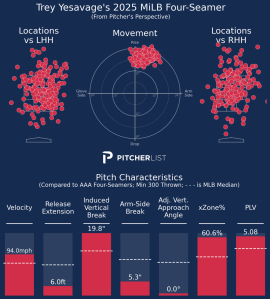
Averaging over twenty inches, Yesavage is in the 99th percentile in terms of induced vertical break on the four-seamer. A fastball that is already high, getting even higher, must be a fun task for hitters to deal with. These two elements on his fastball help him overcome its mediocre 94 mph velocity. Poor fastball command is ultimately holding him back and should lead to a decrease in the usage of the pitch. Unfortunately, the walk rate has jumped to 28% on the fastball through 14.1 innings, after sitting at around 13% for the entire season.
FF 94
6.2’ extension
18.7”IVB minimal horz break
7.1’ release height pic.twitter.com/36ODJhRtwV— YGM Fantasy Baseball (@YGMfantasy) September 12, 2025
Splitter
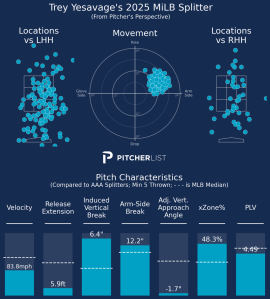
Looking at his other notable pitch, the 2.6 feet dive on his splitter falls closer to the 90th percentile in terms of drop (Kenta Maeda averages over three feet!). Yet, Yesavage generates almost a foot of horizontal break, which brings the total movement of the pitch closer to the 99th percentile. One would expect the splitter to be his poor command pitch, but the walk rate is an acceptable 13% in Triple-A.
FS 84
6’ extension
5” vertical break 10” horz break
7.3’ release height pic.twitter.com/VWNHCy3FJj— YGM Fantasy Baseball (@YGMfantasy) September 12, 2025
Slider
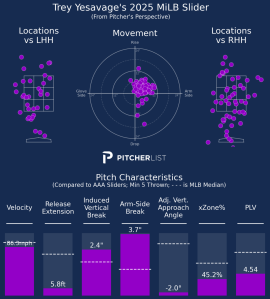
Yesavage leans heavily on the fastball, but has been balancing the rest of his throws between the splitter and a slider. The slider has a tighter spin and doesn’t generate much movement, but gives him a pitch in the 87 mph velocity band. It has been a more effective pitch for him than the fastball, so we could expect to see him throw it a bit more. Furthermore, he is listed as having thrown a cutter during his stint in the Florida League, but has not registered a single cutter in Triple-A. That cutter is very similar to the slider, such that they may be one and the same.
SL 87
5.9’ extension
5” vertical break 1” horz break
7.23’ release height pic.twitter.com/J8dudoX0DQ— YGM Fantasy Baseball (@YGMfantasy) September 12, 2025
Performance
The early-season success of Yesavage highlights the ceiling of his value in 2026. In his final five Single-A starts, he had 47 strikeouts to two walks and an extremely impressive 71% strike rate. His confidence in his stuff was overpowering hitters and became the impetus for his first promotion to High-A. There were some command issues in May and at the start of June that were mostly resolved in July. Yet, we are back to questioning the command in September.
Down the stretch, it will become harder to assess his starter’s outcomes as his role has shifted to the bullpen. Yet, any pitcher, especially a reliever, cannot walk batters. Yesavage will need to return to trusting his stuff so that he can inch back down closer to what his true talent was showing before Triple-A.
On the positive side, he hasn’t allowed many home runs (only eight home runs over the season) despite the concerns over the angle of his pitches. This was also true during his final season at East Carolina, so he may be adept at sequencing his three pitches just enough to get hitters to modify their tilt.
Rookie Rankings
Where would Yesavage fit on a list of major rookie pitchers? His arm angle mirrors that of Jonah Tong, who has had mixed results through two major league starts. The strikeout and walk rates of Yesavage compare well with Jacob Misiorowski, but Yesavage doesn’t have the same levels on his fastball and is unlikely to develop high 90s velocity.
Therefore, I see him in the Cade Horton and Schlittler range, two starters who are turning in solid innings with strikeout upside. Schlittler is a favorable comparison as well, given that he developed a stronger fastball over the last year and his performance has come on strong down the stretch. The other necessary comparison is to Hurston Waldrep, who throws his splitter 33% of the time. Waldrep’s walk rate spikes from time to time, but he has turned in multiple quality starts, too. Yesavage has demonstrated the endurance to go longer than five innings, even if his initial major league role will be out of the bullpen. I would forecast Yesavage to be around the Waldrep and Misiorowski level of production, given their similarities in stuff, command, and strikeout upside.
One final thought is that the name value of Yesavage may carry enough weight in prospect circles that, for certain dynasty teams, the best thing to do may be to sell. The caveat is that one would expect a solid return and possibly even a younger veteran who can contribute in the near term. Yesavage has a very high ceiling, but the walk rate could delay his starter track. On the flip side, the Blue Jays may be saying goodbye to Chris Bassitt, Max Scherzer, and Shane Bieber after 2025. Even Alek Manoah and Bowden Francis will need to be re-signed. All of these movements could leave the door wide open to a youth movement in Toronto led by Yesavage.
Where would you place Yesavage on this chart?
The list below is ordered by FanGraphs dollar value generated per game. (as of September 8, 2025)
Photo by Todd Kirkland, Susan Renee, Susan McGowan | Adapted by Parker McDonald (@CarbonFoxGFX on Twitter/X)
