


The latest in our Dynasty Takeaways series takes us to the outfield, home of the second-largest player pool in fantasy and also most of the top-25 overall dynasty assets. Outfield has been star-studded since day one, and it only gets deeper each season. In 2026, we saw plenty of breakouts, former stars fall off, and top prospects make their MLB debuts. With all that activity in the outfield, here are the top dynasty takeaways from the 2026 MLB season.
1. There was PCA, and then everyone else
Anyone who watched baseball this season knows that Pete Crow-Armstrong was the best player on the planet, and it wasn’t particularly close. The 24-year-old had a monster season, going 43/41 in a world where the next closest outfielder by WAR (Arozarena) was a full FIVE wins behind, and even with a terrific season, finished with 18 fewer homers and 15 fewer steals. It wasn’t so much that PCA dominated because he’s an elite player; it was the manner in which he did it. Entering play on June 1st, Crow-Armstrong had a .237/.325/.388 slash line with seven homers and 12 steals in his first 60 games, managing a 101 wRC+. Over his next 60 games, PCA took off. He hit .330 with 20 homers and 18 steals, including an 11-homer month in June where he posted a 1.249 OPS. In that 60-game stretch, his wRC+ was 205, 16 points over the second-best hitter, Yordan Alvarez.
PCA’s profile isn’t perfect, but he made considerable gains across the board in 2026 that undoubtedly fueled his potential MVP season. It started with his plate discipline: he cut his overall swing rate by nearly 10% year-over-year, made higher-quality swing decisions, and changed the narrative around his profile. He chased 7% less, raised his contact rates by 2% overall and in-zone, saw his walk rate climb from 4.5% in 2025 to 11.4% this year, and then let his natural ability to crush the ball do the rest. Even though Isaac Paredes still exists, PCA posted the highest pull-air rate in the majors, at 33%. With his already-elite power, improved swing decision-making, and a nearly 3 mph increase in bat speed, he went BOOM, literally. I’ve seen Crow-Armstrong ranked as high as first overall in dynasty rankings; given his skill set, age, and team context, it’s hard to argue against him. PCA is OF1!
2. Jordan Walker finally breaks out, for part of the year
Normally, a 24-year-old going full breakout isn’t a big deal, unless that 24-year-old is Jordan Walker. Fantasy managers have been waiting for Walker to reach his “potential” since he hit two tantalizing home runs in spring training in 2023, and everyone is STILL talking about them years later. Instead of becoming a star right away, Walker struggled over his first three seasons. He was optioned to the minors twice and posted a sub-100 wRC+ with a low .200s batting average and a high strikeout rate in 179 MLB games entering 2026. Most of Walker’s issues were self-inflicted, continually making poor swing decisions and just trying too hard to reach expectations. His willingness to expand the zone led to below-average quality of contact and an inability to tap into the 80-grade raw power we saw on that beautiful afternoon in the Grapefruit League way back in 2023.
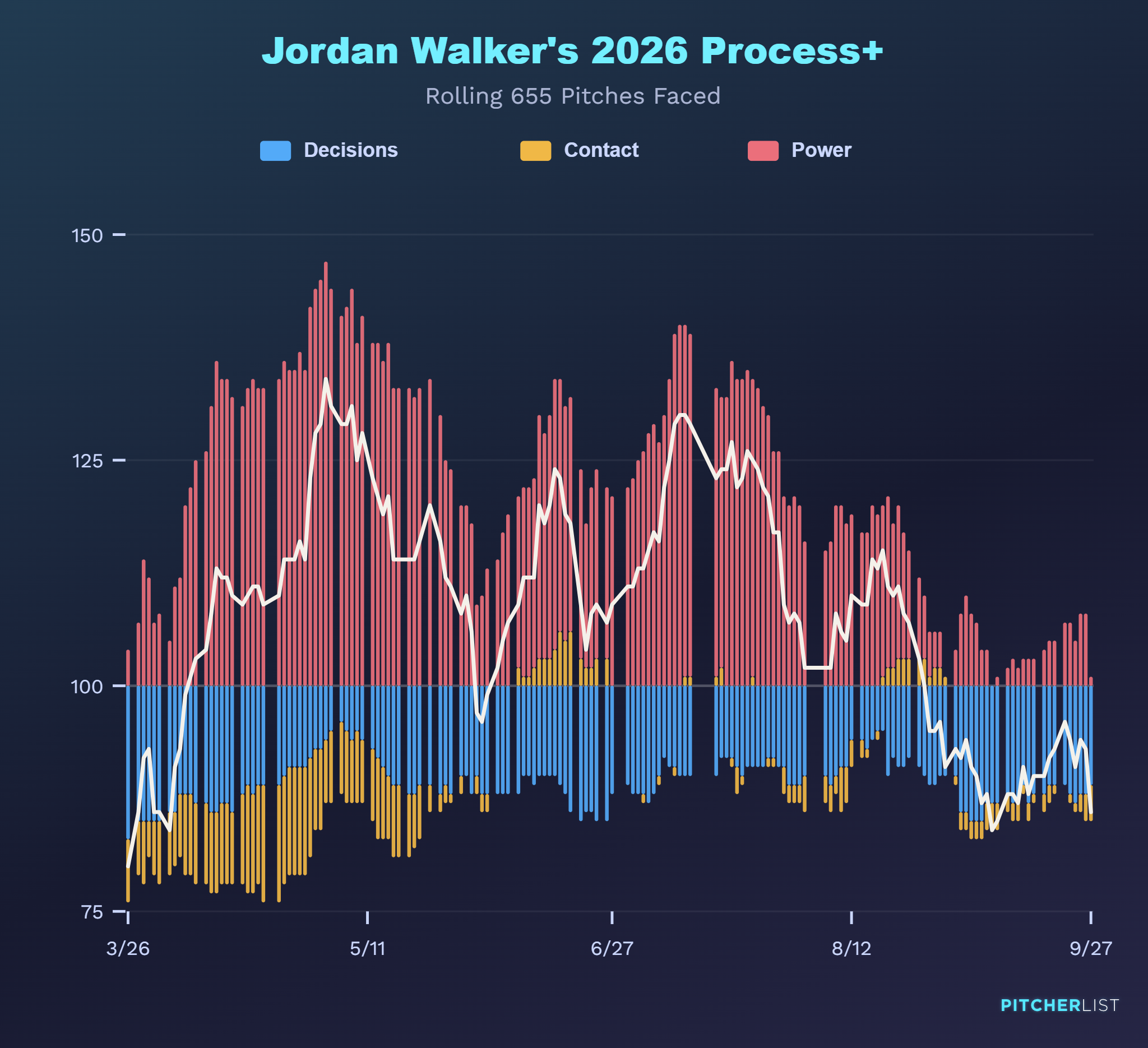
Even with his dazzling final line, Walker’s season was a tale of two halves. Early on, his swing decisions and contact skills were much better, letting that power play up. In the first half of 2026, he slashed .294/.354/.532 with 22 homers and 74 runs batted in, walked over 8% of the time, and struck out at a respectable 24.8% rate. Walker’s contact rates were among the best of his career, and although his chase rate was still 34%, his approach had changed considerably over the past few seasons. His second half saw some regression to the old Walker, as he slumped to a .234/.287/.373 slash line, mustering only seven homers with an 83 wRC+. On his Process+ rolling chart for 2026, the clear outlier is what you would expect: his power. His Process+ Power never fell below the Mendoza line in 2026, peaking at 147 in the first half of the season and then tapering off down the stretch. That dip came with considerable drops in his contact and decision ratings, which hovered around league-average early on.
Simply put, Walker fell back into old habits, chasing more and making much weaker contact than in the first half. It’s hard to argue with a 29-homer, 22-steal season, given the lack of production we’ll talk about later, but it’s noteworthy that Jordan Walker knows what he has to do to sustain success all season. But will he do it in 2027?
3. DeLauter delivers on pedigree
Ready for something to really blow your mind? Chase DeLauter is actually seven months older than Jordan Walker…now back to the story. DeLauter had a very odd MLB debut, appearing in a Wild Card game last fall for the Guardians before ever stepping foot on the field during the regular season. The 25-year-old finally made his regular-season debut in 2026 and had a solid rookie season, playing a career-high 133 games (including MiLB) with a .287 average, 16 homers, and 11 steals. The volume he provided for dynasty managers is almost as notable as his stat line, after he missed considerable time in each of his first three pro seasons due to various injuries, but mostly a cranky left foot that’s been a problem since his collegiate days at James Madison.
DeLauter showed the skills we saw in a former top-10 prospect, including excellent plate skills, an advanced hit tool, and a sprinkling of raw power. Among qualified rookie hitters, DeLauter was second in overall contact rate at 87.5% and third with a 93.7% in-zone rate. He also ranked inside the top 10 in O-Swing rate (24.7%) and swinging-strike rate (5.6%), showcasing elite bat-to-ball skills in his age-24 season. His power metrics weren’t eye-popping, but a 91.4mph average EV and a 90th-percentile EV of 105.7mph are nothing to sneeze at. He also had a 35% squared-up rate, which Baseball Savant ranked in the 97th percentile among qualified hitters. If he stays healthy, DeLauter’s rookie season feels like the start of a lengthy, All-Star-caliber career with plenty of dynasty value, most likely as a top-15 to 20 asset at the position.
4. Temper expectations with Ronald Acuña Jr.
It wasn’t long ago that Ronald Acuña Jr. hit 41 homers and stole 73 bases in his historic 2023 season, arguably the greatest fantasy season in the last decade. At the time, Acuña was 25, and everyone expected him to be OF1 for years. Things changed quickly when Acuña tore his left ACL the following season and played just 49 games. His recovery lasted into the 2025 season; he returned in May and played 95 games, but also suffered hamstring and Achilles injuries along the way. Acuña finished that season with 21 homers and nine steals, but lacked the explosiveness and dominance he asserted two years prior. Now two full seasons removed from his ACL surgery, Acuña played 107 games but again missed nearly a third of the season with several injuries, including more soft-tissue ailments. In his age-27 season, the former MVP hit .255 with 20 homers and 21 steals, once again reaching the 20-20 mark, but he hasn’t looked like the Acuña we once knew.
Since 2021, the first season in the post-pandemic era, Acuña has had three seasons with at least 100 games played, and 2026 is the first time he’s done that since the historic 2023 season. Injuries are no longer a possibility; they’re inevitable. Atlanta fans are frustrated with Acuña; he’s frustrated with them, and now trade rumors are circulating for the first time. The front office hasn’t said much, but where there’s smoke, there’s fire, and trading a former superstar on one of the most team-friendly contracts in pro sports (given the caliber of talent and AAV) seems unfathomable.
As dynasty managers, temper expectations: plan around rostering him, just like you do with guys like Buxton, Trout, etc. The most you can project is a 100-game season, and you don’t ever really know what you’re getting. Think about someone like Blake Snell. You’re getting ~100 innings with elite strikeout numbers, an above-average ERA, and a relatively high WHIP because of his walks. Acuña isn’t predictable; he’s no longer “untouchable”, nor is he “elite”. The skills are still present to put up solid seasons, but everything is trending negatively, and as he enters his age-29 season, Acuña is more of an afterthought than I ever thought he could be.
5. Platoon splits continue to grow
Although we tried to ignore it and push the migration off as long as we could, platoon splits are here and only getting more extreme. The days of the same three outfielders playing 120+ games together are long gone. In today’s game, if you get one outfielder to play 120 games, you’re probably really excited about it. Building outfield depth is almost as important as it is with starting pitchers. The simple fact is that rostering four or five guys isn’t enough, especially in roto. Daily leagues are much easier to navigate. The goal is to find two to three guys who are “everyday” players, then rotate in the strong-side platoon bats as they play, occasionally running out the weak-side guy. That’s in a perfect world without injuries, which does not exist.
Back to platoons and their fantasy impact – 102 left-handed hitters had at least 10 plate appearances against same-side pitching in 2026. Of them, 40 had more than 100 plate appearances, and only 10 had over 200. Only one left-handed hitter hit more than ten homers against left-handed pitching, which was PCA, of course. Two had an OPS over .900: Corbin Carroll and Jake Bauers, while Carroll led the group with a ridiculous .395 OBP. By and large, lefties don’t face lefties very much, and, to an extent, that’s hurting fantasy managers. The silver lining may be that it protects batting average, but does it? Most of these platoon bats are hitting between .230 and .250, and that doesn’t help, even in a world where .270 is elite.
6. Elite power and speed were hard to find; adjust accordingly
2026 was a rough year statistically for outfield, which trickled down to fantasy managers. While home run totals were down about 6% league-wide compared to 2025, the outfield seemed particularly impacted. With Aaron Judge, Juan Soto, Ronald Acuña Jr., and Oneil Cruz all missing significant time, the lack of power was evident. Three outfielders hit more than 30 homers, including Yordan Alvarez, who didn’t gain positional eligibility until late in the year. By comparison, 14 players reached that plateau last season. The year finished with 38 outfielders hitting 20 or more home runs, down slightly from 42 in 2025, but elite power was almost non-existent at that position. Speed wasn’t much better.
Two outfielders stole over 40 bases, with only four reaching the 30-SB plateau. In 2025, nobody stole 40 bases, but seven guys reached 30. So what does that say about what we should target at outfield? What is elite production from that position? Are we now in a world where the “elite” outfield production is a .280 average with 25 homers and 25 steals? Or is it still 30/30? Only three guys went 30/30 this season, and only one was an outfielder. Four outfielders did it in 2025, but none in 2024. I think we see the outfield as the place to target elite production, but in reality, only a few options actually offer it, and even those aren’t consistent.
7. Target specific skills and accept flaws
With platoon splits having completely altered the strategy at the position, and overall production down among outfielders, it’s time to target skills only and scrap the rest. For example, Chandler Simpson is an elite batting-average and stolen-base option, but offers no power and very little counting stats. Jarren Duran is another example. He went 20/20 again this season, but his counting stats were mid-tier, and he hit just .207. Michael Harris hits for average and power, but didn’t run this year. Riley Greene hits for power and sometimes for average, but his counting stats somewhat stink, and he doesn’t run. Bryan Reynolds scores a bunch of runs and sometimes hits for power, but his average is low, and he doesn’t run.
I could keep going, but you get the point. I found more joy rostering Jonny DeLuca this season than I did with last year’s 30+ HR bat Taylor Ward. When DeLuca played, he hit for average and power and ran, but he was one of many platoon players with fewer than 400 plate appearances. The same goes with Randal Grichuk. If he gets 500 or more plate appearances, he probably hits 30 home runs. Instead, he had 280 and hit 15 HR. My strategy with outfielders is to treat them like starting pitchers, both in terms of depth and what I’m rostering them for. I’m focused only on skills, and I’m not going to stress about playing time.
8. Defense reigns supreme; bats come later
Another layer to the platoon issue is how your outfielders perform defensively. In today’s analytics-driven game, defense is a huge factor and offers so much more access to playing time than being a good hitter. Keep that in mind as you build your rosters. PCA’s offensive talents have carried him to this level, but his defensive wizardry kept him on the field when he hit .216 in the second half of 2026. The same goes with Ceddanne Rafaela and Andy Pages, two of the streakiest players at the position. Each of them had great years in 2026, but they’ve also struggled mightily at various points. The common denominator is that they’re elite defenders, so they get more runway to hit their way out of a slump. At the other end is Lawrence Butler, who returned a -12 fielding run value in 2026. Butler started 32 of his team’s first 40 games in the outfield. During that span, he hit .180 with five extra-base hits and a 48 wRC+. His struggles led the A’s to call up prospect Henry Bolte, an above-average defender with no proven offensive success in the majors. Defensive skills got Jesús Sánchez run out of town in Toronto, while elite defense lets Colton Cowser post sub-100 wRC+ seasons year after year. Defense matters, and although it means absolutely NOTHING in fantasy baseball scoring, it means absolutely EVERYTHING to real-life baseball teams that decide when your fantasy outfielder plays, and when he doesn’t.
9. The (expected) rookie class was underwhelming
As a unit, the 2026 rookie class in the outfield was pretty underwhelming. Carson Benge and A.J. Ewing carried the load, with Sam Antonacci also having a strong year. But most of those guys weren’t necessarily on the radar at the open of 2026 as guys we should be targeting in a redraft. The names most drafted last season were Chase DeLauter, Ryan Waldschmidt, Justin Crawford, and Braden Montgomery. Of the four, only DeLauter met expectations (as described earlier).
In contrast, the others struggled mightily, and Waldschmidt, in particular, bounced back to Triple-A midseason for a period. The 23-year-old played almost 90 games at the MLB level, batting .256 with three homers and seven steals. He also struck out nearly 30% of the time, much more than in the minors. Crawford played almost 150 games, batting .264 with three homers and 17 steals. Fantasy managers expected far more stolen-base production, and his 41 runs scored were among the lowest for a full-time positional player. Montgomery hit .226 with six homers in 93 games for the White Sox and underwhelmed pretty significantly for a highly-touted prospect. The good news is that……
10. The 2027 Rookie Class will deliver
We’ve already seen productive debuts from Josue De Paula and Joshua Báez, both of whom will remain prospects entering 2027. Joining them will be Walker Jenkins, Bo Davidson, and Lazaro Montes, all of whom also debuted with less success. The likely debut group includes Theo Gillen (TBR), Mike Sirota (LAD), Charlie Condon (COL), and Josh Adamczewski (MIL), among others. This class has a bit of everything, but mostly high-impact power and speed, plus some exciting young talent that will undoubtedly captivate the fantasy world.
