






Lessons from the 2025 Weekly Stash List: Pitcher Edition
During the 2025 season, we gave readers 24 weeks of stashes, graduates, and players on the bubble. For better or for worse, Bubba Chandler was the most featured at 15 times, followed by Mick Abel (4), Andrew Painter (2), and then Jonah Tong, Robby Snelling, and Quinn Mathews at once each. While Bubba Chandler may not have graduated as early as we wanted, I don’t believe it was an error to continually view him as the top pitching prospect to stash. His Statcast data stayed within a narrow range each week, and he delivered strong performances after a few rough ones. Yet, there were other misses, such as having Brandon Sproat ahead of Nolan McLean for far too long. Another miss was not foreseeing early enough that Chase Burns, Jonah Tong, and Trey Yesavage would rise so rapidly to the major leagues.
There will always be surprise storylines, but the hope is that we can apply a new perspective to the ever-changing landscape in baseball. The evidence is mounting that young pitchers who are excelling at any level are more likely than ever to find their way to the major leagues with minimal Triple-A service time. In other words, a player does not need to spend substantial time in Triple-A to be considered a promising stash. The higher likelihood of a rapid promotion cycle greatly widens the candidate pool from which the stash list can emerge.
With the intention of putting together the best product out there from week to week, here are a few other lessons I will carry with me into the 2026 season.
Spring Training Usage
Spring training usage can illuminate the forthcoming plan for a pitching prospect by an organization. Many variables will factor into how soon a prospect will get involved in the team activities, but players receiving length into a single game or over many games are both a result of that player’s performance but also of an organization’s confidence in that player blossoming into a valuable contributor. The best recent example is Cam Schlittler, who had not cracked a AAA lineup before facing 70+ batters over 16.1 innings in the 2025 spring training. In March, his velocity wasn’t reaching the high-90s like it was in September, but he was getting solid whiffs with a four-pitch arsenal. In addition, Schlittler threw 3.1+ innings in three straight spring training starts, which is typically reserved for a member of the rotation. I did highlight Schlittler in a pre-season article, but didn’t seriously consider him as a stash for my own dynasty teams until he was in Triple-A, and it was way too late to freely pick him up.
Prospect Watch
Cam Schlittler
AA Somerset NYY
6’6” RHP5.21 v New Hampshire
6 IP 6H 0R 0BB 8K
13 whiffs/87 pitchesUses CU/SL to disguise FF w hittable attack angle. Leads to many fly balls although he is at 47% GB in ‘25. Improved 71% strike rate is great at his size. pic.twitter.com/hiHZFqBa5q
— YGM Fantasy Baseball (@YGMfantasy) May 27, 2025
Another in-season standout is Noah Cameron, who received two appearances of three innings and ten innings overall before being sent down to Triple-A on March 10. Cameron only stayed with Omaha for seven starts before having an impressive scoreless debut on April 30, when he allowed five walks and struck out three over 6.1 innings.
Lefty Noah Cameron stays high atop the stash list after almost reaching a triple digit pitch count over 5.1 IP.
April 13: 7K: 2BB, 2 ER over 5.1 IP
A few long hits, but mostly a clean start using the wicked change as he builds up for his likely call up. pic.twitter.com/r7VdkwvIsz
— YGM Fantasy Baseball (@YGMfantasy) April 17, 2025
Of the prospect pitchers who had more spring training innings than Cameron, only Jack Leiter made the rotation out of spring training. The other prospects who threw more than 10 innings would all reach the major leagues at different points in the season. Those prospects were Chase Dollander (4.6 2025 debut), J.T. Ginn (4.12), Joe Boyle (4.13 & then 7.6), Chase Petty (4.30), Michael McGreevy (5.4), and Janson Junk (5.24). Notable prospects who threw less than 10 innings but emerged as valuable major league contributors were Zebby Matthews (9.1 IP), Logan Henderson (8.2 IP), Jacob Misiorowski (7.2 IP), Cade Horton (3 IP), Chase Burns (1 IP), and Hurston Waldrep (1 IP). Nolan McLean, Trey Yesavage, Troy Melton, Parker Messick, and Cade Cavalli all saw no major league action in the spring.
Here are the lowlights from Quinn Mathew’s 4.11 start before going on IL with shoulder soreness.
2.2 IP 5 H 2 HR 4 ER 6 BB 2 K
Lowkey Daz Cameron highlight reel as he almost had 3 HR off Quinn.
No noticeable issues but had a 31 pitch 1st inning & 26 pitch 2nd inning. pic.twitter.com/m2IoNh97bE
— YGM Fantasy Baseball (@YGMfantasy) April 18, 2025
Of the pitchers that were on top of the Weekly Stash List at one point in 2025, they were less featured in the spring. Quinn Mathews had the most with six innings, while Bubba Chandler only pitched 2.1 innings. Mick Abel and Robby Snelling tied at 1.2 innings, while Jonah Tong didn’t get any major league spring training action on top of throwing in the Spring Breakout game.
While spring training usage will not directly correlate to regular-season usage, it will provide another signal for dynasty managers to use as they decide on which arms to add or drop before the in-season drama begins.
Playoff Roster Cutoff Affecting Timing of Call-Up
A quick note to self that the end-of-season deadline to add players to the 40-man roster is an unnecessary talking point. Teams can send in an appeal to the league office to have players added for almost any reason, and therefore, any player in the organization is easily added to a team’s playoff roster. There is no need to exhaust an article’s character count about how a player won’t be on the playoff roster. See Trey Yesavage and Connelly Early as recent examples. Don’t expend any energy worrying about it or discussing it.
Stash List Watch
Trey Yesavage
AAA Buffalo TOR9.2 v Syracuse
3 IP 2H 0R 1BB 6K
15whiffs/54pitchesStarted 2nd inn.
‘24 draft pick likely heading to bullpen role for TOR playoff push.
7.2’ avg release height
FF 94 20”IVB
FS major 2-plane movement 64%whiffs
SL 87 47%whiffs pic.twitter.com/N1DxAikAmz— YGM Fantasy Baseball (@YGMfantasy) September 3, 2025
Outliers
I can’t watch a lot of live MLB games, so when I do, it is apparent that there is a much higher level of skill that is consistently delivered than in the MiLB. Check out these pitches by Michael Soroka, who was at the peak of his streaming value, in this game.
Stash List Lessons
Outliers are Valuable
Michael SorokaFlashed solid MiLB metrics
CH 18” break
SL 50” drop 14” breakEarned 35K% 8BB% 14.1 IP AAA
Translated 25K% 8BB% 89.2 IP MLBLesson: Even 4th/5th rotation SPs have outlier skills that are way better than MiLB standouts. pic.twitter.com/uND50UB5pd
— YGM Fantasy Baseball (@YGMfantasy) October 16, 2025
Soroka was flashing horizontal movement that was amazing for its ability to be absolutely unhittable, but through the zone. He had a two-pitch sequence when he struck out Tommy Edman on a changeup breaking 18 inches to his arm side, followed by a slurve cutting 16 inches into the batter and dropping 52 inches out of thin air. This 10-strikeout performance was him at his peak, but he did have to endure a few starts in Triple-A, where he had three pitches with greater than a 60% whiff rate over a small sample of innings.
Stash List Monitor
Jacob Misiorowski
AAA Nashville MIL5.15 v Memphis
7 IP 4H 1ER 1HR 1BB 5K
10 whiffs/86 pitchesExtremely efficient, but a lot of balls in play & 11 FB. Maybe he is auditioning a reduced FB use to build up secondaries.
Hit 103….In the sixth inning! pic.twitter.com/2l8bHuaw66
— YGM Fantasy Baseball (@YGMfantasy) May 16, 2025
The point being that when you follow only minor league pitching, it becomes a bubble where even the best-performing players are barely scratching the surface of what a major league bench player could do. Those minor leaguers need to overachieve to stand out, flashing something that is approaching the extreme ranges of velocity, spin, extension, movement, command, etc. This is why Misiorowski should have been higher up on stash lists sooner. The velo and extension were so great that his stuff would “play up” in Milwaukee. Joe Boyle was popping similar data and became a target for me mid-summer because I believed that the splitter was going to help him cross up the opposition at elite rates. The pitch didn’t bear fruit because his control was too poor to overcome. Misiorowski, on the other hand, demonstrated stronger control more consistently and excelled in the majority of his appearances.
Stash List Watch
Joe Boyle
AAA Durham TBR6.7 v Jax
6 IP 2H 0R 1BB 8K
15 whiffs/78 pitches71% strike rate is next level for historically poor SP. injury scare avoided.
98 FF 14” IVB 7 whiffs
FS 16” hor break 4 whiffsMuch more effective when filling the zone w secondaries pic.twitter.com/Zjc76GL6Rc
— YGM Fantasy Baseball (@YGMfantasy) June 9, 2025
The guidance is to quickly identify players having success with outlier characteristics on their stuff (using Statcast or game-to-game scouting) as well as the players with extreme characteristics on their pitches who are not yet getting the expected results..
Results vs Metrics vs Scouting
I am still reflecting on the lessons to be learned while striking the balance between what my eyes tell me versus the actual outcomes and the underlying metrics. Typically, the outcomes in the game logs signal who to spend time on researching their Statcast data and for which games to go back and scout. If a pitcher continually underwhelms, there is much less motivation to dig through their underlying data, no matter the level of hype (ie, Noah Schultz, Quinn Mathews in 2025).
On the other hand, there are times when scouting the Statcast data uncovers players to pay closer attention to. I like to download all of the available Statcast data by player and pitch type. This allows me to import into my own spreadsheet and create my own filters, formulas, and charts. I am probably at the intermediate level in terms of understanding and interpreting the data, so I tend to lean on the more easily understood pitch metrics like the various “api_break” columns, extension, release positions, velocity, as well as the swing and miss percentage. In 2026, I hope to unlock the ability to incorporate some of the other Statcast columns into a cohesive narrative for the weekly stash list. And it would be great to get arm angle data, too!
Stash List Monitor
Bubba Chandler
AAA Indianapolis PIT5.7 v Columbus
2.3 IP 5H 3ER 1HR 4BB 5K
12 whiffsThe bad line belies the grind of this outing. Yes, poor 56% strike rate but still had good stuff. Hitting 100 FF. Lost a 9-pitch battler for the 3R-HR. Just a blip, maybe? pic.twitter.com/bFZfAgGfWs
— YGM Fantasy Baseball (@YGMfantasy) May 8, 2025
The weekly stash list has also helped me track changes in pitch mix and their characteristics. By keeping my own spreadsheet with a tab for each week, I have a snapshot of many pitchers throughout the season. I was able to more closely monitor Bubba Chandler’s progress and hypothesize why he wasn’t performing as well as expected. I also hope to take greater advantage of an in-house resource.
PLV Data
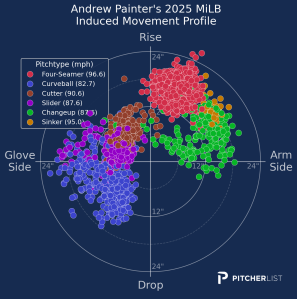
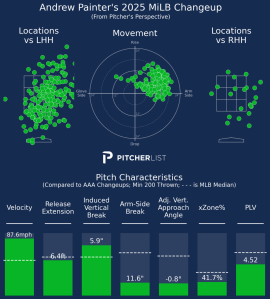
Pitcher List has beautiful player cards for each minor league pitcher that are only available to Pro-level members and staff. The cards show info for each pitch type as well as a movement chart for the entire arsenal. These cards use Statcast data to calculate a pitch level value for each type of pitch thrown by a pitcher.
In 2026, I hope to incorporate this data from opening day so that we can develop a more intuitive sense as to how a prospect’s pitches are comparing against the average or even to himself over time. I find the Stuff+ scaling is a bit easier to absorb, but it doesn’t exist in a freely public way at the minor-league level.
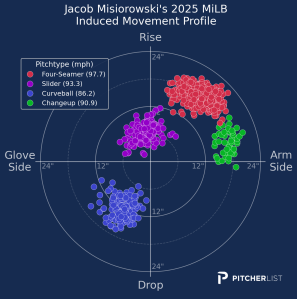
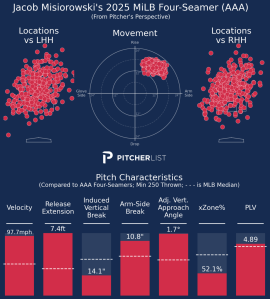
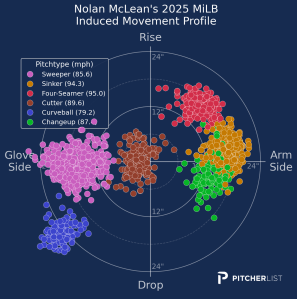
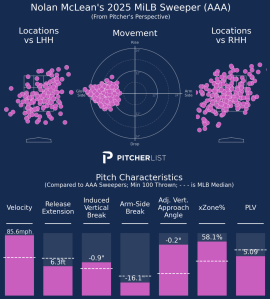
Therefore, it would behoove dynasty managers to adopt a system of assessing a pitcher’s arsenal. The other nice thing about the PLV model is that it breaks down the pitches by an opposing batter’s handedness. The splits data is rare to find and, therefore, is valuable when assessing pitch mix changes over time. There was a time when Andrew Painter wasn’t throwing a changeup, which may have been a result of easing back from the arm injury. Or maybe he wasn’t facing many right-handed batters since he rarely throws them the changeup. Either way, the PLV data easily highlighted this and made it a point of emphasis when completing the task outlined in my final lesson.
Watch More Baseball
The number one thing that I learned by doing the weekly stash list is that there are virtually no free video scouting options for the majority of pitchers in the minor leagues. I love baseball and spend a lot of time thinking about baseball, but I don’t have the luxury of watching many live games. All minor league games are available (*save for a few stadiums without cameras) once you subscribe to the MLB At Bat app, which is a $30 annual subscription. After a few weeks of trying to find game footage for mysterious prospects like Gage Jump on the internet and social media, I just decided that I would capture and post the game footage myself. One of my first game clips below:
Noah Schultz stays high on the stash list after a 6K: 2BB performance in the longest MiLB outing of his career with 5 IP. Got saved by his defense from any runs.
Light weight Sal Stewart propaganda: 2/3 off Schultz, added grand slam in 7th
Here is 1st inning from 4.12 start: pic.twitter.com/HYsb8fLqiR
— YGM Fantasy Baseball (@YGMfantasy) April 17, 2025
I embarked on a never-ending task of watching, editing, and posting game footage for every pitcher on the stash list. Once I figured out how to manage that, I branched out to emerging prospects or buzzworthy names. In fact, there should be 2025 game footage for every pitcher on the Top-100 list, and I tried to capture at least one game from everyone on the Top-400 lists (See Kenya Huggins below). Early on, I realized the value of having this snapshot of a pitcher, so I pledged to myself to make sure that I followed up with high-performing players at least a second time to use the footage for comparison. These game clips are important because they tell a story that the numbers cannot tell. They give dynasty managers more confidence in their roster decisions. And they offer a chance at conversation that numbers cannot always start.
Prospect Watch
Kenya Huggins
A+ Lansing ATH
6’3” RHP 22 yo6.4 A Daytona v Lakeland
4 IP 1H 0R 1BB 3K
12whiffs/63pitches4-pitch mix from 3/4 arm slot
FF 96 18” IVB
SI 94
CH 41%whiffs
7.2’ extension seems a touch hi but pops25: 22K% 10BB% 78 IP 3.82ERA 13SwK% 65strike% pic.twitter.com/cq8yUs97qH
— YGM Fantasy Baseball (@YGMfantasy) October 15, 2025
I hope to continue clipping games in 2026 to improve my own understanding of the art of pitching, as well as to improve the analysis that folks read in the weekly stash list.
The bottom line is, watch more baseball.
Adapted by Kurt Wasemiller (@kurt_player02 on Instagram & Threads @kuwasemiller.bksy.social on BlueSky)
