





A couple of weeks ago, I reviewed the offenses that had all but secured playoff baseball. We now have just 1 playoff spot, the AL West title, up for grabs, with the rest of the games mostly meaningful for seeding. Let’s wrap up what we started in that previous article and take a look at the offenses of the rest of the playoff field. As always, and for the last time of the season, we’ll do this through the lens of their swing decisions and general approach at the plate.
Here at Pitcher List, we have a suite of PLV metrics to analyze every pitch in a baseball game. Decision Value (DV) is our hitter swing decision metric. It takes inputs like pitch velocity, location, and movement, and tells us whether the hitter made a good decision to swing or take a particular pitch. This isn’t quite as simple as plate discipline; swinging at a Logan Webb sinker and pounding it into the ground is a bad outcome even if the pitch was a strike.
Instead, Decision Value rewards hitters for swinging at pitches they should be able to hit hard, and for taking pitches they’re unlikely to do much with. The flip side is that Decision Value punishes hitters if they don’t swing at pitches they should be doing damage on or swing at pitches that are unlikely to generate quality contact. You can find a much more thorough introduction to PLV metrics and Decision Value here.
San Diego Padres
The Padres offense has changed remarkably in the second half, ascending from a 90 wRC+ before the break to a 119 wRC+ afterwards. The change hasn’t been driven by different personnel, but by core personnel returning to levels they’ve shown earlier in their careers. Xander Bogaerts hasn’t exactly returned to his peak Red Sox form, but he’s been worth nearly two and a half wins on the strength of excellent defense and nearly average offense. He’s producing a 101 wRC+ in the second half and has an excellent 127 DV on the season. Bogaerts’s 22.7% chase rate is the best rate of his career, while he’s swinging at 61% of strikes, a slight tick up from the past few years. Manny Machado has a 107 DV despite his .218/.306/.404 line, producing a 99 wRC+, the lowest of his career since a 200 plate appearance sample as a 19-year-old. Jackson Merrill has a 106 wRC+ for the season, courtesy of a .254/.302/.442 line. He has the worst approach of the Padres’ regulars with just an 81 DV, thanks to a persistently high 37.3% chase rate and a zone swing rate that has declined from nearly 80% to 77.8%.
The most pleasant surprise for the Padres this season has been Ty France. The 32-year-old journeyman started his MLB career with the Padres in 2019, before moving to the Mariners in 2020. He had a three-year peak from 2020-22 where he was consistently about 30% better than average at the plate by wRC+ thanks to an average-heavy .285/.355/.443 line. The last couple of years were less appealing, with a below-average bat and poor defensive numbers leading to France spending 2024 and 2025 with four different teams. This season, France has been the best hitter on the Padres by wRC+, 1 point ahead of Samad Taylor in triple the playing time. France has an above-average 103 DV, with his strength being aggressive in the zone. I’ve written about 25 of these articles this season, and he’s the only hitter that I can recall with an above-average DV, above-average zDV (111), and below-average oDV (96). France has added a tick of bat speed this season and gained 2 mph in average exit velo, up to a career-high 91.7 mph.
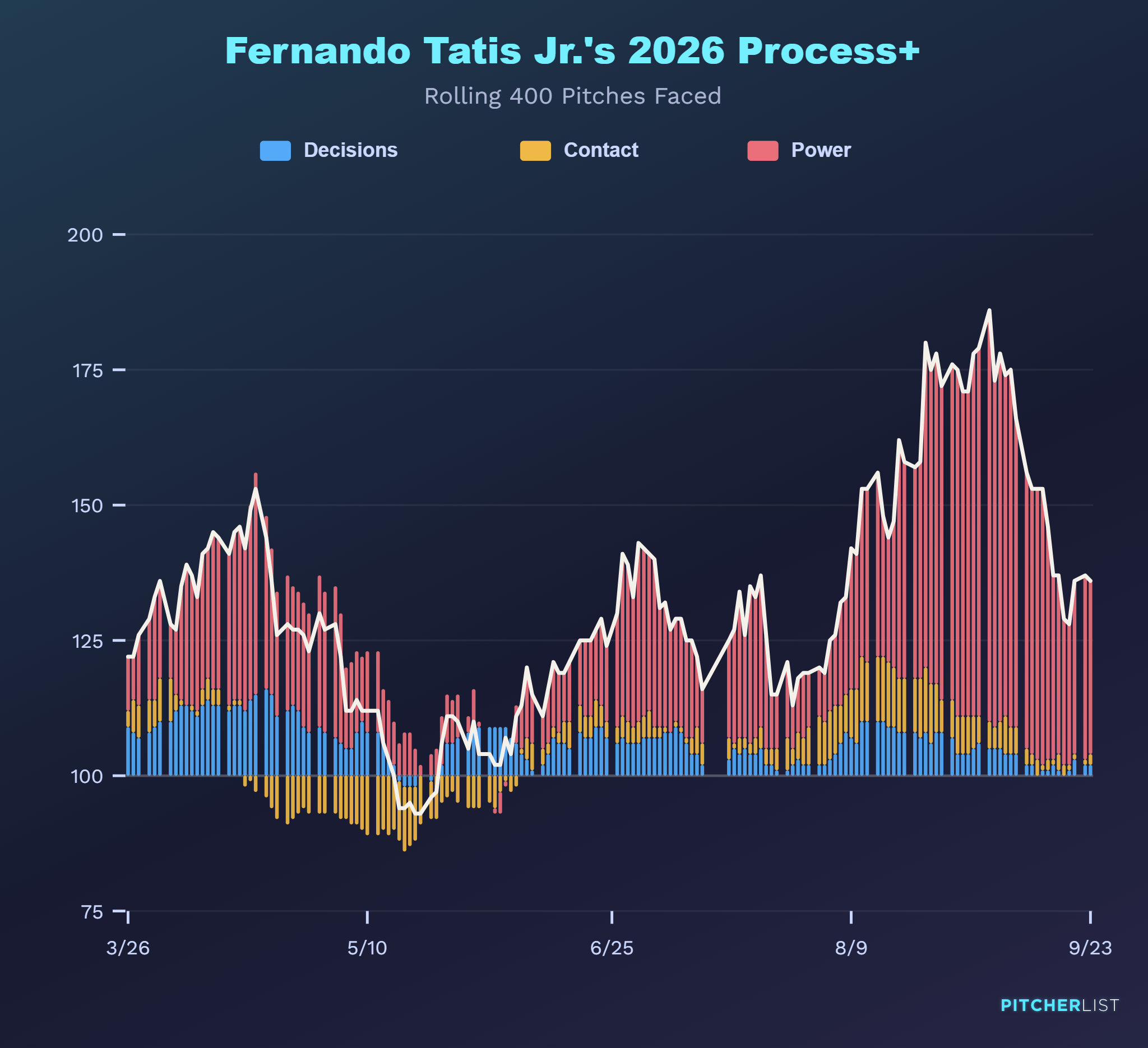
No discussion of the Padres’ resurgence is complete without Fernando Tatis Jr. making an appearance. Recall that the rolling graph above measures his Process+ over the preceding 400 pitches; all of that power in the first month of the season is influenced by his .293/.352/.549 line in September of 2025. In early May, when the data covers most of April, his power had nearly disappeared, and it remained low until early June. In the second half of the season, he’s been a one-man wrecking ball, hitting .303/.380/.615 with 20 homers. Tatis ranks well by DV (112), about a standard deviation better than average. Tatis started his career as a hyper-aggressive hitter, with zone swing rates peaking close to 80% in 2021 and 2023. He also chased more than you’d like early in his career, swinging at about 30% of balls in his first 5 seasons. He’s toned it down a bit recently, chasing only 26.5% of the time this season, but only swinging in the zone 67.4% of the time, too. The upshot is the lowest swinging strike rate of his career, although his CSW is up a point thanks to called strikes. His walk rate is a bit below his career average, but still a solid 9%, and he’s cut his strikeout rate to 18.6%. When you hit the ball 93 mph on average, it’s usually a good idea to put it in play. The biggest issue for Tatis has been a decline in his average launch angle to around 5 degrees this season. He’s lifting the ball a bit more in the second half, up to 6.5 degrees, but you’d much rather see the 10- or 11-degree average launch angle he posted from 2023-24.
Houston Astros
It would be easy to just write “Yordan Alvarez” and move on, but that would be a disservice to the rest of the Astros. Isaac Paredes, Jeremy Peña, and Yainer Diaz have all been above-average hitters by wRC+, with Diaz and Paredes having taken significant steps forward in the second half. Paredes leads the Astros in DV with a 114. Paredes has actually chased at a near-career-high rate this season, but thanks to seeing 3 percentage points fewer pitches in the zone, it’s only had a small impact on his walk rate. Paredes is fourth in MLB with a 33.5% pull air rate, but that’s a 5 percentage point decline from last season.
Unlike Paredes, most of the other Astros regulars don’t rank particularly well by DV. Peña, Diaz, and Jose Altuve score 85, 83, and 79, respectively. Diaz and Peña are both very aggressive at the plate, with slightly above-average zDVs offset by well below-average oDVs. The challenge for Peña is a declining contact rate, which reached a career-low 70.6% this season. His chase rate is up a couple of points to a career-worst 38.8%, but he’s never had a season below 35.5%. He’s swinging at 74.2% of strikes, the second-highest rate of his career, but his zone contact rate is the worst of his career at 84.3%. Despite seeing 2 percentage points fewer strikes this season, he’s added 7 percentage points to his strikeout rate. Diaz chases at rates that make Peña look like Taylor Ward. Diaz’s 42.6% chase rate this year represents a career-best. His second-half resurgence (.858 OPS vs. a .688 OPS in the first half) coincided with a 4 percentage point increase in his chase rate. Altuve has always chased too much, but his chase rates have been worse recently, with his 36.8% this season sitting above any other season from 2012-23. He’s been average at the plate by wRC+, with the main culprit being a decline in his signature contact ability. Early-career Altuve had contact rates around 90% and stole upwards of 30 bases, peaking at 56 in 2014. Chandler Simpson at second base was an excellent value proposition; adding 20+ homers a season made Altuve a star. Recently, Altuve’s contact rates have been in the low 80s, with this year’s 79.2% marking the first time he’s slipped below the 80% mark. Peak Altuve was an incredible player, but it looks like we’re approaching the end of his Hall of Fame career.
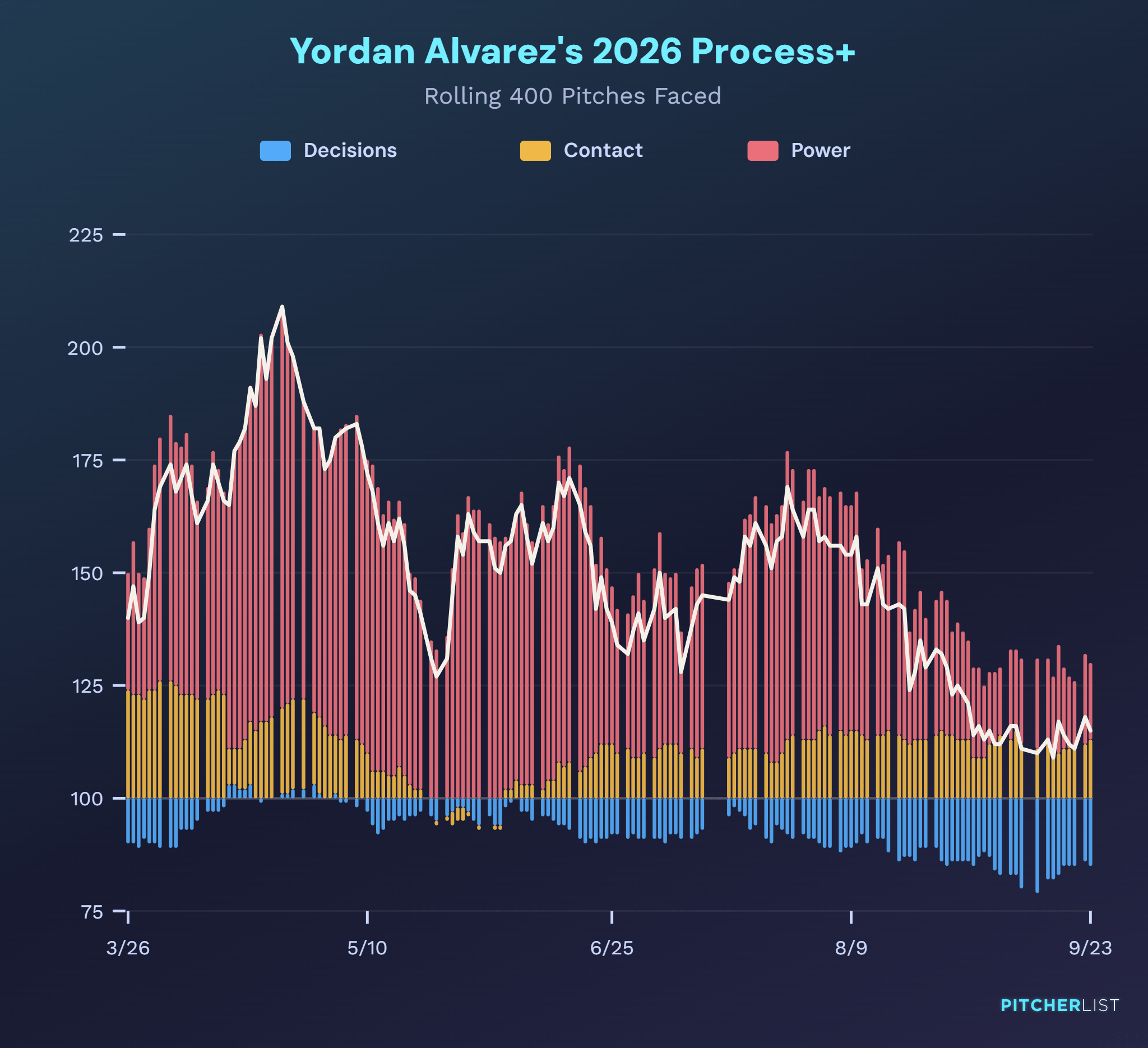
Alvarez is the engine of the Astros’ offense, the best pure hitter in the game. I originally had a “perhaps” qualifier in that last sentence, but there’s no doubt in my mind anymore. His 181 wRC+ is 23 points above Pete Crow-Armstrong in second place; the 4 WAR difference in their seasons is more than explained by PCA’s better baserunning and 40 extra runs of defensive value. Alvarez doesn’t stand out for a particularly strong plate approach – more detail about him here – but his approach has deteriorated in the second half of the season. He’s still an absolute force offensively, but he’s chasing 5 percentage points more often in the second half with a slight decline in his zone swing rate. He’s back to swinging at two-thirds of the strikes he sees in September, though, so I don’t think there’s too much room for concern here.
Texas Rangers
The Rangers had the 10th-best offense by wRC+ in the first half, but declined to the 14th-best offense in the second half of the season. Josh Jung has been quietly excellent, hitting for a .294/.358/.448 line that is 30% better than league average. He hasn’t shown the 30-homer power that his rookie season promised, but his strikeout and walk rates have taken big steps forward this season. He’s walking nearly 8% of the time, 2 percentage points more than his previous best, while cutting his walk rate from 25.2% to 18.2%. His DV is still just 91, courtesy of a 29.2% chase rate that is still a 4-percentage-point improvement on his 2025 mark. Joc Pederson was Jung’s equal in wRC+, but with a very different shape to his production, until a left wrist fracture landed him on the IL. He’s eligible to return for the postseason if he’s healthy and the Rangers qualify. Justin Foscue has also been a quiet 131 wRC+ producer. He has an average 100 DV, thanks to a slightly better-than-average 27.6% chase rate and a 5-percentage-point decline in his zone swing rate. He’s shown a little more power than Jung this year, but I’m skeptical based on his 71 mph bat speed and 89 mph average exit velocity.
The offensive core for the Rangers tends to rank pretty well by DV despite fairly disappointing seasons at the plate. Wyatt Langford has had the best offensive season of the rest of the Rangers and ranks fairly well with a 113 DV. Langford has been noticeably more aggressive at the plate this season. He’s chasing 3 percentage points more often, but he’s also swinging in the zone nearly 5 percentage points more often. On net, that’s a positive change. Corey Seager has traditionally been the archetype for hitters with an excellent plate approach. He’s down at a 112 DV, which is still solid. He’s swinging at 82.2% of strikes, the second-highest rate in the majors, while keeping a 60th percentile chase rate of 28.3%. His 53.9% zSwing-oSwing leads the majors, but he’s been unlucky when it comes to results. His bat speed is down a tick this season, but his Statcast expected stats suggest he should have another 23 points of average and 55 points of slugging percentage.
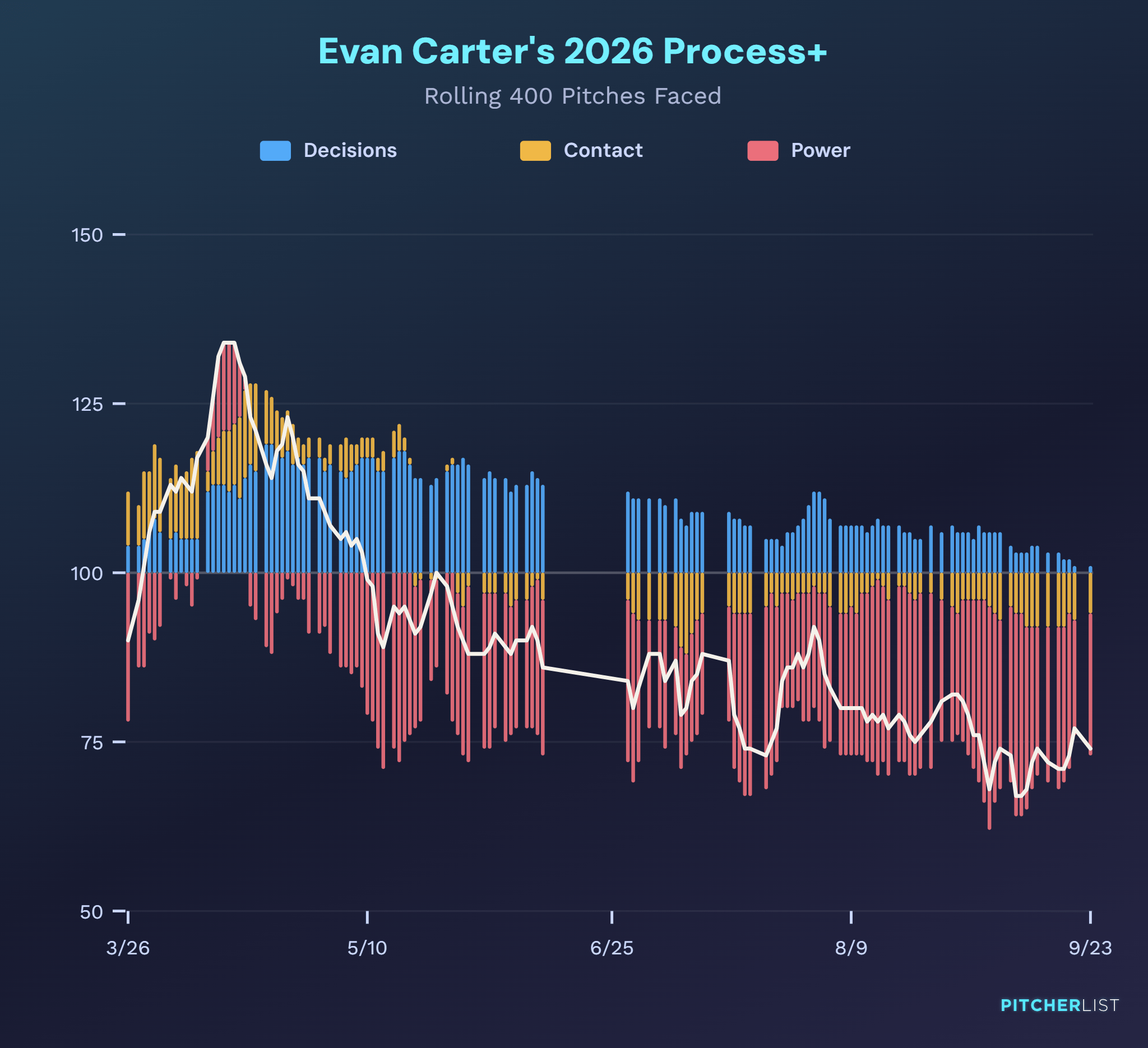
Evan Carter has an excellent 119 DV, but that’s where the positives end for the one-time top prospect. He’s always been able to avoid chasing, with this season’s 21% being a career-worst. His zone swing rate has taken a step back to 60%, down from 65.7% last season. His bat speed is up 1.5 mph from last year, but his average exit velocity remains a disappointing 87.6 mph. Combined with middling contact rates, it’s tough to be optimistic. At least his glove has been a plus this season, but nothing is pointing to a breakout at the plate in the immediate future.
Cleveland Guardians
The Guardians’ offense isn’t a strength, although they have improved from 26th by wRC+ in the first half to 12th in the second half. Steven Kwan, Travis Bazzana, and Angel Martínez are all about 10 percent better than league average at the plate. Kwan and Bazzana have particularly strong approaches, with DVs of 116 and 115, respectively. Kwan has hardly swung the bat this season, swinging more often than only Taylor Ward among qualified hitters. Bazzana has been substantially more aggressive, with his 26.5% chase rate and 64.6% zone swing rate yielding above-average marks in both zDV and oDV. Martinez, on the other hand, is not a paragon of a good approach. He chases 42.1% of the time while swinging in the zone 66.2% of the time. He has a 63 DV, with below-average marks in both zDV and oDV. He’s added 2.5 mph of bat speed over the past two years, leading to a career-high, if modest, barrel rate of 7.6%.
José Ramírez is the Guardians’ major question mark this season. He’s never put it together, finishing the season with a below-average wRC+ for the first time since 2015. He has a 97 DV, with his chase rate taking a step back in recent years to close to 30%. He’s lost a tick-and-a-half of bat speed over the past two years, which is concerning for a player who has always gotten to more power than his raw measurables would suggest. He’s not whiffing or striking out much at all, and has maintained a pull air percentage of nearly 30% this season. Statcast thinks he’s underperformed his batted-ball quality this season, and most of his profile remains in line with career norms. With six more years on his contract, the Guardians have to be hoping this is a momentary blip and he’ll see a return to expectations in the near future.
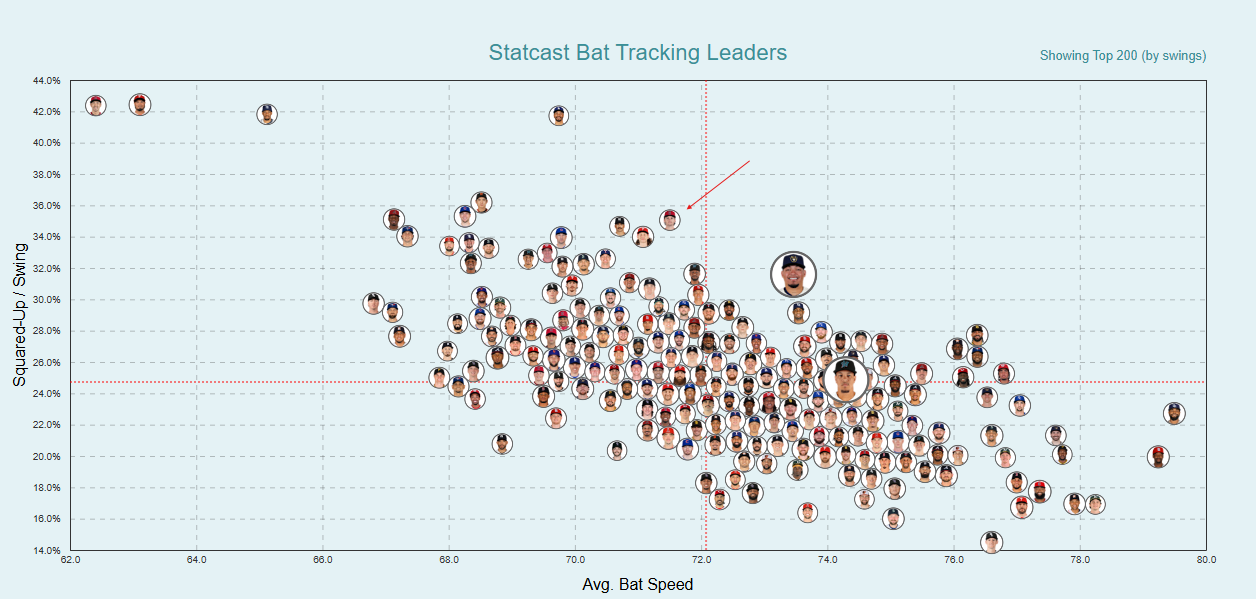
Chase DeLauter has been the best offensive player on the Guardians. He’s had a very successful rookie season, hitting .290/.364/.455. He has a strong approach, with a 111 DV based on a 21.4% chase rate and a 65.6% zone swing rate. DeLauter’s main skill appears to be making the most of his average bat speed. There’s generally a negative relationship between bat speed and squared-up rate; DeLauter (indicated with an arrow above) sits well above the average squared-up rate for batters with his bat speed. That ability has been part of Mookie Betts’s success despite his below-average bat speed. As a result, DeLauter has an 85th-percentile average exit velocity despite a 37th-percentile bat speed.
