







Pro$pect Hype to Ca$h In On
Hip hop runs through my veins the same way baseball does. I can still remember spending hours digging through CD stacks at Wherehouse or Amoeba Music, hunting for something new to listen to. I’d take an album home and dub it onto a cassette — this was long before digital music, and even a few years before cheap, reliable CD duplication was common.
I had a system: I’d listen to an album, and if it wasn’t an instant banger, I’d dub it, return it, and get a small store credit to put toward the next find. I repeated this cycle until I hit the return limit. Artists like Boot Camp Clik, Redman, 3xKrazy, and countless Bay Area artists ended up on my blank cassettes. I was essentially trying to predict my future enjoyment of an album — and if it didn’t hit, I cashed in.
Below is a guide to which hyped prospects you should CA$H IN on while their value peaks — and which breakout candidates you should SPEND CA$H ON before they explode.
Extraordinary Performance
A few prospects who raised their profile with great results in a short time period.
Trey Yesavage, Toronto Blue Jays
Trey Yesavage capped an incredible 2025 by taking the mound in Game 7 of the World Series — the final stop in a season where he climbed through all five levels of pro ball and never missed a beat. He logged 139.2 innings and fired more than 2,300 pitches, easily the most demanding workload of his young career. For comparison, he threw just 93.2 innings at East Carolina in 2024, roughly 800 pitches based on his strikeout and walk totals.
Back in the preseason, I flagged Yesavage as a pitcher to watch, mainly to see whether he could sharpen his control. He didn’t just improve — he leveled up. Aside from a brief dip in command during his Triple-A stint, Yesavage lived around a 36% strikeout rate with an 11% walk rate all year, then carried nearly identical numbers (36 K%, 10 BB%) into October. His signature moment came in Game 5 of the World Series, when he struck out 12 over seven one-run innings to secure his third postseason win.
TOR RHP Trey Yesavage vs LAD (Game 5)
7 IP, 3 Hits, 1 ER, 12 Ks, 44% Whiff%
Slider: 4 IVB, 5 HB at 89 MPH
Splitter: 9 IVB, 13 HB at 84 MPH
Fastball: 19 IVB, 6 HB at 94 MPH pic.twitter.com/fqyhdjSYzB— Baseball Unstitched Podcast (@BaseUnstitched) November 4, 2025
Most evaluators will focus on his splitter and the advantage created by his high release point, but don’t overlook the slider. It’s a legitimate weapon and a key part of why hitters struggle to stay balanced against him.
Yet, is it too much to ask for Yesavage to reach this level again in 2026? Could he be cooked after putting so much mileage on his arm? Well, for those who lean towards pessimism about his immediate future, CA$H IN now. In trade talks, you could form a cogent argument that he is the number one prospect pitcher over Nolan McLean. So, why not get commensurate value?
Carter Jensen, Kansas City Royals
Carter Jensen delivered a strong debut, even if he didn’t quite elevate his stock to the same level as Yesavage. In a year when it was tough to find a hitter who performed well and still maintained prospect eligibility, Jensen earns a spot here simply because his short run was that good. After launching 13 homers and posting an OPS north of 1.000 across July and August, he earned a September call-up to Kansas City — and he validated the decision right away. Jensen hit .300 by pairing tons of contact (84%) with ideal launch quality (21% barrel rate) and plenty of thump (58% hard-hit rate).
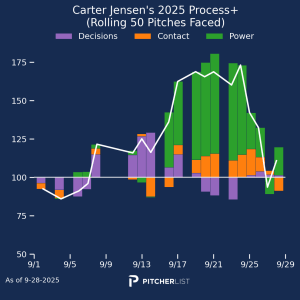
Jensen’s PLV data underscores just how impressive his performance was. With the minimum filter set at 50 pitches seen, he ranks 5th on the Process chart with a score of 138 — a combined measure of Decision Value, Contact Ability, and Power. While his Power drives most of that score, he’s above average in all three categories (over 100), and he also checks in above 100 in Strikezone Judgment. In short, Jensen consistently made smart decisions at the plate and punished pitches when he connected.
Another one for Carter Jensen. Third of the series. He’s on another level at the moment. pic.twitter.com/XpPYPrfGRQ
— Preston Farr (@royalsminors) July 2, 2025
The main obstacle for Jensen in 2026 will be finding a spot in the lineup. With Salvador Perez being re-signed and the team already having a bunch of left-handed hitters, Jensen may have a slow start simply due to a lack of playing time. On the other hand, Perez and he form a nice platoon duo. In addition, there is absolutely no reason that Kansas City needs to remain loyal to Jonathan India as the designated hitter. Therefore, SPEND THAT CA$H and grab Carter Jensen where you can because he may be about to break out in a big way.
Considered: Sal Stewart, but I would definitely buy!
Do You Believe?
A few prospects who could return your dynasty team a ton of value since they are at the top of the rankings.
Konnor Griffin, Pittsburgh Pirates
The hype around Konnor Griffin is about to go nuclear once fantasy players start prepping for their spring drafts in February. As soon as they dive into those “most likely to impact 2026” prospect lists, they’re going to see one name over and over again: Konnor Griffin. He was the only minor leaguer to hit 20+ home runs and steal 60 bases, and his production across all levels (A–Triple-A) was elite. Griffin finished second in runs scored (117), second in wRC+ (165), and tenth in OPS (.941).
At this point, the hype is almost too good to be true — he reportedly performed the Heimlich on a choking teammate, rescued a cat from a tree, and bought out 10 lemonade stands on his way to a game in Altoona. None of that happened, but Griffin can seemingly do no wrong, and his value might be as high right now as it will ever be before he even steps on a major league field.
The FINAL @ProspectLarceny top hitting prospects update of the season!
1. Konnor Griffin 🎦
2. Jesús Made
3. Kevin McGonigle
4. Colt Emerson
5. Aidan Miller
6. Samuel Basallo
7. Walker Jenkins
8. John Gil
9. Nelson Rada
10. Max ClarkWhat a season it has been!
Become an STS… pic.twitter.com/0I0F5PgLIe
— Scout the Statline (@StatlineScout) September 24, 2025
Griffin is going to be everywhere this offseason — on the cover of prospect guides, splashed across fantasy articles, and highlighted by analysts as one of the top two candidates to debut in 2026. And sure, all that hype might prove justified. But what if it doesn’t? Or what if the breakout doesn’t happen this season? For dynasty managers with a shorter competitive window, this could be the perfect moment to CA$H IN as his value may never be higher than it is right now.
A counterpoint: I am going to keep Griffin as one of my four keepers in a head-to-head category league. I believe that I can draft a suitable shortstop holdover until he makes his debut.
Travis Sykora, Washington Nationals
You may not have the same situation, but I find myself with Gerrit Cole, Jackson Jobe, and Travis Sykora on the same dynasty team. A year ago, I was drooling over the possibilities, but now I face a decimated pitching core. Given the dire circumstances, I may need to cut bait on one of them to clear IL spots so that I can contemplate competing in 2026.
After a hip injury delayed the start of his 2025 season, Sykora wasted no time making an impact. He struck out 23 of the first 38 batters he faced, posting a 24% swinging-strike rate, and the buzz around him only grew as he climbed the prospect list. By the time he reached High-A Wilmington, his strikeout rate had surged north of 40%. He also began logging 90+ pitches per outing, with his strike rate settling at 64% and his walk rate dropping to a solid 7%.
Could he be the real deal? The 6’6″ right-hander made two Double-A starts before landing on the injured list for reconstructive elbow surgery. Mechanically, Sykora’s long levers create both potential and challenge. His setup involves a lateral step before driving his knee sky-high — nearly to the level of his nose — which can occasionally throw off the timing of his plant foot and release. With so much motion packed into each pitch, some hitches are inevitable. If he can clean up the timing upon his return, his upside could be enormous.
Prospect Watch
Travis Sykora
Promoted A+ Wilmington WAS5.25 v Aberdeen
4 IP 1H 0R 0BB 9K
15 whiffs/64 pitchesDominant debut. Only 4 ground balls in play, faced one over the minimum as he picked off the only batter he walked. Major dynasty add if somehow still on the wire. pic.twitter.com/rJNSeYs8oh
— YGM Fantasy Baseball (@YGMfantasy) May 28, 2025
Yet, you don’t need to reveal any of this to your trade partner. You show them the shiny stats of a greater than 30% K%-BB% and greater than 20% swinging strike rate over the last two seasons and CA$H IN.
Considered: Max Clark DET, who I would SPEND CA$H ON!
Off-Season Standouts
A few players who are generating some buzz while getting extra reps in the quiet part of the off-season.
Arizona Fall League
Esmerlyn Valdez, Pittsburgh Pirates
If you have listened to any fantasy baseball podcasts in October, you probably heard that Esmerlyn Valdez is close to setting the Arizona Fall League home run record after smashing eight dingers in the first two weeks of play. Guess what? He probably won’t set the record, as he hasn’t hit any home runs since launching number eight on October 21. Undoubtedly, there is a great talent here with demonstrable power, but he was also putting up an OPS of less than .635 in two out of his three months at Double-A.
Another Prospect I’m following in 2026 is Esmerlyn Valdez.
The 21-year-old posted an impressive 156 wRC+ across A+ and AA with 26 HR and a .286/.376/.520 slashline. He already can pull the ball in the air with authority (28.4% Pull Air%/11.5% Brl%) and had a 104.9 MPH 90th% EV. pic.twitter.com/XLZt7rNuLC
— Running From The OPS (@OPS_BASEBALL) September 24, 2025
With back-to-back 20+ home run seasons, he also improved his plate discipline to be a power hitter with a 25% strikeout rate, a 10% walk rate, and 11% swinging strike rate. At 22 years old in the spring, he may not need to be a part of your dynasty team if you need help in 2026. CA$H IN on the “AFL HR Leader” to see what other teams will offer.
Karson Milbrandt, Miami Marlins
At 6’2″, Karson Milbrandt doesn’t have the towering frame of Sykora, but his delivery is just as deliberate. His full wind-up starts with a long step to the side, followed by raising his hands fully over and behind his head. From there, he drops the glove with his right hand tucked inside down to his chest before channeling all that energy toward home plate. It’s methodical — maybe even a bit over the top to an untrained eye — but it works.
Milbrandt is starting to earn attention after a strong showing in the Arizona Fall League. His best season came in High-A, where he posted a 30% strikeout rate, a 12% walk rate, and a 3.26 ERA. He carried that momentum into Double-A Beloit, recording three ten-strikeout games and generating a 16% swinging-strike rate, showing that his methodical delivery can produce serious results.
AFL Watch
Karson Milbrandt
AA MIA
6’2” RHP 22 yo8.22 Mesa v Surprise
2.2 IP 1H 1ER 2BB 7K
15whiffs/59pitchesRunning up to 98 FF balances w FC & CU
Elaborate windup is still be working, but wondering if it is too taxing. Look forward to more 4+ IP outings pic.twitter.com/gbj9ubgROA
— YGM Fantasy Baseball (@YGMfantasy) October 26, 2025
Milbrandt features a four-pitch mix in the AFL that all generate at least a 30% whiff rate. His arsenal is led by a 95 mph four-seamer and an 87 mph cutter, followed by a curveball and slider. The slider has been his go-to putaway pitch during the season, while the curve has been even nastier in the AFL, racking up a 60% whiff rate over the short stint.
While pitchers like Jake Bennett, James Hicks, Hagen Smith, and Anderson Brito are also turning heads in Arizona, Milbrandt may be the one to see the biggest jump. His future looks bright, but if you’re not sold on the windup or worry his results may not hold long-term, this could be the perfect time to CA$H IN.
Liga Venezuela
Are the Marlins going to make the playoffs in 2026? If they do, it will be because of strong starting pitching and overachieving performances from players like Maximo Acosta. Did you know Maximo has a 56% hard hit rate and a 13% barrel rate, along with hitting three home runs in his first nine games in the major leagues? I didn’t know that. Acosta is currently playing down in the Liga Venezuela, where he has five home runs, nine steals, a .393 OBP, and a .527 SLG in the first 23 games.
Así fue la semana de “EL GLADIADOR” Máximo Acosta🔥🦈
📸: Prensa TiburonesBBC#TiburonesReport pic.twitter.com/YLKFUdICXQ
— Tiburones Report (@TiburonesReport) November 10, 2025
He has experience at second base, shortstop, and third base, giving him many pathways back to the majors. In addition, he has also posted four straight seasons of at least 26 stolen bases. This is not a player to put a lot of money on, but he has opened up my eyes that there is more value than his scouting report would give him credit for. Time to SPEND CA$H on Maximo.
Liga de Beisbol Dominicano
Emmanuel Rodriguez, Minnesota Twins
Last season, I let Chase DeLauter go in a dynasty league after yet another injury sidelined him early. This year, I might have to make a similar call with Emmanuel Rodriguez in a different league if he can’t prove he can stay healthy. Naturally, his current value for dynasty managers is low. Any sign of improvement, though, could dramatically boost his trade stock.
Holding onto Rodriguez makes sense if you still believe in the high power grade from his scouting report and find some encouragement in the four home runs he’s already hit in 14 games in Venezuela. On the other hand, selling now could be justified if you focus on his injury-plagued 2025 minor league season, where he showed little power — just six homers and a .400 slugging percentage.
Emmanuel Rodriguez watches this one fly!
The @Twins’ No. 4 prospect (MLB No. 69) unloads on his 4th homer over 14 games in @LIDOMRD: pic.twitter.com/ikuEMaLkvS
— MLB Pipeline (@MLBPipeline) November 12, 2025
I lean towards the results and the fact that the Minnesota Twins already have a bunch of left-handed “power” hitters with contact and strikeout issues in Matt Wallner, Trevor Larnach, Edouard Julien, and Kody Clemens. If the Twins want to switch out one of those bats for a younger Rodriguez, then okay, but his path in 2026 is muddled. It is probably time for dynasty managers to move on, recoup some value, and CA$H IN on any buzz he generates this offseason.
Considered: Tony Blanco Jr. is playing in the AFL, but the poor hit tool seems like an easy reason to be skeptical, despite the huge power.
Pop Up Stars
A few prospects who made significant leaps on the rankings board.
Gage Jump’s rise from injury-riddled 2024 compensatory pick to one of the most exciting pitching prospects in baseball was nothing short of remarkable. By May, he had captured the attention of scouts and fans alike, thanks to impressive early performances that featured a 69% strike rate, a 16% swinging strike rate, and a 1.91 xFIP over six starts in High-A.
During this stretch, Jump not only proved himself as one of the top arms in the Athletics‘ system but also became part of a larger narrative: the A’s are developing a pipeline of promising pitchers. From Wei-En Lin and Kenya Huggins to Luis Morales, Gunnar Hoglund, and Jack Perkins, the A’s system is brimming with young talent that, combined with a deepening offensive core, could set up a bright future.
At 6’0″, Jump has developed a fastball that consistently sits at 97 mph, complementing it with a sharp curveball and slider that he uses to finish off hitters. His strike rate was solid in the first half of the season, hovering around 67%, but it dropped to 63% after his promotion to Double-A. Whether the decline was due to fatigue or tougher competition remains to be seen, but it’s clear that Jump’s strikeout rate (which had been 37% in High-A) and swinging strike rate (which had been 16%) also fell off, dipping to more average numbers at Double-A.
Prospect Watch
Gage Jump
AA Midland ATH7.3 v Amarillo
5 IP 3H 1ER 1BB 1HBP 5K
9 whiffs/76 pitchesAfter initial excitement, he has regressed to average rates in AA: 26K% 10BB% in 47.1 IP.
Was doubtful on arm health due to perceived hitch, but motion aids deception. pic.twitter.com/xqGdLT3PhZ
— YGM Fantasy Baseball (@YGMfantasy) July 8, 2025
Fortunately for the Jump believers, he closed the season with two strong outings, topping 90 pitches in both and piling up eight strikeouts each time. Still, those final flashes of promise don’t erase a rough two-month stretch where he posted a 6.03 ERA, allowed a sky-high 59% fly-ball rate, and paired a merely average 24% strikeout rate with a 7% walk rate. If the hype train keeps rolling and others keep pumping helium into his profile, you might want to seize the moment — and CA$H IN.
Edward Florentino, Pittsburgh Pirates
Edward Florentino is giving me serious 2024 Kristian Campbell vibes. Campbell got all the attention for mechanical tweaks to his swing, and the early results were impressive — he earned Minor League Player of the Year honors, sending his profile and expectations soaring. Through March and April, it looked justified: four home runs and a .301 average.
But as the season wore on, pitchers challenged him with more offspeed and breaking stuff, and his production cratered. After finishing 2024 with a 20% strikeout rate in the minors, Campbell struggled over his final 38 games in Boston, posting a .159 AVG, .243 OBP, .222 SLG, and just two home runs, with a 28% strikeout rate. While he was still hitting the ball with the same velocity as in the minors, more of his contact was on the ground. The early hype couldn’t hold, and by June, Campbell had disappeared from many fantasy rosters.
Edward Florentino’s numbers by month
May: .273/.385/.509, 3 HR, 4 SB
June: .364/.443/.636, 3 HR, 5 SB
July: .364/.400/.909, 3 HR, 3 SBCrazy to think he’s the same age as a lot of the high school players that will get drafted next Sunday pic.twitter.com/g1Ywr88m20
— James Weisser (@JWeisser88) July 7, 2025
Turning to Florentino, he’s shown a balanced approach at the plate that keeps his swing-and-miss rate low — just 6% in Single-A. In 2025, he significantly improved his contact rate to 86% while maintaining his power (.258 ISO) and plate discipline (14% walks, 22% strikeouts). The 19-year-old outfielder’s meteoric rise from far outside the Top 200 to inside the Top 20 in a single season is exactly the kind of breakout dynasty managers dream about.
That surge in value also presents a strategic decision: Florentino isn’t expected to reach the majors until 2029, so managing his hype requires careful timing. While his growth isn’t as dramatic or risky as Campbell’s, expectations for Florentino have skyrocketed, and fantasy chatter will only amplify the narrative of his potential. The smart move? CA$H IN now and use that value to make your 2026 fantasy roster as strong as possible.
Considered: Luis Pena, but I don’t want to put shade on his name.
Record Setters
A few players who will get an extra bump due to the bias of being the first name seen on a list of category leaders.
Kendall George, Los Angeles Dodgers
Kendall George had to put in a statistical sprint in his final week to pull a Chandler Simpson and reach triple digits in steals. Over six games, he swiped 15 bases and was caught just once, pushing him to the century mark. Even more impressive, he stole 34 bases in August while posting a .934 OPS.
Speed is clearly his greatest weapon, but his hitting is equally intriguing. The 5’9″ left-handed outfielder sprays 52% of his batted balls to the opposite field, with 60% of those on the ground — a clear sign he’s leveraging his proximity to first base and applying a deliberate, thoughtful approach at the plate. George is also showing strong discipline: a 16% walk rate, 15% strikeout rate, and just 6% swinging-strike rate.
Kendall George is 3 stolen bases away from 100 on the season!
He has 19 more steals than the next closest minor leaguer (Asbel Gonzalez at 78). pic.twitter.com/c58mrKWt82
— Ross Jensen (@RossJensen12) September 4, 2025
With this gushing report on his profile, you would imagine that I would advocate holding onto this prospect. Quite the opposite. CA$H IN now on George because it is more likely that he turns into a fourth outfielder type than a fully fledged starter. See Victor Scott II and get your value back now.
The top minor league pitcher didn’t translate into the top rookie in the majors, and it might be wise to recoup some value before his profile slips further. Under the surface, Jonah Tong’s pitch metrics look nearly identical across Triple-A and the major leagues: velocity, vertical and horizontal movement, extension, and release height all fell within expected ranges.
The problem? Major league hitters weren’t missing nearly as often. Every pitch type generated fewer than 22% whiffs, and his fastball strikeout rate dropped from over 40% in Triple-A to just 31% in the majors, with opponents putting more balls in play (.312 average). Some adjustment is always expected when moving up a level, but a 22-year-old with only 11.2 Triple-A innings is a recipe for continued struggles. It wouldn’t be surprising to see him start 2026 back in Syracuse.
Stash List Add!
Jonah Tong
AAA DEBUT Syracuse NYM8.16 v Rochester
5.2 IP 3H 0R 2BB 9K
18whiffs/90pitchesExpressive SP who enjoys the game
Elite 6.9’ extension w 5.8’release ht
FF 96 18.7”IVB
CH 55%CSW 13”break
CU 60”drop! 2650rpm
SL 7” break&dropLet’s see how mix evolves pic.twitter.com/ulTHMqp69C
— YGM Fantasy Baseball (@YGMfantasy) August 17, 2025
Therefore, dynasty managers need to consider how they may affect their starting rotation and may want to CA$H IN on the Jonah Tong name value now.
Photos by Icon Sports Wire | Graphic by Carlos Leano
