





The end of the MLB regular season is in sight, and fantasy playoffs are reaching their conclusions, so what better time to take a step back and assess the performances of ten outstanding young players who could become stars in the coming years. There are 10 total players featured in this article, so each section is aimed at highlighting standout features of each player’s profile and projecting their future role, as opposed to a full, in depth breakdown of each.
For the purposes of this article, we’re focusing on late-season MLB breakouts, as well as standout performers during the entire 2025 MiLB season. Rookie of the Year candidates like Nick Kurtz, Cade Horton and Roman Anthony will not feature on this list, as their roles with their respective organizations is effectively locked up going forward. Instead, we’re focusing on MLB players who made headlines over the last 1-2 months of the season, and could use their newfound notoriety to thrust themselves into being key pieces for their teams in the coming years.
This is not an exclusive list. There are dozens of players who performed above expectations and could fall into the “breakout” category. The players selected (in my subjective opinion) have generated the most “buzz” around their futures as dynasty assets, as well as put together an outstanding resume over the course of the 2025 season.
MLB Rookies
MLB Stats updated as of 9/16
Nolan McLean, SP – New York Mets
What in the world happened to the Mets’ rotation. Kodai Senga was optioned to AAA. Tylor Megill and Griffin Canning are on the injured list, and Sean Manaea is pitching out of the bullpen. For most other teams around the league, that amount of pitching atrophy would lead to a complete disaster. Instead, the Mets have a 3.97 ERA from starters this year (13th in MLB). A big part of that stability has been the rise of Nolan McLean.
In his big-league debut, McLean showed flashes of what’s to come. He struck out eight Mariners and allowed just two hits en route to his first Major League win. McLean’s best start came eleven days later, when he shut the Phillies out over eight innings, striking out six in a vital win over their division rivals. A quick glance at McLean’s arsenal makes it obvious why he’s been so successful.
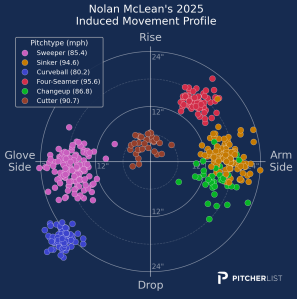
McLean’s pitches all movement in a unique manner, and he’s able to force hitters into uncomfortable swings due to the uniformity of the release point he throws them from (apart from the four-seamer, which is slightly higher and more to the glove-side). That six-pitch mix allows McLean to be equally dominant against lefties (.197 BAA) as he is against righties (.190), despite a unique difference in pitch distribution. Unlike other pitchers who abandon certain pitches depending on the handedness of the hitter, he simply adds two offerings to his repertoire whenever a lefty comes up.
If the Mets make the playoffs (79.2% chance per Fangraphs), McLean is making a compelling case to be one of the arms called upon to start in the Wildcard Series. Clay Holmes and David Peterson have earned their opportunity to start too, but that third spot may come down to the trio of rookies in the Mets’ rotation right now. Due to Sproat’s lack of track record, and Tong’s 14 runs allowed in three starts, McLean is in the best position to land that role. That should lock McLean into one of the five rotation spots in 2026. With McLean’s upside and likelihood of sticking in the rotation, he’s one of the safest breakout rookies to roster/acquire. If you can trade for, or by some miracle add McLean, do it.
Cam Schlittler, SP – New York Yankees
Schlittler has become a reliable arm in a Yankees rotation that desperately needed one. Gerrit Cole was doomed to miss the entire season with Tommy John in March, and Clarke Schmidt joined him on the injured list in July. With Luis Gil not due back until August, New York needed someone to hold down a rotation spot and keep the Yankees pitching afloat until reinforcements arrived. Schlittler did that and then some.
Schlittler made his debut at home against the Mariners (huh, another rookie pitcher debuts against Seattle), striking out seven and allowing three earned runs (two home runs) en route to his first MLB win. His first five outings weren’t bad, but they weren’t outstanding either. Schlittler allowed 2+ ER in each of his first five starts, and failed to reach the sixth inning in any of those outings. He broke out over his next four starts though, allowing two runs in the next 23.2 IP, striking out 30 (34.1%) and allowing just eight walks. Two of Schlittler’s last three outings haven’t been good, but he’s still showing flashes of dominance (7 K’s, 1 ER in 6.0 IP vs. DET).
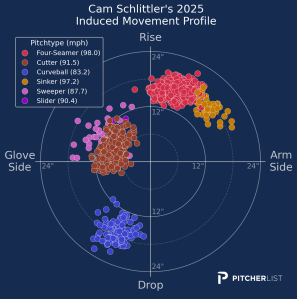
Schlittler’s induced movement profile is a unique one, because three of his pitches appear to break the exact same way. The sweeper, slider and cutter all move sharply to the glove side with just 3-4 miles an hour of velocity separating them. Additionally, the attack plan between lefties (.244 BAA) and righties (.223) is nearly identical. Schlittler goes to the four-seamer over 50% of the time against both, with the cutter serving as his secondary option to both. The lone difference is Schlittler’s tendency to go to the sinker/sweeper against RHH, and stick with the curveball against LHH. Despite the unique nature of his arsenal, the results are there, and the Yankees will likely continue to ride the hot hand into October.
New York is uniquely aggressive when acquiring players, especially stars. However, this year’s starting pitching crop isn’t as robust as previous years. With Cole (hopefully) returning at full strength, an emerging star, and a relatively weak free agent SP class, the Yankees could stick to their in-house options. If they do, Schlittler is in line for the #5 spot in the 2026 rotation, behind Cole/Fried/Rodon/Gil.
Sal Stewart, INF – Cincinnati Reds
MLB Stats
Stewart is the first of two players that I became very accustomed to this season while writing the weekly Hitter Stash List. At the start of the season, Stewart was assigned to AA and was expected to wait until at least 2026 for a debut. Instead, he dominated AA pitching en route to ten home runs, a .401 wOBA and a 146 wRC+ in 80 games with Chattanooga. Once he reached AAA, he was even better. Stewart doubled his home run tally in less than half of the games, adding another ten in just 38 appearances. He also improved his batting average (.315), walk rate (11.5%), wOBA (.438) and wRC+ (163) during his time in Louisville.
With the Reds still in the playoff hunt at the start of September, Cincinnati decided to promote their slugger to the Majors. He’s appeared in 11 games since his debut, hitting four home runs with a 145 wRC+. The underlying numbers are even better (20.7% Barrel, 48.3% Hard Hit), even if the plate discipline could use some improvement (40.3% Chase). The bat has translated to the Majors, no question about that, but the Reds have made a major change in terms of his defensive home. Stewart came up through the minors primarily as a second/third baseman, but has since been moved over to first base. He’s played eight games there, after just two professional appearances at first prior to joining the Reds. Considering the Reds’ struggled to lock down an everyday first baseman this season, it’s a perfect fit for Stewart. He has little competition for his spot in the lineup, and slides in nicely behind the other exciting bats in Cincinnati such as Elly De La Cruz and Noelvi Marte.
Stewart’s MLB performance, track record of offensive production, and willingness to move into a defensive spot where he has little blockage in, all bode well for his future outlook. Barring a major slump to end the season, or an ice cold spring, Stewart will open next season on the Reds’ roster, and should feature every day. Depending on the moves made this winter, Stewart could be shifted around the infield, or thrust into the DH role, but he’s too exciting of a bat to keep out of the lineup. Over the course of a full season, Stewart could threaten the 30-home run mark while maintaining a .250-.260 AVG. He may strike out between 25%-30% of the time, but with his upside, that’s a risk worth taking for fantasy managers.
Payton Tolle, SP – Boston Red Sox
Few pitchers in professional baseball fly through the minors, starting at High-A and ending in the Major Leagues. Two young pitchers in the AL East did just that. Payton Tolle got the call first, and Trey Yesavage followed closely behind. I debated for two days about which player to include, but (in my opinion), Tolle’s explosion onto the scene was more surprising than Yesavage’s, even if the performance levels were very similar. The Blue Jays’ young arm will have to settle for the honorable mentions section.
Tolle was a two-way player in college, but his pitching talent far exceeded his hitting ability (.182 AVG in 66 PA’s with TCU). After striking out 125 hitters in 81.1 IP in his final season, the Red Sox drafted him with the 50th overall selection in the 2024 Draft. That 13+ K/9 carried over to professional baseball, where Tolle pitched to a 1.67 ERA in six AA appearances before reaching AAA in late June. Just over a month later, he was en route to Fenway Park after pitching just 15 innings with Worcester in AAA. The 17/2 strikeout to walk difference and blistering stuff were enough to convince the Red Sox brass to hand the 22-year-old his debut.
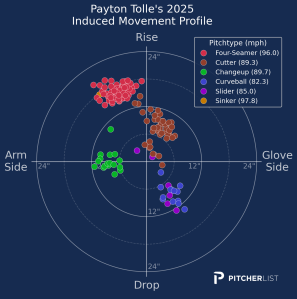
While Tolle’s arsenal dominated minor league hitters, he’s struggled to replicate the same success against MLB competition. His first start was fantastic, striking out eight Pirates in 5.1 innings and allowing just three hits (two earned runs). Since then, seven earned runs in five innings (four home runs), a 14.35 FIP and a 293 ERA-. That stretch prompted the Red Sox to skip his turn in the rotation, and instead rely on Tolle’s arm out of the bullpen. With the track record he has, and the stuff he possesses, I doubt that move is permanent, but he could be an electric bullpen arm for a playoff team.
This statement applies to every pitcher/organization featured in this segment, and I’ll say it once instead of repeating myself later on: The Red Sox/Mets/Yankees have money, and they tend to spend big in free agency. That, along with Tolle’s struggles as of late, clouds the clarity around Tolle’s future role. However, the fifth spot in the Red Sox rotation is currently wide open. If Tolle can rebound over the next few weeks, and put together a strong spring, he could be in line for that spot. Connelly Early, Dustin May, Tanner Houck, and more will also be in contention, but Tolle’s ceiling makes him the most intriguing option.
Jakob Marsee, OF – Miami Marlins
MLB Stats
After a 2024 season in which Marsee posted a .661 OPS and 103 wRC+ between the Marlins and Padres organizations, many overlooked the offensive potential that the former Central Michigan standout possessed. He registered 10 home runs and 51 steals, one of two players to reach those heights (Cole Carrigg – COL), but still finished 2024 outside the Marlins’ top-30 prospects (per. MLB.com). Marsee briefly reached AAA that season, and improved his batting average noticeably in 22 games (.275 AVG).
His second stint in AAA, in 2025, was even better. While his .246 AVG was lower, every other offensive statistic took a massive step forward.
Despite the improvements, none of those numbers were elite. Marsee’s hard hit rate and average exit velocity both sat well below the AAA average, and he struggled mightily against four seamers (.198 xBA) and sliders (.203). The 83.8% contact rate (54.2% O-Con, 90.3% Z-Con) and his speed were encouraging, but there was still reason to be wary about Marsee’s outlook as a MLB player.
Marsee settled those doubts immediately. He hit safely in 10/11 games to start his career, racking up five steals in that time. Marsee would have to wait two weeks before his first homer, but then had to wait a matter of minutes for his second, going long twice against Cleveland. The contact (18.3% Whiff) and plate discipline (17.6% Chase) have transferred into the Majors, and the power concerns have quieted (90.0 AVG EV, 43.8% Hard Hit).
He’s played his way into a spot atop of the Marlins order, and is showing no signs of relinquishing that spot. Miami’s still a ways away from competing with the Phillies and Mets in their division, but the rebuild seems poised to take a step forward. Jakob Marsee, alongside Agustin Ramirez, should anchor the middle of Miami’s batting order for the next half-decade at least. The power surge, with the existing bat-to-ball ability and stolen base pedigree he has, makes him one of the more exciting players to track going into next year. The contact/power/speed floor that Marsee possesses, even if he regresses in 2026, is high enough to warrant picking him up this offseason if you can.
Honorable Mentions
Trey Yesavage: I’m not sure if a 2024 first-rounder can be considered a “breakout” prospect, but going from Single-A to the Majors in one season is incredibly impressive. At the time of writing, he also had just one MLB start under his belt. A strong September should land him in the rotation for 2026.
Warming Bernabel: Injuries and a few slumps ended a red-hot start for Bernabel. He was a fun story to follow for a few weeks but he hasn’t posted a 100+ wRC+ over a full season since 2022. I don’t expect that to change in 2026.
Colson Montgomery: 18 home runs in 60 games is outstanding. A strikeout rate north of 30% is not. He looks like he’s going to be a high-power, high-strikeout bat, like he was in the minors. That’s not necessarily a bad thing, but if the power regresses there could be problems.
Dylan Beavers: A 135 wRC+ in 25 games has been good enough to lock down a spot in the O’s lineup for now. He just misses out due to the insane performances of Stewart and Marsee, but should still be considered a valuable asset heading into 2026.
Luke Keaschall: If he hadn’t gotten hurt, Keaschall could have competed (kind of) with Nick Kurtz for a Rookie of the Year nod. The amount of time he spent on the MLB roster (although injured) excluded him from featuring. He should be a key cog in Minnesota’s lineup in 2026.
Minor Leaguers
Cumulative MiLB Stats updated as of 9/16
Rainiel Rodriguez, C – St. Louis Cardinals (CPX, A, A+)
I ranked Rodriguez as the #12 prospect in the Cardinals system during the offseason. He proved that I drastically underrated him, and then some, during the 2025 campaign. In his first taste of professional baseball in the United States, Rodriguez ranked 2nd in home runs among teenagers (min. 300 PA’s), and was in the top five in wRC+ (162), wOBA (.445) and OPS (.954). Those numbers all ranked as the top marks in the Cardinals organization.
His 60-game stint with Single-A Palm Beach was his “least” successful by the numbers, but he still posted a 145 wRC+ with 13 homers in 60 games there. During that time, his barrel rate (10.5%) was among the best marks among hitters at that level, even if his average exit velocity (88.6 mph) and hard hit rate (39.2%) weren’t quite on that level. Arguably even more impressive than his batted ball data was his plate approach. Rodriguez whiffed on 23% of his pitches and had a chase rate just above 25%. Those aren’t outstanding marks, but for an 18-year-old in his first taste of pro-ball, it’s a solid foundation to build on.
Rodriguez will be 19 at the start of the 2026 season, and he should start the year either back in Single-A or at High-A. Either way, the Cardinals can afford to be patient with him, as Ivan Herrera’s breakout season should keep him behind the plate for at least one season. Rodriguez has adapted to, and then dominated, every level he’s been at so far. If that trend continues, he could be pushing for a debut as early as late-2027.
Edward Florentino, OF – Pittsburgh Pirates
The term “breakout” technically doesn’t apply to the 18-year-old first baseman. His lowest wRC+ so far as a professional is 143, a mark he posted in 54 Single-A games, where he also mashed ten home runs and stole 29 bases this season. Florentino was one of four teenagers this season with 15+ home runs and 20+ steals, alongside #1 prospect and organizational teammate Konnor Griffin, Eduardo Quintero and Tai Peete. His .948 OPS ranked third among hitters 19-years-old or younger, and his .442 wOBA and 159 wRC+ are also in the top five.
The “under-the-hood” numbers are encouraging too, and point towards this level of production being sustainable as he moves through the Pirates’ ranks. At 6’4″, 200 lbs, Florentino has the build of a Major League slugger. Players with that archetype, especially those still in their teenage years, tend to struggle with whiff issues. Florentino does not have that problem. His 16.3% whiff rate was the third lowest in the Florida League (min. 1,000 pitches), and his 5.6% SwStr was in the top ten (min. 150 PA’s). He could afford to be more aggressive (39.2% Swing, 20.8% CStr%), but a contact rate over 85% is very encouraging for an 18-year-old.
With that aforementioned frame. It’s doubtful that Florentino can continue to reach 30-35 steals annually. However, he is a good athlete, and moves well for his size. Settling in a range between 18-25 steals is far from out of the question for him.
Florentino’s power is apparent too, even if he has a ways to go before it’s MLB-ready. His 89.0 average exit velocity ranked in the top 15 in the Florida League. His max exit velocity (109.1) is outside the top 200 marks in the Majors this season, but that could increase with time. Florentino’s swing is lightning quick and generates easy power to all fields with ease, without compromising his bat-to-ball skills. If he’s able to build on that profile, the Pirates could have a future cornerstone to build around.
Carlos Lagrange, SP – New York Yankees
The Yankees were one of the more aggressive teams at the trade deadline, acquiring six new players to bolster their playoff push. Arguably their biggest win though was improving their roster without sacrificing any of their top three prospects. George Lombard Jr. and Spencer Jones remain key future pieces in the eyes of the organization, and Carlos Lagrange’s 2025 season has firmly placed him in a future Yankee rotation. It’s been a meteoric rise for the 22-year-old, who went from the #17 spot in the Yankees’ top 30 prospects to the #2 spot in just one year.
Lagrange exploded onto the scene in July. In four starts, he allowed just three runs in 21.1 IP, striking out 31 in the process. During that stretch, he held hitters to a .101 AVG and a 0.84 WHIP. Lagrange has had some bad starts (5 ER in 3.2 IP on 8/30), but his resume over the entirety of the season has been impressive. In his last three starts, he has a 1.23 ERA, with 21 strikeouts in 14.2 IP. If those numbers aren’t impressive enough, just look at the film. Lagrange has the ability to consistently hit triple digits with his fastball (he was up to 103 on 9/5) with a 90 mile an hour cutter and mid-80s gyro slider. The changeup will likely need to improve for him to take the leap into “future-ace” conversations, but the building blocks are there.
New York’s rotation has been quietly solid this season, despite losing their ace, Gerrit Cole, to injury. As previously mentioned, Cam Schlittler has blossomed into a reliable arm, and Max Fried remains one of the more consistent pitchers in baseball. That said, Fried is 31, and Cole isn’t getting any younger. The Yankees already have one piece of that future rotation locked down, and with Lagrange’s growth, could see another piece fall into place before the end of 2026. A lot has to go right for Lagrange to debut next season, but he has the stuff and the track record to fly through the minors next season.
Jacob Reimer, 3B – New York Mets
Early returns indicate that the fourth round of the 2022 Draft may be one of the more underrated pick periods in recent memory. Five players selected in that 30-pick span have already reached the Major Leagues, including Chase Meidroth and Troy Melton. The Mets had the pick just two selections after Melton, and spent more than $200,000 over slot to secure the services of an 18-year-old infielder out of Yucaipa, California.
After a good, but unremarkable first professional season in 2023 (119 wRC+) and a injury-riddled 2024, Reimer is finishing up an outstanding season, and could be rewarded with a Major League debut next season. The 21-year-old was one of 11 players in the minors this season with 15+ homers and steals, as well as a 150+ wRC+. The other names on that list include Sal Stewart, JJ Wetherholt, Edward Florentino, and Eduardo Quintero (more on him next).
Reimer doesn’t have a standout tool, but he’s able to impact the game in a variety of different ways. At 6’0″, 205 lbs, Reimer’s frame is able to generate plenty of power, which could translate to 20-25 home runs at the Major League level. While the speed tool may become less impactful as he faces tougher competition when he reaches higher levels, his 83% steal success rate shows his baseball IQ.
The Mets have Mark Vientos and Brett Baty at third base as things stand, but neither have truly asserted themselves as “must-play” pieces in the Mets’ lineup. Reimer is far from a sure thing, but if he remains on this trajectory, he will be knocking on the door of the Major League roster sometime next summer. His defensive home will be a question mark, but New York should be very excited about Reimer’s development.
Eduardo Quintero, OF – Los Angeles Dodgers
Say what you want about how the Dodgers utilize their prospects, they’re elite at acquiring young talent. Since being signed by L.A. in January of 2023, Quintero has done nothing but hit. Outside of a 27 game stint in Single-A as an 18-year-old (three years younger than average), Quintero has posted a wRC+ of 120 or higher at every level he’s been at, and has propelled himself into the #53 spot in MLB’s top 100 list.
During the first half of the season, Quintero was one of the best hitters in all of baseball. He posted a .335 AVG with a 1.047 OPS and 11 home runs. He slowed down significantly in the second half, partially due to facing High-A pitching for the first time, but still registered a .250 AVG and .732 OPS. It’s easy to see what makes Quintero so exciting when you turn on the film. His swing looks effortless, yet the ball flies off of the bat. It’s a long swing, and facing more advanced pitching will likely lead to a drop off in an already below-ideal 79.2% contact rate, but it generates impressive pop when Quintero connects.
The 19-year-old has spent most of his professional career in center, and he has the frame and speed (101 steals in 245 games) to remain there. In nearly 1,400 innings as the center fielder, Quintero has just six errors (.983 fielding %). He’s still at least two years away from the Major Leagues, but Quintero’s 2025 season has made him one of the most exciting prospects in baseball. A strong start to 2026, and a successful transition to AA could launch Quintero into the top-25 prospects, or even higher, next season.
Honorable Mentions
Alfredo Duno: A 164 wRC+ as a 19-year-old in Single-A is very impressive. However, he’s likely become accustomed to that level over the course of two seasons (145 games). The Reds should have promoted him to High-A to further test his talent.
Juaron Watts-Brown: Baltimore’s trade deadline acquisition is looking more and more like a reliable rotation arm as he progresses through the minors. The results aren’t as impressive as the featured names but he’s a name to keep an eye on.
Esmerlyn Valdez: 26 home runs, a .286 AVG and a 156 wRC+ from a 21-year-old who’s reached AA is fantastic production. He has the frame to add to that power, but his 72.4% contact rate is a concern, and will likely regress against AAA pitching.
Carson Benge: Similar to Yesavage, a first rounder performing well shouldn’t be considered a “breakout” prospect. However, he’s playing his way into consideration for a MLB debut in 2025. Benge will certainly be at Citi Field at some point in 2026.
Roc Riggio: Going from the Yankees to the Rockies accelerated Riggio’s MLB timeline, albeit at the expense of playing in an organization with a good player development track record. Either way, 20 homers, a .400 wOBA and 154 wRC+ are all career (season-long) highs for the former Oklahoma State standout.
