





The last couple of weeks of the regular season are the perfect time for retrospectives on the also-rans. The playoff field has mostly crystallized, with most of the remaining stakes being tied to playoff seeding rather than qualification. At the same time, the playoffs are still far enough in the future to make analyzing potential matchups difficult. So, let’s take a look at how some of the non-contenders found themselves in this position, as always, through the lens of their plate approaches.
Here at Pitcher List, we have a suite of PLV metrics to analyze every pitch in a baseball game. Decision Value (DV) is our hitter swing decision metric. It takes inputs like pitch velocity, location, and movement, and tells us whether the hitter made a good decision to swing or take a particular pitch. This isn’t quite as simple as plate discipline; swinging at a Logan Webb sinker and pounding it into the ground is a bad outcome even if the pitch was a strike.
Instead, Decision Value rewards hitters for swinging at pitches they should be able to hit hard, and for taking pitches they’re unlikely to do much with. The flip side is that Decision Value punishes hitters if they don’t swing at pitches they should be doing damage on or swing at pitches that are unlikely to generate quality contact. You can find a much more thorough introduction to PLV metrics and Decision Value here.
Los Angeles Angels
As in all things pre- and post-Ohtani, the Angels’ offense is led in DV by Mike Trout. The injury-prone slugger has put up his second consecutive season of 130+ games played and is one of only two Angels who have played enough to qualify for the batting title. Trout has a 119 DV on the season, courtesy of his consistently excellent chase rate and a return to a 62.3% zone swing rate after an atypical 55.9% in 2025. Earlier in his career, Trout was a more passive hitter, swinging at about 23% of balls and just over 54% of strikes. Of late, however, he’s managed to keep a chase rate of 18-21% while swinging at upwards of 60% of strikes. Recent-year Trout has lost a bit of contact relative to his peak years, but he’s still barreling the ball over 15% of the time. Wade Meckler has a good approach, managing a 43% zSwing – oSwing as a 26-year-old rookie. His 109 DV is pretty solid, but there’s no juice in the bat. He’s still been productive this year, though, with an OBP-heavy .297/.373/.387 line rating 20% better than the MLB average.
Unfortunately for the Angels, that’s about where the good news ends. Nolan Schanuel has a 103 DV thanks to a good approach on pitches out of the zone. His 27.2% chase rate isn’t amazing, but he does well laying off the worst pitches to hit. For context, Kazuma Okamoto chases about the same amount (27.5% chase rate), but swings at obvious balls 2-3 percentage points more often than Schanuel does. Schanuel has good contact ability, but there’s not really anything happening when he hits the ball. Schanuel has added 3 mph of bat speed over the past two seasons, but he’s still swinging an average of 68.1 mph, alongside contemporaries like Andrés Giménez and Nico Hoerner. Liam Hicks is the success case here for guys who aren’t athletic middle infielders, but Hicks has a better approach at the plate, and frankly I wouldn’t be surprised if this was a career year for Hicks.
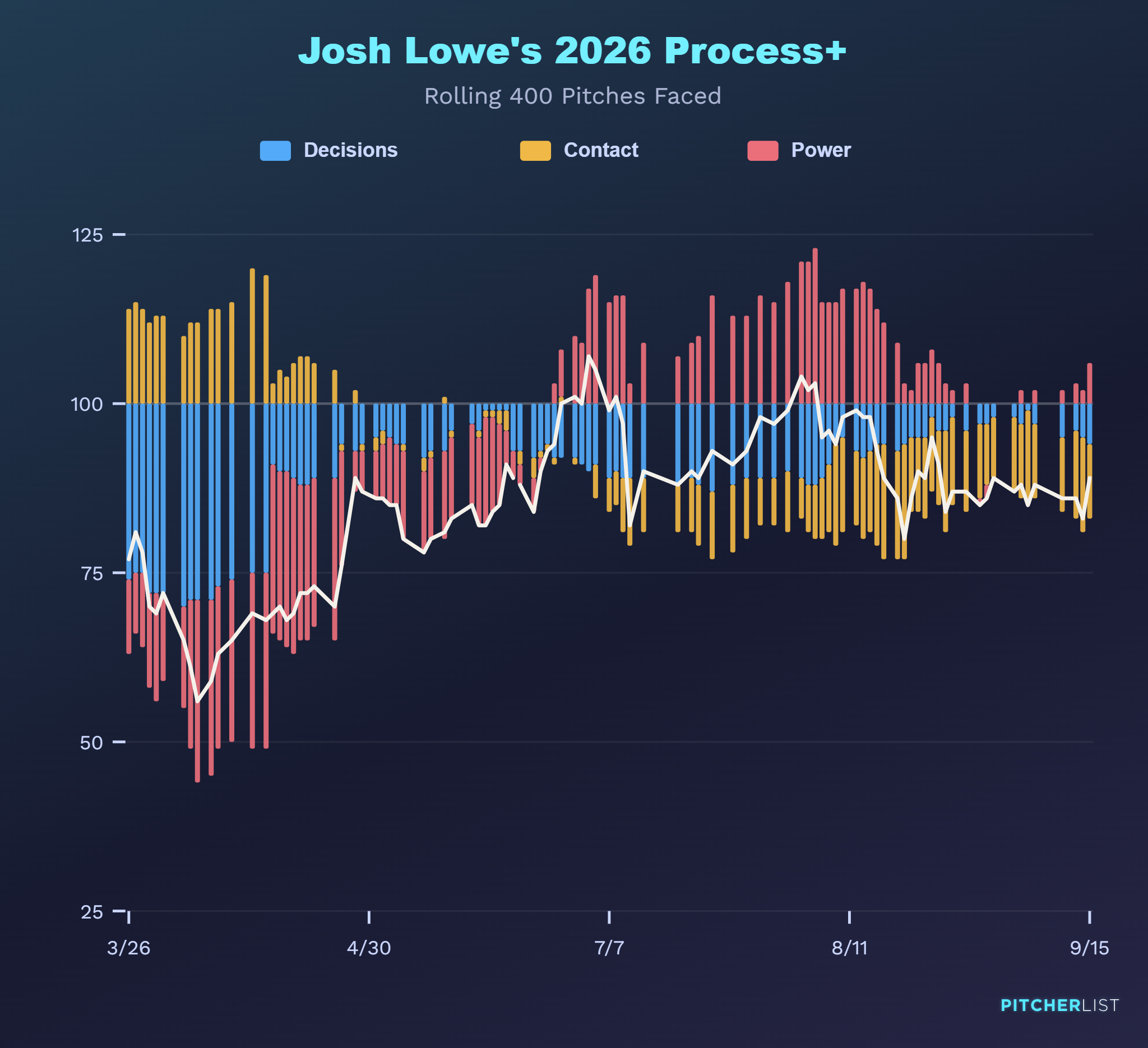
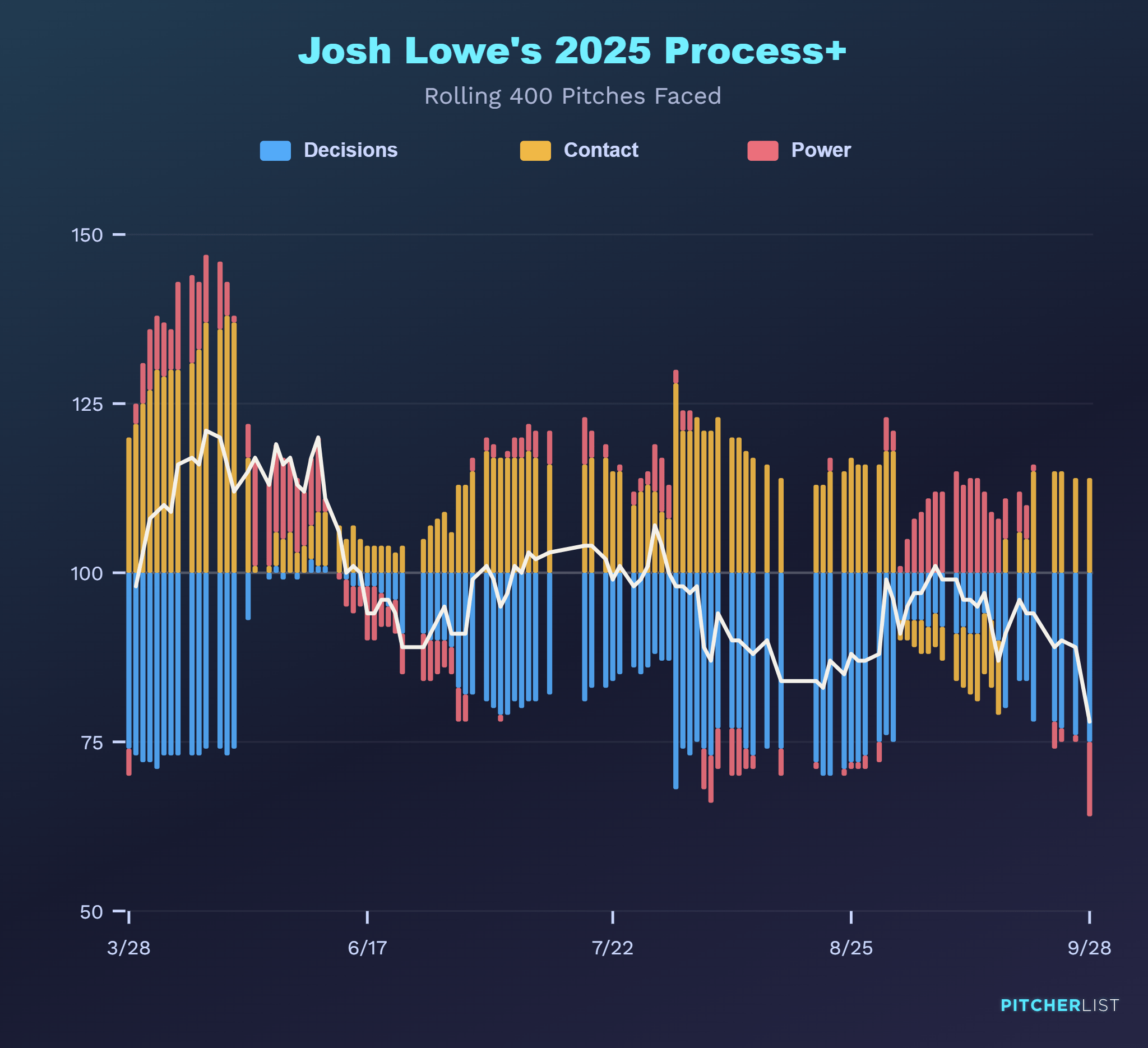
Josh Lowe is both a trade acquisition that didn’t work out and emblematic of the Angels’ overall struggles. Lowe has never had a particularly disciplined approach at the plate, but the rest of the profile fell apart this season as well. His 88 DV is actually a step forward on his usual output. He didn’t stop chasing, but he did start swinging in the zone 77% of the time. He could never maintain average contact and power at the same time this season, and his overall hard-hit rate and contact rate both took a step back. Zach Neto is the Angels’ second-best player, but he had a Lowe-ian 37.6% chase rate this season. He’s taken steps back in his strikeout rate every year in the majors, culminating in a 30.4% K rate this year. As a team, the Angels aren’t particularly noteworthy in batted ball metrics, but they’re very aggressive (4th in swing rate) and dead last in contact rate. The other teams with hyper-aggressive approaches are the A’s and Rockies, teams who play in stadiums where hitting the ball receives massively outsized rewards, and the Braves. Atlanta has the third-best bat speed and EV90 with above-average contact rates, especially outside the zone. Any one of the Angels’ flaws can be dealt with, but the combination has been deadly.
Cincinnati Reds
The Reds are a peculiar offense, ranking 27th in runs scored despite a very favorable home park and lineup mainstays Elly De La Cruz and Sal Stewart. JJ Bleday, who was signed for $1.4 million after the A’s designated him for assignment last offseason, has contributed a 102 wRC+. Where Bleday stands out, though, is that he has an exceptional approach at the plate, contributing a 128 DV. Bleday has chased 22.8% of balls while swinging at 69.8% of strikes. His 47% zSwing-oSwing is matched only by strike zone savants like Kevin McGonigle and Miguel Vargas. Bleday’s .213/.323/.411 line is a bit ugly due to a .234 BABIP. Part of that is bad luck, but part of it is that Bleday hits over 70% of his contact in the air, and fly balls have the lowest BABIPs of any batted ball type. De La Cruz has shown incremental improvement in his plate approach every year. He debuted in 2023 with a 32.7% chase rate, but has cut it to 25.8% this year, which ranks in the 74th percentile in MLB. Overall, he has an 85 DV because he’s lost some aggression in the zone, swinging at only 58.2% of strikes. Stewart is dead average in his plate approach, with a 100 DV, 101 zDV, and 99 oDV.
Most of the Reds have a better plate approach than you might think based on their level of success this season. Matt McLain has had a strikeout rate between 28% and 29% each of his three seasons in the majors, but he has very good discipline. He’s added nearly 5 percentage points of zone swing over the past two years while keeping his chase rate at a very solid 26%. The strikeouts are a consequence of a contact rate that hovers around 74%, similar to de la Cruz but lacking the otherworldly power. McLain has lost 150 points of BABIP from the .385 he posted as a rookie. That was an unsustainable debut, but it’s also hard to imagine the athletic second baseman remaining in the Bleday Zone.
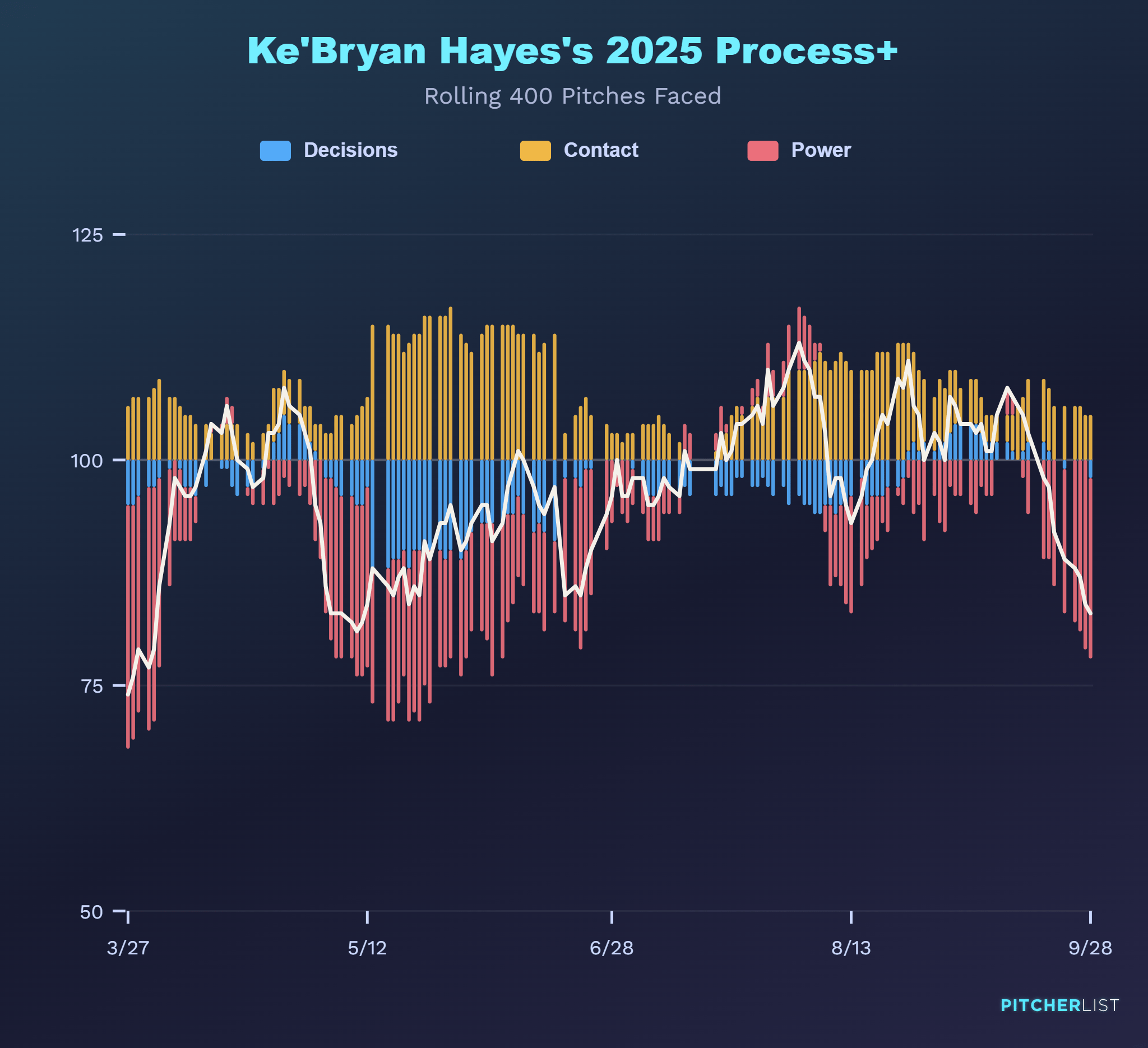
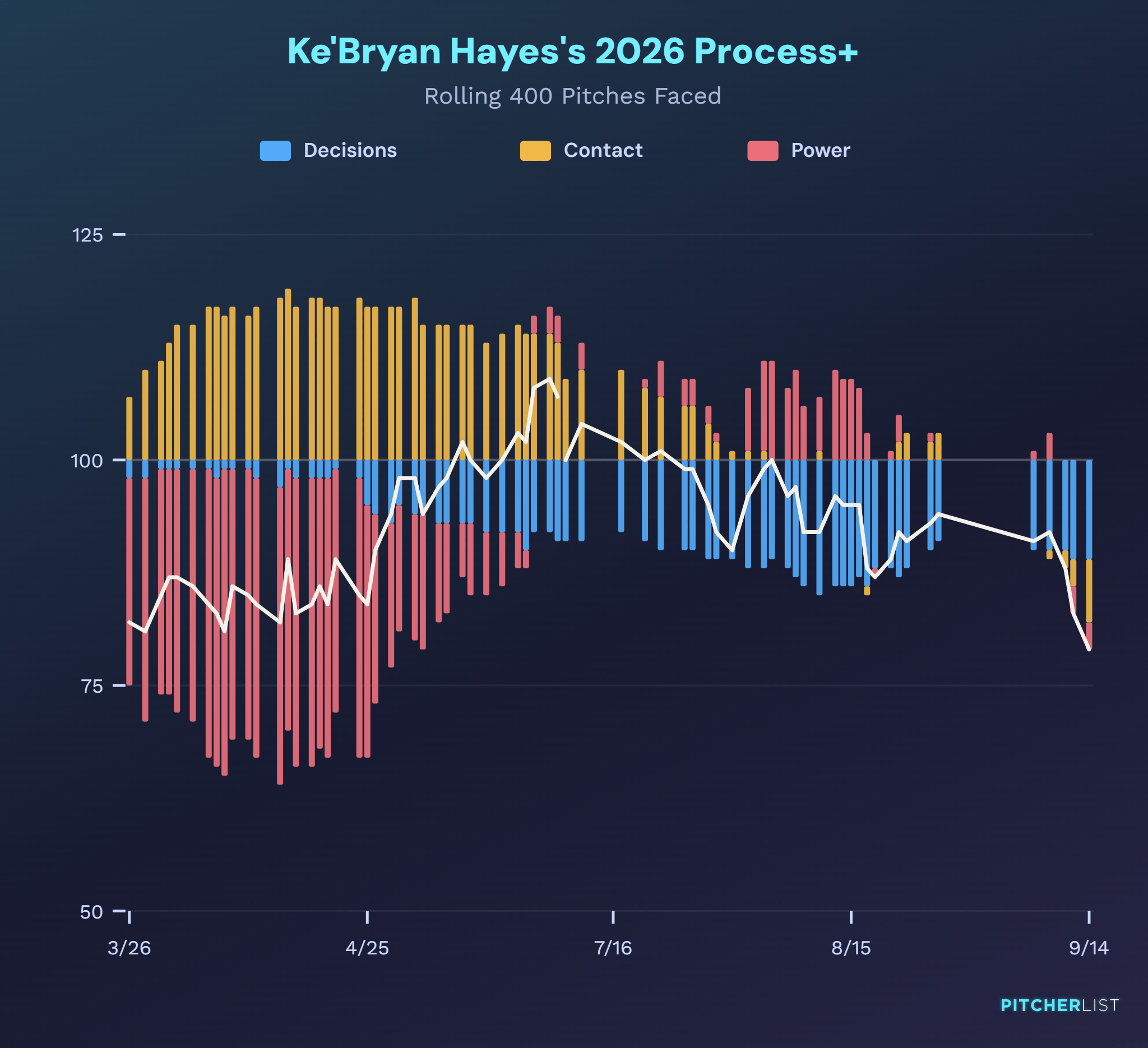
No one is more representative of the Reds’ problems on offense than Ke’Bryan Hayes who has an 81 DV this season. Hayes was acquired from the Pirates for Sammy Stafura and Taylor Rogers, before the Pirates then flipped Rogers for another prospect and Stafura at the deadline for Luke Weaver. Hayes has historically had pretty good contact ability and exit velos, although groundball-heavy outcomes have prevented him from showing much power. This season, he’s lost 5 percentage points of contact rate. The plus side is that he’s finally elevating the ball, hitting at a career-high 16.5 degree average launch angle. He’s pulling the ball a bit more often, leading to a career-high 14.6% pulled flyball rate. Ultimately, he’s had an awful stretch of batted-ball luck, with a .146 average and .240 expected average, a .236 slugging percentage and a .382 expected slugging. With the Reds still owing him $23 million over the next three years and Hayes’s glove still playing, I’m ready to get hurt again next year (for a very, very cheap draft price in very, very deep leagues).
Baltimore Orioles
The Orioles have skewed passive as a team this season, swinging the 22nd-most in baseball despite seeing the 14th-most strikes. Part of that is Taylor Ward, who had a 117 wRC+ in Baltimore despite swinging at only 34.1% of pitches. Ward has a 131 DV on the season, carried by a 122 DV. I still can’t quite wrap my head around what’s going on with him. Sure, he’s the best in baseball at avoiding chase, but he’s also having his worst full-season barrel rate. He’s not pulling the ball in the air anymore, either, and has done nothing with the bat on any pitch-type except fastballs. When the Orioles were competitive, Pete Alonso carried the offense before the team got late-season lifts from Coby Mayo and Christian Encarnacion-Strand. Alonso has a 107 DV in his first season in Baltimore. He’s chasing at the second-lowest rate of his career, which has led to a career-best 11.6% walk rate. He’s also added a point of zone swing rate up to 66.5%, bringing him closer to the 71.1% he ran in his 2021-22 peak.
Mayo, Samuel Basallo, and Encarnacion-Strand all rank poorly by DV, although Mayo is a bit different than the other two young hitters. Basallo and CES are both aggressive hitters, especially the latter. Basallo has swung at 52.5% of the pitches he’s seen. You’d rather see a bigger split between his zSwing and oSwing, though, with Basallo chasing nearly 40% of the time and swinging in the zone only 30 percentage points more often. Encarnacion-Strand puts him to shame, though, chasing 47.6% of balls outside the zone. That rate would lead MLB if he had enough opportunities to qualify. Encarnacion-Strand does swing aggressively inside the zone, too, taking hacks at just over three-quarters of the strikes he sees. Both he and Basallo have sub-70 DVs, with decent-to-good zDVs and extremely poor oDVs. Mayo, on the other hand, swings at only 47% of pitches he sees. That’s a totally normal rate, close to the MLB average, and somehow less than CES’s chase rate. Mayo’s chase rate has regressed a bit this year, increasing to 32%, but he’s pushed his zone swing rate up to 63.7%, too. His DV is just 83, but unlike the other two sluggers, he ranks relatively better by oDV than zDV.
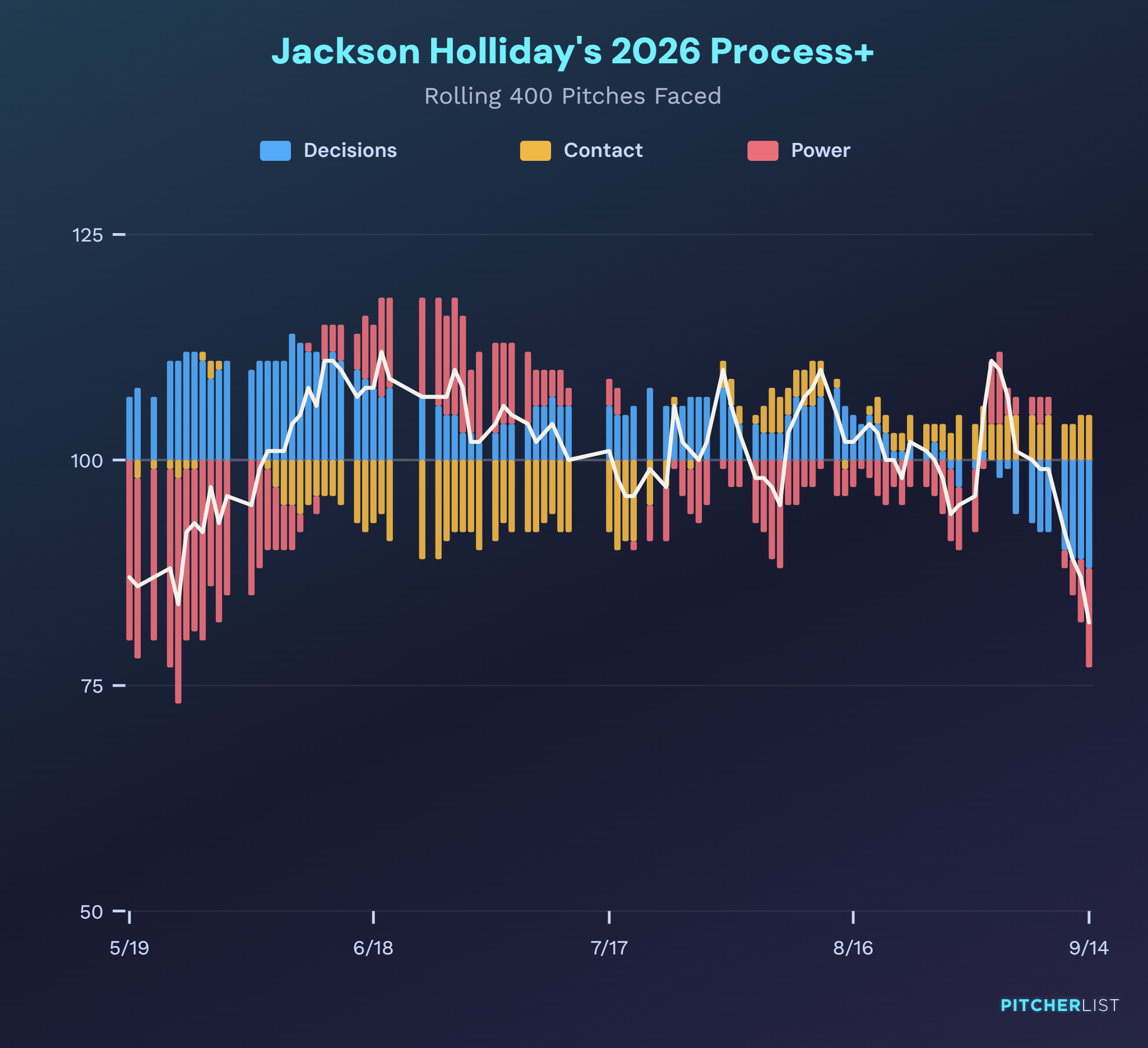
Jackson Holliday was perhaps the most disappointing Orioles hitter this season, managing just a .229/.300/.340 line in a half-season’s worth of plate appearances. Part of Holliday’s issue is that he hasn’t shown any growth in power that was projected for him as a prospect. He has below-average bat speed, below-average exit velos, and a below-average contact rate. The last of these is what’s particularly concerning, as his high minor league batting averages are starting to look more like BABIP-induced hallucinations than true talent. One positive for Holliday is that he’s still maintained a decent approach at the plate. His 101 DV this season is right in line with last year’s number, and he’s managed a 68th percentile chase rate as well. Holliday is still super young – despite playing 150 more major league games, he’s just over 2 years younger than Mayo – so there’s still some hope he’ll develop and add strength. There’s been a concerning trend of highly-touted Orioles hitting prospects coming up short of their offensive projections, though, and Holliday is the most glaring case for 2027 after Adley Rutschman and Ryan Mountcastle leave the team.
St. Louis Cardinals
Let’s start with the positives for the Cardinals. JJ Wetherholt has an excellent approach, posting a 117 DV in his rookie season. His approach has taken a tiny step back from his minor league numbers, chasing 2 percentage points more often and swinging in the zone 2 percentage points less often. He’s still got a 95th percentile chase rate and swings in the zone about 4 percentage points less than average. A few other Cardinals have excellent chase rates and DVs, although here is where the story starts to unravel. José Fermín and Masyn Winn have 91st and 84th percentile chase rates, respectively. Victor Scott II sits between them, close to the 90th percentile if he’d had enough playing time to qualify. None of them have a wRC+ above 85, and Scott has struggled enough at the plate that the Cardinals are no longer willing to carry his bat in exchange for his plus center field defense.
The non-Wetherholt success stories in the lineup aren’t known for their approach. Ivan Herrera has the best approach of the other three non-Wetherholt hitters who posted an average wRC+ for the Cardinals. He swings a bit less than average at both balls and strikes, with plus bat speed and a plus contact rate. He rates poorly as a catcher, but a 108 wRC+ as a DH isn’t special when the league gets a 105 wRC+ from the DH spot. Jordan Walker and Alec Burleson will end the year with very similar lines, except for Walker’s added contributions on the basepaths. Walker is hitting .278/.336/.482, while Burleson has a .284/.350/.471 line. They rank similarly by DV, with Burleson earning an 83 and Walker a 79, but how they get there differs. Burleson is aggressive in the zone. After his zone swing rate dropped to 69.1% last year, he’s up to 71.4% this season, closer to his career average of 72.6%. That has come with a big step back in his chase rate, though, with Burleson’s 37.6% chase rate ranking in the 12th percentile. Walker has similar overall chase and zone swing rates, but has been better at avoiding waste pitches. He swings at about 10% of them, the 30th-highest rate among qualified hitters, but Burleson ranks 7th, swinging at 14% of obvious balls. That’s not necessarily a production-killer; Pete Crow-Armstrong ranks sixth in swing rate at waste pitches, with Drake Baldwin, Ceddanne Rafaela, and Michael Harris II in the top 5.
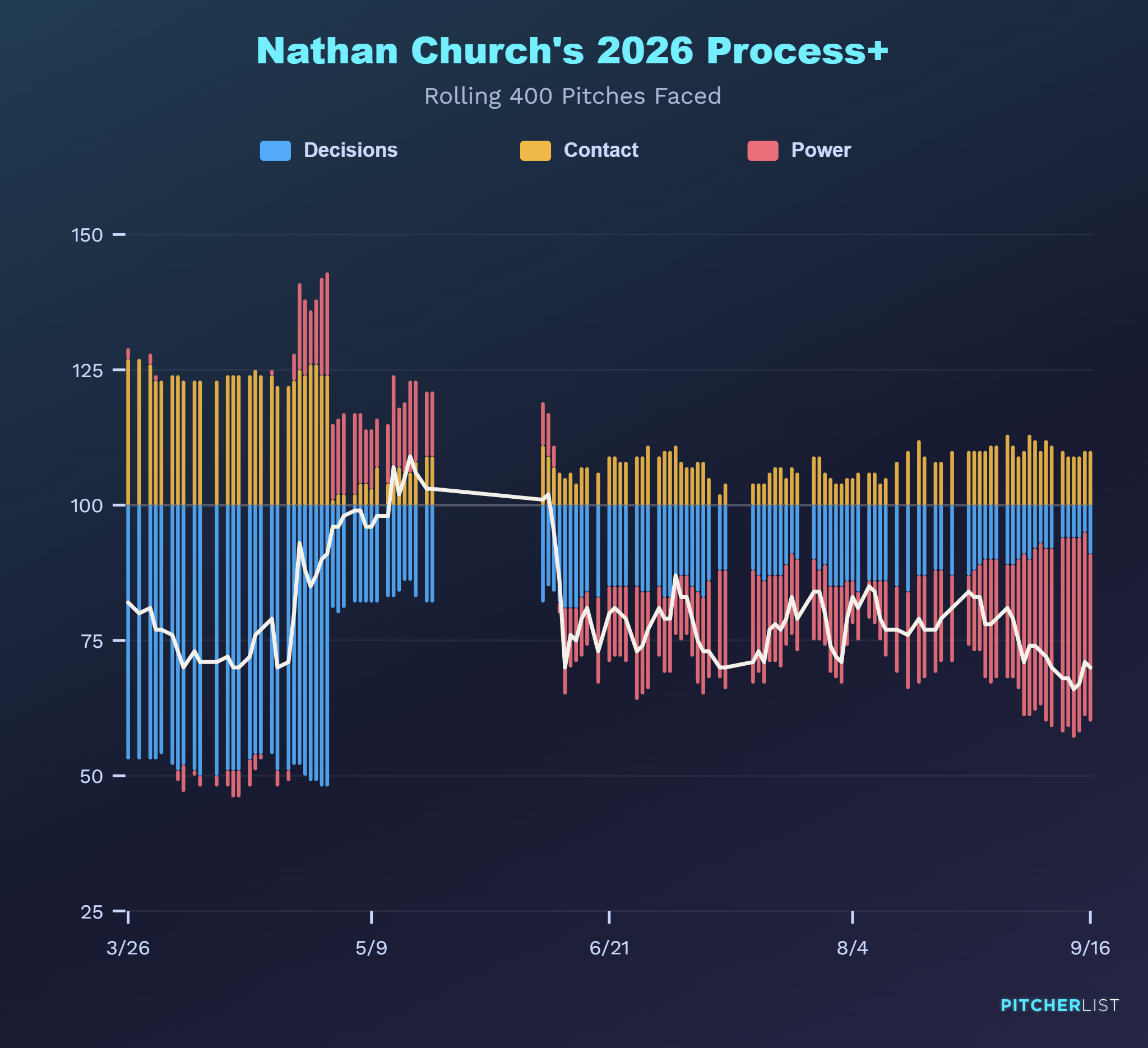
Nathan Church has been the primary beneficiary of Scott’s struggles, receiving 441 plate appearances, mostly in center field. The early-season returns were good, with Church hitting 5 homers and looking like an elite contact bat. He only hit 5 homers the rest of the way, though, and the power looks like a small-sample mirage. Church did spend time on the IL in May with a left shoulder strain, so the extent to which that lingered for the rest of the season could be a reason for optimism. Church lost about a tick of bat speed between April and the rest of the season, but that’s really grasping at straws for a guy who never hit more than 13 homers in a minor league season. It’s fine to be a contact-first profile, but you either need a good approach or outlier contact skills like Ernie Clement or Luis Arraez. Church has neither. He has a 73 DV, which is only that high because he’s swinging at 71% of strikes he sees. He’s chasing 41% of balls, with poor results when he expands the zone. Overall, this is an offense that was above average by runs scored, but very poor by wRC+; there’s a lot of room for improvement around the core 3-4 hitters.
Seattle Mariners
It’s been a poor season for the Mariners despite the excellent production from Randy Arozarena and the breakout from Dominic Canzone. The team acquired Decision Value All-Star Taylor Ward at the deadline, but it turns out you need to swing the bat at least occasionally. Ward has a .106/.224/.129 line with the Mariners; despite swinging 2 percentage points more often than he did in Baltimore, he and JP Crawford swing more than 6 percentage points less than any other Mariner. Generally speaking, the offense has been okay, ranking 9th by wRC+, but with a park-aided 28th-most runs scored. Cole Young has been a bit better than average at the plate, with a 104 DV matching his 103 wRC+. Arozarena has seen his chase rate creep up to 30.6%, just shy of his career high, but his chase contact rate has spiked. He’s making contact 70% of the time when he swings outside the zone, the highest rate of his career since he left the Cardinals.
Many of the Mariners’ core rank poorly by DV. Julio Rodríguez has many talents, but laying off pitches outside the zone is not one of them. In previous years, Rodriguez’s high chase rates were offset by aggression inside the zone. From 2022-25, he chased 36.2% of balls, but also swung at 73.2% of strikes. This season, the chase rate is a career-high 38.4%, and the zone swing rate is a career-low 68.8%, leaving Rodriguez with an 80 DV. Josh Naylor, Colt Emerson, and Canzone all have DVs in the 80s as well. Naylor’s approach mirrors Rodriguez’s, chasing 38% of balls and swinging at 68.2% of strikes. That’s the second-highest chase rate of his career combined with the lowest zone swing rate since his 279 PA rookie season. Canzone has added a tick of bat speed each of the past two years, but lost 6 percentage points of zone swing rate while only cutting his chase rate by 2 percentage points to 34.6%. T-Mobile Park has the highest strikeout park factor and the 4th-lowest walk park factor among MLB stadiums, so that may be showing up in the data here.
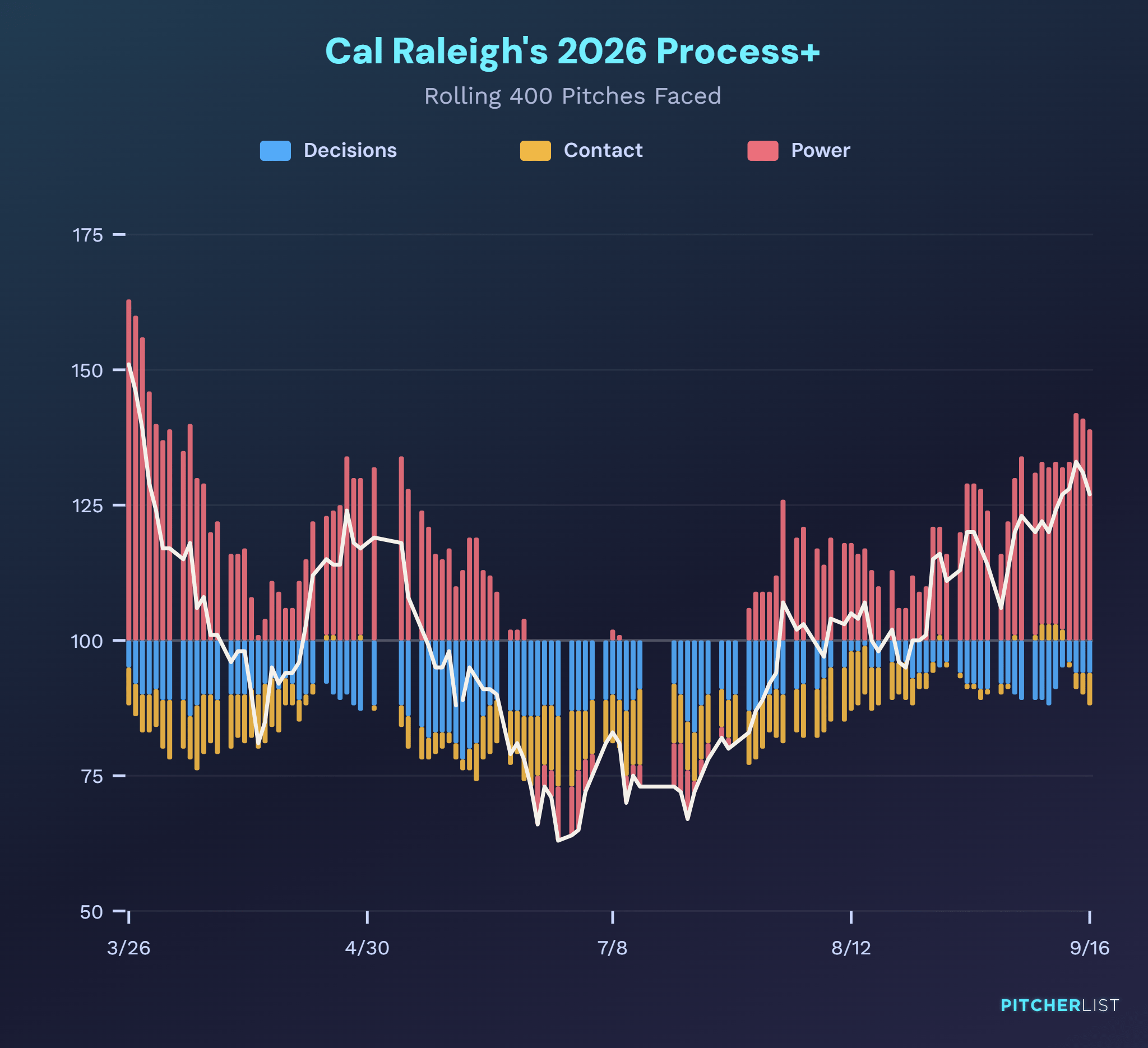
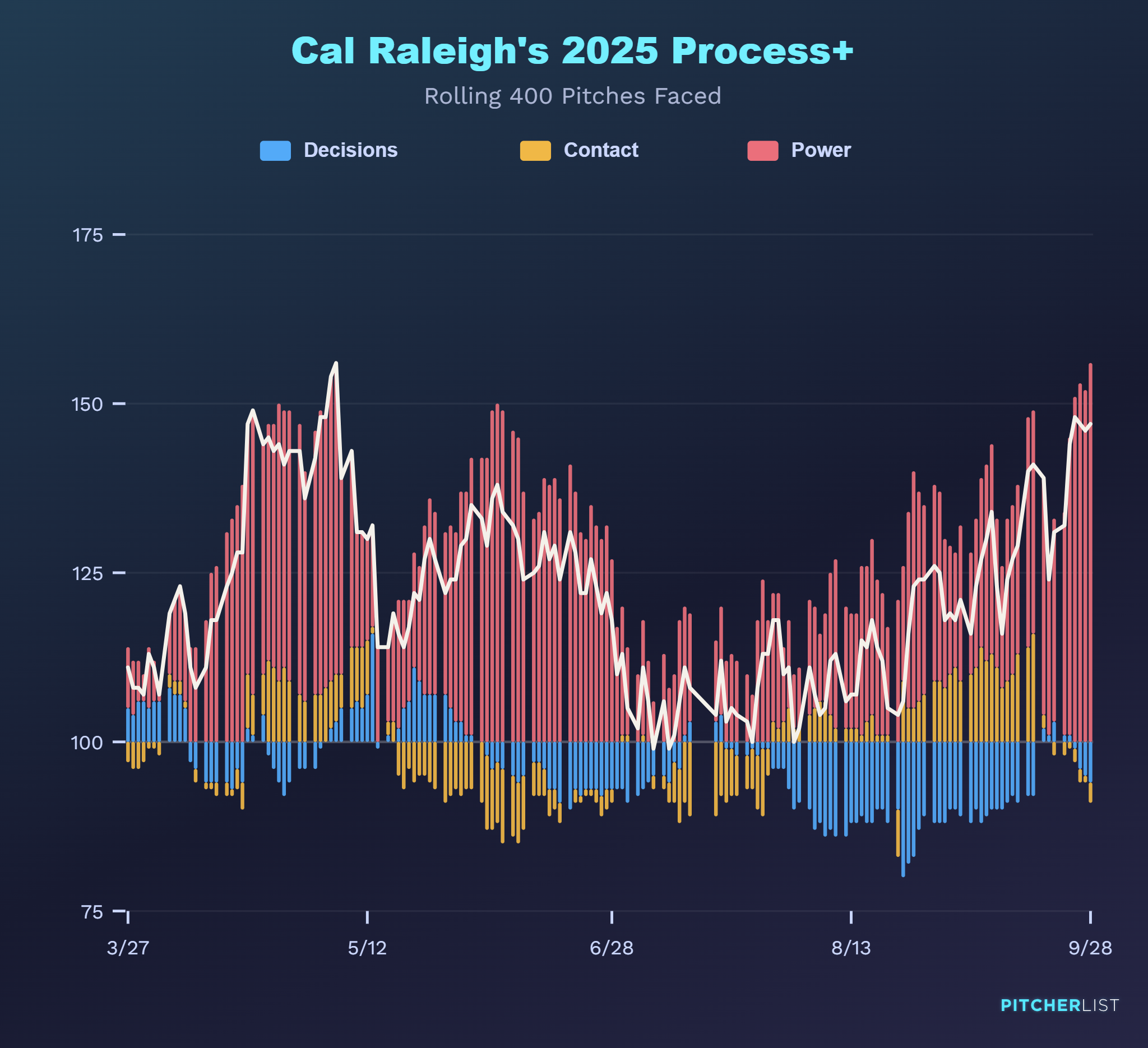
Ultimately, no discussion of the Mariners’ offense would be complete without Cal Raleigh. After his historic 2025 season, Raleigh has struggled his way to a .182/.295/.372 line. Plate discipline has never been Raleigh’s forte, but he’s taken a step back from an 89 DV last year to an 81 this year. More notable is the midseason stretch when Raleigh hit for less power than the average player. Some parts of Raleigh’s season look like bad luck: a .220 BABIP and 22 homers despite a 94th percentile barrel rate. Other parts are more concerning for the future. Raleigh’s plate discipline has eroded on both balls and strikes this year. He’s chasing 36% of balls, his highest rate since his 47-game rookie season. He’s also swinging at only 69.2% of strikes, a 6-percentage-point drop from last season and a career low. Moreover, Raleigh was a 4-5 WAR player even before last year, in part because he was an excellent defender. It’s not a great idea to trust single-season defensive metrics, but Statcast thinks Raleigh’s made radical changes behind the plate. After three years of good-to-great throwing and a career of outstanding framing, Statcast thinks he’s now a 4th percentile arm and a 25th percentile framer. He rated poorly by Statcast’s blocking metric for the past three years, but is in the 94th percentile this year. Some of the Mariners’ problems have come from an underperforming rotation, but getting Raleigh back to even his 2022-24 levels would be a massive improvement.
