






The Pitcher Edition of the Stash List highlights the ten best pitching prospects likely to make an impact during the 2025 season.
Prospects are often thought of as only holding value in dynasty formats. However, knowing which prospects hold value for the current season can help set you apart in redraft leagues. Several have a 2025 ETA, and getting ahead of the curve on rostering these prospects is a key part of roster management. Last year, we saw more pitching prospects make their debut than ever before, and there is no reason we should expect to see anything change in 2025. Keep reading to find out the top ten pitchers you should stash in your redraft leagues.
Ground Rules
- The Stash List is for your redraft leagues and does not consider impact beyond 2025.
- Only current minor league players who are expected to make an impact this season are included.
- Upside, proximity, health, and opportunity are all weighed for each player.
- The focus is on 12-team leagues with standard categories.
- Rankings and roster percentages will be updated weekly.
- Stats will be updated weekly for all players through Thursday’s games.
The Stash List
Graduates/Call-Ups
The following prospects got the call to the major leagues within the last week:
The Pittsburgh Pirates promoted one of their Triple-A starters, and it wasn’t Bubba Chandler. Welcome to the major leagues, Mike Burrows, who will appear in long relief.
Doug Nikhazy has also been promoted to serve as bullpen depth in Cleveland. He is a left-handed pitcher who was building up as a starter with a 28.2% strikeout rate and 9.0% walk rate through 18.1 innings. He is displaying elite extension in 2025.
Logan Henderson is all grown up after delivering a spectacular debut against the Athletics. Henderson threw 83 pitches in six innings with 13 whiffs, mostly on a two-pitch mix of the fastball and changeup. The changeup was the star pitch with seven whiffs on its 18-inch horizontal break. Although injuries have ravaged the Brewers at the start of the season, some pitchers like Tobias Myers and Brandon Woodruff are almost back up with the club. Henderson was sent down and may be sent down until a more permanent spot opens up.
Brandon Young didn’t find an early rhythm in his debut against the Reds, leading to many baserunners in the first two innings. He finished with three walks, three strikeouts, three earned runs on seven hits, including one home run. He will get a chance to redeem himself against the Tigers after initially being optioned back to Triple-A due to a setback with Kyle Gibson’s rehab assignment.
Congratulations to Ryan Gusto, who made his major league debut out of the bullpen but has since emerged as a serviceable starter for Houston. The four-seamer has excellent shape and is generating enough whiffs to make him relevant.
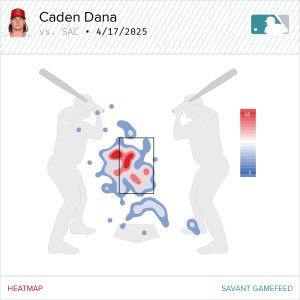
Since many pitchers below will be on the stash list for the foreseeable future, let’s dig deeper into a different part of their profile each week. This week, we will include a pitch usage chart and heat maps for any recent starts with Statcast data.
Top 10 Pitching Prospects to Stash
1. Bubba Chandler, RHP, Pittsburgh Pirates
2025 AAA Stat line: 15.1 IP | 1.76 ERA | 41.1 K% | 10.7 BB%
2024 MiLB Stat line: 119.2 IP | 3.08 ERA | 30.9 K% | 8.6 BB%
After a lukewarm first two starts, Bubba Chandler has roared back to rightfully claim the number one spot on the stash list. Ok, this isn’t Tiger Woods on the 16th hole at the 1997 Masters, but Chandler is doing what is expected of him and what he is allowed to do by the Pirates organization. He finished his most recent outing with a 62% strike rate over 69 pitches, a season high. I mention the strike rate frequently in this article because it is an indicator of how many competitive pitches a player is throwing. It’s a decent statistic to compare a pitcher to themselves from start to start. Hitters’ eyes need to be taken in and around the strike zone so that they are less able to key into a particular area of the grid. For minor league pitchers, we want to see them around a 65% strike rate. On this day, the 62% strike rate Chandler had was within a normal range of his season average of 64%. Also within typical patterns, Chandler continued with similar usage rates on the fastball, changeup, and slider. While he got five whiffs on the slider, he pumped the fastball up to 100 mph to generate five whiffs. Once Chandler hit his unannounced pitch limit for the day, he came out of the game, allowing one run on two hits and one walk with five strikeouts.
Chandler is having swing-and-miss success from all of his pitches, with the fastball and changeup being his most consistent strikeout pitches. His next scheduled start is in St. Paul on April 25, where we would expect to see over 70 pitches thrown.
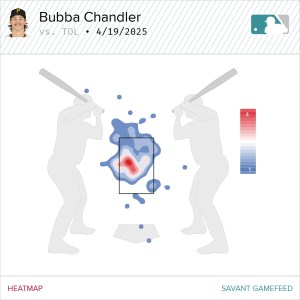
The Pirates have scored the second-fewest runs in the National League, so having someone like Chandler around to keep the score low would be a good thing. Going into their Thursday game, their rotation had the 20th-ranked MLB ERA (4.18), which could be better given the staff’s second-ranked FIP (3.27). Surprisingly, the rotation that includes Paul Skenes, Mitch Keller, Bailey Falter, Andrew Heaney, and Carmen Mlodzinski has earned the second-highest number of quality starts. Even with this moderate success, dynasty managers will argue that it will be even better when Chandler is included on the staff.
2. Zebby Matthews, RHP, Minnesota Twins
2025 AAA Stat line: 18.2 IP | 1.45 ERA | 32.4 K% | 4.1 BB%
2024 MiLB Stat line: 97.0 IP | 2.60 ERA | 30.5 K% | 1.9 BB%
The start against Indianapolis on April 22 represents the hardest Zebby Matthews has been hit in 2025. And guess what? All of the hits allowed were singles. He finished the game with 80 pitches over 3.2 innings with four strikeouts, one walk, and one unearned run. His velocity is still up from year to year, but he topped out at 97 mph in this game. Hitters were able to put 14 balls into play and suffered only 10 whiffs. His most effective pitch on the night was the slider with six whiffs that he threw almost exclusively to right-handed batters. Matthews was not as crisp on this evening, whether that was because of the decreased velocity, throwing more pitches than usual after 18 fouls, or another reason.
On the season, Matthews is going with a pitch mix of a fastball, slider, and cutter. Curiously, he abandoned the seldom-used changeup and curveball in this start. Those two pitches were a larger part of his 2024 arsenal when each had a greater than 26% whiff rate. This could be a situation where the opposing lineup dictates his pitch usage. Matthew’s feature pitch is a sharp-breaking slider at 88 mph that has five inches of horizontal movement. The slider has a similar release height as the cutter, but comes in slower and with greater glove-side break.
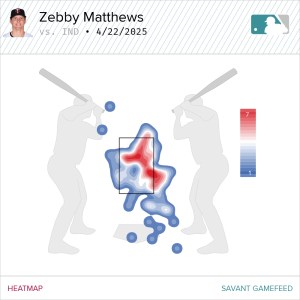
The Twins’ starters are middle-of-the-pack in most pitching categories, except they are standouts with the second-lowest walk rate in the league. This ratio stat can be an indicator of a team’s strategy, but it must also be pointed out that their team philosophy does not allow their starters to go deep into games and therefore, not face as many hitters as other staffs. This analysis thus points out that even if Zebby Matthews were to get the call-up to the Major Leagues, he might face a reduced workload for the long term. The test case is David Festa, who was never allowed to complete the fifth inning in his three appearances. Matthews has enough strikeout upside to tamp down any concern for the likelihood that he wouldn’t earn a quality start in the near term.
3. Jacob Misiorowski, RHP, Milwaukee Brewers
2025 AAA Stat line: 24.2 IP | 2.19 ERA | 30.2 K% | 13.5 BB%
2024 MiLB Stat line: 113.0 IP | 3.03 ERA | 34.2 K% | 10.0 BB%
This past week, we got the best version of Jacob Misiorowski with his velocity up to 100 mph. Against Durham, Misiorowski struck out eight Bulls over 76 pitches and six innings. Misiorowski displayed efficiency with his 66% strike rate, allowing only one walk and one single. Excitingly, he was balanced and consistent in this outing. His fastball hit 99 mph in all six innings, generating seven of his 11 total whiffs with 18 inches of induced vertical break. If we compare the heat map from his two previous appearances, Misiorowski was filling the zone in clearly defined pockets against Durham, a likely signal that he was executing on the attack plan and hitting his targets.
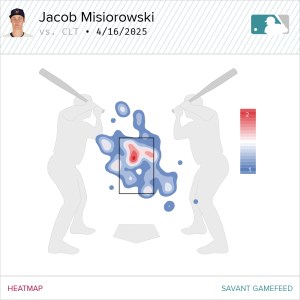
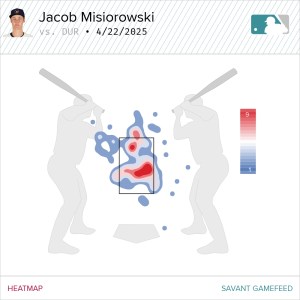
Misiorowski is primarily using the fastball and slider on the season, yet he went much heavier with the curveball against the Bulls. His curveball is his second most effective whiff pitch with its late break and up to 12 inches of drop. Nevertheless, the fastball is the key indicator of his performance, as supported by its contradicting high walk rate and high whiff rate. As his feel for the fastball goes, so goes the quality of his results. Opposing hitters are on notice as he is now sitting 98-99 mph with over 7.36 feet of extension that will play up its effective velocity. Going forward, it will be interesting to see how he varies the curveball and slider in his next outing to assess if he is decreasing dependency on the slider or adjusting according to the competition.
Although the Brewers have a loaded list of injured starters, they are getting quality starts from Chad Patrick and Jose Quintana at the moment, with Woodruff and Henderson performing capably in Triple-A. Next week may represent a significant test for his case for a spot on the Brewers’ 40-man roster, as Misiorowski appears to have a two-start week.
4. Noah Cameron, LHP, Kansas City Royals
2025 AAA Stat line: 20.1 IP | 3.54 ERA | 29.3 K% | 8.5 BB%
2024 MiLB Stat line: 128.2 IP | 3.08 ERA | 27.8 K% | 6.7 BB%
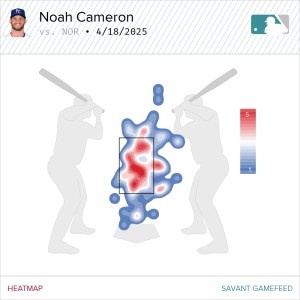
On April 18, Noah Cameron almost overcame a rough first inning to have a decent start. To his credit, he was able to get a swinging strikeout on a curveball after serving up a three-run home run with two outs. He also gave up a two-run home run in the fourth inning before striking out the next batter on a changeup. These moments were indicative of a mixed night where the runs allowed were balanced out by his 15 whiffs from a 65% strike rate. In fact, Cameron has double-digit whiffs in all four starts this season, underscoring that his arsenal is fooling enough hitters most of the time.
Cameron is mixing five-pitches with a slight tick up on his four-seam fastball. Each of these pitches is getting a good whiff rate, illustrating that hitters may not be getting a good read on his offerings. His changeup is producing a 43% whiff rate and can achieve up to 16 inches of arm-side break at 81 mph. The curveball had five whiffs in this game with up to nine inches of straight drop and no horizontal movement. Speaking of side-to-side action, Cameron doesn’t seem to possess a pitch that breaks to his glove side. Curiously, he had only a handful of pitches reach up to four inches of break to his right side in this start. On the season, his slider and cutter only register as having up to three inches of glove-side break. Interestingly, he was clobbered for two home runs by left-handed hitters and six hard hits overall. Cameron is experiencing an uptick in home runs allowed in the early season, but that should come down naturally as he is allowing an elite low level of fly balls, as seen by his 15% fly-ball rate. Nevertheless, any lack of pitch movement to both sides of the plate may be an in-game indicator for success or failure in future games. Cameron has a road start on April 25 versus Toledo, where we will monitor pitch movement early in the game.
Kansas City is in the hunt for a title in a weak American League Central division. Their offense is frustratingly poor, with the third-lowest runs scored in their league. The starting rotation has come up clutch in run prevention while going deep into the ball game with 10 quality starts. One key member of the rotation, Cole Ragans, suffered a groin injury and may need a replacement soon. Although he doesn’t possess anywhere near the velocity of Ragans, Cameron can continue eating, getting whiffs, and keeping runs off the board until the Royals’ hitters start swinging it better.
5. Andrew Painter, RHP, Philadelphia Phillies
2025 A Stat line: 7.1 IP | 2.45 ERA | 33.3 K% | 3.3 BB%
2024 MiLB Stat line: 15.2 IP | 2.30 ERA | 30.5 K% | 6.7 BB%
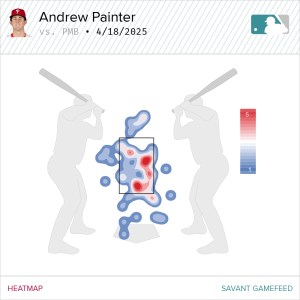
Andrew Painter’s comeback is following the plan nicely after a great start last Friday night. As announced, Painter went three innings on 49 pitches with four strikeouts, zero walks, and three singles. He was consistently hitting his spots in this contest, giving up only two flyballs, two line drives, and four ground balls. Painter dialed back the velocity a bit, which may have come at the expense of generating only four whiffs. Nevertheless, he did finish his outing with two strikeouts, punching out the last batter with a 99 mph fastball. It’s too much of a small sample (86 pitches), but he was primarily using a fastball-slider mix (four-seamer and cutter at 79% usage with slider at 19%). Even if the mix changes as his confidence in his health grows, the 70% strike rate is a great signal of his ability to control his pitches in the strike zone. Painter is checking all the boxes of velocity, command, and consistency on his way up to his major league debut.
In his latest start, Painter broke out the curveball from hibernation. His curve has a modest drop of four inches with 10 inches of glove side break. It did earn him one strikeout on one whiff, so it will be interesting to see how often he uses it in the future. He was efficient with his command, pumping in 74% of his 43 pitches for strikes and producing eight total whiffs. The final line was mediocre at three innings with three strikeouts, zero walks, and two hits. Most importantly, he finished the game healthy, without any reports of fatigue or soreness.
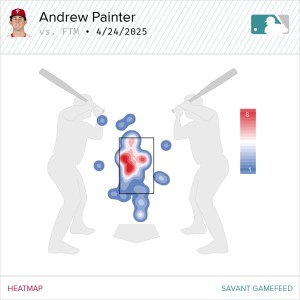
Painter will be monitored not only for performance, but incremental steps to gaining the stamina necessary to go 5-6 innings in the major leagues. This latest game was another positive step for the 6’7″ righty to throw on a shorter rest of six days. The minor leagues have every Monday off, so that could mean that he could make his next start on Tuesday or Wednesday. They stuck to the plan of under 50 pitches or three innings, so we will await any announcements of a gradual increase in either area. It’s a little early to start describing the performance of the Phillies’ starting rotation, but they have done a tremendous job at run prevention, as seen by having the top SIERA in baseball. Their starters are also going deep into the game with 11 quality starts. The main setback to this early success could be any prolonged injury to Cristopher Sánchez, but they are covered there with a rehabbing Ranger Suárez. There are no immediate plans to bring up Painter, but he should have a firm place on your fantasy squad.
6. Noah Schultz, LHP, Chicago White Sox
2025 AA Stat line: 17.2 IP | 3.57 ERA | 22.5 K% | 13.8 BB%
2024 MiLB Stat line: 88.1 IP | 2.24 ERA | 32.1 K% | 6.7 BB%
Similar to Jacob Misiorowski, Noah Schultz is experiencing inconsistency in the early part of the 2025 season that is making his future hard to assess for dynasty managers. On April 18, Schultz gave up five walks over 3.2 innings with three earned runs, six hits, and only two strikeouts. One would think that this was a horrible day for one of the top left-handed pitcher prospects in baseball, but alas, there is hope! Schultz was squeezed with numerous strikes being called balls, as supported by the pitch chart from each of his five walks. I am not sure if this kind of wildly inconsistent strike zone has been prevalent over the years, but it feels like I am seeing miscalled balls more frequently. Nate Schwartz had a great article on the changing environment in the major leagues, and similar trends may apply to the minor leagues. Even his fifth walk had a few balls that could have been called a strike by a different umpire.
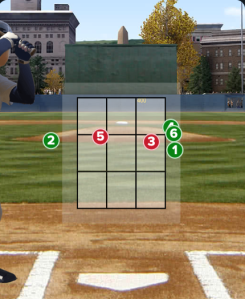
Walk 1 vs Lara
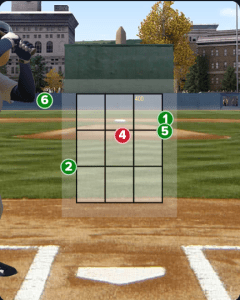
Walk 1 vs Brown Jr.
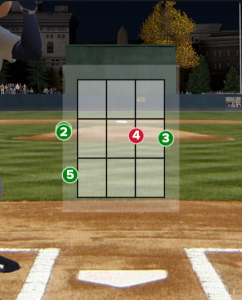
Walk 3 vs Wilken
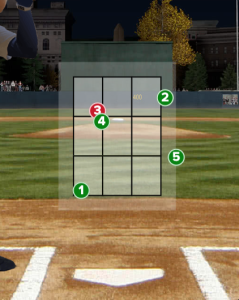
Walk 4 vs Adams
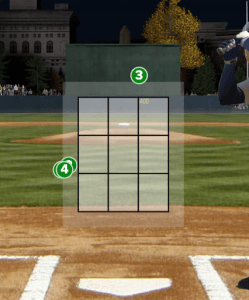
Walk 5 vs Spain
Schultz escaped many a jam in his latest outing on April 24 with the help of three double plays. He got back on track with a solid performance of five strikeouts, three walks, and three hits over five innings. His strike rate is dipping near 60%, but he countered that in this game by inducing eight ground balls. His batted ball profile is spectacular, with a 49% groundball rate opposing a 21% flyball rate. Schultz has been able to counter his propensity for allowing the free pass by not allowing any home runs. In general, Schultz can get away with allowing an occasional walk if he can generate a lot of ground ball outs. The premiere version of Schultz will be unlocked when he can achieve consistent command like he did when he struck out the side in the third inning with dotted strikes on the edges of the zone.
There are zero preconceived notions that the Chicago White Sox are competing for a division title this year. Yet, there will come a point in the summer when simply competing in each individual game can morph into seeing what the future building blocks of the team look like. Although the White Sox rotation ranks near the bottom in ERA indicators such as FIP and SIERA, they are actually in the middle of the pack in ERA. On the downside, their pitchers have the lowest strikeout-minus-walk rate, mainly due to a poor walk rate. Unfortunately, this is an area where Schultz would not be of much support with his walk rate above 13%. White Sox hitters are the lowest-scoring offense in the league, so run prevention is fundamental to winning the battle of the day for this team.
7. Ian Seymour, LHP, Tampa Bay Rays
2025 AAA Stat line: 25.1 IP | 2.49 ERA | 33.3 K% | 6.7 BB%
2024 MiLB Stat line: 113.0 IP | 3.03 ERA | 34.2 K% | 10.0 BB%
And your Triple-A strikeout leader four weeks into the season is Ian Seymour with 35 punchouts (Sean Linan has 40 Ks in AA and Aidan Foeller with 35 Ks in A). I was ready to cast him from the list over the weekend, but one has to examine how he is achieving 17 whiffs and nine strikeouts with a low 90s fastball and a middling pitch arsenal. If we examine the pitches first, he is getting a lot of swings and misses with his fastball and changeup. He gets 6.25 feet of extension on the fastball, releasing it a little lower than the rest of his pitches, which may help beef up the 18-inch average of induced vertical break on the pitch. His most effective pitch, the changeup, is traveling to the plate at the same velocity as last year, but with 100+ more rpm and 3 more inches of arm side break.
The other thing to note about Seymour is his batted ball profile, since he could play one day in the hitter-friendly environment of George M. Steinbrenner Field. Tampa’s new home ballpark is ranked at number 12 with a park factor of 103. When adjusted for home runs, it moves up to ninth place. Seymour is suffering a small sample-influenced home run per fly ball rate after serving up another one in his previous start against the Sounds. Although his fly-ball rate is in a normal range compared to previous seasons, his pull rate is up slightly. With the shorter fence distances of 314 feet in right field and 318 feet in left, Seymour will need to remedy any increased frequency of balls in the air.
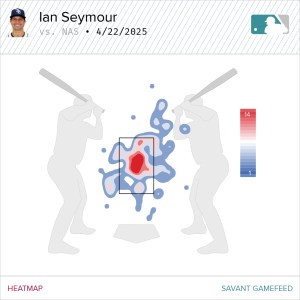
The Tampa Bay Rays continue to throw Zack Littell every five turns of the rotation. Littell has a similar low-90s fastball as Seymour, but nowhere near the strikeout upside. It seems like a worthwhile move to have a left-handed starter on a staff of only righties to offer a variety of release points during a three or four-game series. As much as we want Joe Boyle to be a thing, his control issues will continue to be a concern until he proves it month over month. Seymour feels like the intelligent move for Tampa to make once they can move away from the millions of dollars owed to Littell via trade or demotion.
8. Chase Petty, RHP, Cincinnati Reds
2025 AAA Stat line: 23.0 IP | 3.52 ERA | 27.0 K% | 9.0 BB%
2024 MiLB Stat line: 137.0 IP | 4.20 ERA | 22.4 K% | 10.2 BB%
Welcome Chase Petty to the stash list, who is coming off a strong start for the Triple-A Louisville Reds against the Iowa Cubs. Petty is effectively wild with his five-pitch mix. The exciting part about Petty’s arsenal is that he has shapes and velocities that pair well with each other. The four-seam velocity is up to 98 mph, with a sinker coming in a tick slower with greater movement. He also uses a sharp late-biting slider as well as a looser sweeper. Against the Cubs, he was able to generate eight whiffs, six on the slider, and strike out seven batters. Although he allowed only one hit, he did give up six hard-hit balls that didn’t do any damage to his final line. Petty was able to finish six strong innings of one-hit ball with two walks.
As mentioned above, Petty has a solid five-pitch bag of tricks that he dips into depending on the situation and opponent. His most effective whiff pitches are the fastball, slider, and sweeper. The changeup could be an effective whiff pitch, but he prefers to sneak it in, or possibly doesn’t view it as a strong putaway pitch since he has no strikeouts with it.
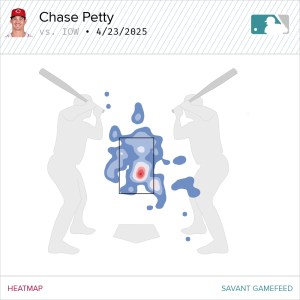
Petty and Chase Burns are easily outperforming all other prospects in the Reds organization. While they are both 22 years old, Petty was drafted in 2021 out of high school and has amassed over 360 innings as a starter. Over that career, he has done well to limit fly balls and home runs, which will be an important skill given that Great American Ballpark has the highest park factor for home runs over the last three years. Petty has seen an uptick in home runs allowed early in 2025, so games such as this most recent one, without a home run allowed, are a positive development. Beginning April 25, the Reds will have 17 straight games without a day off. Nevertheless, they have a rotation at full health and no 40-man roster spot in which to place Petty. He will have to continue thriving in Triple-A until his time arrives.
9. Carson Whisenhunt, LHP, San Francisco Giants
2025 AAA Stat line: 20 IP | 2.70 ERA | 29.1 K% | 2.5 BB%
2024 MiLB Stat line: 109.2 IP | 5.17 ERA | 28.4 K% | 11.3 BB%
After appearing a few times on the bubble of this stash list, Carson Whisenhunt lands within the top ten after earning Pitcher of the Week honors for the Pacific Coast League. Whisenhunt is a 6’3″ lefty drafted in 2022 out of East Carolina, now in his second season at Triple-A Sacramento. He started 27 games in 2024 with an injury and performance issues, leading to a low total of 109.2 innings. He primarily features the sinker and changeup with a few sliders. Even though his velocity is down a half tick to 92 mph this season, Whisenhunt is achieving better results. He is releasing his sinker a touch higher, which may increase its enhanced drop. In addition, his changeup and slider have a similar release point and velocity, but break in opposite directions.
In his remarkable outing, Whisenhunt struck out nine Salt Lake Bees over six innings with only one hit and one walk. He got 17 whiffs, mainly on the sinker and changeup. Even when the opponent made contact, they only had one hard hit out of the ten balls put in play. Although Whisenhunt appears to rely heavily on two pitches, the slider is effective enough to limit solid contact with hitters’ poor exit velocity and launch angle readings.
He had a 66% strike rate on 87 pitches for this game, while hovering around a 70% strike rate through four games. In his worst outing of the season on April 13, he was hit harder with the heat map showing his pitches were landing lower in the zone. Subsequently, the Tacoma Rainiers put more balls in the air, and they happened to land for hits.
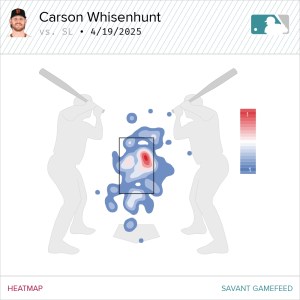
Heat map for Whisenhunt 4/19
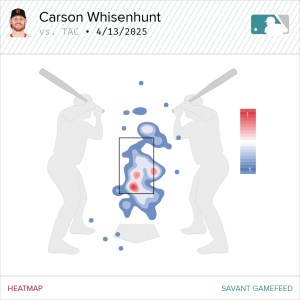
Heat map for Whisenhunt 4/13
Next up, Whisenhunt will take the mound in the high elevation of El Paso on April 25 to see if he can continue his momentum towards a Major League debut. The Giants do not have any upcoming schedule quirks, but they are having a few poor outings from Jordan Hicks and Justin Verlander, which could open up a spot for Whisenhunt or Carson Seymour in May.
10. Caden Dana, RHP, Los Angeles Angels
2025 AAA Stat line: 19.2 IP | 2.29 ERA | 31.3 K% | 8.4 BB%
2024 MiLB Stat line: 135.2 IP | 2.52 ERA | 27.4 K% | 7.3 BB%
This addition to the stash list feels like a bold take after only a few games in the 2025 season, yet Caden Dana appears poised on the mound while firing strikes with a plus fastball and 70-grade slider. He has already had two different stints with the Angels, so any prospect jitters should be out of the way. He is a 2022 eleventh-round draft pick out of high school. Dana earned himself the honor of the 2024 Southern League Pitcher of the Year after 23 starts with 147 strikeouts over 135.2 innings pitched. He had a 2.25 ERA and 0.94 WHIP even with a 46% fly ball rate. Of concern is his propensity to give up the fly ball. In his major league appearances, he has already been blasted for six home runs over 13.1 innings to the tune of 4.1 home runs allowed per nine innings. Allowing the ball to be put in the air is something he will need to address with pitch selection before finding success with the Angels.
On April 17, Dana went seven shutout innings, giving up four hits against seven strikeouts and zero walks. Of his 12 whiffs, he had five whiffs on the changeup, averaging 13 inches of arm side break, and four on the 95 mph fastball, averaging 18 inches of induced vertical break. His 70-grade slider doesn’t have much movement, but rather it has late-breaking action at 85 mph. He also displayed a keen sense of his arsenal by switching up his pitch mix to different-handed batters, which is always a good quality for a rising prospect to demonstrate. The concern will continue to be how badly he gets hurt by any fly balls allowed. In this game, he had a few warning track outs and hits that didn’t come across to score. His final line looks much better than it might have with a different chain of events following the first inning double. In a small sample of 2025 minor league data, he is suppressing home runs despite a fly-ball rate that matches his ground-ball rate. Dana will play in Triple-A home games at Smiths Stadium in Salt Lake City, where the elevation is over 4,200 feet. It is expected that he may suffer a few bad home run outings, so pay attention to how well he does in those home starts.
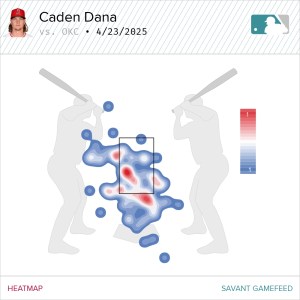
Dana wasn’t able to carry on the momentum from his previous start to the April 23 game against the Oklahoma City Comets, souring his debut on the stash list. His lack of success may have been due to his pitches having a few inches less of break with a half-tick down on the fastball velocity. Without his best stuff, he gave up eight hard hits, including one home run, yet also generated 12 whiffs. Based on the batted ball data, it appears that hitters were sitting on the fastball as they made contact on 89% of fastballs in the zone. Expectedly, he had a brief evening with 3.2 innings of work on 87 pitches, giving up six hits, two walks, three earned runs, and six strikeouts. The Angels’ starters have been outperforming their ERA indicators even with the second-worst strikeout-minus-walk rate in the major leagues, a combination of poor strikeout rates and high walk rates. A further obstacle for Dana, given his fly ball tendency, is that Angels Stadium has a 125 home run park factor and a 103 park factor overall. Even with admirable contributions from Tyler Anderson, Jack Kochanowicz, and Kyle Hendricks, Dana offers the strikeout upside that none of them possess.
On The Bubble
Here are the next several pitchers that were in consideration for inclusion on this week’s list:
Shane Drohan BOS (23 K over 14.2 IP), Cade Horton CHC (Proximity play but walking too many batters 18K: 10BB), Chase Burns CIN, Rhett Lowder CIN, AJ Blubaugh HOU, Sean Linan LAD (Dynasty add in Single-A with a 50 K% over 15 IP. I added him in a 20-team dynasty league), Luinder Avila KCR, Robby Snelling MIA, Carlos Rodriguez MIL, Blade Tidwell NYM (3-pitch mix hitting 97+ mph), Brandon Sproat NYM (pitching inconsistently), Jonah Tong NYM, Jack Wenninger NYM (Dynasty add in AA with 42.1 K% 6.6 BB%), Cam Schlittler NYY (7 IP & 9K!), Seth Johnson PHI, Logan Evans SEA, Quinn Mathews STL (Should begin throwing program soon) & Joe Boyle TBR.
Pitcher Stash List
