





Welcome to the positional rankings! In addition to the expected positional ranks, there are two other additions:
First, a foreword by author Nate Schwartz! These give a breakdown of the position as a whole and provide an additional view on how to approach it on draft day.
Second, at the end of the article, you’ll find a table of all of the players at this position who wound up in my Top 300.
We hope that these rankings and the notes throughout give you something to think about as draft day approaches and help you feel as prepared as possible when it comes to hitters in your 2026 drafts.
- As a reminder, these rankings are geared toward a standard, daily, 12-team H2H redraft league, which is typically the most popular fantasy baseball format. They will only factor in the five standard categories: runs, RBI, home runs, batting average, and stolen bases.
- These are not best ball or draft and hold rankings. The 12-team redraft format with daily moves is the fundamental opposite of that. Pure volume plays are not valued as much here as in those no-move formats.
- The listed positions are based on five starts or 10 appearances, matching Yahoo’s eligibility rules. I use this because it’s the most inclusive standard across major platforms. If you’re in a format like ESPN or CBS, you may find certain players do not have one of the listed eligibilities. The most jarring example is Maikel Garcia, who could have anywhere from one to five eligibilities based on your site’s rules.
Ranking Philosophy
To keep things in the same ilk, here are a couple of notes on how I generally evaluate hitters before we dive in:
- In 12-team formats, I don’t see much value in guys who only provide stolen bases. It’s an important category, especially in Roto, but in shallower formats, there are too many other (and better) ways to get the steals you need without sacrificing production in the other categories.
- No stat is an island, and they should all be taken in proper context. For ranking purposes, the primary starting points I use are plate discipline, wRC+, quality of contact metrics (also known as Statcast batted ball data), lineup context, and the skills we can measure using tools such as our PLV Hitter Attributes (available for PL Pro members). I also use various projections (some free, some I buy) and dollar value generators.
- Positional eligibility, specifically multi-eligibility, is neat but isn’t a huge factor in many 10- and 12-team leagues anymore due to the prevalence of multi-eligible players. It’s of more value in deeper contests like the NFBC or in leagues with limited roster moves (draft and hold leagues, transaction limits/costs, extremely short benches, etc.). Still, the value is fairly situational and context-dependent.
- Similarly, I don’t penalize players for only qualifying in the utility slot. At most, it is a mild inconvenience if a DH-only player is available at a great value and you already have filled your utility spots.
- Regardless of true talent, anyone talented enough to make it to the big leagues can be brilliant or putrid for 50 to 100 at-bats. It could even last over a month with no change in potential or skill. It also could be wildly meaningful. We can’t and don’t know which will be valid until it’s over, though track record, scouting, and trends can give us hints.
- One of the most difficult things to account for in these rankings is the dynamic between low-ceiling players who have clear roles and players who could have higher ceilings but are without a clear path to playing time. I try to note this in the blurbs as much as I can. NOTE: PROJECTIONS AND AUCTION CALCULATORS WILL ALWAYS FAVOR THE FORMER OVER THE LATTER.
Read The Notes
If you’d like input on a player or have any feedback, your best bet is to contact me on Bluesky (@scottchu.pitcherlist.com), X (@ifthechufits), or Reddit (u/ChusephEsquire)
I also host an AMA in the r/fantasybaseball subreddit every Friday (starting sometime in late March) with Nate, starting around noon ET that lasts through the rest of the day and into the weekend, so feel free to join the fun and ask questions or make comments.
For additional insight, also check out the Hacks & Jacks podcast! This is a hitter-focused pod with myself, Brett Ford, and occasional special guests. We will soon be releasing episodes breaking down these rankings.
Want more from Nate? Check out The Approach Angle podcast, his weekly articles, or jump into our Reddit AMAs during the season! You can also find him on Bluesky (@nschwartz.bsky.social), X (@_nateschwartz), or Reddit (u/NateSchwartzPL).
Foreword
By Nate Schwartz
First base continues to have its mainstays in the early rounds, with established veterans largely making up the top group. Vladimir Guerrero Jr., Pete Alonso, Bryce Harper, and Matt Olson are joined by Nick Kurtz as the names going in the first 50 picks, and you largely know what you’re getting with each, outside of Kurtz.
After that top group, however, the first base options bring more questions than you might be comfortable with. There are legitimate age, ballpark, or profile questions with the next set of first basemen, ranging from Freddie Freeman to Vinnie Pasquantino. Beyond that, there’s a nice variety of bats that can fill specific needs, but there seem to be more batting average options than power options for second division players.
I would look to grab one of the top options if possible, making sure you can bank as many counting stats as possible with your primary first baseman. Then, you have more flexibility to take shots at specific skills the later group of first basemen provides.
Tier 1
1. Nick Kurtz (1B, ATH) — Despite a slow start and playing in just 117 games in the big leagues, Kurtz finished as a top-30 hitter on the FanGraphs Player Rater and as the fifth-best first baseman. To put that in more perspective, every other first baseman in the top 10 had at least 150 more plate appearances, and while he tied Lindor, Pages, Harris II, and Elly De La Cruz in RBI with 86, each of them played in at least 156 games. Sophomore slumps have bitten players with an even shinier prospect pedigree than Kurtz, though those guys presumably didn’t have the benefit of hitting in a minor league ballpark. It might be a bumpy ride due to the strikeout rate that has a tendency to spike, but few players have hot streaks that burn as brightly as Kurtz’s.
2. Pete Alonso (1B, BAL) — A new home for Alonso might be just what the doctor ordered. For what it’s worth, Statcast indicates that if he had played all of his games in Camden Yards, he’d have hit 45 home runs. Had he played all his games in Citi Field, it would have been just 36. The new dimensions certainly played nicer with right-handed hitters in 2025, and Alonso should be able to take advantage of that (plus whatever he gained by getting a fresh start) to hit .250 or better with 40 home runs.
3. Vladimir Guerrero Jr. (1B/DH, TOR) — Thanks to his propensity to hit liners and grounders, 30 home runs feels more like a ceiling than a floor for Vlad Jr. these days, despite his elite exit velocities. However, that lower home run ceiling comes with excellent ratios and counting stats (though it’s insane he only drove in 84 runners while hitting second or third on the fourth-highest scoring offense in the land). Vladito presents one of the highest floors in the game, as he’s never missed 10 games in a season since being activated to the major league roster and in the top 15 in both runs and RBI since the start of 2022 (which means I’ve excluded his incredible 48-home run 2021) and is an excellent pick to anchor a team that either already has or soon plans to get risky.
It feels a little crazy to rank Guerrero lower than Kurtz, especially with projections loving Guerrero, but my philosophy in 12-teamers is usually to chase that ceiling early, and that’s something Guerrero just can’t deliver to the same degree as the rest of the players in this tier. If you’re more of a floor person, you can bump him to 14th or 15th.
Tier 2
4. Bryce Harper (1B/DH, PHI) — Harper missed a decent chunk of the summer on the IL with inflammation in his wrist, and it was something he dealt with for at least a large portion of the season. I’m treating 2025 as more of a floor than the new norm, and even if I expect him to miss 15-20 games for whatever reason (he hasn’t played in more than 145 games since 2019), Harper should still be able to hit 30 home runs with excellent ratios. The path to something like a top-20 finish for Harper is all about staying healthy, as thanks to his routine absences from the lineup, he’s failed to reach 90 runs or 90 RBI in any of the last four seasons. Still, it’s hard to ignore the upside of a healthy Harper, and it’s not as though the remainder of this tier is without risk.
Why does Harper get a big bump from my October ranks? Well, because I was simply far too low on him. That description above is the same as the one from October, and makes just as much sense with this ranking.
5. Josh Naylor (1B/DH, SEA) — How do you not love Josh Naylor? This 5’10” ball of effort not only drove in at least 90 runners for the third straight season, but he took a second percentile sprint speed and turned it into 30 stolen bases in 2025 while getting caught just twice. He actually led the Mariners in steals from the day he joined up, beating out Julio Rodríguez. A return to Seattle was an ideal outcome for all, as it makes a return to 20-25 steals (or more) become a lot more likely. Naylor’s skillset is contact-driven and very safe, and while elite home run numbers aren’t likely, I truly believe in his ability to be a plus in all five categories once again.
6. Matt Olson (1B, ATL) — Olson looked much the same in 2025 as he did in 2024, albeit with a better batting average. Olson’s true strength, apart from the 30-ish home run power, is his durability. He’s played in all 162 games for four straight seasons and has only missed more than six games one time since his first full season in 2018. His incredible 54 home runs in 2023 are unlikely to be repeated, but 28-30 home runs and decent (or possibly even good) ratios will be there in 2026, and if the Atlanta offense is even just slightly better and/or healthier than it was in 2025, we should see 200 combined runs and RBI as well.
7. Rafael Devers (1B, SFG) — Devers finished 2025 with 35 home runs and 109 RBI, though the story of his season is less about numbers and more about the absolute circus he endured to start the season. Boston signed a third baseman and relegated him to DH duties, followed by a stretch of struggling with strikeouts in April. He was then traded to the Giants just two years into a 10-year contract. Devers was a slightly worse hitter by the Bay than he was in Boston, though the stats under the hood were quite similar outside of an elevated pull rate that was likely more random than anything else.
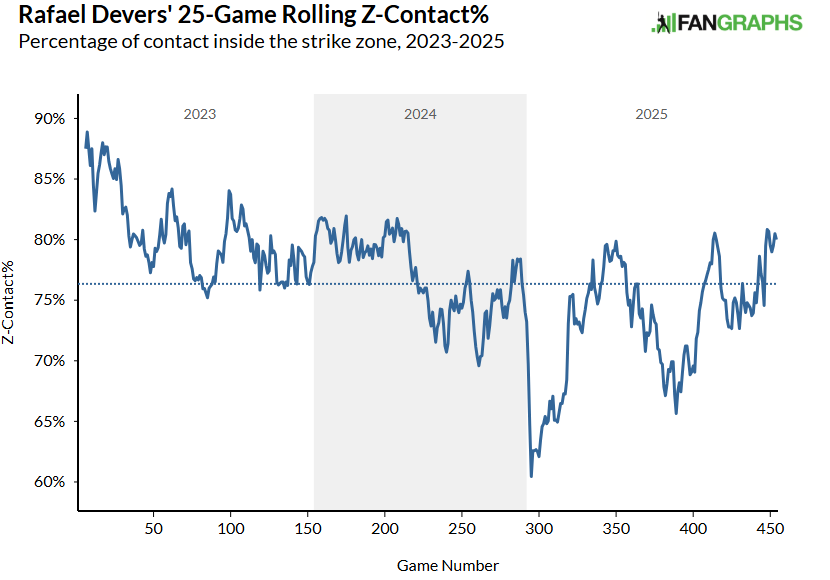
The one worry I have for Devers is how well his historically poor contact ability will play out over time. He’s never been excellent at making contact, but his 73.8% zone-contact rate in 2025 was a new low and made him the only player to get 500 or more plate appearances while having a zone-contact rate below 75% (Chisholm’s 76.8% was the next lowest). His old zone contact floors have turned into his rolling average, and his floors (especially from early in the season) are TERRIFYING. This makes me believe the .250 batting average and elevated strikeout rates are here to stay, making him more of a three-to-three-and-a-half category guy than four, almost like a poor man’s Kyle Schwarber. If he can rebound to something closer to his 2023-2024, then he’d move closer to the top of this tier.
8. Freddie Freeman (1B, LAD) — For the first time in seemingly forever, Freddie Freeman did not finish as a top-five first baseman. An injury slowed him down over the summer, and it’s also possible that Father Time has started to come for Freeman. That all being said, this was still a top-40 hitter in 2025 thanks to a .295 average, 24 home runs, and 171 combined runs and RBI hitting in the heart of the most dangerous lineup in the National League. Freeman should keep that role for one more season at least. With the Dodgers’ hitting core of Ohtani, Betts, the newly acquired Kyle Tucker, Freeman, and Will Smith remaining intact for 2026, another season with elite ratios, 20+ home runs, and well over 100 RBI seems likely.
Tier 3
9. Vinnie Pasquantino (1B/DH, KCR) — I never thought Vinnie Pasquantino would be a 30-home run hitter after seeing what he brought to the table in his first three seasons, but here we are. Vinnie P’s power appeared in full force over a relatively short time frame, where he hit nine home runs in a 14-game stretch in mid-August. Outside of that stretch, the Pasquantino we saw was more like the 20-25 home run guy we expected. I’m not bringing that up to say that it was all a fluke and that we should ignore the power uptick, but I do want to recommend caution on projecting another 30 home runs for a player who didn’t really hit the ball harder or in the air or to the pull side much more than he did in past years.
Twenty-five homers feels like a more reasonable projection with 90-100 RBI if he can stay healthy, though notably, he missed significant time in 2023 and 2024 due to injury, which can’t be ignored. For points leaguers, and particularly those dealing with a strikeout penalty, go ahead and boost Pasquantino up a tier, as he is excellent at avoiding strikeouts, especially when compared to his first base peers.
10. Ben Rice (C/1B/DH, NYY) — He’s got to be a fixture in the lineup in 2026. Right? RIGHT?! Ben Rice is a Statcast darling, finishing as a top-five hitter in terms of xwOBA and hard-hit rate with a 99th percentile xSLG. In addition, he’s above average at taking walks and avoiding strikeouts and does a good job making contact. That said, the Yankees have shown an easy willingness to sit Rice against many lefties (he can hit them for power, but not for average, while striking out much more often and walking less), there’s some risk that he’ll get capped at 135-140 games. Still, with Paul Goldschmidt off the roster and no other obvious competition for first base at-bats, Rice ought to get the full-season chance he deserved.
One quick quirk to point out, though: in back-to-back seasons, Rice has seen a prolonged slump despite consistently strong batted-ball quality. I’m not sure if it’s because he enjoys walking under ladders or gets a kick out of spilling salt at meals, but it’s happened twice now, and in both cases, it’s led to reduced playing time for a while.
As a final note, Rice’s ADP on sites like NFBC will be surprisingly high, but I suspect it will be much more reasonable in single-catcher formats where many managers choose to wait on the position due to the depth. This is true of all the catchers in this tier, but Rice has been the most highlighted example in conversations I’ve had.
11. Salvador Perez (C/1B/DH, KCR) — It’s insane how this guy keeps catching over 80 games a season, isn’t it? Sal got off to a slow start in 2025, hitting just four total home runs over the first two months, but for the rest of the season, he hit at least five home runs per month, including a nine-dinger July. Perez still swings at everything and manages to barrel more than his fair share of baseballs, though the ratios tend to suffer because he puts bad pitches in play a lot and wasn’t fast even in his prime. He will hit 25 home runs and drive in 100 again, somehow, though the slumps will likely be just as brutal as they were in 2025.
Tier 4
12. Tyler Soderstrom (1B/OF, ATH) — Soderstrom is the type of hitter who produces in large spikes with long lulls in between (two separate 25+ game stretches with no home runs, for example), but because he burns so hot when he’s on, the final numbers work out in his favor. Soderstrom’s strikeout rate improvement was a significant positive and helped him post a .276 batting average, though the high ground-ball rates force me to hesitate on his power ceiling, as hitting 30 home runs with so few fly balls is difficult even when your home park is a bandbox. Soderstrom is a solid back-end first baseman in 12-teamers, but make sure you’re aware of his particularly volatile on-again, off-again nature and are ready to deal with that emotionally.
13. Yandy Díaz (1B/DH, TBR) — Yandy Díaz took full advantage of his temporary home park, hitting 18 of his 25 home runs at home. A return to the Trop is likely to suppress a lot of those numbers (he’s never hit more than 12 home runs in that park in any single season), but Díaz should remain an incredibly consistent producer of ratios and counting stats as an everyday player for the Rays. He’ll hit around .290 to .300 with 150 or more combined runs and RBI, though those home run totals will be closer to 16-18 than 23-25. Díaz gets a boost in points leagues due to his low strikeout rate and the fact he hits high in the order on a daily basis, but his boost in OBP leagues isn’t what it was earlier in his career (though he walked nearly 20% of the time at the end of the season, so perhaps a return to double-digit walk rates is on the horizon).
14. Jonathan Aranda (1B/DH, TBR) — Aranda was everything we hoped for and more when he was healthy, posting a robust 93.0 mph average exit velocity and hitting well against both righties and lefties (which is especially critical in Tampa, where they love to platoon their hitters). Injuries have been an issue in back-to-back seasons, though, and strikeouts became an issue as pitchers got more looks at Aranda (31.8% over his last 288 games). Our PLV metrics also found him to be a merely average decision-maker and subpar at making contact. Those risks force me to rank Aranda just a little lower than I’d like based on the quality of his contact skills, but if he can make some minor adjustments, we could see him rise through the ranks quickly. As a final note, moving back to the Trop shouldn’t change his power output, as he hit most of his home runs on the road.
15. Michael Busch (1B/DH, CHC) — Michael Busch got a full season of action, including starts against lefties, and the results were overwhelmingly positive as he slashed .261/.343/.523 with 34 home runs and 90 RBI. He also hit at least five home runs in five of six months and consistently drove in runners. Busch also ended the season on quite a heater, hitting eight home runs over his last 15 games, and then carried that heat right into the playoffs to hit four more in his eight playoff starts.
Busch fell over 40 spots since my October ranks, largely because of a projected drop in ratios and home runs from the vast majority of projection systems I trust.
16. Alec Burleson (1B/OF/DH, STL) — Burleson is best deployed in points leagues due to his low strikeout rate and his role in the middle of the order, and his ability to make contact keeps his floor very high when healthy. He should hit at least .280 in 2026, and there’s a chance he boosts his power a bit to something like 23-25 home runs. The lack of depth in the Cardinals’ lineup makes him a liability in runs scored, though, and his RBI totals will be more decent than good, but this is a good hitter who will help your bottom line.
17. Christian Walker (1B, HOU) — Walker got off to an incredibly slow start as an Astro, winding up on many waiver wires by the All-Star Break as he hit just .229/.286/.374. He looked much more like himself in the second half, though, especially in the power department, as his .488 slugging was 114 points higher than it was in the first half. While that strong finish helped Walker squeeze into the top-100 hitters on the FanGraphs Player Rater for 2025, I can’t shake the concerns that volatility and extended slumps may be more common for Walker than in the past as he enters his age-35 season, especially with the below-average walk rate he showed throughout the season. Walker could be a 30-home run hitter with 85+ RBI in 2026, though, between the falling walk rate and rising strikeout rate, the floor for Walker is a guy who finishes outside the top-200.
Tier 5
18. Luis Arraez (1B/2B/DH, SFG) — You should know all about what Luis Arraez is and what he can do by this point: he has a highly compact swing that he uses to pepper line drives all over the field. He’s had the lowest strikeout rate among qualified hitters for four straight seasons, and his worst single-season batting average is .292 (which is what he hit in 2025).
Landing in San Francisco is rather ideal because they have a place for him to play in the infield, and they also need a full-time leadoff man. He wasn’t going to hit home runs anyway, so the park factors don’t matter.
19. Spencer Torkelson (1B/DH, DET) — Tork was much better in the first half than the second half, but he remained a functional back-end first baseman and corner infielder for the whole season, and he should return to a full-time role and hit another 30 home runs for the Tigers in 2026. I’m a bit concerned about the strikeout rate spikes and overall volatility, and I’m not convinced he’ll ever truly buck those trends, but the elevated walk rate helps a little. If you need plus power and not-bad counting stats and don’t care about a low batting average, Torkelson is your guy.
20. Willson Contreras (1B/DH, BOS) — Historically, when Willson Contreras plays more than 100 games, he finishes as a top-seven catcher, and 2025 was no exception. Contreras set a career-high mark in plate appearances, runs, and RBI, though the real story here is that he’s no longer a catcher. As purely a first baseman, Contreras fills a role when healthy by hitting near the heart of a lineup and probably driving in 70-80 runners if he gets into 130 games with decent ratios (for a guy in this portion of the player pool). Contreras is a floor guy for deeper leagues and might even spend some time on your roster if you get hit with injuries or are chasing ribbies.
21. Yainer Diaz (C/1B/DH, HOU) — Like most of the Astros offense, Diaz got off to a miserably slow start, but did manage to hit 20 home runs in 2025. The batting average took a 43-point step backward, though under the hood, it looks like he was more a victim of bad luck than skill regression. Between the volume and counting stats, Diaz should finish as a top-10 catcher as long as he doesn’t bottom out for a month as he did in 2025.
22. Sal Stewart (1B/3B, CIN) — Stewart doesn’t have nearly the same prospect pedigree as the others in this tier, but he does have an exceptional minor league track record, including a 152 wRC+ across Double-A and Triple-A in 2025 and five home runs in his first 18 major league games with a bunch of balls that he hit really hard.
Projections love what Sal Stewart brings to the table, with most major systems projecting him for 20+ home runs if he wins a full-time role. Even if he doesn’t, he could still threaten that mark with solid ratios. As of now, the Reds don’t have any real threat to Stewart’s chances at being a regular in the lineup, but they are known to do weird things in Cincy, and resigning a guy like Hays could cause Sal to drop hard in the ranks.
23. Alec Bohm (1B/3B, PHI) — After back-to-back seasons of 97 RBI, Bohm disappointed by delivering just 59 in 2026 due to a combination of injury and poor performance throughout the season. He had been carved into the cleanup role for the last few seasons, but due to a slow start and never really finding his groove until late in the year, Bohm spent quite a bit of time hitting in the bottom half of the order, and it showed us that his value is tied to his lineup position. Bohm doesn’t have the power or speed to make an impact unless there is a steady stream of runners on base for him to drive home with singles and doubles (and the occasional home run). If he returns to the four-spot (as he did by the end of the year), he can outperform this rank, but the risk if Bohm doesn’t hold that spot is a hitter who can’t quite crack the top 100 even on his good days.
24. Ryan O’Hearn (1B/OF, PIT) — Surprisingly, O’Hearn is a Pirate! That means he’s likely to be a mostly everyday player simply due to the lack of options and competition in Pittsburgh. PNC Park is quite spacious, but O’Hearn should still be a decent bet for 15-17 home runs and solid ratios, plus as many counting stats as the Pirates can muster (which isn’t a lot unless a few guys find a new level). The ceiling isn’t terribly high, but the floor is as good as it gets in the later rounds.
Tier 6
25. Jake Burger (1B, TEX) — Burger still has home run power and what appears to be a starting role at first base for the Rangers. He should hit near the middle of the order, too. The ratios will probably hurt you, and he could bottom out entirely, but 25 home runs should be there.
26. Andrew Vaughn (1B/DH, MIL) — Vaughn’s stunning demotion and move to Milwaukee are the story of his 2025, but there are reasons to believe his 2026 could be a little less bumpy. Vaughn should get the chance to win an everyday role next spring (despite his fairly poor showing to end the season and in the playoffs) with Rhys Hoskins out of the picture, and an offseason with the Brewers could help him take a step forward in a way the White Sox never could. To really unlock his power, Vaughn would need to get a lot better at pulling balls in the air (or even just pulling the ball at all), and I don’t expect that to happen, but if it did, he’d be a very solid fantasy first baseman.
27. Kyle Manzardo (1B/DH, CLE) — Manzardo has one last opportunity to establish himself as an everyday first baseman coming off a 27 home run season. Sure, it was marred with inconsistency and he has a heck of a time trying to make contact against lefties (though when he does, he hits it hard), but the Guardians desperately need their young slugger to add pop and depth to this offense to continue to compete for playoff spots, and I think they’ll head into the year hoping 162 games of Manzardo creates that lift. The ratios won’t be useful in any format, but a repeat of his 27 home runs plus 85 RBI is in the cards if he can earn that role, and the runs scored should be better than the insanely low 43 he picked up in 2025.
28. Jac Caglianone (1B/OF/DH, KCR) — Caglianone has oodles of upside, though he was positively miserable in his 232 plate appearances in 2025. While Cags avoided strikeouts, he hit far too many grounders and wasn’t able to really tap into any of his prodigious power.
He gets a significant jump in these ranks because of what could now be a spot closer to the middle of the order. The strong spring numbers are cool too, but only insofar as they land him a more secure role in a top-heavy offense.
29. Spencer Horwitz (1B/DH, PIT) — It took a while for Horwitz to turn it on after missing the first few months with injury, but he gave a strong performance in the second half, finishing as the sixth-best second baseman for the half and showing he can provide some pop and strong ratios, albeit on a bad offense. Horwitz loses his second-base eligibility in 2026, though, and while he was the sixth-best second baseman, he was only the 15th-best first baseman. Horwitz is a solid addition late in drafts if you need a corner infielder who boosts your ratios, or if you’re in a points or OBP league, but otherwise, you might want to chase upside elsewhere.
30. Gavin Sheets (1B/OF/DH, SDP) — Sheets is a streaky lefty with power who will give us one or two good months and three or four bad ones. Keep him on your streaming radar, but don’t fool yourself into thinking this is a full-season option. On the bright side, O’Hearn’s departure gives Sheets a clear path to regular playing time, though remember that you don’t want his games against lefties.
Photo courtesy of Icon Sportswire | Adapted by Aaron Polcare (@abeardoesart on Bluesky and X)
