





Welcome to the positional rankings! In addition to the expected positional ranks, there are two other additions:
First, a foreword by author Nate Schwartz! These give a breakdown of the position as a whole and provide an additional view on how to approach it on draft day.
Second, at the end of the article, you’ll find a table of all of the players at this position who wound up in my Top 300.
We hope that these rankings and the notes throughout give you something to think about as draft day approaches and help you feel as prepared as possible when it comes to hitters in your 2026 drafts.
- As a reminder, these rankings are geared toward a standard, daily, 12-team H2H redraft league, which is typically the most popular fantasy baseball format. They will only factor in the five standard categories: runs, RBI, home runs, batting average, and stolen bases.
- These are not best ball or draft and hold rankings. The 12-team redraft format with daily moves is the fundamental opposite of that. Pure volume plays are not valued as much here as in those no-move formats.
- The listed positions are based on five starts or 10 appearances, matching Yahoo’s eligibility rules. I use this because it’s the most inclusive standard across major platforms. If you’re in a format like ESPN or CBS, you may find certain players do not have one of the listed eligibilities. The most jarring example is Maikel Garcia, who could have anywhere from one to five eligibilities based on your site’s rules.
Ranking Philosophy
To keep things in the same ilk, here are a couple of notes on how I generally evaluate hitters before we dive in:
- In 12-team formats, I don’t see much value in guys who only provide stolen bases. It’s an important category, especially in Roto, but in shallower formats, there are too many other (and better) ways to get the steals you need without sacrificing production in the other categories.
- No stat is an island, and they should all be taken in proper context. For ranking purposes, the primary starting points I use are plate discipline, wRC+, quality of contact metrics (also known as Statcast batted ball data), lineup context, and the skills we can measure using tools such as our PLV Hitter Attributes (available for PL Pro members). I also use various projections (some free, some I buy) and dollar value generators.
- Positional eligibility, specifically multi-eligibility, is neat but isn’t a huge factor in many 10- and 12-team leagues anymore due to the prevalence of multi-eligible players. It’s of more value in deeper contests like the NFBC or in leagues with limited roster moves (draft and hold leagues, transaction limits/costs, extremely short benches, etc.). Still, the value is fairly situational and context-dependent.
- Similarly, I don’t penalize players for only qualifying in the utility slot. At most, it is a mild inconvenience if a DH-only player is available at a great value and you already have filled your utility spots.
- Regardless of true talent, anyone talented enough to make it to the big leagues can be brilliant or putrid for 50 to 100 at-bats. It could even last over a month with no change in potential or skill. It also could be wildly meaningful. We can’t and don’t know which will be valid until it’s over, though track record, scouting, and trends can give us hints.
- One of the most difficult things to account for in these rankings is the dynamic between low-ceiling players who have clear roles and players who could have higher ceilings but are without a clear path to playing time. I try to note this in the blurbs as much as I can. NOTE: PROJECTIONS AND AUCTION CALCULATORS WILL ALWAYS FAVOR THE FORMER OVER THE LATTER.
Read The Notes
If you’d like input on a player or have any feedback, your best bet is to contact me on Bluesky (@scottchu.pitcherlist.com), X (@ifthechufits), or Reddit (u/ChusephEsquire)
I also host an AMA in the r/fantasybaseball subreddit every Friday (starting sometime in late March) with Nate, starting around noon ET that lasts through the rest of the day and into the weekend, so feel free to join the fun and ask questions or make comments.
For additional insight, also check out the Hacks & Jacks podcast! This is a hitter-focused pod with myself, Brett Ford, and occasional special guests. We will soon be releasing episodes breaking down these rankings.
Want more from Nate? Check out The Approach Angle podcast, his weekly articles, or jump into our Reddit AMAs during the season! You can also find him on Bluesky (@nschwartz.bsky.social), X (@_nateschwartz), or Reddit (u/NateSchwartzPL).
Foreword
By Nate Schwartz
Shortstop is the strongest position this year in fantasy, providing all sorts of talent deep into the middle rounds of the draft. Despite the strength, only two players are bona fide first-round picks: Bobby Witt Jr. and Elly de la Cruz. It’s the second and third rounds that will assuredly be filled with shortstops, with five other names likely to go before pick 30. All of these options, such as Francisco Lindor or Zach Neto, all provide different flavors of the same outcome: five-category outputs that are foundational for any fantasy team.
The other shortstops in the top 100 start to show a diverse range of skillsets, but all still have that potential to be upper-echelon contributors across multiple categories. If you don’t end up with one of the all-around balanced options, there are fun ways to build out your roster with a non-stolen base option like Corey Seager or take a shot on the ever-dynamic Oneil Cruz.
While shortstop is known as a position of dynamic athletes and exciting potential, the later names like Trevor Story, Willy Adames, or Dansby Swanson create ample opportunity to bank a healthy mix of home runs and stolen bases from a non-flashy player.
Beyond the main group of likely starters, the late-round options include some exciting skills that could pay off in a big way. Colson Montgomery’s power is unlike anyone else’s this late for a middle infielder, Xavier Edwards has the potential to be a league leader in steals, and then there’s the group of prospects. Three shortstop prospects could be impact bats in the early months of 2026: JJ Wetherholt, Kevin McGonigle, and Konnor Griffin (who likely won’t have shortstop eligibility out of the gate). All possess skills that would make them much more expensive if word got out that they are making an early debut. If you have room to throw them in a bench role, it could pay off very quickly. However, holding prospects too long can be detrimental to necessary early waiver moves.
While grabbing a top shortstop in the first few rounds would be preferred, there will be good options up through the middle of the draft to grab as a starting shortstop. Enough players will post at the position that you can take a chance on an injury-prone name if you want, since there will be good names to take as reserves that could become starters.
Tier 1
1. Bobby Witt Jr. (SS, KCR) — Thirty home runs is a tough ask when you play half your games in Kauffman and have a spray-hitting approach. He should hit around 25, though, and Witt will provide elite ratios with 35-40 steals. The counting stats could improve as well if the Royals find one or two more pieces (not that I necessarily expect this to happen).
Tier 2
2. Francisco Lindor (SS, NYM) — Lindor is averaging over 30 home runs and 30 steals over the last three seasons, with well over 100 runs scored. He’s also among the most durable players in the game over the course of his career, missing more than 20 games just once since his first full year in the majors back in 2016. Sure, we’ve seen some extended slumps in each of the last two seasons, but the end results are fantastic, and there’s no reason to believe that will change in 2026.
News that Lindor may have surgery on his hamate bone may scare some into dropping him in their ranks, but the limited data available suggests there isn’t a long-term impact on power or overall performance.
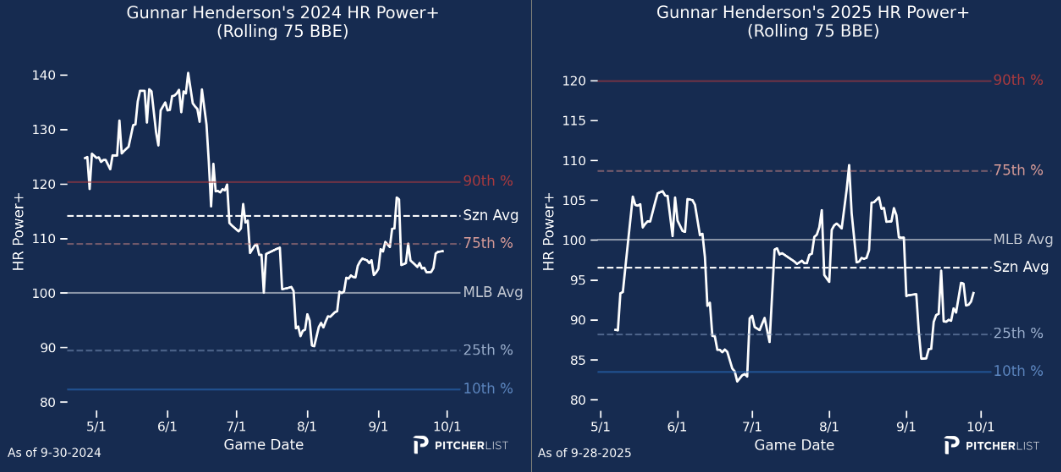
3. Gunnar Henderson (SS/DH, BAL) — One of the most frustrating things about trying to evaluate players in-season is that we just don’t know everything that’s going on. Earlier in January, Henderson admitted that he played with a shoulder issue for most of the season, which may very well explain the 4.2 drop in his average fly ball velocity in 2025. That’s why he jumped from 28th in my “too early” rankings from October to 16th today. It is worth noting, though, that the power outage we saw really started in the second half of 2024 (see charts below), and there’s still risk that he won’t get back to the 30+ home run guy we fell in love with in 2024. Still, with an improved lineup around him and a boatload of talent, Henderson is well worth the gamble.
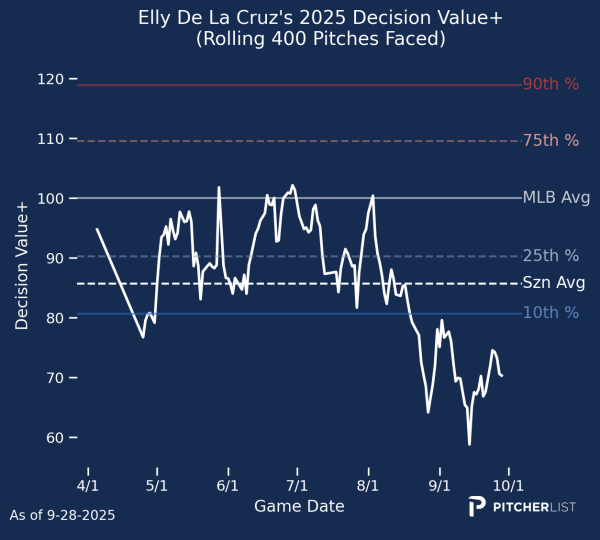
4. Elly De La Cruz (SS, CIN) — The Reds were far less aggressive on the base paths in 2025 than in 2024 (when they were one of the most aggressive teams in the league) under Terry Francona, and it’s hard to imagine that changing too much in 2026. That puts a lower ceiling on the steals, though the rest of the package is as promising as ever. Elly will likely never be an elite decision-maker, but if he can just be below average like he was in the first half instead of abysmal like he was in the second half, there’s a chance he’s at the top of this tier early into 2026. The more likely outcome, though, is more of the rollercoaster ride we’ve seen from him throughout his career so far, albeit with a bit higher floor thanks to the reduced strikeout rate.
Tier 3
5. Zach Neto (SS, LAA) — Neto’s season started and ended on the IL, but in the 128 games in between, we saw an excellent fantasy shortstop. His average exit velocity, barrel rate, and hard-hit rate were all up significantly, with no real loss in contact ability and a minimal uptick in strikeouts. Neto is a threat for a 30-30 season if he stays healthy in 2026, especially if the across-the-board improvements to his quality of contact stick around.
6. Trea Turner (SS, PHI) — It was great to see Turner return to the land of 30 stolen bases and a .300 batting average, even if he fell short of 20 home runs for the first time since 2020. Turner will be the veteran leadoff man on a Phillies team that knows the clock is ticking, and if he can play in at least 140 games (which he has done in four of the last 5 seasons), he should be good for at least another 15 home runs, 30 stolen bases, 90-100 runs scored, and a batting average north of .290.
7. Mookie Betts (SS, LAD) — Through his first 453 plate appearances of 2025 (103 games), Mookie Betts was objectively a disappointment. He was slashing just .231/.302/.355 with just 11 home runs, and for quite some time, we openly questioned whether Betts was in the twilight of his career. He must have heard us, because for the remaining 47 games, he hit nine home runs with a fantastic .317/.376/.516 line. Our metrics certainly caught this spike as well.
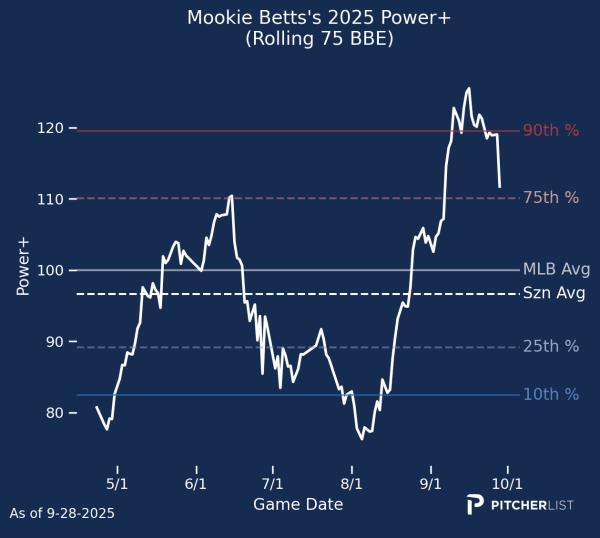
If Betts can avoid the horrifying lows in 2026, he should clear 100 runs scored without an issue, and his elite decision-making and contact ability give him multiple paths back to a batting average above .265 and an OBP above .350.
8. Bo Bichette (SS/DH, NYM) — After years of declining production, Bichette finally reversed the trend and improved as the season went on. Sure, the stolen bases are likely never to return, and he fell short of 20 home runs, but he did manage to hit .311 and drive in 94 runners thanks to the Blue Jays’ offense finding its groove. Bichette did miss over 20 games for the third straight season, but there’s no reason he couldn’t pitch in a full one in 2026 with another .300 batting average, 17-20 homers, and plenty of runs and RBI.
Bichette actually bumped up a whole tier with the news he’d be a Met. Not because of the landing spot itself, mind you, but because he’ll be the primary third baseman for the Mets. Adding that eligibility is a big deal in my book, as it adds another safe piece in a position dying for more of them. He would have gotten this bump if he had gone somewhere to play second base as well, but third base is just as nice.
Tier 4
9. Maikel Garcia (2B/3B/SS/OF/DH, KCR) — Garcia’s 16 home runs in 2025 were five more than he had in all of 2023-2024 combined, and he did it with a better batting average than ever before. Garcia doesn’t have a gawdy barrel rate thanks to his propensity to hit ground balls, but his average exit velocity of 91.3 mph shows he does have some thunder in his bat if he can get it up in the air to the pull side, which is precisely what he improved on in 2025. These changes can sometimes be fluky, but with a guy who can play several premium positions, enough raw power to make it believable, and the ability to steal over 20 bases in his back pocket, Garcia is a solid choice for managers who need speed and batting average boosts without sacrificing power entirely.
10. Corey Seager (SS, TEX) — As per usual, the question for Seager is health. When healthy, we see elite production and elite quality of contact. Seager hasn’t played in 120 games since 2022, though that didn’t stop him from hitting 30 home runs in three consecutive seasons prior to 2025. If you haven’t taken on too much injury risk by this stage of the draft, Seager represents an opportunity to get a player with the potential to vastly outproduce his cost. If you’ve already taken on a lot of risk (such as Yordan Alvarez or Ronald Acuña Jr.), then you probably need to shove Seager down a tier (which will effectively remove him from your board).
11. Trevor Story (SS, BOS) — 2025 was Story’s first full-ish season since 2021, when he was still with the Rockies, and he did not disappoint, hitting 35 homers and swiping 31 bases with a .263 average and 187 combined runs and RBI. Story is under contract for one more season, and if anyone had any faith he’d be healthy for more than 120-130 games, I’d probably have Story ranked higher. Unfortunately, even with a full season to add to the math, Story is averaging just 80 games per season for the Red Sox, and we have to take that into consideration.
Furthermore, Story’s plate discipline screams streaky profile. It’s worth wondering whether he can make this kind of magic (he finished as a top-25 hitter in 2025) again in his age-33 season, considering all of the things working against him. There will be plenty of hemming and hawing in the offseason, trying to figure out exactly when is the right time to call his name at the draft. Still, projections I trust seem to trust Story, so that gives me a little less pause.
12. Geraldo Perdomo (SS, ARI) — Perdomo finished as a top-15 hitter in most formats (even higher in many points leagues), which is a challenge for a player like Perdomo who rarely hits the ball hard. In fact, Perdomo had only 14 home runs in 401 games in the majors coming into 2025, and never more than six in any single season in the minors or majors. His home runs weren’t cheap either, as Statcast credited him with 19.2 expected home runs. Perdomo’s success stems entirely from his elite contact and decision-making, making him a player with a very high floor and a ceiling closely tied to his ability to get the ball out of the yard. The high ratios, excellent plate discipline, and buckets of runs scored will be there in 2026, as will 25-30 stolen bases. That’s a good player, even if it only comes with 10-12 home runs.
I definitely over-ranked Perdomo in October, as I forgot to take into account that the counting stats will likely come down in a big way from 98 runs and 100 RBI. Something more like 90 runs and 60 RBI is a lot more likely.
13. Willy Adames (SS, SFG) — At the end of May, Adames was slashing .210/.297/.339, had sunk to the bottom half of the order, and was looking like a bust by the Bay outside of an outstanding series in Colorado. In shallow leagues, Adames had hit the wire all over the place, but July changed all that as he posted a 1.096 OPS that month with seven home runs and as many RBI as he’d driven in for all of May and June combined (21). While the batting average was ugly for the rest of the season (as it had been before July), the power stuck around as he hit a total of 18 home runs in the second half, as many as Aaron Judge, Eugenio Suárez, teammate Rafael Devers, and Julio Rodríguez (and others).
I gave Adames a big boost since the October ranks, if only because I can’t ignore that he consistently finishes as a top 50-75 hitter even if the start is brutally slow.
Tier 5
14. CJ Abrams (SS, WSN) — You’ll get about 20 home runs, 30 steals (they’ll come in bunches, then disappear), a mediocre average, a bad OBP, and 80-90 runs scored. I feel confident that the guy we’ve seen is the guy we will continue to get, and whether he flirts with the top 50 or just misses the top 75 will be mainly based on how lucky he gets spinning the BABIP wheel. I really don’t have much more to say here.
15. Nico Hoerner (2B/SS, CHC) — Hoerner’s ceiling and floor aren’t that far apart, which can be a bit boring. He’s going to hit fewer than 10 home runs, and he’s going to steal more than 25 bases while batting something close to .280. At this stage in the draft, you should have a good idea of whether Hoerner is a good fit for your roster: if you need a second baseman and/or steals and/or batting average, and have plenty of power already plugged in, then he makes a lot of sense. Alternatively, if you’re in a points league that penalizes strikeouts and gives more than one point for a stolen base, Hoerner is also a good fit. If these don’t apply, then he can be pushed down your board.
16. Jeremy Peña (SS, HOU) — Peña missed about 30 games due to injury, costing him all of July, and also lost some time at the end of the season, but when healthy, we saw a new level of production from Peña as he locked himself into the leadoff role in Houston. He was on track to clear 20 home runs and 25 steals had he played a full season, and a career-high hard-hit rate helped him achieve a .304 batting average. Even this improved form of Peña isn’t going to hit .300 for a full season (probably), but there’s a very real chance he hits 20 home runs, scores 85 runs, and swipes over 20 bags if he can stay healthy and if the Astros offense can find its groove with the return of Yordan.
Peña has a fracture in the tip of his finger, but he may not miss Opening Day. Even if he does miss time, I would expect it to be minimal and not enough to impact my ranking (he finished as a top-70 hitter in 2025 despite playing in just 125 games).
17. Dansby Swanson (SS, CHC) — If you didn’t get a shortstop earlier in the draft, Dansby Swanson is here to be your perfectly cromulent placeholder. He’s durable and hasn’t finished outside the top 20 at the position since 2019, usually finishing somewhere between 12th and 15th. You can pretty much bank 20 home runs, 80 runs, 75 RBI, and 15 steals with a .240-ish batting average with a ceiling that is only slightly better across the board and a floor that’s only marginally worse. He’s a great addition to teams that have taken on a ton of risk and need at least one position they can set-and-forget for a while.
18. Colson Montgomery (SS, CHW) — Montgomery was one of the best power hitters in the second half, whacking 21 home runs in 71 games by yanking a bunch of fly balls down the right field line. Pulling the ball is definitely part of Montgomery’s profile. Still, I’m struggling to understand how Montgomery took such a massive leap forward when making it to the big leagues on a team that, let’s be honest, has shown no real ability to develop players at the major-league level. The most home runs Montgomery had ever hit in a full season were 18, and it took 130 games for him to do it. Then, in 2025, he hits 32 total dingers by completely selling out for power (lowered his walk rate, raised his strikeout rate, and popped out a ton in Triple-A).
Is there a chance this is all real, and that he could hit 30 home runs with crummy ratios? Yes. Is there a chance that teams use the offseason to figure out how to stop Montgomery, and we have to drop him by May? Also yes. If you’re chasing power upside, you should star Montgomery on your board. If you need stability and scooped plenty of power early, you can let someone else take the risk.
Still, I did move Montgomery up 30 spots or so since October, largely because projections confirmed that they also believe in the power. If there’s any kind of gain in decision-making or contact ability, we could see even more excitement behind this guy.
Tier 6
19. Jacob Wilson (SS, ATH) — Wilson was on a collision course with the ROY award before a slump and an injury took him out of consideration. Wilson is a slap hitter through and through, as you can tell from his sub-30% hard-hit rate in the majors and minors, so expecting 20 home runs from him is likely to bring disappointment. If you’re asking for a .290-.300 batting average with solid counting stats, though, it should be there.
20. Ezequiel Tovar (SS, COL) — On the bright side, Tovar cleaned up the strikeout rate a bit and improved in most batted ball quality metrics when healthy in 2025. Unfortunately, Tovar wasn’t healthy all that often, appearing in just 95 games, and his actual production lagged behind the improved expected stats. Tovar’s ceiling is a top-80 hitter in standard leagues, who despite a sub-.300 OBP and playing for the worst team in the league can pile up 23-25 home runs with decent counting stats and a .260-.270 batting average (or in other words, what he did in 2024 but with a better strikeout rate to balance out the good luck he had that season), but the floor is much lower due to the at times ugly plate discipline and horrendous team around him.
21. Xavier Edwards (2B/SS, MIA) — Edwards only stole bases at about half the rate he did in his electric 2024, but he did all the other things we expected, hitting very few home runs, showing solid plate discipline, and providing a strong batting average. I expect those things again in 2026, as he should steal 30-35 bases and hit fewer than five home runs while hitting .280-.290. Not everyone will require his services, but he’s a locked-in, everyday player with speed and solid ratios that can fill both middle-infield roles.
22. Xander Bogaerts (SS/DH, SDP) — Xander Bogaerts has appeared in 1,666 games in his career, and all of that mileage means his best days are behind him. At this stage of his career, Bogaerts can reliably keep a strikeout rate below 20%, steal 15 bases, and hit double-digit home runs with a .260 average. I don’t think the ceiling is much higher than that, and the floor is much lower, but in deep leagues, there’s comfort in bankable stats, and that’s something Xander does provide.
23. Otto Lopez (2B/SS, MIA) — Lopez is a jack-of-all-trades as a fantasy contributor, evidenced by his 2025, where he provided mostly neutral values in all five categories. While he doesn’t give you a big boost anywhere, he also doesn’t really hurt you anywhere, and that’s more valuable than you might think. Lopez’s batted ball quality and distribution suggest he should hit better than .246 in 2026 (more like .260-.270), and I expect the rest of his stats to be more or less repeated next season as the Marlins’ starting shortstop (though in fantasy, he’ll more likely be your second baseman).
24. Bryson Stott (2B/SS, PHI) — Stott struggles to break his slumps, and in 2025, that led to a miserable 63-game stretch where he slashed .196/.266/.274 and was not rosterable in mixed leagues. Annoyingly, Stott was quite excellent in the month leading up to that slump and in the two months that followed, and it’s not the first time Stott has performed in this manner. The final results of the 2026 season will likely have him somewhere in the top-80 to top-120 hitters, depending on how long the inevitable slump lasts, and if you need a second baseman and/or speed, Stott is a fine gamble to take in the late rounds.
Tier 7
25. Brendan Donovan (2B/SS/OF, SEA) — Brendan Donovan faded hard down the stretch, mostly due to injury, but when healthy, he was a solid, if unspectacular, hitter who could hit .280 or better and score runs while leading off due to an elite ability to make contact. He doesn’t do much else, though, and injuries have been an issue in two of the last three years.
A move to Seattle probably boosts his run-scoring opportunities a bit, though the fact that his power is quite limited, combined with his durability issues, still applies, so his overall outlook doesn’t really change.
When healthy, look for 13-15 home runs, decent counting stats, and excellent ratios from a guy who can cover second base in all formats and shortstop in some others, and in points leagues, Donovan should be moved up a tier.
26. Matt McLain (2B/SS, CIN) — Expectations were high for McLain coming into 2025, but unfortunately, he fell quite short of them despite staying healthy. McLain was unable to overcome his high strikeout rate, saw his line-drive rate drop significantly, and saw his home-run-to-fly-ball ratio nearly cut in half. Put those things together, and you get a .220 hitter who failed to reach 20 home runs or 20 steals. The ink isn’t totally dry on McLain quite yet, as an offseason to adjust could help him find the consistency he needs to hit 20 homers, steal 20 bags, and get out of the bottom of the order, and the Reds will give him every chance to make that happen. I wouldn’t be banking on a McLain resurgence to power my team, but in the late rounds of a draft where you need some upside and support in the middle infield, McLain might make sense.
27. Chase Meidroth (2B/SS, CHW) — Meidroth doesn’t have much power, but he does have strong plate discipline and upside to hit north of .270 with 15 steals and double-digit home runs, plus he should be the everyday leadoff man for the White Sox on Opening Day. There’s more ceiling than his projections suggest, but don’t confuse that for a high ceiling, as Meidroth is still mostly a slap-hitter. He’s a floor player in the middle infield.
28. Konnor Griffin (SS/OF, PIT) — If your league allows you to stash players with a minor league spot or a deep bench, move Griffin up a tier or two, as he’s the premier stash in the game. There’s incredibly little chance he breaks camp with the big club, which isn’t the worst thing in the world (he only notched 98 plate appearances in AA).
Griffin has exceptional power and lightning speed, along with a maturing (but not yet mature) hit tool, and will be the talk of the time when he makes the big leagues. The only real question is when that will happen. I’d take the slight under on 100 games played for Griffin in 2026, and it may be rough going upon initial callup, but make no mistake: this is baseball’s best prospect.
29. Carlos Correa (3B/SS, HOU) — It’s all too easy to look at the numbers Correa had when he returned to Houston and feel like he’s going to have a much better season in 2026; however, the truth is rarely so simple. Correa actually hit the ball harder in Minnesota (by about 1.5 mph, on average), and the other batted ball quality metrics were not different enough to explain the big difference in production.
So where did this success come from? His line-drive rate. In Minnesota, he had a line-drive rate of 20.7%, which is roughly in line with his career norms. In Houston? 27.1%. That gave him the eighth-best line-drive rate among qualified hitters from August 1 to the end of the season. That is very unlikely to continue in 2026, though he can still be a very useful contributor at two critical positions while batting fourth for this top-heavy offense. In deeper formats that require a middle infielder and corner infielder, you might consider moving Correa into the previous tier.
30. Jackson Holliday (2B/SS/DH, BAL) — Not every top prospect breaks out immediately, and Holliday represents one of those guys who has flopped a bit but who might still find success over a slower burn. While Holliday’s power faded hard at the end of the season, there was a light at the end of the tunnel in that his decision-making and contact numbers dramatically improved, and critically, an improvement across the board against breaking pitches (see below). If he can maintain even half of these improvements in 2026, we should be looking at an excellent leadoff hitter who can hit 20 home runs, swipe 20 bags, and score 85+ runs with good ratios; however, it’s a tall order that is as likely to produce varying results in 2026 as it is to work out.
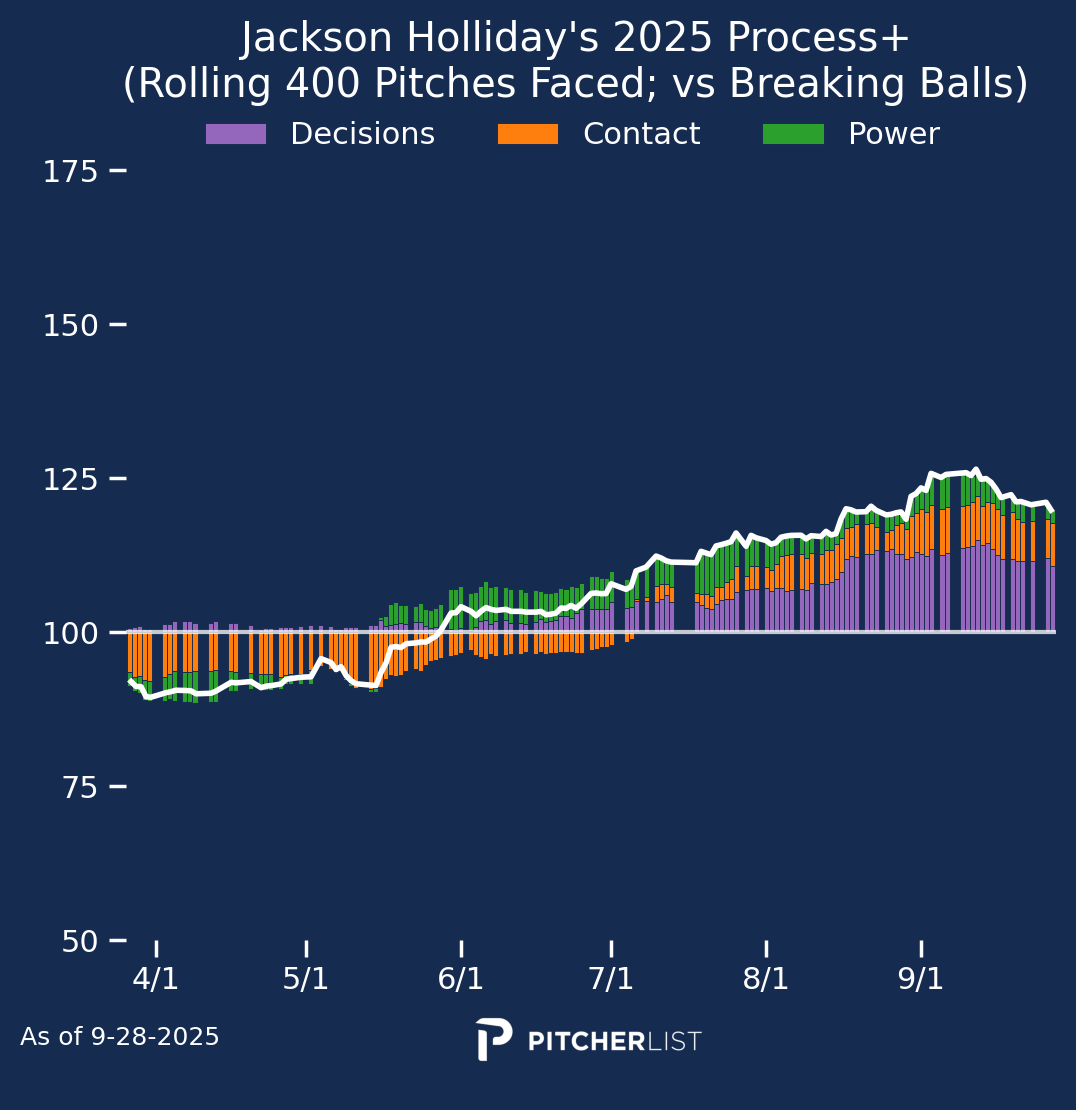
It’s possible Holliday misses most of April, but even then, I’m more than happy to scoop him up a little earlier than he’s gone in recent drafts and stick him on the IL. In fact, this might be too low considering the appalling lack of upside at the position.
Photo courtesy of Icon Sportswire | Adapted by Aaron Polcare (@abeardoesart on Bluesky and X)
