





Welcome to the positional rankings! In addition to the expected positional ranks, there are two other additions:
First, a foreword by author Nate Schwartz! These give a breakdown of the position as a whole and provide an additional view on how to approach it on draft day.
Second, at the end of the article, you’ll find a table of all of the players at this position who wound up in my Top 300.
We hope that these rankings and the notes throughout give you something to think about as draft day approaches and help you feel as prepared as possible when it comes to hitters in your 2026 drafts.
- As a reminder, these rankings are geared toward a standard, daily, 12-team H2H redraft league, which is typically the most popular fantasy baseball format. They will only factor in the five standard categories: runs, RBI, home runs, batting average, and stolen bases.
- These are not best ball or draft and hold rankings. The 12-team redraft format with daily moves is the fundamental opposite of that. Pure volume plays are not valued as much here as in those no-move formats.
- The listed positions are based on five starts or 10 appearances, matching Yahoo’s eligibility rules. I use this because it’s the most inclusive standard across major platforms. If you’re in a format like ESPN or CBS, you may find certain players do not have one of the listed eligibilities. The most jarring example is Maikel Garcia, who could have anywhere from one to five eligibilities based on your site’s rules.
Ranking Philosophy
To keep things in the same ilk, here are a couple of notes on how I generally evaluate hitters before we dive in:
- In 12-team formats, I don’t see much value in guys who only provide stolen bases. It’s an important category, especially in Roto, but in shallower formats, there are too many other (and better) ways to get the steals you need without sacrificing production in the other categories.
- No stat is an island, and they should all be taken in proper context. For ranking purposes, the primary starting points I use are plate discipline, wRC+, quality of contact metrics (also known as Statcast batted ball data), lineup context, and the skills we can measure using tools such as our PLV Hitter Attributes (available for PL Pro members). I also use various projections (some free, some I buy) and dollar value generators.
- Positional eligibility, specifically multi-eligibility, is neat but isn’t a huge factor in many 10- and 12-team leagues anymore due to the prevalence of multi-eligible players. It’s of more value in deeper contests like the NFBC or in leagues with limited roster moves (draft and hold leagues, transaction limits/costs, extremely short benches, etc.). Still, the value is fairly situational and context-dependent.
- Similarly, I don’t penalize players for only qualifying in the utility slot. At most, it is a mild inconvenience if a DH-only player is available at a great value and you already have filled your utility spots.
- Regardless of true talent, anyone talented enough to make it to the big leagues can be brilliant or putrid for 50 to 100 at-bats. It could even last over a month with no change in potential or skill. It also could be wildly meaningful. We can’t and don’t know which will be valid until it’s over, though track record, scouting, and trends can give us hints.
- One of the most difficult things to account for in these rankings is the dynamic between low-ceiling players who have clear roles and players who could have higher ceilings but are without a clear path to playing time. I try to note this in the blurbs as much as I can. NOTE: PROJECTIONS AND AUCTION CALCULATORS WILL ALWAYS FAVOR THE FORMER OVER THE LATTER.
Read The Notes
If you’d like input on a player or have any feedback, your best bet is to contact me on Bluesky (@scottchu.pitcherlist.com), X (@ifthechufits), or Reddit (u/ChusephEsquire)
I also host an AMA in the r/fantasybaseball subreddit every Friday (starting sometime in late March) with Nate, starting around noon ET that lasts through the rest of the day and into the weekend, so feel free to join the fun and ask questions or make comments.
For additional insight, also check out the Hacks & Jacks podcast! This is a hitter-focused pod with myself, Brett Ford, and occasional special guests. We will soon be releasing episodes breaking down these rankings.
Want more from Nate? Check out The Approach Angle podcast, his weekly articles, or jump into our Reddit AMAs during the season! You can also find him on Bluesky (@nschwartz.bsky.social), X (@_nateschwartz), or Reddit (u/NateSchwartzPL).
Foreword
By Nate Schwartz
This is as good as it gets for the catcher position in fantasy. From top of the draft talent to intriguing options throughout the middle rounds, catcher feels deeper than usual. Cal Raleigh’s early second-round ADP is as high as we’ve ever seen a modern catcher go – Buster Posey in 2013 and Joe Mauer in 2010 are the only ones who come close. The quality of bats across upper-echelon catchers is as good as it’s ever been, too. According to ZiPS projections, 14 catchers are projected to have a 110 wRC+ or better and play 100 or more games in 2026, the most in ZiPS’ historical projections database.
After Raleigh at the top, there are a plethora of options in the next tier, allowing you to pick your poison across a variety of hitter archetypes. There are power-specific options in Hunter Goodman or trusty Salvador Perez, or you can chase more all-around profiles in William Contreras or everyone’s favorite breakout, Ben Rice. The positional depth really starts to show around pick 100, where World Series hero Will Smith and NL Rookie of the Year Drake Baldwin aren’t getting the playoff or award tax one might usually get.
Later in the draft, there are intriguing bounce-back candidates and prospects that make the catcher position more exciting than in years past. It creates an interesting proposition for weighing playing time against prospect pedigree. J.T. Realmuto or Adley Rutschman may play every day, but the potential of a Samuel Basallo or Carter Jensen may be more enticing depending on team build.
In one catcher leagues, I think there is significantly more flexibility to grab one of the top ten catchers – a premier option isn’t required, but waiting to be one of the last options might put you in a bind. However, for two catcher leagues, I think it will be important to grab one of the top options and make sure you grab a formidable second catcher as well. The depth of catchers gives you more options, but there is still a significant drop-off around catcher 20ish. Don’t end up empty-handed.
Tier 1
1. Cal Raleigh (C/DH, SEA) — Considering that there’s a legitimate improvement in his fly-ball rate, pulled-fly-ball rate, and barrel rate, we should assume Cal Raleigh’s power is legit, even if 60 home runs is improbable. We aren’t too sure about what the rest of the offense will look like with Polanco and Suárez all hitting the market in the offseason, but Raleigh is a threat to hit 50 home runs and drive in 100 runs as long as there’s a league-average offense around him. Many of you will have Raleigh lower on your board due to wanting to play the back-end of the catching pool, but per the FanGraphs Player Rater, Raleigh out-earned the second, third, and fourth-best catchers combined in 2025 ($47.7 to $46.0). That’s a huge advantage.
Tier 2
2. Hunter Goodman (C/DH, COL) — The only ray of sunshine that pierced through the cold, hostile mountains of Colorado, at least from a baseball perspective. Goodman started 2025 hot and stayed productive the entire season, playing 144 games (104 at catcher) and producing both at home and on the road – a rare feat for a Rockies hitter. Goodman’s power plays in every park, evidenced by the 18 home runs he hit on the road, though the thin air and spacious outfield grass in Colorado allows Goodman to hit over .300 on the road (59 points higher than how he hit on the road).
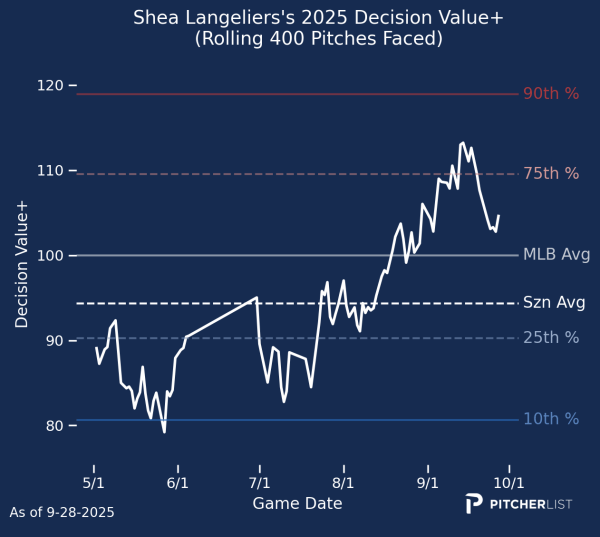
3. Shea Langeliers (C/DH, ATH) — I definitely believe in the improved batting average for Langeliers due to the much-improved strikeout rate (just 19.7%, a full 7.5 points lower than his previous career-best rate), but the question is how much we believe in the absolutely insane run Langeliers went on following the All-Star Break. In 36 games following the break, Langeliers hit 17 home runs, drove in 34 runners, and slashed .331/.360/.748. He returned to earth a bit after that run, hitting just two home runs and driving in just seven baserunners in his final 21 games, though the batting average remained strong.
Langeliers should hit 25-30 home runs again in 2026, though the batting average may dip just a bit due to normal variance, and the counting stats will be dependent on how much offense can happen around him. Also, while the strikeout rate improvement was consistent over the season, there’s still a risk he reverts to something closer to his old self, which could shave even more off his batting average. If he can keep up the plus decision-making skills he started to show at the end of the season, though, this rank will be far too low.
4. Ben Rice (C/1B/DH, NYY) — He’s got to be a fixture in the lineup in 2026. Right? RIGHT?! Ben Rice is a Statcast darling, finishing as a top-five hitter in terms of xwOBA and hard-hit rate with a 99th percentile xSLG. In addition, he’s above average at taking walks and avoiding strikeouts and does a good job making contact. That said, the Yankees have shown an easy willingness to sit Rice against many lefties (he can hit them for power, but not for average, while striking out much more often and walking less), there’s some risk that he’ll get capped at 135-140 games. Still, with Paul Goldschmidt more of an afterthought than a threat, Rice ought to get the full-season chance he deserved.
One quick quirk to point out, though: in back-to-back seasons, Rice has seen a prolonged slump despite consistently strong batted-ball quality. I’m not sure if it’s because he enjoys walking under ladders or gets a kick out of spilling salt at meals, but it’s happened twice now, and in both cases, it’s led to reduced playing time for a while.
As a final note, Rice’s ADP on sites like NFBC will be surprisingly high, but I suspect it will be much more reasonable in single-catcher formats where many managers choose to wait on the position due to the depth. This is true of all the catchers in this tier, but Rice has been the most highlighted example in conversations I’ve had.
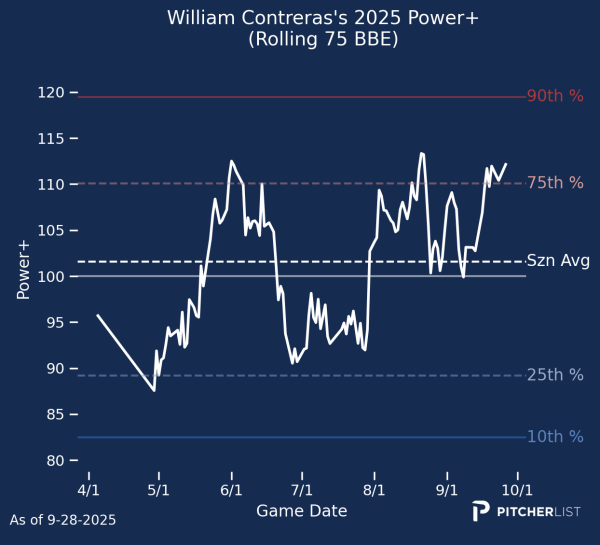
5. William Contreras (C/DH, MIL) — Contreras dealt with an injury in his left hand all season, though he looked a bit more like his old self as the season wore on (as you can see below in the rolling Power chart). It’s not easy to determine precisely how much this sort of injury impacted a hitter, but even with the injury, Contreras finished as a top-five catcher and as a top-40 hitter, so it feels silly to rank him any lower than that heading into what will presumably be a healthy 2026. Despite his power, Contreras has never hit more than 23 home runs due to his high ground-ball and low fly-ball rates, though he did make some improvements in that regard in 2025 (they turned into liners instead of fly balls, though, so it may have merely been a bit of a fluke).
Tier 3
6. Salvador Perez (C/1B/DH, KCR) — It’s insane how this guy keeps catching over 80 games a season, isn’t it? Sal got off to a slow start in 2025, hitting just four total home runs over the first two months, but for the rest of the season, he hit at least five home runs per month, including a nine-dinger July. Perez still swings at everything and manages to barrel more than his fair share of baseballs, though the ratios tend to suffer because he puts bad pitches in play a lot and wasn’t fast even in his prime. He will hit 25 home runs and drive in 100 again, somehow, though the slumps will likely be just as brutal as they were in 2025.
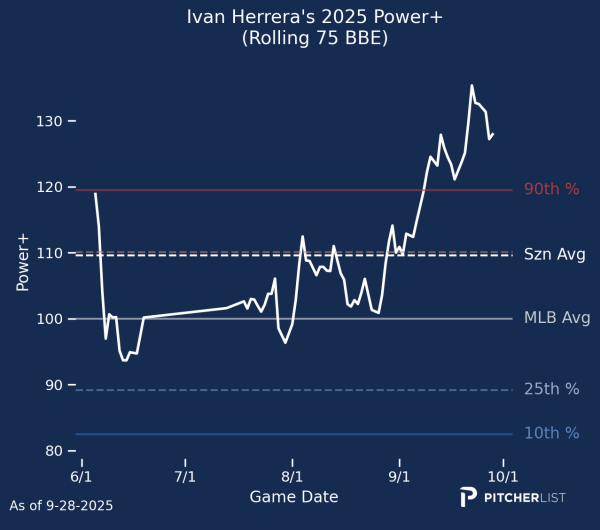
7. Ivan Herrera (C/DH, STL) — Iván Herrera is one of the few hitters who, by our PLV metrics, is consistently above average in Contact Ability, Power, and Decision Value, which makes his breakout 2025 campaign feel legitimate. Injuries have been a bit of an issue, as he hit the IL twice in 2025 with left leg issues (knee and hamstring) and also spent almost a month on the IL in 2024 with back tightness. Sure, he doesn’t have the track record of a guy like Salvador Perez, but everything under the hood suggests Iván Herrera is a 25-home run bat with plus ratios if he stays healthy all season, though he’s struggled to do just that, and of course, he’ll have to keep the ball in the air, which also was an issue at times in 2025 and in the minors.
A reminder that Herrera will only be eligible at catcher in leagues that require 10 starts. If your league needs 15 or more, he’ll miss the cut and be DH-only. That isn’t a huge deal, as I expect a ton of playing time (if healthy) and the bat is very promising in its own right, but he’d still fall about two tiers without the eligibility.
Still, there’s a lot to be excited about. I’ll show you the rolling Power+ below, and you should also keep in mind that he consistently has shown 75th percentile (or better) decision-making skills and contact ability.
8. Will Smith (C, LAD) — Smith only appeared in 110 games in 2025, leading to suppressed counting stat totals, and he also struggled mightily in the second half before he hit the IL, hitting just .237 over 36 games. That being said, Smith showed the best ratios of his career last season, slashing an impressive .296/.404/.497, and should he remain healthy in 2026 while carrying over his improved hard-hit and barrel rates, Smith should finish as a top-seven catcher with way more than the 64 runs scored and 61 RBI he gathered this season. The only reason he ranks a bit lower than you may expect is that catcher is very deep.
9. Drake Baldwin (C/DH, ATL) — Drake Baldwin had an incredibly successful rookie campaign, hitting 19 homers with just a 15.2% strikeout rate and a .274 batting average while driving in 80 runners. Baldwin should have an easier time getting to 500 plate appearances in 2026, assuming Ozuna is out of the picture, and if he can continue to fight off the ground-ball issues he had at times in 2026, he has a chance to be a top-six catcher.
I suspect many folks will be waiting on catcher and do a lot of “Player A vs. Player B” comps on Baldwin based on his second half, and I totally agree that he’s an exciting catcher for fantasy. That said, a great outcome would be repeating his excellent 2025. Wanting more than that is, in this guy’s opinion, a bit aggressive.
Tier 4
10. Agustín Ramírez (C/DH, MIA) — The ratios were uglier than Baldwin’s, but Ramírez had quite the rookie year himself, hitting 21 home runs and swiping 16 bases, albeit with a .231 batting average and .287 OBP. Despite missing the first few weeks of the season, Ramírez finished with 136 games (585 plate appearances) under his belt and is poised to get to 150 games in 2026, assuming he stays healthy. Ramírez’s spotty decision-making will likely keep his batting average somewhat low. Still, if he adds just a touch of patience (he posted double-digit walk rates in the majors), he could find a bit more consistency and provide solid value as an everyday player eligible at catcher.
11. Alejandro Kirk (C/DH, TOR) — Kirk set a new career high in home runs with 15, edging out his original breakout in 2022 when he hit 14, and this version is a bit more believable than the first. In his 2022 campaign, Kirk exploded with power for about a month and a half, then reverted to being a line-drive machine who hit for average and no power. In 2025, showed above-average power at several points in the season. For a catcher, 15 home runs isn’t too bad a ceiling, and the floor, thanks to the contact ability and decision-making, is high. Throw in plenty of RBI (again, for a catcher), and you’ve got a solid back-end piece.
12. Yainer Diaz (C/1B/DH, HOU) — Like most of the Astros offense, Diaz got off to a miserably slow start, but did manage to hit 20 home runs in 2025. The batting average took a 43-point step backward, though under the hood, it looks like he was more a victim of bad luck than skill regression. Between the volume and counting stats, Diaz should finish as a top-10 catcher as long as he doesn’t bottom out for a month as he did in 2025.
13. Adley Rutschman (C/DH, BAL) — In what has been roughly a full season for Rutschman since July 1, 2024, he’s hit .209/.294/.332 with just 13 home runs and 114 combined runs and RBI. In contrast, in the 346 games before July 1, 2024, Rutschman was an elite hitter at his position, with a 130 wRC+ and an average of 22 home runs, 91 runs scored, and 82 RBI over 160 games. I couldn’t tell you why or how he fell off so steeply, but it’s the reality we’ve faced for over a year now. I rank Rutschman because I do think he could bounce back and be a top-five catcher again, though the path to that outcome isn’t very clear to me.
Tier 5
14. Gabriel Moreno (C/DH, ARI) — Moreno missed about two months over the summer due to injury, and injuries have been a common occurrence for the young catcher. When healthy, Moreno excels at hitting for average and providing excellent ratios for his position, and in 2025, we saw Moreno get more balls in the air, leading to a career high of nine home runs in 83 games. If he can keep up the fly balls and stay healthy, Moreno will be a steal at a pick anywhere close to these rankings, but to date, we’ve never really seen him sustain either of those things. Even if he doesn’t, though, the ratios and counting stats should make him a useful backend backstop.
15. Samuel Basallo (C, BAL) — Basallo will start the season with the big league club as a second catcher and DH, though a platoon looks pretty likely (at least to start the year). There’s upside for 30 home runs (his average exit velocity in Triple-A was 94.2 mph), though he’ll need to figure out how to chase a lot less in the majors and avoid falling behind in the count so often. If you choose to skip a catcher until the end of the draft, Basallo’s big power makes him an enticing lottery ticket.
16. J.T. Realmuto (C, PHI) — Realmuto was fine in 2025, though the dropoff in power was significant as he popped just 12 home runs in 134 games (for reference, he had 14 in 99 games in 2024). In deeper formats where volume is a premium, Realmuto might be a tier higher, but for standard leagues, the declining Realmuto is more of a backend option than a safe starter, and you may find yourself looking to stream if other catchers come storming out of the gate.
17. Francisco Alvarez (C, NYM) — So you waited on catcher and want to chase upside? Well, here it is. Alvarez has serious power, evidenced by his 54.3% hard-hit rate in 2025, but injuries, contact issues, and ground balls have kept him from blossoming into the home run hitter we think he can be. A healthy Alvarez has the upside to be a top-six catcher who hits 27+ home runs with a .250 batting average, but it does require several planets to align to realize that potential. If it doesn’t work out, go ahead and cut him for one of the many other cromulent catchers on the wire.
Tier 6
18. Austin Wells (C, NYY) — Wells hit 21 home runs with 71 RBI as a primary catcher, though in true catcher fashion, it came with poisonous ratios and just 51 runs scored in 126 games. The vast majority of that production came in the first half, though, and his .208/.259/.403 line in the second half, with a 30.8% strikeout rate, was a tough pill to swallow and likely sent many managers running to the wire. If he can find some consistency, Wells could be a sneaky backend starting catcher in 12-teamers, though even a more consistent Wells would likely post bad ratios.
19. Ryan Jeffers (C, MIN) — Jeffers doesn’t do anything special as a hitter, but he should have no issue hitting 15 or more home runs with a .245 average while getting plenty of plate appearances for the hapless Twins. Volume and reliability are there, even if the upside is firmly capped.
20. Carlos Narváez (C, BOS) — Narváez should bat sixth for the Red Sox in 2026 and should play as much as his body lets him behind the dish. He has a bit of pop, though most projection systems don’t buy the idea he’ll repeat the 15 home runs he hit last season. I think it’s quite possible, though, as he posted surprisingly decent exit velocities with a barrel rate just short of 10%. He’ll be a streamable catcher who outperforms his projections.
21. Dillon Dingler (C, DET) — Dingler finished as a top-12 catcher last season, taking a huge step forward in strikeout rate by laying off many more pitches outside of the zone and turning on the stuff he did hit. It’s highly unlikely Dingler repeats his 28.2% line-drive rate, which will pull the average down considerably. He should be a .250 hitter who could hit 10 home runs with 50 RBI, though there’s also a chance Dingler’s inconsistent decision-making and contact ability lead to slightly more depressing totals.
22. Kyle Teel (C/DH, CHW) — Kyle Teel had a strong second half for the White Sox, showing the potential to hit 16-18 home runs with good ratios for a catcher. I’m pretty concerned about the strikeout rate spike at the end of the season and the fact that the White Sox have shown no ability to develop talent in the bigs. Still, those in OBP leagues could bump Teel up a tier or two and/or tag him as their last round catcher (if you’re into that sort of thing).
Teel will miss a few weeks to start the season, which in theory gives Quero a chance to go off and lock himself into the lead role. I don’t anticipate that outcome, and think Teel is the more interesting option long-term as he’s more likely to secure DH at-bats when he’s healthy, but this brings the two of them closer together.
23. Edgar Quero (C, CHW) — Quero made his debut in 2025, and overall, it was an admirable performance for a rookie catcher. Quero has more hit tool than power, and should be appreciated in deep points leagues that have a strikeout penalty. He went to Driveline to work on his launch angle and power, which would be a help as Quero hit a ton of balls on the ground, but he’d benefit just as much from pulling the balls in the air that he does hit. It’s not a huge ceiling here, but double-digit home runs and a .250 average should be there even if the improvements are mild.
The injury to Teel should give Quero a few extra plate appearances to start the season, but his ceiling is lower than Teel’s until we see Quero hit balls in the air and carve out DH at-bats of his own.
24. Tyler Stephenson (C/DH, CIN) — The bottom fell out for Stephenson in 2025 after a promising 2026. He struck out a painful 33.8% of the time and hit just .231. He also missed a chunk of the season due to injuries. I guess it’s possible Stephenson stays healthy and hits 15 home runs with 50 RBI, but the eroded contact ability, combined with his average decision-making and injury history, leaves little room for upside.
25. Logan O’Hoppe (C, LAA) — Through May 22, O’Hoppe was one of the most productive fantasy catchers in the game, having swatted 14 homes in 43 games while slashing .275/.309/.556. Unfortunately, his terrible plate discipline (33.3% strikeout rate, 4.3% walk rate) caught up with him. O’Hoppe’s 36 wRC+ from May 23 to the end of the season was the worst among all MLB players with at least 200 plate appearances in that time.
O’Hoppe’s power is legitimate, but his terrible contact ability and decision-making skills leave you with an incredibly streaky hitter who is best left as a streamer in deep leagues when the bat is hot and the matchups are good. The season-long line will probably have close to 20 home runs and 50 RBI, but all that production will happen in a short time, and he’ll be a sandbag the rest of the way.
Tier 7
26. Bo Naylor (C, CLE) — Naylor will be the primary catcher for the Guardians, and it was great to see the strikeout rate normalize after a scary 2024 spike. Naylor’s extreme fly-ball approach helps him hit a few extra home runs (he set a career-high with 14 last year), but it also keeps his average down (.205 in 318 career games). If you don’t care at all about ratios, he’s probably worth grouping with the guys at the top of the tier because of the durability and volume, but his ceiling is a bit lower.
27. Carson Kelly (C, CHC) — Kelly was phenomenal in April last season, hitting seven home runs in 17 games with a .360 average and a whopping 21 RBI, though the rest of the season was decidedly more lackluster. Kelly’s solid plate discipline and modest (but not absent) power should lead to 12 home runs and maybe 90 combined runs and RBI with a .240 average, which screams backend C2 to anyone in a format that has two catchers.
28. Carter Jensen (C, KCR) — Jensen should get plenty of time behind the plate as the Royals give Sal more days as a DH, and Jensen’s minor league track record is hard to ignore, especially the 20 homers and 166 wRC+ he had in Triple-A last season. With 100 games or so, Jensen can hit 12-15 homers with a .250 average and a solid OBP if the plate discipline stays strong, though Sal’s legendary durability makes it hard to see a path to more than those 100 games for Jensen in 2026.
29. Victor Caratini (C, MIN) — Caratini’s average and OBP over the last three seasons have been stronger than other catchers you’d see at this stage, though he doesn’t often get quite as much volume. Caratini should rotate at DH and catcher with Ryan Jeffers, and if Jeffers were to lose time with injury (as he is known to do), the volume could be closer to 110 games or so. As long as he plays 90-110 games, 10 homers, and a .260 average should be there.
30. Sean Murphy (C, ATL) — Murphy will be out until May, but on his return, he should play most days at either catcher or DH. He should play at least as much as he did last season, despite the injury, if he stays healthy otherwise, though, and the counting stats should be passable for a second catcher. He’s hit less than .200 for the last two seasons, and that’s likely to continue, but you may not care about that at this point.
Photo courtesy of Icon Sportswire | Adapted by Aaron Polcare (@abeardoesart on Bluesky and X)
