





Welcome to the PLV Power Report! Here, we examine hitter performance by utilizing Power+, a PLV+ metric that indexes a player’s power based on the characteristics of the pitch, i.e., count, location, velocity, induced vertical break, height-adjusted vertical approach angle, and other factors. Essentially, we’re searching for players with upside who are adding power based on the expectation of the individual pitches they see.
For example, say a hitter hits a well-located fastball on the outside corner that might typically coax a weak line drive, but instead, they belt a home run the opposite way; they’ll get a much better power grade for that outcome. Conversely, if that hitter sees a hanging changeup over the heart of the plate, or another pitch that would normally be crushed, and instead pops up to short, they’ll get a much lower score for the outcome. The power metric is unique because it provides a more intuitive way to assess player performance by accounting for the quality of each pitch they see. In other words, it’s a good way to check if a player is over- or underperforming by adding context. Note that Power+, like PLV+ metrics, is normalized to 100 and generally becomes more meaningful after around 75 BBE (batted ball events).
If you’re new to the PLV metrics, you can find Nick’s primer here.
So last week, we reviewed this season’s veteran breakouts. However, there were at least two glaring omissions that I’d like to touch on quickly. And, yes, there are probably a couple of others I missed, too. Regardless, here we go.
Let’s start with Taylor Ward, who blasted his 36th home run last night; that’s 11 more than last year’s 25, his previous career-high. But oddly enough, his Power+ has dropped this year from 113 to 105. Still good, but go figure.
Trevor Story! Wow, I don’t think anyone saw this coming. He socked his 25th dinger last Thursday; that’s the most he has hit in a season since 2019. He can get himself out with below-average swing decisions (92 DV+). However, his 106 Power+ is what you like to see.
That done, this week we’ll review what we saw from this year’s rookie class. Note that I’m focusing on qualified rookies, so there are a couple that I won’t mention here; Samuel Basallo is a big one, but I’m sure there are others. Without further ado, let’s take a look.
Catcher
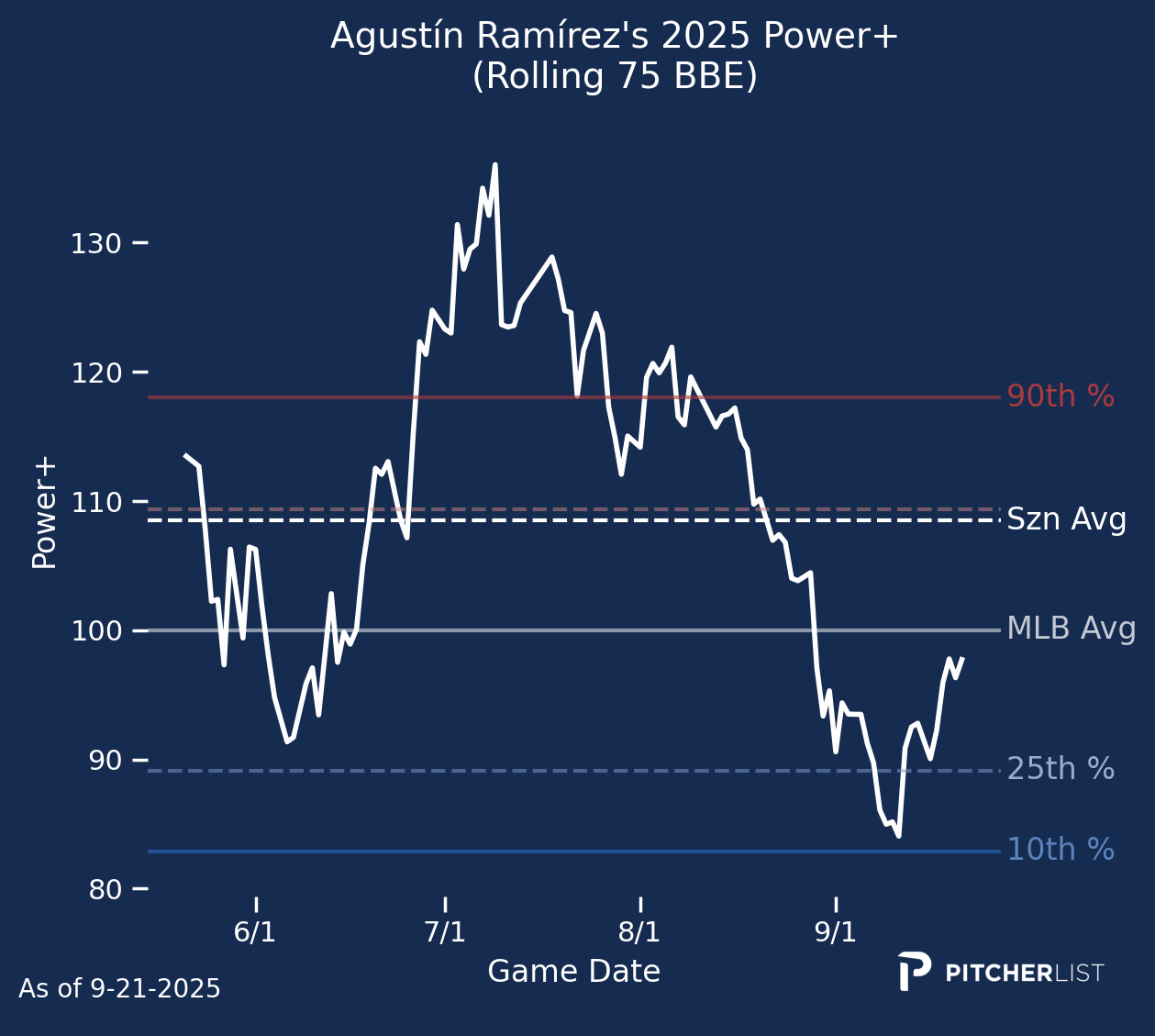
Traded to Miami last summer in the deal for Jazz Chisholm Jr., Agustín Ramírez looked like a world beater for a little while, but settled down, hitting .233 with a 94 wRC+. Still, 21 home runs from a rookie catcher is nothing to sneeze at, and neither is 14 steals. He was billed with big power as a prospect, and we certainly saw that at times this season. He also had a 110 Contact Ability+, and you know he is going to get DH at-bats, too. I have the sense he’ll make the rounds in next year’s sleeper columns.
Drake Baldwin seems like a decent bet for this year’s NL RoY, slashing .274/.341/.464 with 19 home runs; his 124 wRC+ would be good for third among qualified catchers, trailing Raleigh and Ben Rice. Baldwin checks more boxes with a 109 Contact Ability+, 101 DV+, and 113 Process+.
However, PLV thinks there might be an even higher home run ceiling lurking in the south side of Chicago with Kyle Teel, as he leads the way with a 115 Power+. He is very quietly (I’m sorry, no one is paying attention to the White Sox), slashing a spicy .275/.381/.424 with eight home runs and a 130 wRC+.
Looking ahead to next year, the catcher position kinda sorta seems a lot better than it has in the past, no?
Second Base
Unfortunately, Luke Keaschall’s season ended a few days early, sustaining a thumb injury while doing the thing we all love. Hit home runs? No, the other thing. Oh, right, stealing bases. Keaschall ended, hitting .302 with 14 stolen bases, four home runs, and a 134 wRC+ across 207 PAs. He should be a great source of batting average and speed next year, just don’t expect more than 15 home runs or so.
Shortstops
It’s Colson Montgomery and everyone else; he is fourth among all rookies with 19 dingers in only 262 PAs, no less. And he’s second on the White Sox in home runs; Lenyn Sosa has 21 in 528 PAs. Montgomery’s strikeouts (85 Contact Ability+) and swing decisions (92 DV+) create a scary floor, but I don’t think it’s a stretch to think he could finish top five in home runs at the position.
Outfielders
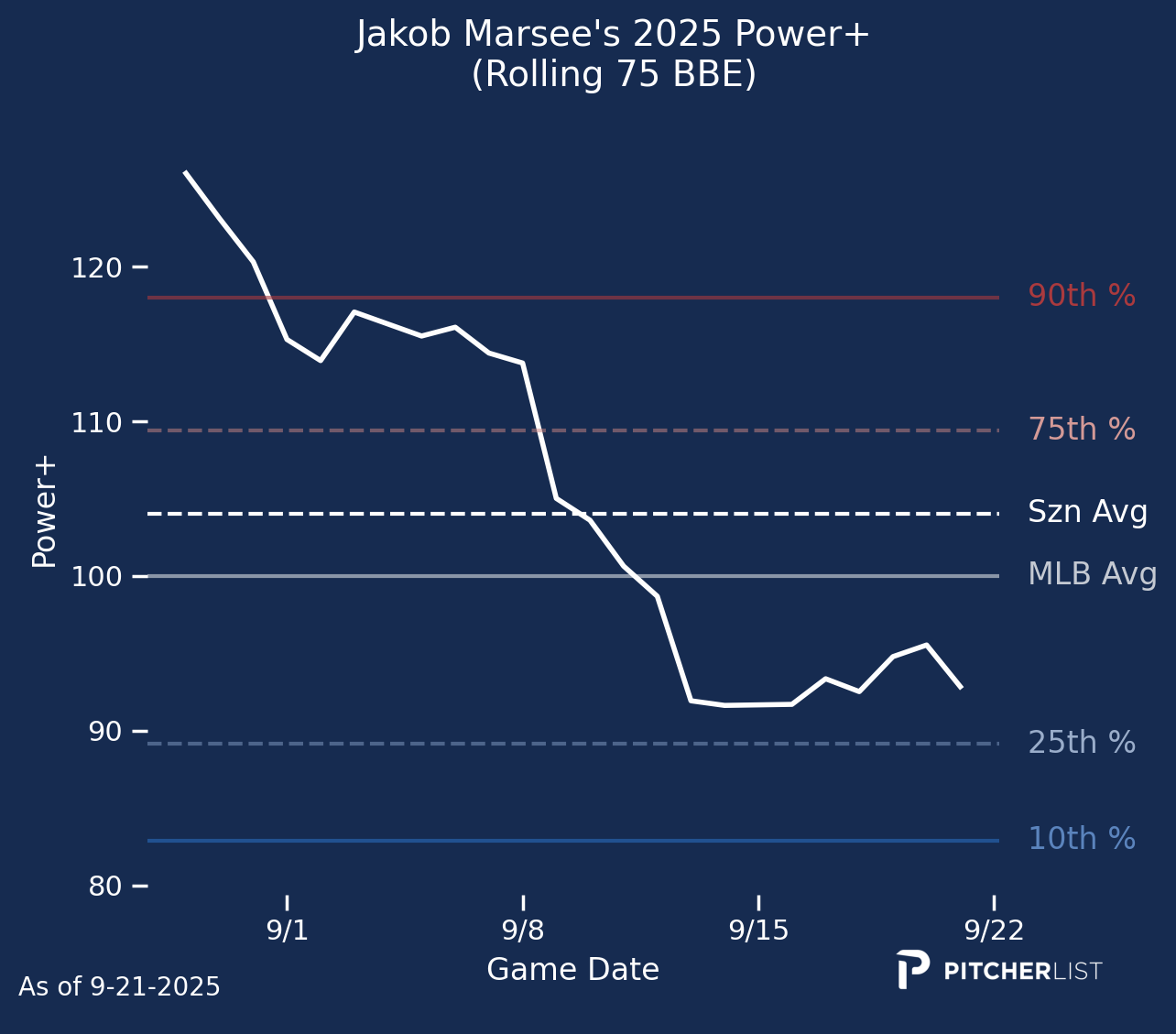
Waiver wire wonder Jakob Marsee is second among qualified rookies with a 145 wRC+. Initially, I thought Marsee might have some Trent Grisham to his game, given his sound swing decisions (110 DV+). However, he has pulled the ball in the air at a 14.8% clip, about nine ticks lower than the mustachioed Yankee. I like Marsee’s speed and OBP ability, but it could be a mistake to consider his power as anything more than average-ish, considering his recent trends.
Yep, Jasson Domínguez is still rookie-eligible this season. He might be one of the most difficult rookies to really get a handle on because he has barely played much at all over the past two months, thanks to Grisham, Bellinger, and Stanton being terrifically productive. His surface numbers: a .257/.331/.388 slash, 23 stolen bases, and a 103 wRC+ aren’t bad. But again, as a 22-year-old switch-hitter, we need to see him play consistently to get a better idea. Based on what we’ve seen, he’s a tick below average in the power department. Also, his splits as a right-hander (78 Power+) are poor enough to make me wonder if he might ditch switch-hitting. Still, he needs more at-bats.
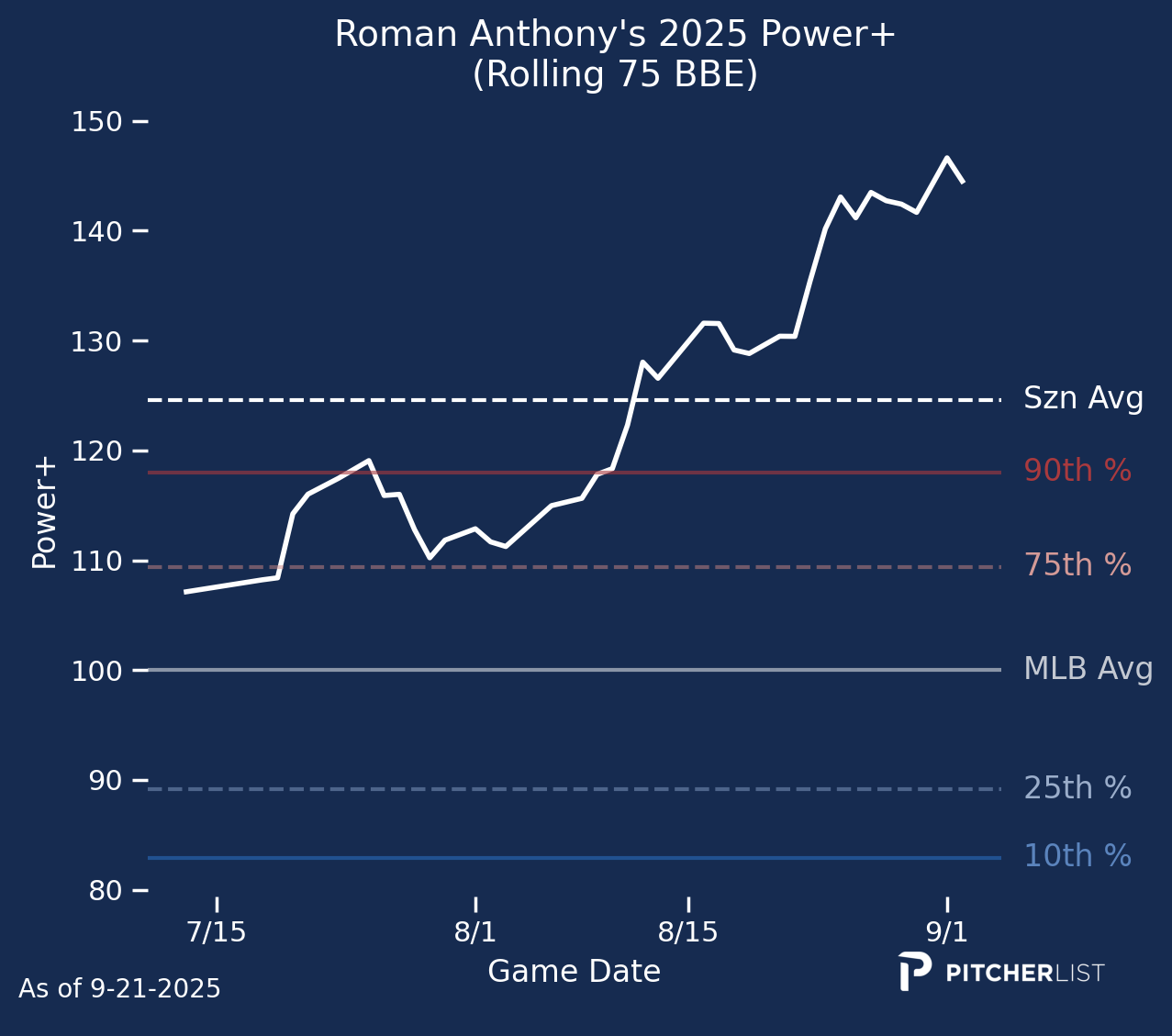
It’s a bummer that Roman Anthony got hurt. If you get anything from this, it’s that he has the highest ceiling of any rookie we saw this year. Not that that’s a contrarian take by any means. He was starting to look unstoppable. Life isn’t fair.
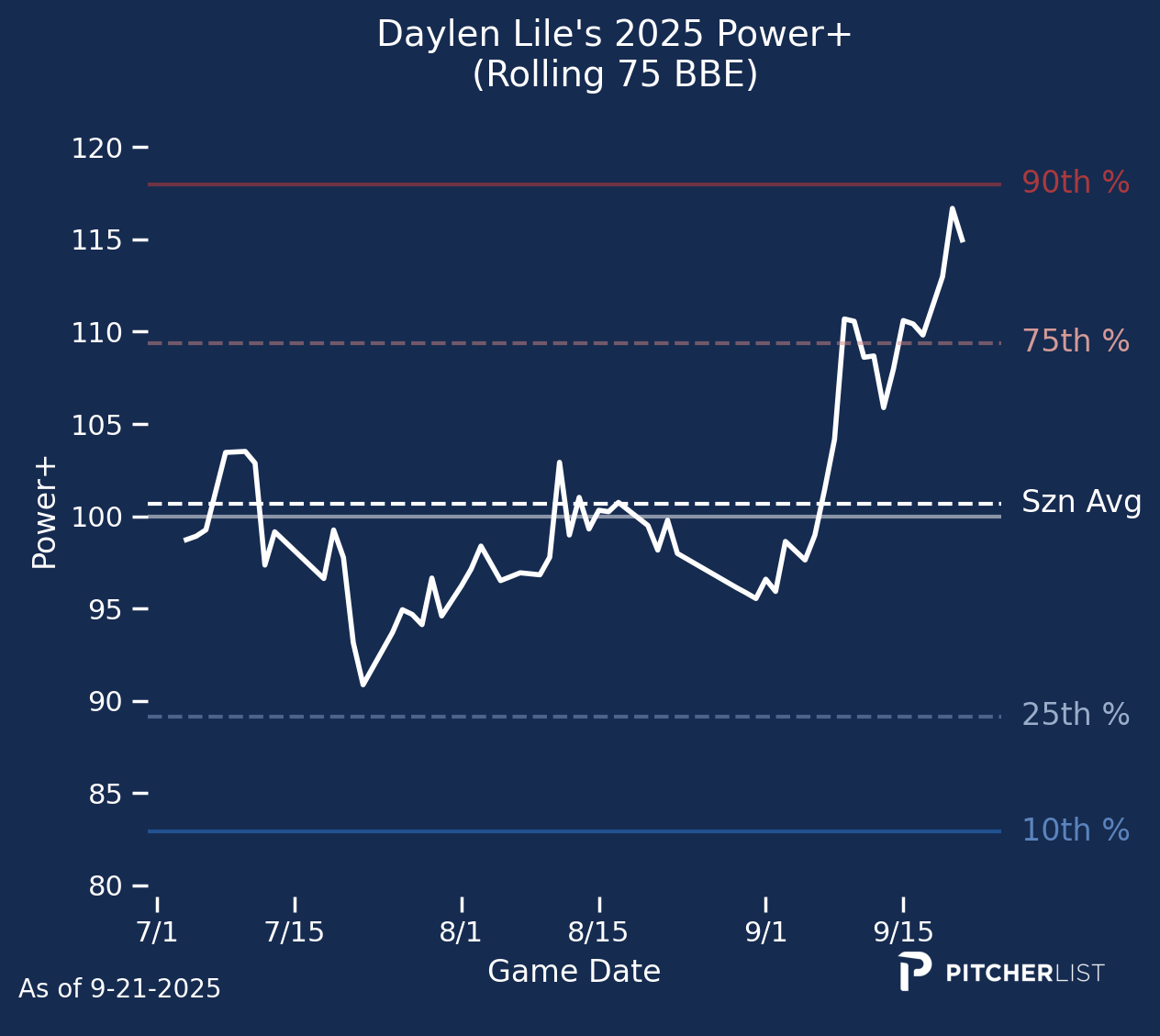
Fortunately, Daylen Lile dodged a bullet with what could have been a bad injury. The 22-year-old lefty has emerged as a late-season hero, hitting .290 with a 124 wRC+ in about half a season. Lile’s PLV metrics are impressive, including a 111 DV+, 109 Contact Ability+, and a 114 Process+. That 102 Power+ might not seem like much, but it is trending up.
Outfielders cont.
We know Chandler Simpson is a jackrabbit. Imagine if he had power? That wouldn’t be fair. Still, his 134 Contact Ability+ is stupid good.
Swing-and-miss issues (85 Contact Ability+) have pestered Dylan Crews. Still, he demonstrated enough pop that I’d want to roll the dice on him next year as a post-hype guy.
It feels silly to fret about Jac Caglianone this soon; he was barely out of college this time last year. Still, swing decisions (63 DV+) are a problem for him now. As far as his power goes, he has another level to go, considering his bat speed (77.4), but a 49.7% groundball rate has tied him down; that’s about five ticks above the MLB average.
Third Base
Ronny Mauricio showed the highest Power+ among rookie third baseman. However, his playing time has dwindled down the stretch, and the Mets have really shielded him from LHB, a little like the Yankees have done with Domínguez. He has upside, but even if he were to fall into a regular role, his swing decisions (69 DV+) would likely keep him stuck in the bottom of the lineup.
Caleb Durbin has been a useful deep-league option. However, its probably best to view him as a batting average guy (124 Contact Ability+) with some steals.
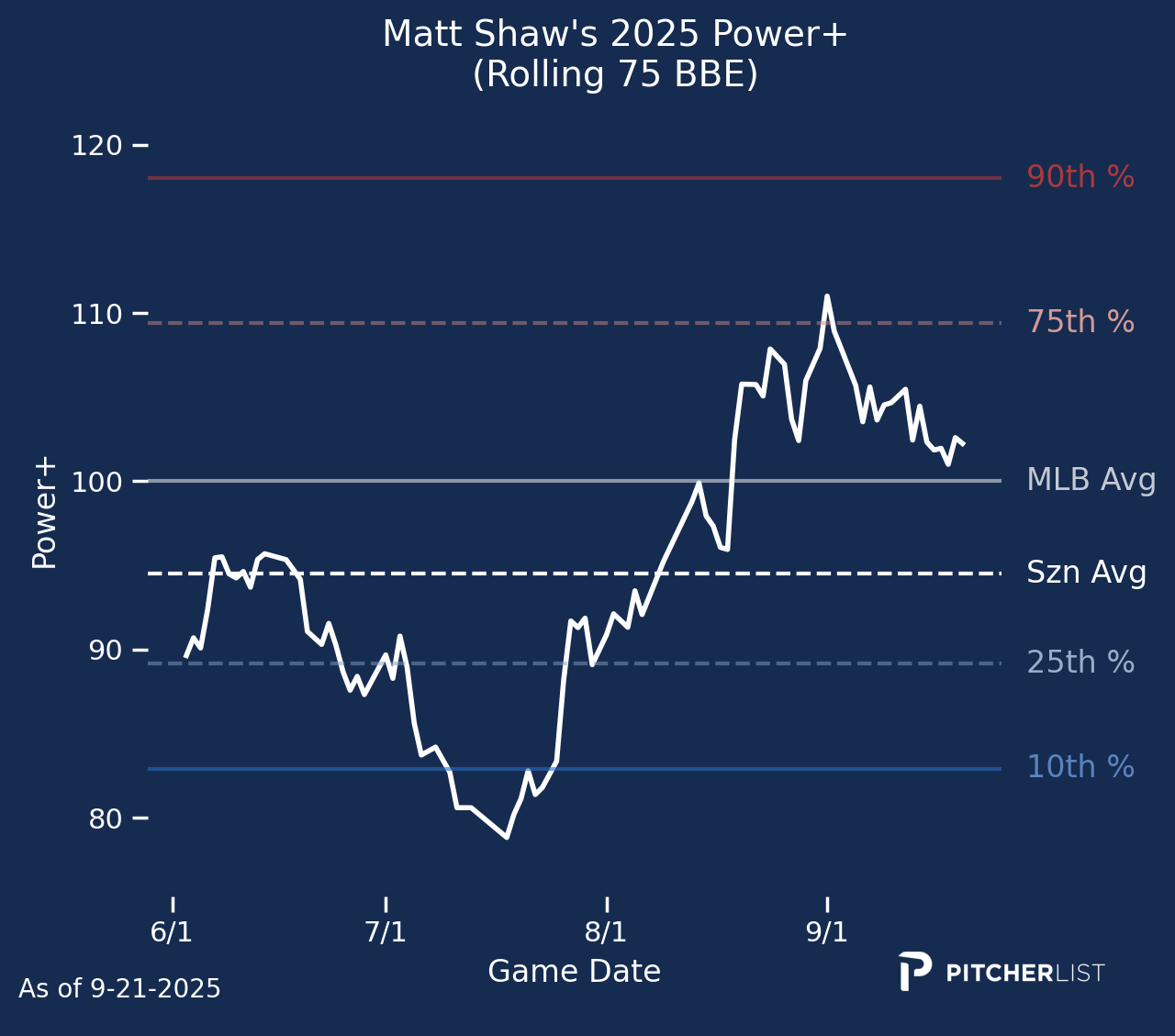
Selected by the Cubs 13th overall out of Maryland two years ago, Matt Shaw demonstrated some ability in the minors (144 wRC+ last year), but it hasn’t translated. However, he has trended upward. I think he has shown enough, especially with the 16 steals, to be a worthwhile sleeper next season.
Nats third baseman Brady House has had issues with strikeouts (87 Contact Ability+), but he has shown a little bit of juice. Deep-leauge sleeper? NL only? Eh, maybe.
First Base
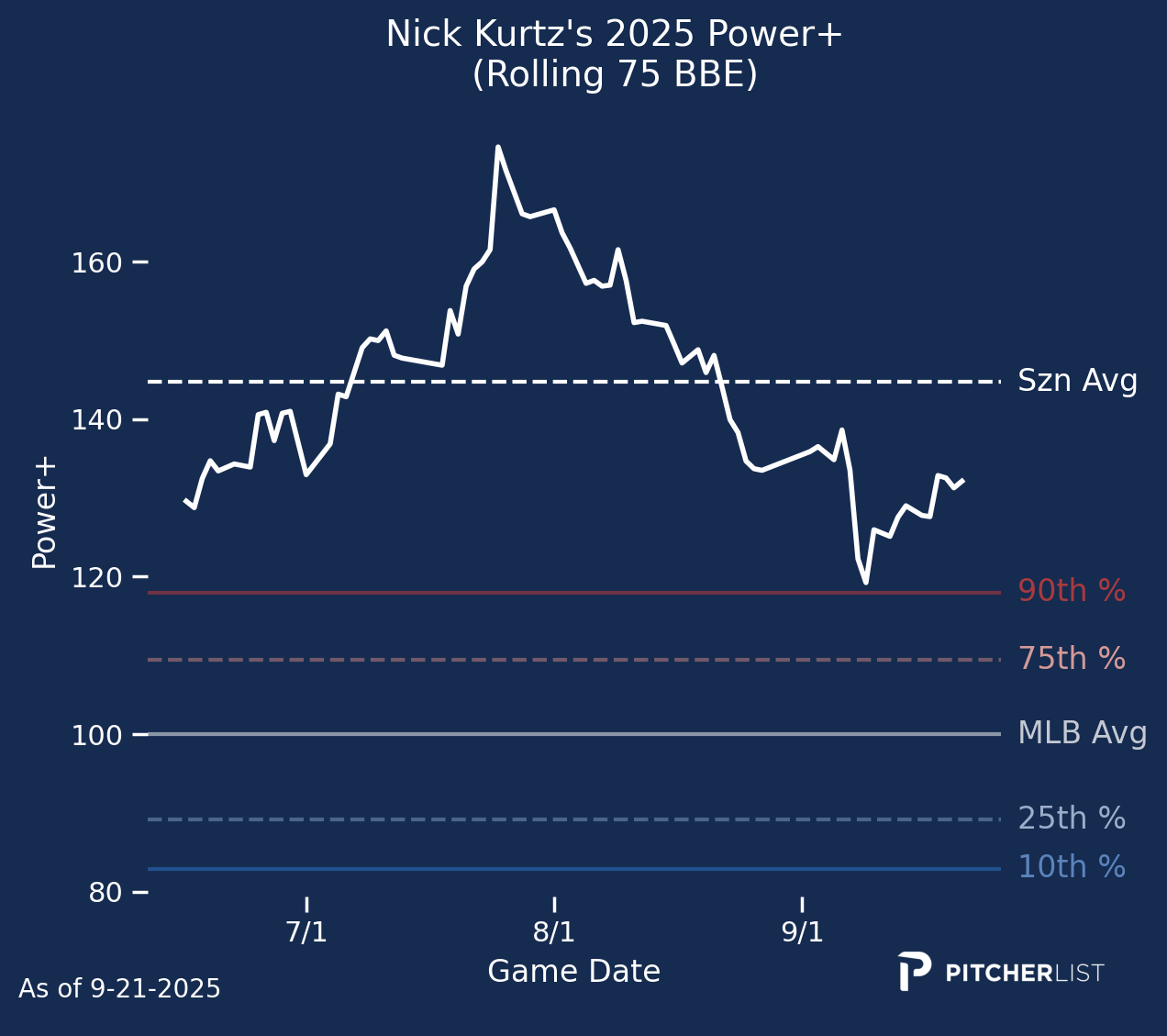
Yeah, I buried the lede. Nick Kurtz, or the Big Amish, if you’d prefer, didn’t break Pete Alonso’s rookie record. Still, 33 home runs in 472 PAs is pretty darn good work. And the 6-for-6 gem made him the only rookie in history with four dingers in a game. He just won Baseball America’s Rookie of the Year. He played for Wake Forest last year! It’s an all-time debut. And yet, the only stat you need: his 154 Power+ is second only to Ohtani’s 158. Haha! Behold.
Adapted by Kurt Wasemiller (@kurt_player02 on Instagram & Threads
@kuwasemiller.bksy.social on BlueSky)
