






The Pitcher Edition of the Stash List highlights the 10 best pitching prospects likely to make an impact during the 2026 season.
Prospects are often thought of as only holding value in dynasty formats. However, knowing which prospects hold value for the current season can help set you apart in redraft leagues. Several have a 2026 ETA, and getting ahead of the curve on rostering these prospects is a key part of roster management. Last year, we saw more pitching prospects make their debut than ever before, and there is no reason we should expect to see anything change in 2026. Keep reading to find out the top ten pitchers you should stash in your redraft leagues.
Ground Rules
- The Stash List is for your redraft leagues and does not consider impact beyond 2026.
- Only current minor league players who are expected to make an impact this season are included.
- Upside, proximity, health, and opportunity are all weighed for each player.
- The focus is on 12-team leagues with standard categories.
- Rankings and roster percentages will be updated weekly.
- Stats will be updated weekly for all players through Thursday’s games.
Top 10 MiLB Starting Pitchers in Strikeout Rate through April 22, 2026 (minimum two games started)
The Stash List
Graduates/Call-Ups
The following prospects joined the big league clubs over the last week:
It was a banner week for graduates! Three top 10 starters and a few honorable mentions were called up.
Didier Fuentes ATL made his return against Washington on Wednesday. See the breakdown below.
JR Ritchie ATL made his Major League debut on Thursday. See the breakdown below.
Payton Tolle BOS was phenomenal in his return on Thursday against the Yankees. He carried over his strong Triple-A performances to Boston as he struck out 11 batters on 18 whiffs using a deeper arsenal than he featured in September. The four-seamer is still primary, but he blended the sinker, curveball, and cutter in equal amounts over six innings. He was tasked with improving his secondaries, and he appears to have done so. With Sonny Gray on the injured list, Tolle should be given at least one more start to earn a longer-term role on the Major League team.
Congratulations to Coleman Crow MIL on a successful Major League debut! Crow is known for a devastating curveball that drops 66 inches from a low arm angle. He was optioned back to Nashville and is now someone to monitor. The upside is minimal with his low-90s fastball and sinker as support pitches. He went 5.1 innings on short notice, striking out four batters while allowing two runs on four hits and one walk.
Kendry Rojas MIN and Connor Prielipp MIN were brought up as bullpen depth this week. Prielipp is viewed by most as the more complete pitcher, but his strikeout ceiling is low. Rojas is the more dynamic pitcher, but has control issues. He had three walks against the Mets in his Major League debut. It was Prielipp who got the start, giving up two runs on four hits and no walks across four innings. He struck out six batters, mostly on the high-spin slider. His fastball velocity was up a tick, and he makes for an interesting waiver wire add. Prielipp is tentatively scheduled for a two-start week at home against Seattle and Toronto.
Walbert Ureña LAA did his thing against San Diego with his 91 mph changeup and upper 90s fastball. Assuming he can maintain the control, Urena can develop into a José Soriano clone given their groundball tendencies with the sinker. He struck out 8 batters on 12 whiffs over six innings.
Christian Scott NYM gave Jonah Tong believers a glimpse of hope as he served up five walks in his first Major League appearance since returning from surgery in 2024. Scott had gone five-plus innings in his previous two starts for Syracuse, but this lack of control may mean that he is not ready for prime time. He was optioned back to Triple-A on Friday.
Riley Cornelio WSN is among the Minor League whiff leaders with a dynamite fastball and slider. Reportedly, it will begin in relief, but following a shaky Miles Mikolas makes sense. Cornelio struck out nine batters across five innings against one walk in his last Triple-A start.
Wilber Dotel PIT was called up to bolster the bullpen.
Mason Barnett ATH appeared in one game for the Athletics before being optioned back down to Las Vegas.
Carlos Rodríguez MIL has had some brief moments of success, but is not generating the same level of excitement as Logan Henderson, Robert Gasser (had triceps soreness, but will continue starting on Friday night), Shane Drohan, or even Coleman Crow.
Doug Nikhazy CHW was recalled the previous Friday and optioned back to Triple-A.
Eduardo Rivera BOS had two strong Double-A starts before being called up to the Red Sox. He was picked up as a reliever in the middle of 2024 by Boston, who then turned him back into a starter. In his first Major League outing, he finished out the game against the Yankees by using a heavy fastball (95 mph) and slider combo. No runners scored as he allowed only one baserunner and struck out three on eight whiffs. Let’s see how they use the big lefty.
Alan Rangel PHI was called up as long relief for his only appearance against the Cubs before being optioned back to Triple-A. Rangel utilizes an extreme over-the-top delivery. He racked up five strikeouts, three on the changeup, on six whiffs overall. He offers Philadelphia a unique arm slot to deploy whenever he returns to the team.
Note: There have been multiple innings during various Minor League games where Statcast data has not been gathered. In some instances, this absence of data significantly affects the overall marks of some pitchers due to the small number of pitches at the start of the season.
Top 10 Pitching Prospects to Stash
1. JR Ritchie, RHP, Atlanta Braves
2026 MiLB Stat line: 27.1 IP | 0.99 ERA | 26.2 K% | 12.1 BB%
2026 MLB Stat line: 7 IP | 2.57 ERA | 25.9 K% | 7.4 BB%
It’s a death-by-a-thousand-cuts approach for JR Ritchie against opposing lineups. Ritchie used all six of his pitches each of the three times through the Memphis order last Saturday. He continues to get positive results without an overwhelming arsenal, rather with a savvy attack plan. Similar to Robby Snelling, Ritchie doesn’t have a high-power fastball, but is built with a rubber arm that can go deep into games. This outing represented his third consecutive game reaching the sixth inning. He finished the scoreless appearance with three hits and three walks allowed, along with eight strikeouts on twelve whiffs.
Heck of a MLB debut by JR Ritchie. 👏👏👏 pic.twitter.com/fTjlBj9vnd
— Rob Friedman (@PitchingNinja) April 23, 2026
Ritchie is now at 27 Triple-A innings in 2026 after throwing 59.1 Triple-A innings in 2025. It does appear that he is replacing the sinker as his primary pitch with a four-seamer. Neither of these pitches aren’t heaters, but they are a tick up in velocity while serving as eye candy for hitters. His main weapons appear to be the changeup and the curveball, each of which has more spin. The breaker was and still is an effective weapon for Ritchie as his number-one strikeout and whiff pitch. He mixes it in whether ahead, behind, or even in the count. With this one standout pitch, Ritchie is locating well enough with the rest of his arsenal to create advantages each at bat. The next thing to observe is if he maintains his success with higher and sustained velocity on the fastball.
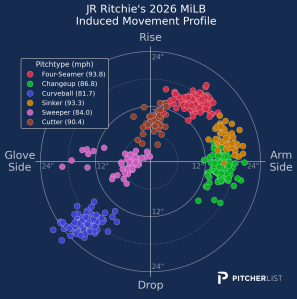
Saving the best for last is a breakdown of the Major League debut for Ritchie on Thursday. This game was an exhibition of his wide arsenal as Ritchie led with the curveball for the first time, fading the use of the sinker. Ritchie reached the seventh inning under 80 pitches, striking out seven batters on double-digit whiffs. The walks were an issue in his first few starts at Gwinnett, but he only issued two here in this game on a below-average strike rate of 61%. The main area to clean up is fairly straightforward. Don’t fire middle-middle fastballs to power hitters like James Wood, who demolished the first pitch for a leadoff home run. Ritchie’s velocity was up almost a full tick, and he was fired up as he wrapped up his debut with an inning-ending double play.
Ritchie looks like an immediate add to all lineups, but it is unclear if he will stay in the Atlanta rotation. Spencer Strider is wrapping up his rehab assignment and most likely returns during the trip to Colorado next Saturday.
2. Didier Fuentes, RHP, Atlanta Braves
2026 MiLB Stat line: 16.2 IP | 2.16 ERA | 31.7 K% | 9.5 BB%
2026 MLB Stat line: 7 IP | 6.43 ERA | 33.3 K% | 6.1 BB%
Yay, Didier Fuentes got the return trip to Atlanta’s rotation. Unfortunately, it was a one-day stay. After being a healthy scratch from his weekend Triple-A start, Fuentes was tapped with a favorable start against Washington on Wednesday. However, it made it two games in a row where he did not have an ideal first inning.
After garnering Spring Training buzz, Atlanta Braves‘ Didier Fuentes had an inefficient outing against the Nationals on Wednesday (3 IP, 7 H, 4 ER, 1 BB, 7 SO) across 74 pitches. Fuentes was electric with a 20.3% swinging-strike rate and 28% ball rate, likely one of the upside… pic.twitter.com/bCfVVvRc4n
— Corbin (@corbin_young21) April 23, 2026
Using a narrow lens, it was not a good start as he allowed four earned runs on seven hits, including a three-run home run to Daylen Lile in a horrendous first inning. Zooming out past all of the hits, one can see that he struck out five batters through two innings and had 15 whiffs on the night. Fuentes had an outstanding 72% strike rate and allowed only one walk, his eighth across five 2026 appearances. The damage came on balls in play, two of which were infield hits. None of these statements excuses the fact that he didn’t get the outs when his team needed them, but the short outing and high earned run total obscures the fact that this is a 20-year-old player who performed well despite the stress and drama he was facing.
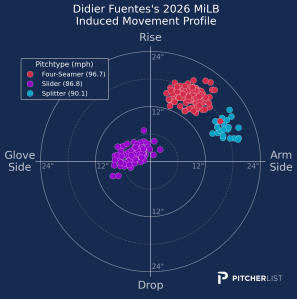
Atlanta has simplified the pitch mix for Fuentes in 2026 to three pitches. The splitter is the least used, likely due to its inability to generate any whiffs, but it also doesn’t give up any walks either. He apparently has a good grasp of the pitch and can control it well, but only uses it when ahead in the count. The primary putaway pitch is the 97 mph four-seam fastball, which has good two-plane movement. He gains a bit of induced vertical break due to his low release height, which has helped him post a 26% whiff rate on the pitch in the Major Leagues. Yet, it is the slider that is really boosting the entire arsenal. He uses a similar release point on the breaker as the fastball, but it is 10 mph slower and breaking a bit to the glove side. Fuentes was using a wider breaking sweeper in 2025, which was also a bit slower. Perhaps this faster slider is fooling hitters enough into thinking a fastball is coming. Against the Nationals, he had 8 whiffs on the four-seamer and six on the slider.
It’s too early to toss Fuentes into a pile of failed starters, so don’t forget about him in the coming weeks when Atlanta needs more rotation help.
3. Robby Snelling, LHP, Miami Marlins
2026 AAA Stat line: 19 IP | 1.89 ERA | 41.9 K% | 12.2 BB%
2025 MiLB Stat line: 136 IP | 2.51 ERA | 30.3 K% | 7.1 BB%
The reins are being loosened on the workhorse, Robby Snelling, who may be on the precipice of his next string of deep starts after going six innings for the first time in 2026. He took advantage of an aggressive Charlotte lineup to rack up eight strikeouts on only 75 pitches. Snelling never threw more than 19 pitches in an inning, and twice had innings with ten or fewer pitches. For the strikeouts, two were on the curveball, and seven were on the fastball, which is gaining velocity each start as it ticks back up to the highs at the end of last season. The four-seamer was sitting at 95 mph, but hitting almost 97 mph on multiple occasions, including in the sixth inning. With momentum growing, Snelling is laying down the case that he is ready for his first Major League ride.
STASH WATCH 26
Robby Snelling
AAA Jax MIA4.17vCharlotte
6 IP 2H 0R 1Bb 9K
9whiffs/75pitchesReally efficient, never threw >19pitches in an inning.
FF star pitch velo ticking back up 7Ks 6whiffsStacking successful outings
69strike% 24chase% pic.twitter.com/wfWy64xaYn
— YGM Fantasy Baseball (@YGMfantasy) April 18, 2026
There have been a few minor changes to his arsenal from year to year. He has not thrown the sinker, instead throwing more four-seamers and sliders. As for global changes, he has a few more inches of extension while releasing the ball at the same height as before. The main difference among the four starts is the lower velocity, but as mentioned above, even that is gradually trending up. One caveat explained in previous places is that the leaderboard shows lower spin rates. Yet, the reality is that his spin rates are more or less the same as before, but have been dragged down by a few innings of missing or incorrect Statcast data. In terms of results, his fastball has not reached the same levels as in 2025. The whiff rate has decreased a bit for him with that pitch. Fortunately, he has been able to rely on his trusty curveball. On the other hand, his changeup performed better in 2026 despite having the same shape and speed as it did in 2025.
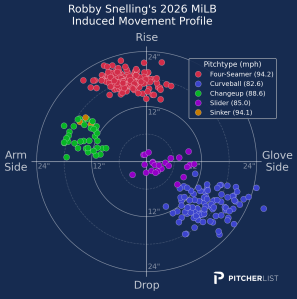
Snelling still projects as a durable workhorse with strong stuff, excellent batted-ball data, and the ability to miss bats at a high rate. Miami has depth here, with both Snelling and Braxton Garrett (on the 40-man roster) performing well at Triple-A Jacksonville. Garrett (29K%, 9BB%, 0.59 ERA, 0.59 WHIP) is likely first in line for a call-up, but Snelling could follow quickly—similar to how Noah Schultz emerged for a contender. His next test comes on Friday night against Gwinnett.
4. Tanner McDougal, RHP, Chicago White Sox
2026 AAA Stat line: 23 IP | 3.13 ERA | 27.4 K% | 13.7 BB%
2025 MiLB Stat line: 89.2 IP | 2.31 ERA | 38.6 K% | 13.6 BB%
Phew! It appears that Tanner McDougal escaped serious injury while avoiding a comebacker in his latest start against Nashville. During the fourth inning, McDougal dodged an 87 mph grounder off the bat of Luis Lara and appeared to stumble like he pulled something or rolled an ankle. He acted as if he could stay in the game, but the team removed him precautionarily. You can see the play and his reaction in the embedded video below. It’s too bad for the early exit because McDougal was serving them up a cold dose of spin from his curve and slider. Those two pitches each had a called-strike and whiff rate above 41%. This was on top of the four-seamer sitting 99 mph. This game represents the best version of the 6’5″ righty, where he lands strikes with his best three pitches and avoids the free passes.
STASH WATCH 26
Tanner McDougal
AAA Charlotte CHW4.23vNashville
3.2 IP 2H 1ER 1BB 4K
8whiffs/61pitchesStrong outing til 4th inn exit. Likely lower body issue: hammy/calf.
Not an arm injury. Phew!99FF
CU/SL on point >41CSW%1-2-3 1st on 15 pitches
66strike% 35chase% pic.twitter.com/Xqy9c9BTtA
— YGM Fantasy Baseball (@YGMfantasy) April 24, 2026
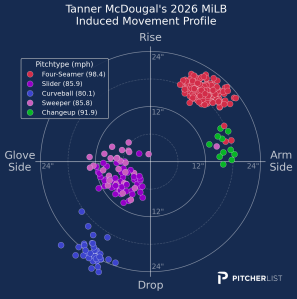
You must have an outstanding weapon or outlier delivery characteristic to succeed in the Major Leagues. Tanner McDougal possesses an above-average fastball, mainly due to its 98 mph velocity that gets average vertical movement. He does have a little cut on the pitch that causes 11 inches of run on the pitch. That horizontal movement is the culprit for the high walk rate on the pitch. Fortunately, the arsenal doesn’t stop there, as he has been given a 60 grade on his curveball. However, he is not using it much, and it is not spinning as high as reported back in 2025. Yet it still has a high whiff rate, and surprisingly, almost no walks. The 86 mph slider is his bridge pitch, a wicked diving pitch that has a 60% whiff rate. Sometimes he mixes in a changeup, but it’s those first three pitches that should lead him to debut sometime this summer. The power delivery serves him well until it doesn’t. Assuming he can maintain 63% or greater strike rate, he should be in the zone enough to get through 5-6 innings.
Given the injury concern, McDougal is someone to continue monitoring as the next pitcher up in the Chicago system. Hagen Smith is being handled with kid gloves as he appears to have a strict pitch count limit. Shane Smith is his main competition for Erick Fedde’s or Anthony Kay’s spot.
5. Thomas White, LHP, Miami Marlins
2026 AAA Stat line: 14 IP | 1.93 ERA | 43.6 K% | 16.4 BB%
2025 MiLB Stat line: 136 IP | 2.51 ERA | 30.3 K% | 7.1 BB%
Thomas White fans will key in on one stat every time he starts: total walks. His followers will rejoice after seeing that he did not walk a single batter in his first Triple-A start of the season. A deeper dive reveals that this may be a one-off revelation, given that he was at three balls on five of the 14 batters he faced. Nevertheless, he did the job in this game and didn’t buckle in as he struck out three of those five batters with the count including three balls. White only went four innings as he continues to return to full strength after a spring oblique injury.
He followed up that game with another four-inning appearance against Gwinnett on Thursday. The 6’5″ lefty struck out six batters, but also walked three hitters. His sweeper was inconsistent and landed all over the place during the first inning. White settled down after that and induced weak contact all night. However, he ran three balls on six of the 15 batters he faced, something to track each start. It was a poor 58% strike rate overall, a mark that was above 61% last season. White still has some grace time to build up to his normal self, but throwing strikes is a must no matter how short or long he goes in games.
STASH WATCH 26
Thomas White
AAA Jax MIA4.23vGwinnett
4 IP 1H 0R 3BB 6K
8whiffs/73pitches94FF a tick down
ST was all over the place58strike% 26chase%
3-ball counts 6/15 batters faced
Don’t you dare start walking people! pic.twitter.com/nEEL6jM6wg— YGM Fantasy Baseball (@YGMfantasy) April 24, 2026
Ah, drats! The dreaded Statcast data outage strikes again! Only 70 pitches are showing for White at the time of writing, even though he has amassed 179 across three starts. We won’t be able to line up the pitch usage changes as of yet, but we can assess their shapes. White is still using the same four-pitch mix with the four-seamer picking up a bit of velocity despite losing a few inches of movement. The sweeper and changeup are still both spinning at high rates and dropping off the table at big distances. There is also a notable increase in his extension, showing that he is putting in more effort into his follow-through down the mound. It is a subtle change that is also giving him a lower release height. These tweaks could mean improved landing spots for his pitches, perhaps more frequently dotting the strike zone. Of course, we will need to return to see what’s real and if he can maintain a 62% or above strike rate for longer outings.
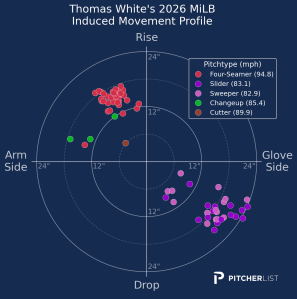
The Miami Marlins are flush with options right now, so White is not an immediate call-up candidate. He represents a strikeout upside arm who has been near 40% strikeout rate and 18% swinging strike rate for his last few Minor League stops.
6. Logan Henderson, RHP, Milwaukee Brewers
2026 AAA Stat line: 12.2 IP | 0.71 ERA | 32.7 K% | 15.4 BB%
2026 MLB Stat line: 2.0 IP | 3.60 ERA | 33.3 K% | 11.1 BB%
That sinking suspicion that Logan Henderson fans have had about his shorter outings has been confirmed by manager Pat Murphy. Henderson will be limited to preserve his health for the late stages of the season. This severely dampens his value as a stash in April and May. On the other hand, these 3-4 inning appearances could mean that he is more likely to go 5+ innings “when it counts” in the Major Leagues. You can decide how to roster him, but know that his debut is not imminent.
STASH WATCH 26
Logan Henderson
AAA Nashville MIL4.21vCharlotte
3.1 IP 4H 0R 2BB 3K
8whiffs/65pitches80%FF/CH tad higher than usual but check the gap in movement
93FF 20”IVB 6whiff
82CH 20”HBMgr Pat Murphy confirmed shorter outings to preserve health :(
65strike% 25chase% pic.twitter.com/wiac34vHSo
— YGM Fantasy Baseball (@YGMfantasy) April 23, 2026
On the field, Henderson continues to sew up the competition to keep feeding them fastballs and changeups 75% of the time. Those two pitches work in tandem to expand the width and height of the zone, opening the door for larger use of the cutter. One would think that his changeup with almost 20 inches of horizontal movement would be the better whiff pitch, but it’s his 93 mph four-seamer that takes the top spot. He runs it up the ladder with 19 inches of induced vertical break and 11 inches of horizontal break. The cutter helps him establish a middle ground between those two pitches. Overall, the low velocity, high movement package is working as Henderson has yet to give up an extra base hit and a smattering of hard-hit balls.
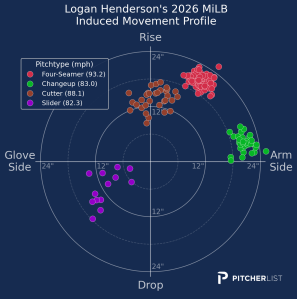
Following the Brewers’ method, Henderson threw only 65 pitches against Charlotte on Tuesday. He is averaging 55 pitches per appearance, which gives him a decent chance at completing four innings. In this game, he made it into the fourth inning after giving up four hits and two walks with no runs. He managed only three strikeouts. The beat rolls on for Henderson as he tries to break through while remaining healthy. This is a pitcher who had 33 strikeouts to 8 walks across five Major League starts in 2025. So, what are we really waiting for?
7. Kade Anderson, LHP, Seattle Mariners
2026 AAA Stat line: 14.0 IP | 0.64 ERA | 41.5 K% | 7.5 BB%
2025 NCAA Stat line: 119.0 IP | 3.43 ERA | 37.4 K% | 7.3 BB%
Kade Anderson continues plugging along with solid five-inning outings with Double-A Arkansas. He struck out five batters, while walking only one and allowing only three hits, despite a lot of balls in play. The batted ball data continues to support a ground ball pitcher profile, which is a strong foundation for when the strikeouts aren’t present. Either way, he throws strikes and
STASH WATCH 26
Kade Anderson
AA Arkansas SEA4.17vTulsa
5 IP 3H 1ER 1BB 5K
12whiffs/64pitchesSimilar to Noah Schultz, dots low glove side corner. Will need to vary eye level & speeds given mediocre FF velo
A lot of balls in play
26: 14 IP 41K% 7BB% 0.64ERA 70strike% 19SwK% pic.twitter.com/MIP5UvC3Up
— YGM Fantasy Baseball (@YGMfantasy) April 18, 2026
His Spring Breakout data compares favorably to scouting reports that his wide arsenal will continue to befuddle lower-level hitters. Anderson offers a four-pitch mix with a four-seamer that sits at 93 mph. He uses a high arm slot and high release that naturally limit the vertical break on the pitch, but he frequently locates it above the strike zone. The curveball is his best weapon, given that it is very similar to the fastball arm action and falls out of the sky into the strike zone. The changeup helps him neutralize righties, while the slider is just a faster curve. He is exclusively pitching out of the stretch to start the season. Anderson is having success, but it will suit him to continue varying up the locations of his pitches since many of them land on the lower gloveside corner.
The path to a Major League is not clear at the moment, but it is free of obstacles. There are currently no major left-handed pitching prospects in the Seattle organization. As for workload concerns, Anderson threw 119 innings last season, so there is no reason to believe that he needs to be held back. Furthermore, Logan Gilbert, George Kirby, Bryan Woo, Emerson Hancock, and Bryce Miller all spent little to no time in Triple-A before their Major League debuts. It’s possible Seattle doesn’t want its prospects marinating in the Tacoma aroma for too long and is quite content to horde their best arms for the big club.
8. Elmer Rodríguez, RHP, New York Yankees
2026 AAA Stat line: 21.1 IP | 1.27 ERA | 25.6 K% | 9.0 BB%
2025 MiLB Stat line: 150 IP | 2.58 ERA | 29.0 K% | 9.4 BB%
Elmer Rodríguez is trending in the right direction after back-to-back successful starts against Syracuse and Rochester. He went 5.2 innings in each game, striking out 13 total batters compared to three walks. He allowed only one run with a 64% strike rate and 11% swinging strike rate. With his pitch count already approaching 90 per game, Rodriguez appears set to outpace his 150 innings in 2025. His workhorse reputation, combined with a modest strikeout upside, makes him a solid stash. One note about his pitch mix is that his four-seamer utilizes a lower spin rate, something that makes it “heavier” and more apt to produce ground balls. Rodriguez is matching his 55% groundball rate from 2025 while striking out 26% of the batters he faces.
STASH WATCH 26
Elmer Rodríguez
AAA Scranton NYY4.22vRochester
5.2 IP 2H 1ER 1BB 7K
11whiffs/85pitchesBalanced 5-pitch attack
Lo spin 95FF is GB% focused
CH/SL main whiff pitchesRegaining confidence as workhorse SP w modest K upside
68strike% 39chase% pic.twitter.com/OxK7T44yg8
— YGM Fantasy Baseball (@YGMfantasy) April 23, 2026
2026 is a carbon copy of 2025 for Rodriguez, who throws six different pitches, save for a few minute changes. He is exhibiting a lower release height, which may be from a slightly lower arm angle, but not from greater extension, which has stayed the same. Also, his 2026 slider is the only pitch with greater spin and a wider break. He is throwing it a tad more, which makes sense given its 40% whiff rate. Overall, Rodriguez has a wide arsenal of average grades, with no standout pitch. His success comes from mixing and matching pitches with supreme control. Yet, his sinker is probably his necessary pitch, which has led to a 50% groundball rate over the last few seasons. He is down a few percentage points in his overall strike rate, so locating more of his secondaries will help him boost his strikeout numbers.
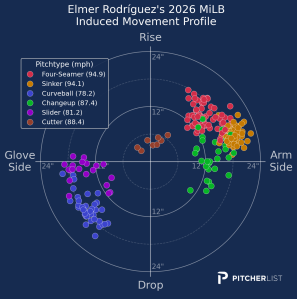
Rodriguez takes over the stash list spot of organization mate Carlos Lagrange, who has yet to post major whiff or strikeout numbers in 2026. Rodriguez has always been the steady hand. Yet he faltered in his first two Triple-A starts in 2025. Fast forward to this season, where he appears to have regained his confidence and stuff. The main factors that will lead to his Major League debut are the health of Gerrit Cole and Carlos Rodón. It also hinges on the success of his sinker.
2026 AAA Stat line: 14.1 IP | 5.65 ERA | 26.5 K% | 10.3 BB%
2025 MiLB Stat line: 112.2 IP | 3.28 ERA | 28.4 K% | 7.4 BB%
Gage Jump, an emerging left-handed pitcher, is the next great prospect starter in the Athletics organization. Although he is not on the 40-man roster, Jump has moved fairly quickly through the ranks. He was a bit of a mystery box after starting 15 games for LSU in 2024. He didn’t make his professional debut until April 2025, when he was quickly promoted to Double-A after slicing up High-A bats with a 37% strikeout rate and a 4% walk rate. It wasn’t so easy the rest of 2025, but Jump was impressive enough to begin 2026 in Triple-A.
STASH ADD? 26
Gage Jump
AAA Vegas ATH4.21vSaltLake
4 IP 7H 6ER 1HR 2BB 2K
8whiffs/81pitchesPredominantly 95FF/85SL
Needs to embrace CH or other 3rd pitch
Burned 3rd time thru order67strike% 37chase% pic.twitter.com/C6lL0Mu07u
— YGM Fantasy Baseball (@YGMfantasy) April 23, 2026
Jump predominantly uses the four-seamer and slider against opponents. Those two pitchers combine for 90% of his mix, with the changeup and curveball used as secondaries primarily against righties. With an anemic pitch mix, Jump relies heavily on the deception inherent in his funky delivery. He drops the arm down fairly low in the windup and pumps it through with a short arm action that keeps the ball hidden for longer than most pitchers. He’s added a few ticks on the four-seamer, so that gives it a bit more zip.
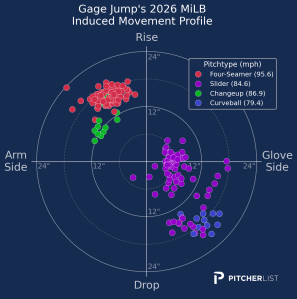
In his latest outing against Salt Lake, it was a down performance. Jump allowed six earned runs on two walks and seven hits, including a two-run home run by Christian Moore on a high fastball. Jump was throwing strikes, but with just two pitches, it appears that the righty-heavy Bees could work the counts into their favor.
Jump is someone to monitor as the prospect ranks thin out for a bit with the high number of graduates. In his favor, the Athletics lack interesting pitchers in the upper parts of their organization. If he can embrace the changeup or a different third pitch, his arsenal should be deep enough to succeed in Triple-A and then maybe the Major Leagues.
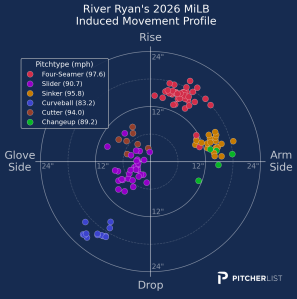
10. River Ryan, RHP, Los Angeles Dodgers
2026 MiLB Stat line: 7 IP | 5.14 ERA | 30.3 K% | 6.1 BB%
2026 Spring Training Stat line: 9.2 IP | 1.86 ERA | 33.3 K% | 11.1 BB%
River Ryan went on the seven-day injured list for a hamstring injury on April 19. He last pitched on April 11, so it will be another gradual buildup to 2026 when he is healthy. Fortunately, this does pause the ticking clock on his innings limit. With Roki Sasaki not performing well, Ryan could appear as the “savior” for the Dodgers.
On The Bubble
Here are the next several pitchers that were in consideration for inclusion on this week’s list: Brody Hopkins TBR, Carlos Lagrange NYY, Chase Petty CIN, Jonah Tong NYM (With David Peterson likely on the way out and Christian Scott being optioned, Tong is next up. He needs to demonstrate consistency with control of the secondaries, especially the new cutter), Miguel Ullola HOU, Jack Wenninger NYM, and Jaxon Wiggins CHC.
Pitcher Stash List
| Stash List Key |
|---|
| Stash now! Upside + Proximity |
| Upside Stash |
| Proximity Stash |
Photo by John Korduner/Icon Sportswire | Featured Image by Justin Redler (@reldernitsuj on Bsky/Twitter)
