




Ten Dynasty Takeaways from 2026: Pitcher Edition
Here are ten dynasty topics to consider ahead of your 2027 drafts.
You can find game video for any of the prospects on @YGMfantasy on Twitter, where I post 20+ games of pitching prospects weekly, including the Arizona Fall League.
1) Sandy Alcantara Becomes the Shohei Ohtani of Pitching
And your 2027 Cy Young winner with 196 innings pitched, 11 wins, and 20 saves is… Sandy Alcantara!
That’s right. Some of the most unexpected mad scientists in the pitching lab reside in the Miami Marlins organization. What the heck are the Marlins doing? And crazy enough, it could work. Alcantara may be uniquely equipped to masquerade as a part-time closer while remaining a full-time starter.
First, we need to clarify what pitchers actually do between starts. Relying on articles like this one (since I am neither a professional pitcher nor someone who knows professional pitchers), most starters throw on the second or third day after their start. Those sessions can range from light side work to more formal mound throwing, but they generally aren’t throwing more than 30-40 pitches.
That raises the obvious question: Can a pitcher withstand the demands of opening a game one day and closing one out a few days later?
Historically, the line between starter and reliever has been blurred before. You just have to dust off the cobwebs to find the relevant examples. Dennis Eckersley, John Smoltz, and Rich “Goose” Gossage all found success in both roles, although they generally did it in separate seasons rather than simultaneously. That’s what makes Alcantara so fascinating.
Assuming an injury doesn’t derail the experiment, here’s how I could see it working. I projected a full 2027 season from Opening Day on March 25 through the final game on September 26, then replicated the usage pattern Miami employed with Alcantara at the end of 2026. His schedule featured two days of rest, followed by four days, then three days, then four days before repeating. Using that schedule, a similar average pitch count to 2026, and the massive assumption that Alcantara continues flipping between starting and closing, I project him making 28 starts and 28 relief appearances. That’s 56 total games, roughly the workload of a high-usage reliever. For the projection, I gave him 91 pitches per start and 15 pitches per relief appearance. That would put him around 3,000 pitches for the season, a few hundred below his career high. I also assumed he would never throw more than one inning in a relief appearance and would average six innings per start. The result? A realistic 196 innings. The main difference is that he received 184 off days between starts in 2026, but would only rest 108 days with the higher usage.
Now comes the even more speculative part: the fantasy stats.
Alcantara has won roughly 35% of his starts over his career. Apply that rate to 28 starts, and we get approximately 11 wins. For the relief appearances, let’s assume he converts 75% of his save opportunities, which would put him around 21 saves. That’s an awfully interesting fantasy profile for a pitcher eligible at both SP and RP, particularly if Alcantara can pair that something near that heavy workload with the rate stats he produced earlier in his career.
There is another wrinkle that could make this experiment less realistic. Pitchers don’t necessarily throw their entire arsenal during bullpen sessions. Some pitches require more force and stress on the pitcher’s ligaments, tendons, and arm, in general. This part requires a deeper dive, but we can already see some evidence of a modified approach for Alcantara. Across his final three appearances, Alcantara threw a heavier percentage of four-seam fastballs while using fewer cutters and sliders. That makes sense. Breaking pitches generally require more force and exertion, something a starter may be less inclined to emphasize when throwing between starts.
So the final question: Can a modified, fastball-heavy arsenal still be attractive enough for Miami to use Alcantara in those shorter relief appearances?
That’s the part we won’t know until someone tries it. And if Miami is willing to experiment, Alcantara might be one of the few starting pitchers capable of making the numbers work. Or possibly the Miz beats him out...
2) Triple-A Pitchers had Their Worst Year…since 2024
The 2026 stash lists of prospect pitchers to pick up in 12-team roto leagues were often top-heavy, featuring a few strong candidates who were likely to get the Major League call and make an impact right away. While scrolling through game logs and Statcast data sets, there were few pitchers who stood out. It felt like pitching was down and that equated to fewer exciting options to stash all season. Well, let’s take a look at the overall Triple-A statistics to see if any trends are revealed.
BIG PICTURE
Triple-A pitchers from the International and Pacific Coast League had similar sample sizes across the last two years, facing virtually the same number of hitters over a similar number of innings. Although the pitcher statistics appear to show improvement in WHIP, the increase in ERA demonstrates that batters were doing more damage when they put the ball in play or that pitchers were succumbing to a higher offensive output that ran the gamut in Minor Leagues this past season. One cause has been mentioned as a more tightly wound baseball.
COMMAND & CONTROL
Triple-A pitchers weren’t striking out batters at the same rate as in the previous season even though they were earning a higher percentage of strikes. Their swing-and-miss was measurably lower than before, signifying that pitchers as a group just didn’t have the same level of stuff as before. Yet, they were in the zone more often, leading to a lower walk rate. Statcast shows that the 90th percentile velocity across all pitch types was up 0.2 ticks to 94.5 mph. Despite the increased velocity, 90th percentile pitch movement was down. Induced vertical break, vertical drop, and horizontal break were all diminished. Pitch trends need a more exhaustive study than examining the entire data set, but in general, Statcast-tracked pitchers were not as good as they were in 2025.
CONTACT
Triple-A pitchers did sustain worse home run luck in 2026 than they did in 2025. Despite their efforts to limit hits, there were measurably more long balls this past season. There is a really good piece that delves much deeper into the possibility of the ball as a culprit for the increased home run rate. The article also mentions the consolidation of the Minor Leagues as a possible reason for big changes in data. This is the sixth year after Minor Leagues were contracted in a uniform fashion with only 120 affiliates across the entire Minor Leagues. We would expect teams to be settled in the organizational strategy, but perhaps new strategies are being experimented with that could have an effect on player movement through the levels of the system.
2024 STATISTICS
Adding to the data debate, 2024 statistics show that the current 2026 season was not that bad for pitchers, as home runs, walks, and runs allowed were significantly higher. As bad as it felt this season, it could have been worse.
3) Will We See More Double-A Pitchers Reach MLB Quickly?
No.
Although Triple-A pitching may have had a down year, there is no apparent trend of Double-A pitchers any faster than they were before. Kade Anderson, Yunior Marte, and Luke Murphy appear to be the only Double-A pitchers to skip Triple-A and head directly to the Major Leagues in 2026. And Murphy had appeared in Triple-A the previous season, so he doesn’t really count. Although we had to wait much longer than we wanted, Anderson had relative success once promoted to Seattle. He didn’t follow the path of Chase Burns or Cam Schlittler, who both spent minimal time in Triple-A before their debut.
Nevertheless, some organizations have an unofficial philosophy to promote their pitching prospects at a different pace than their peers. Atlanta and Seattle are the obvious ones. The Los Angeles Angels are in transition, but have moved quickly on Ryan Johnson and Walbert Ureña in recent seasons. And there are a few organizations that need a spark or are on the cusp of something bigger, such as the St. Louis Cardinals, San Francisco Giants, and the Athletics.
Based on that information, we could see the following prospects make the jump at some point in 2027.
Atlanta: Garrett Baumann, Lucas Braun, Owen Murphy, Davis Polo, Cam Caminitti
Athletics: Jamie Arnold (already in AAA), Wei-En Lin, Henry Baez, Steven Echavarria
Seattle: Ryan Sloan
Los Angeles Angels: Tyler Bremner, Austin Gordon
St. Louis: Liam Doyle, Tanner Franklin, Jurrangelo Cijntje (AAA), Daniel Eagen
San Francisco: Jackson Flora, Jacob Bresnahan, Henry Lalane, Josh Bostick
4) 2026 Prospect Pitchers Were A Major Miss
At first glance, from a fantasy baseball perspective, the 2027 rookie pitching class is really unattractive. Kade Anderson looks good, but there aren’t too many other prospects popping on the list. Yet we conduct the research even if the time spent only results in names being crossed off the draft list.
Here are a few positive standouts.
Kade Anderson was a disappointment in the sense that it was a season-long fuse waiting for his promotion that exploded into a dud. He did earn positive value, had a 13% swinging strike rate, and displayed solid control. However, the overall stuff graded as slightly below Major League average, except for his standout changeup. The strikeout rate was high in his final three games, something that could be attributed to being more familiar with the MLB baseball of a different pitch mix (it wasn’t really different). One cautionary note is how hard hitters made contact with his pitches. With the potential for new pitching coaches, Seattle could be in for a change in pitching philosophy. Anderson wouldn’t know much difference due to his recent arrival. Either way, a tick up in velocity could unlock some more benefits.
Hagen Smith works in a similar velocity range as Anderson, with a few different weapons. The exception for Smith is the closer relationship between the cutter and changeup, both coming out of his hand around 88 mph at a lower arm angle and an extreme outside release point. The caveat is that Smith is only being asked to cover short stints for now, which allows him to throw harder. Nevertheless, Smith has shown much better control and is racking up more whiffs than Anderson. It isn’t clear if Smith will be used as a starter in 2027, which makes him a speculative late-round pick.
Jonah Tong made some tweaks to his pitch mechanics and repertoire to restore some shine to his profile after suffering setbacks in his first Major League stint. The lowered arm angle and new cutter have brought about some better results, but nowhere near the high 30% strikeout rate and low average against he was flashing in the Minor Leagues. The foundation is the fastball, so tailoring that pitch to take down Major League hitters is crucial. Upon examination of his 2026 game log, the arm angle actually increased, slightly correlating with a stronger swinging strike rate. Tong should be locked into the rotation and could be a good buy-low.
Here are a few rookies who could turn it around.
Trey Gibson needs a second chance. Well, it would be a fifth chance to be exact after Gibson was pulled up and down from Norfolk to Baltimore all season. The cherry on top was his final big league start, when he struck out seven Blue Jays on 23 called strikes and only three hits. He was pinpoint accurate with a four-seamer that had a few more inches of vertical break. Gibson initially popped up on my radar in 2025 for the elite extension and diverse pitch mix. It looks like he has taken a step forward by merging his fastballs closer together in velocity and release point. It’s also great to see the slider and cutter resemble each other so well. The Baltimore rotation is still wide open, so he has a decent chance at being up as a starter early in the season.
Daniel Espino is not a starter recommendation, but that’s attributed to his back-to-back seasons with arm surgery. Perhaps, with another healthy offseason, he can lengthen out and gain some of the prospect shine he had in the last half of 2021 when he posted a 45 K% to 8 BB%. Espino is primarily throwing a 98 mph fastball and a 92 mph slider, so adding back another pitch to bridge the gap to the 76 mph curveball would be good. Due to the health scares, he is likely destined for the bullpen, where he could flourish.
River Ryan finally got the return call to the Major Leagues, but it had to show up in a new organization. His two starts with Detroit provided mixed results, but still look good on paper. A six-pitch mix with above-average velocity, movement, and spin. There is no way that the Tigers push him back down to Toledo, right? Right?! Sawyer Gipson-Long, Andrew Sears, and Drew Anderson don’t win a spot over him, right? Right?!!!
5) Anthony Molina is the “Rookie” Pick to Click
Although Anthony Molina is no longer technically a prospect or rookie, he checks enough boxes to become one of those late-round pitchers who suddenly become very interesting in 2027.
The biggest development is the fastball and what the Giants are asking him to do with it. Molina’s velocity has steadily climbed and held at 96 mph over the last three seasons, mostly in relief. After acquiring him from Atlanta, San Francisco immediately began stretching him out as a starter in Sacramento, allowing him to throw 80-plus pitches in each of his final seven games. That’s a meaningful vote of confidence for a relatively unheralded arm. The fastball features 17 inches of vertical break from a high release point, and the batted-ball and plate-discipline data suggest it is more of a dependable strike-getter than a pure bat-misser. It generates weak contact, earns some chase, and can be used in any count. That profile could play surprisingly well if Molina can maintain the velocity and command over a starter’s workload.
The secondary mix gives him even more to work with. Molina throws a slider, curveball, and changeup to both sides of the plate, with the slider emerging as his primary putaway pitch. Both the slider and curveball have produced greater than 33% whiff rates. The changeup is the wild card. It carries significant horizontal movement but has produced poor contact results this season and only a 39% zone rate. Its release point also differs from his other pitches, which may make it easier for hitters to recognize and lay off. If Molina can tighten the changeup’s location without sacrificing its movement, he could have a legitimate weapon against left-handed hitters.
The biggest question is whether the delivery will hold up under a starter’s workload. Molina uses an arm-dependent delivery with an inside-out, high-angle arm path that helps him generate spin despite average extension. Visually, it’s a movement pattern worth monitoring as his innings increase. If he remains in the rotation from Opening Day, Molina should quickly surpass the 100-inning mark he has reached over the last two seasons. The Giants will have to determine whether the stuff and delivery can hold up over that increased workload.
That’s ultimately what makes Molina so intriguing. He isn’t a traditional prospect, but he has 96 mph velocity, five usable pitches, and an organization that has already shown a willingness to stretch him out. If San Francisco commits to him as a starter, Molina could become a cheap source of innings and strikeout upside in 2027—and exactly the kind of late-round arm worth taking a chance on.
6) The Southpaw Advantage Continues
For 2026, I can basically restate what was written in the 2025 version of this article: “lefties are diminishing in volume at the same time that their performance is far outpacing right-handed starters.” Except there are a few caveats. Left-handed pitchers actually grew in volume, snatching the largest portion of the starting workload since 2022. Zooming in, they are doing so with a slower fastball and a smaller difference in their swing-and-miss or contact rates over righties.
It is still my belief that most left-handed pitchers offer a distinct advantage in fantasy value over righties. Southpaws are fewer in number and therefore less familiar to hitters. In addition, lefties are getting by with less velocity, which means that the successful players offer secondaries that have been developed to get hitters out. A lefty with a swinging strike rate over the annual average is even more attractive.
The main takeaway is that there is perceptible value to adding more left-handed pitchers to your fantasy team. Players like Quinn Mathews and Hagen Smith, among many older prospects, become attractive end-game draft targets for their combination of strikeout stuff and handedness.
7) Jonathan Santucci is the Lefty Pick to Click
Jonathan Santucci should be the left-handed prospect to focus on for 2027. The pathway to playing time is clear. The skills are already present. And his preparation and training give him another piece of the foundation needed to make the jump.
Santucci is coming through a Mets system that is in a bit of disarray. At the same time the organization has opened its wallet for expensive veteran contracts, it has also begun turning to younger players to fill the gaps. Zooming in on the rotation, New York is trending toward a younger staff, assuming the organization can resist its instinct to buy expensive talent through free agency. Nolan McLean, Christian Scott, Zac Thornton, and Jonah Tong are likely to form the core of that group, with Sean Manaea and Kodai Senga still hanging around. Either way, Santucci has a clear path into this rotation, whether that opportunity comes early in the season or later in the summer.
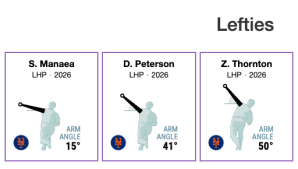
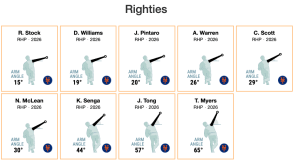
Another reason Santucci fits so well is his arm angle. He has a unique slot for a left-hander, working from one of the higher arm angles in the Minor Leagues. His slot is higher than Thornton’s and, in some ways, mirrors Tong’s, allowing him to snap off pitches from a high release point. Santucci also gets a decent amount of extension, although he finishes his delivery in a more upright position. That unique look only adds to an already intriguing arsenal and gives hitters another variable to deal with.
Santucci also saw a velocity bump in September, giving his four-pitch mix another boost. During the final month, he maintained whiff rates greater than 40% on three pitches: the slider, curveball, and changeup. The changeup may be the most interesting of the group. It’s a high-velocity offspeed pitch with 12 inches of break that can diminish the power of right-handed hitters. Even so, the breaking pitches are currently receiving the best grades in Triple-A. Those secondaries take pressure off the four-seamer, which is lowly rated but is still pumping 95-96 mph with 17 inches of vertical break.
The four-seamer is therefore the pitch to watch in 2027. Santucci could benefit from reducing its usage and finding a better location, particularly higher in the zone. His high release point combined with the fastball’s downward tilt may put too many straight fastballs on the same plane as a hitter’s swing. The results from September provide some evidence of the problem, with three home runs allowed off the pitch during the final month. If he can improve the fastball’s location—or simply let his three dominant secondaries carry more of the workload—his overall arsenal could take another significant step forward.
Finally, the results are beginning to catch up with the stuff. Over his final four starts, Santucci ran up the strikeouts while simultaneously cutting down the walks. He posted a 19% swinging-strike rate, a 30% strikeout rate, and a 6% walk rate. That final number may be the most important of the group because Santucci had been running a much higher walk rate throughout the season. If that improved control is legitimate, the rest of the profile starts to look extremely attractive.
That’s the 2027 question for Santucci: Can he maintain the improved command while allowing his slider, curveball, and changeup to carry the arsenal? If the answer is yes, the Mets may have a high-upside lefty ready to force his way into the rotation sooner rather than later.
8) A New Era of Understanding Pitching
Open Command is a visual pitching measurement tool designed to assess how far a pitcher misses from the intended target. It tracks how the ball moves from frame to frame relative to where the catcher initially sets the glove, creating a much more precise picture of command than simply measuring whether a pitch ends up in or out of the zone. We have always had the clouds and bubbles representing expected location, but Open Command effectively dials the standard deviation down to a much smaller radius. Those tighter error bars also appear to stabilize quickly, meaning you may be able to trust an Open Command rating much sooner than existing control metrics.
That precision also opens the door to placing more value on the catcher, who has a symbiotic relationship with the pitcher in setting up and receiving each pitch. The catcher’s initial glove position can influence how a pitcher finishes the delivery, and that relationship can vary by pitch type. A catcher who consistently presents a target in a particular location may affect not only where a pitcher aims, but potentially how he executes the pitch. The possibilities are almost endless—and they were likely always there—but we now have a highly accurate tool that can begin to quantify them.
You don’t need to spend your free time downloading the platform and running the program yourself. You need to know that this assessment tool exists, and that projection systems or pitching metrics that use it are much more likely to be reliable than those that don’t. You also need to know that it could influence pitching in interesting ways. See the quotes below from the various resources as a few example takeaways.
Resources:
Open Command Git Hub > “OpenCommand is on par with the state-of-the-art command trackers, outperforming human-annotated trackers. It also predicts BB% better than BB% itself!”
Visual Primer to Open Command > “If Stuff+ is a fast version of strikeout rate, OpenCommand is a fast version of walk rate.”
Open Command on Rates & Barrels podcast > “You could even back-end our way into this thing by using Open Command and running it against different biomechanical markers (arm angle, extension, etc.) and asking, ‘Pitchers who do this have good command.’”
Measuring Pitching Command > “Having a public model that isolates intent from execution is a massive step forward for the analytical community.”
The Best Command in Baseball is Still a Cloud > “Often when we think about controlling a pitch we load everything onto the pitcher. What the OpenCommand data suggests is that the catcher holds a decent-sized lever too, one he can pull pitch to pitch, and one most of the league is already pulling to some degree.”
9) A Diverse Pitch Mix is Crucial to Success
While preparing for my 2026 fantasy drafts, I took a look at the pitch grades for the best Major League pitchers. I was curious how diverse their repertoire was perceived according to the Stuff+ model. I keyed in on the number of pitch grades they received above 105, with the thinking that this mark was measurably above the average to be a difference-maker. Of the many things gleaned from that inquiry, the most prescient was to take stock of the pitchers who only had a single pitch over 105 Stuff+. Logan Gilbert, Luis Castillo, Pablo López, Robbie Ray, Trevor Rogers, and Nick Lodolo were starters of note who fell on that list and, by substitution, earned a place on my “Do Not Draft” list. Let’s repeat this exercise for 2027 for pitchers who threw at least 90 innings.
5 pitches above 105 Stuff+
The top 3 are without need for much explanation. However, Cameron Schlittler is the one who has exploded onto the scene, with three dynamic fastballs and a much higher level of velocity than he had as a Double-A pitcher. The 2025 season saw his value plummet a bit due to back and lat soreness that sent him to the injured list in July. His ascendance is the one to study and probe for with up-and-coming pitchers. Of course, Jacob Misiorowski surpassed most everyone’s expectations, but he had a pedigree and had posted months of scintillating Statcast data with Triple-A Nashville. Tarik Skubal is a beast who simply needs to heal up to finish the season healthy.
4 pitches above 105 Stuff+
Drew Rasmussen was a target for me in 2026, and will be again in 2027. The team quality, both offensively and defensively, contributes to a winning profile. Now that he is consistently going six innings, his value is likely more obvious to skeptical people who thought he would always be limited. Hunter Brown is an interesting case due to the injury bug and mixed results. Given that he was returning from a shoulder strain, it’s impressive that he was able to make this list. Taj Bradley took a big step forward this season by reproducing all of his ratios and pitch metrics across almost 40 more innings than he threw in 2025. In addition, his stuff is progressing with more velocity and higher ratings.
3 pitches above 105 Stuff+ with 95 mph fastball velocity
This is an intriguing crop of 2027 starting pitchers because several of them have a disconnect between their 2026 results and the underlying skills. Christian Scott should be particularly interesting in drafts after a mixed season that could push his price down, while Payton Tolle is my favorite breakout candidate thanks to the combination of stuff, stamina, and a powerful fastball. George Kirby presents a different kind of opportunity. His fastball was poorly rated, but his batted-ball and plate-discipline metrics remained within a standard deviation of his previous seasons, suggesting that the ugly results may not tell the entire story. That makes him an obvious pitcher to investigate as a potential buy-low. Roki Sasaki offers perhaps the biggest stuff-versus-results disconnect of the group: he posted the highest average fastball velocity, yet the pitch graded out as roughly average, while his overall pitch ratings haven’t translated into equally impressive run prevention. His control also fluctuated wildly. For all of these pitchers, the key question entering 2027 isn’t simply whether they were good or bad in 2026, but which problems are fixable and which ones represent a fundamental change in their profiles.
3 pitches above 105 Stuff+ with less than 95 mph fastball velocity
These three pitchers have each had their own issues, whether injury-related or driven by poor performance. Matthew Liberatore is the obvious outlier, especially when one zooms in on that splitter grade and notes that the pitch use is below 3%. Pitches with minimal use tend to pop more on models, deflating his appearance. The other two, Kyle Harrison and Joe Ryan, have the potential to be better in 2027, especially Ryan, who has had a higher fastball velocity in the past, added a new knuckle curve to the repertoire, and was able to stave off his home run issue. Harrison enters the offseason with more questions after performing miserably down the stretch. The left forearm soreness derailed what was a phenomenal season for Harrison, who may have good grades, but will have to prove it in the playoffs and then again in spring training.
Pitchers of note with a 105+ grade on their fastball
Sean Burke received a 118, raising my eyebrows, especially after he struck out eight batters in the White Sox first-round clinching victory. The four-seamer averages 19 inches of vertical break with 6.8 feet of extension. As his primary putaway and most-used pitch, it’s more impressive that he has been able to limit hard contact while generating a decent amount of swing-and-miss. Griffin Jax received a 111 after being limited in pitch count and total innings pitched. Jax has posted much higher pitch grades in shorter outings as a reliever, so there is some hope for an even stronger second season as a starter.
Pitchers of note with less than 3 pitches above 105 Stuff+
Yoshinobu Yamamoto gets good grades on his pitches, yet only the fastball is above 105. To make up for that discrepancy, he relies on superior location. Surprisingly, Parker Messick has zero pitches above 105. The changeup is rated as just above-average, but he does get a solid grade for its location.
10a) 2027 Starting Pitchers Need a Killer Fastball
Using the same set of starting pitchers from the previous stuff analysis, I examined a few variables to see if those comparisons would reveal any meaningful relationships.
As expected, the stuff metrics have the strongest relationships with strikeout and swinging-strike rates. One number that really stands out is the Stuff+ Fastball rating, which accounts for a .71 correlation with overall Stuff+. That may be stretching the definition of correlation a bit, but the takeaway is clear: the fastball is a huge part of what makes a successful pitcher in this model. It is also striking to see how much the sinker and four-seam fastball can suppress contact, reinforcing that “stuff” isn’t only about generating whiffs. Some pitches can create value simply by making it harder for hitters to square the ball up.
Although it isn’t clear exactly what goes into each model, here is a primer that provides a useful reminder of just how powerful Pitching+ can be. That strength shows up in this chart, where Pitching+ has some of the strongest relationships with the outcomes we care about most: strikeouts, FIP, and xFIP. In other words, these models aren’t simply telling us which pitches look good—they can help identify the stuff that translates into actual run-prevention and strikeout value.
10b) Payton Tolle is the Fastball Pitcher Pick to Click
This offseason, Payton Tolle should challenge for a spot among the top 10 pitchers in dynasty baseball. That might sound aggressive, but the foundation is already in place. Tolle has established his three fastball shapes as premier weapons, giving him an unusual combination of strikeout upside and the ability to work deep into games. Only the four-seamer generates a whiff rate above 30%, but all three fastballs generate plenty of chase, and Tolle can move between them without giving hitters an obvious visual clue. The pitches travel on remarkably similar paths from nearly identical release points, allowing him to change direction when he loses the feel for one offering. Add 7.3 feet of extension and a low release height, and Tolle has one of the most interesting fastball arsenals in the game.
The next step is turning his non-fastballs from occasional supporting pieces into legitimate weapons. Tolle throws his curveball and other secondaries barely 10% of the time, but the curveball has shown flashes of being a difference-maker. When he incorporates it more frequently, the strikeout totals tend to follow. That’s worth monitoring on a start-by-start basis: when Tolle has a feel for the breaker, hitters suddenly have to defend a pitch that looks completely different from his fastballs. Developing the curveball into a more consistent part of the arsenal could be the difference between Tolle becoming a very good starter and becoming a dominant one.
The other lingering question—workload—should become much less concerning in 2027. Tolle is no longer a rookie arm who needs to be carefully coddled, with more than 150 innings already under his belt. More importantly, he finished the season with a clear change in how the Red Sox deployed him. He reached the sixth inning in 13 of his final 17 starts, compared with only half of his first 17. Boston increasingly trusted him to work deeper into games, and that should carry over into next season. More innings mean more opportunities for wins, quality starts, and strikeouts, putting a 200-strikeout season firmly within his range.
I dropped Tolle after he was bombed by Washington on July 1, and that turned out to be a big mistake. He leaned too heavily on the four-seamer in that game, while the sinker and cutter were also ineffective. Surprisingly, right-handed hitters Andrés Chaparro and Nasim Nuñez accounted for the home runs. The lesson isn’t to abandon the fastball—it’s to keep the entire arsenal involved. Maintaining his fastball shapes and delivery while incorporating the curveball should make it much harder for hitters to simply sit on the heater.
That’s what makes Tolle such an exciting dynasty target. The pitch metrics are already excellent, the strikeout ceiling is enormous, the batted-ball data is strong, and the Red Sox appear increasingly comfortable letting him work deep into games. He doesn’t need a complete arsenal overhaul to make the leap. He needs the curveball to become a consistent weapon, the workload to continue trending upward, and the fastball mix to remain as difficult to distinguish as it is now. If those pieces come together, Tolle has a legitimate path from promising young starter to frontline dynasty ace in 2027.
Photo by Icon Sportswire | Featured Image by Justin Redler (@reldernitsuj on Bsky/Twitter)
