





The MLB trade deadline is a different-feeling beast this year. Combine the Aug. 3rd date being much later than usual and the standings being more clogged than the Pitcher List Discord, and it is an unusual approach all around. Both of those factors certainly led to moves happening much closer to the deadline than baseball fans are used to, but dynasty managers finally have some trades to look at. Here is an early snapshot of the trades that carry some dynasty impact (sorry, José Urquidy truthers).
The first part of this article was written by Jacob Milham; the second part was written by Matt Heckman as noted below.
July 25
• Red Sox get: INF Curtis Mead
• Nationals get: LHP Connelly Early
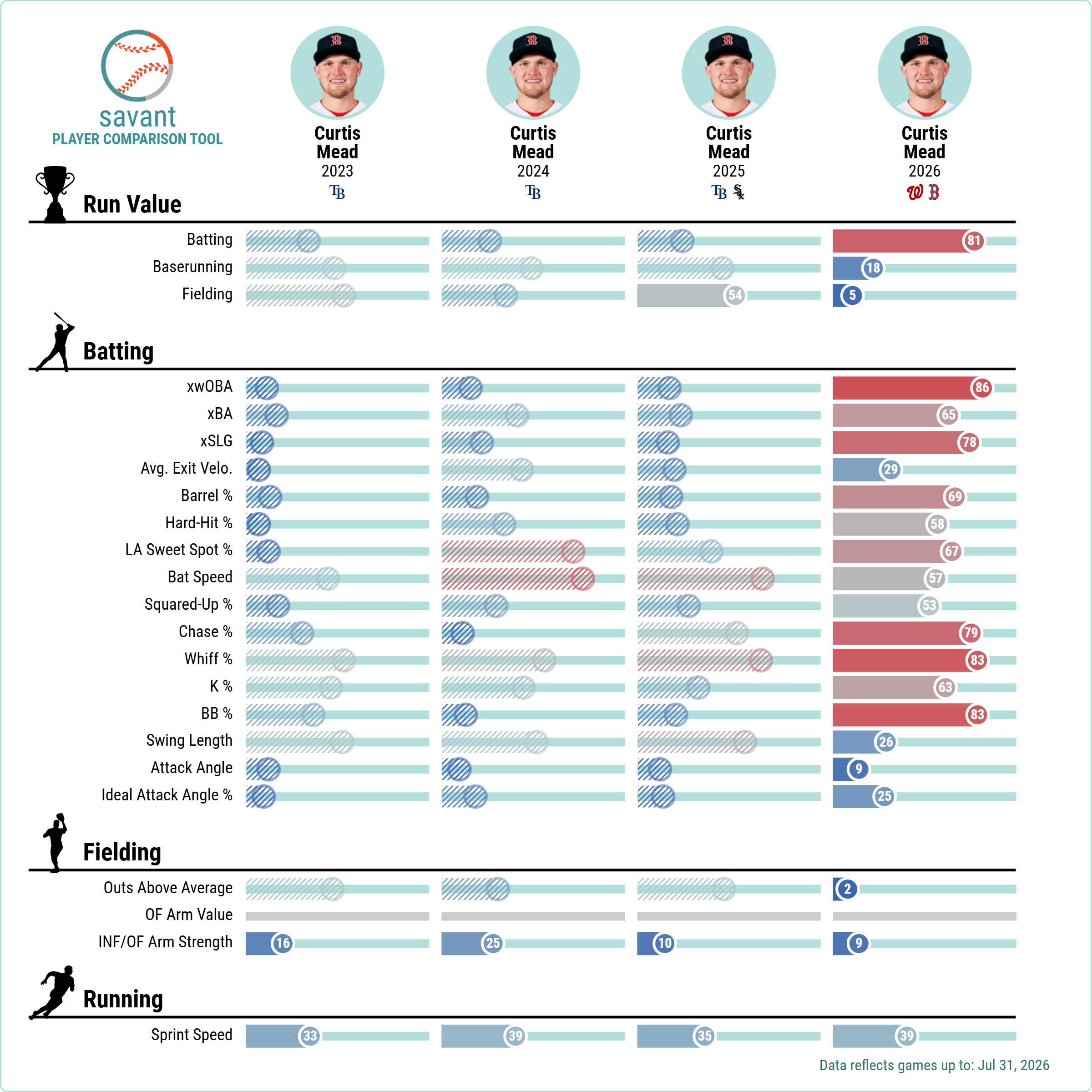
This trade was starting to grow on me by the time it just went off the rails. The dynasty and prospect pedigree could not be more different between these two players, but the trade still makes sense on paper. The Nationals were able to turn a spring training DFA in Mead into a likely middle-rotation starter. That is just good business. Mead had fallen far from grace since his days with the Tampa Bay Rays, but his process improvements with the Nationals have unlocked the bat’s potential this season. It is still a far outlier from his career norm, but the swing decisions and swing-and-miss improvements have coincided with better results. He has at least come back into the dynasty picture as a utilityman with some strong on-base ability. But Mead is already out for most of the season at least after taking a fastball to the wrist. He is a dynasty non-asset for managers needing production now. Any trade for Mead would be buying him at his highest value in years and betting that the process improvements stick. If it is any consolation, he is not outperforming his expected numbers by much.
Early, who is still on the 15-day IL with left elbow inflammation, was having a stellar first season in the Red Sox rotation. His 23.8% strikeout rate and 8.7% walk rate were far cries from his stellar four games in 2025, but it is hard to argue with a 3.44 ERA across 91.2 innings in 2026. Early was giving up a ton of home runs on the road and at home, though, inflating his FIP to 4.60 across his 17 starts. His arsenal is consistent and six pitches deep, and that makes Early an attractive pitcher to acquire with years of control ahead. But for dynasty managers, is he there yet to buy high on? I do not think so. Early does not have a full season of work under his belt yet, lacks an elite pitch this season, and will likely start in front of a flawed Nationals bullpen. All of that makes me hesitant on Early’s dynasty value, even if the real-world impact could be greater.
July 29
• Rangers get: C Logan O’Hoppe, RHP Chase Silseth
• Angels get: INF Angel Arredondo
We talked about this trade on the latest Destination Dynasty, and I am still confused by it. Interim general manager John Mozeliak was upfront that the move was a change of scenery for O’Hoppe, the player most considered to be the Angels’ catcher of the future at one point. He is the biggest name involved in the deal, even if he has the likely nomination as the least impactful of these three in five years’ time. The L.A. backstop slashed .209/.271/.295 with four home runs in 75 games and showed little to no positive impact behind the plate. The 26-year-old needs some major adjustments in the Rangers organization if he wants to return as a notable catcher again.
Silseth’s arsenal is far from average according to PLA, but he is getting results this season in a middle-inning role for the Angels. Opposing batters have a 32.7% whiff rate against him in his 39.2 innings of work this season, his first full season as a bullpen arm since moving from the starting rotation. Lefties can get to the Arizona product, though, especially since his best pitch is a 3-to-9 sweeper that he lands fairly well in the zone. He could be in line for some holds in Texas, but that is about it. The four-seamer needs improvements if the dynasty ceiling wants to rise.
Arredondo is an interesting case of no prospect hype coming into the trade, landing at only 27th on MLB Pipeline’s list for the organization. But the versatile infielder is having a solid season at Low-A, slashing .247/.372/.397 with eight home runs and nearly walking as often as he strikes out. Mozeliak says the organization considers him a top 10 prospect for the Angels, so the pressure is already on. But the Mexico native is still a long way from that prospect pedigree or a big league outlook.
July 30
• Twins get: LHP A.J. Minter
• Mets get: INF Bruin Agbayani, INF Billy Amick
The Minnesota Twins were one of those teams that could have gone either way at the trade deadline, but improving their bullpen shows that a soft buy is at least in hand. Minter is not the most high-profile reliever available, but he brings plenty of experience to the Twins roster and helps address a major sore point for Minnesota. He is just a rental and has a career-low in holds this season. Minter is hardly a dynasty asset right now, even if he will be an important part of any Minnesota run to October.
Agbayani was the Twins’ sixth-round pick last year and has a strong hit-over-power approach while playing middle infield, but has not played since mid-May with a shoulder injury. He slashed .268/.412/.341 in his 51 plate appearances prior, looking like a solid leadoff-hitter type down on the farm. Amick was outside my top Twins prospects in our latest ranking but is having a massive power surge with 23 home runs at Double-A this season. The former Tennessee Volunteer was a second-round pick in 2024, but has some flagrant strikeout issues (28.5% in 2026), and batting .217 in Double-A is not going to win over evaluators.
July 31
• Twins get: RHP Dean Kremer
• Orioles get: OF Jhomnardo Reyes
This is my favorite move of the deadline so far. Not for Kremer, but for Reyes.
Kremer was Mr. Consistent for Baltimore for most of the past five seasons but has failed to follow up in 2026 thanks to a crowded rotation and a quad strain earlier this season. He is on pace for a largely lost season, with only 36.0 innings tossed and a 6.50 ERA for Baltimore. This move feels like the Twins betting on Kremer getting healthy and finding a rhythm as the fifth starter in their rotation. Connor Prielipp and Zebby Matthews have uncertain outlooks to close out the season, and Kremer is a player who would likely take starts and innings from those two.
Reyes was one of the players I was most excited about in the latest prospect update, where he came in at sixth in the Twins’ system. Here is what I said about the FCL prospect:
“Another power-over-hit Dominican outfielder, Reyes is a few years behind Rodriguez but the Florida Complex League numbers are strong. Slashing .291/.406/.547 with seven homers and 13 stolen bases in 46 games is solid enough, but the 107.3 mph 90th-percentile exit velocity shows the room for growth. His power makes him a tantalizing complex prospect to invest in, and there are flashes of above-average contact skills mixed in with baffling whiffs. High risk, high reward.”
Aug. 1
• Pirates get: RHP Camilo Doval
• Yankees get: C Omar Alfonzo, OF Luis Cruz
The Yankees never quite got the returns they hoped for from Doval, who was an electric All-Star back in 2023. The raw tools still remained, but a 4.54 ERA over 39.2 innings pitched this season made Doval more of the problem than the solution. Doval really struggled within the confines of Yankee Stadium, which makes me believe moving to PNC Park, which is much more pitcher-friendly, will help him. He has a good chance to rise quickly in the Pirates’ pecking order if the organization can identify what needs to change, especially since they lack a solid right-handed relief option in the later innings.
Alfonzo is a bat-first prospect with a .757 OPS in Double-A this season and moves to New York’s 27th-best prospect following the trade. He has derby power, not in-game power, and no value on the basepaths or consistency to make him a factor in dynasty formats. Cruz had a solid year in the DSL at 18 years old, but his super passive approach and lack of power also make him a dynasty non-factor right now, unless the deepest of leagues believe in the .313/.460/.396 line translating once he comes stateside.
• Brewers get: C Bo Naylor, RHP Codi Heuer
• Guardians get: RHP Craig Yoho, OF Blake Perkins
For those Cooper Ingle truthers, this trade is for you.
The Guardians cleared up their catching logjam a bit by trading away Naylor, who has not been able to find consistency at the plate this season. The Brewers were not acquiring Naylor so much for his production but to “protect your downside,” as Brewers president of baseball operations Matt Arnold put it. Milwaukee acquired catching depth at last year’s trade deadline too, and if Naylor is seeing everyday at-bats for the Brew Crew, something has gone terribly wrong. There is no question that Naylor is talented, but he has not put the pieces together for managers to monitor him for quite some time. Heuer fits that mold too and will likely be a next-man-up option for the Brewers in the bullpen if injuries deem it necessary.
Perkins has well-above-average value in the field but little more than that and bench depth for the Guardians. His speed will put him into a pinch-runner role, likely, but he has never been an average batter and carries a career-worst 45 wRC+ this season. Yoho is going to have name recognition for his changeup that enraptured pitching heads, but has struggled to grab a foothold in the Brewers bullpen thanks to lacking control. He can fool Triple-A batters with no problem, but working in deeper counts and improving sequencing will be the next step of his development. If any organization can help, the Guardians are a decent bet.
Continued by Matt Heckman
Aug. 1 – Continued
- Braves get: OF Lane Thomas, LHP Bailey Falter
- Royals get: Lucas Braun, LHP Carter Holton
First off, this is a move I was really hoping the Phillies would make. Lane Thomas is a perfect outfielder acquisition for a contending team. He has a plus glove in the outfield and is slashing .263/.370/.420 with a 125 wRC+ against lefties. As far as Thomas’ dynasty value goes, not much changes. Thomas should play nearly every day in favor of Mike Yastrzemski against lefties and then in place of either Jim Jarvis or Mauricio Dubón against righties. He is not a difference-making fantasy asset and possesses little dynasty value at 30.
In terms of prospect acquisition, Lucas Braun is a polish-over-stuff pitcher. Braun has never posted a double-digit walk rate in his professional career. He has a deep six-pitch arsenal, although none of his offerings particularly stand out. The trade to Kansas City should help open up a path to the major leagues, although it is unlikely he becomes more than a back-end starter.
Holton has a bit more upside. A second-round pick back in 2024, he has just 43 professional innings under his belt after undergoing Tommy John surgery. The 5’11” lefty has struggled with consistency as he works to shake off the rust. In terms of upside, his breaking pitches (slider and curve) both flash plus potential, making him a deep-league prospect to keep tabs on.
Overall, not much changes in terms of dynasty value from this deal.
- Dodgers get: LHP Tarik Skubal
- Tigers get: OF Zyhir Hope, RHP River Ryan, RHP Brady Smith
The big move that everybody was waiting for. Tarik Skubal is officially a Dodger (which everybody could have seen coming). Skubal is Skubal. The Dodgers get arguably the best pitcher in baseball, and that should not stop in Los Angeles. In terms of dynasty and fantasy value, the move to Los Angeles is likely to result in more wins, although it would not be surprising to see them move to a six-man rotation once Blake Snell returns. Skubal owns a slightly higher ERA away from Comerica Park in his career, but that has not been the case over the past two seasons.
The prospect return is what dynasty managers are really going to focus on here. The prospect to see the largest increase to his dynasty value is undoubtedly River Ryan. Ryan gets to leave the PCL and has a much clearer path to a major league rotation spot in Detroit than in Los Angeles. Ryan is about to be 28 years old and has not pitched in the major leagues since throwing 20.1 innings back in 2024. Durability and consistency are certainly concerns, but there is no denying the upside in his pitch mix. He has at least three plus offerings and a floor of a high-leverage reliever. He should quickly earn a promotion to the major leagues with his new ball club.
Zyhir Hope’s dynasty value also gets a boost from this trade. Yes, he loses the Dodgers’ prospect development value, but there is MUCH less competition ahead of him for playing time. Hope no longer has to compete with the Dodgers’ ever-growing payroll. He also is away from Mike Sirota, Eduardo Quintero, and Josue De Paula. Hope’s raw power should play just fine in any stadium, even Comerica, and he remains a top dynasty prospect.
Brady Smith cracked the Dodgers’ Top 15 prospect list in last month’s update for Pitcher List. My scouting report on him was: A third-round pick back in 2023, arm injuries prevented Smith from making his professional debut until 2025. 2026 represents the first time he has been healthy heading into a season, and he is putting up impressive numbers. Smith’s fastball is a plus offering with good ride and late life. His curveball is the best of his secondaries, but he is still working to find his command of anything other than the fastball. The stuff is good enough to produce success in the lower levels of the minor leagues, but Smith will need to develop from a thrower to a pitcher once he faces tougher competition.
This is a very intriguing get for Detroit and a prospect that dynasty managers should keep a close eye on.
- White Sox get: RHP Luis Castillo
- Mariners get: RHP Seranthony Domínguez, OF Nolan Jones, C Boston Smith
The biggest piece of this trade is likely the players who were not involved. Seattle needed to clear room in their rotation for both Ryan Sloan and Kade Anderson. Anderson feels like the more likely prospect to earn a promotion in 2026 and is a must-add in all redraft and keeper formats. In terms of dynasty, Anderson’s value increases with a promotion more likely. Luis Castillo also gets a slight boost now that he will be starting more consistently. Castillo owns a 5.06 ERA on the season, but a 4.04 ERA since May 19th.
As far as the rest of the deal, Seranthony Domínguez loses whatever value he still had, as he will not be closing at all in Seattle. With Nolan Jones, I honestly had no idea Jones was even with the White Sox. The team just lost Luke Raley to the IL, so it is possible that Jones gets some major league run in his place. However, this is not a player that dynasty managers need to go pick up.
Boston Smith was a sixth-round pick out of Wright State who is already on his third different level this season. He is up to 22 home runs but does not project as a catcher long-term. He is a heavy flyball and pull-side hitter who works plenty of walks but has some definite holes to his swing. His ceiling is a strong side platoon with power upside and a low batting average.
Aug. 2
- Rays get: Freddy Peralta
- Mets get: Aidan Smith, Gary Gill Hill, Émilien Pitre
This trade goes to show you how quickly a player can lose their trade value. Acquired by the Mets this off-season, Peralta had high expectations before struggling to a 4.99 ERA. For those dynasty managers holding Peralta, this trade can be viewed only as good news. Things could not get worse for Peralta in New York. Now, he goes to Tampa who is known for resurrecting pitching careers. They are sure to adjust Peralta’s pitch mechanics and pitch mix to help bring him back into form. Before this season, Peralta owned a 3.30 ERA across his last five seasons.
From a prospect perspective, this is an underwhelming return. Aidan Smith was once a breakout hopeful as dynasty managers fell in love with his raw tools. He has struggled to stay healthy, with a strikeout rate consistently over 30%. Now 22, Smith has never played above High-A. This can only help to resurrect his dynasty value. The same goes for Gill Hill, who has posted underwhelming strikeout numbers despite strong control.
Pitre is the most interesting of the bunch for dynasty managers. A second-round pick back in 2024, Pitre has an incredible hit tool. His contact skills, plate discipline, and line drive rates are all sensational. Pitre has an extremely high floor with the ability to play both second and third base. As for how this trade impacts his dynasty value, this profiles as less than ideal. The Rays are an organization that always seems to get the most out of prospects like Pitre. The Mets are more likely to spend up on a prized free agent than ever give Pitre a long leash to earn major league playing time.
- Yankees get: Luis García Jr.
- Nationals get: Yovanny Cruz, Jake Bird, Jack Cebert, Ben Grable
In the midst of a breakout season, Luis García Jr. is heading to New York. Garcia has a career-high 23 home runs thanks to increased bat speed and a higher pulled-air rate. This should play exceptionally well in Yankee Stadium with the short porch. Garcia still struggles against lefties and will likely be reduced to a strong-side platoon role over the next year and a half with New York. A hidden takeaway is the news that Ben Rice is going to start seeing more time behind the plate with the Garcia acquisition. If Rice can generate enough starts to maintain catcher eligibility for 2027, that would be a huge boost to his long-term outlook.
The return for Garcia netted the Nationals four pitching prospects, with three of them destined to be relievers. Cruz features a triple-digit fastball with a plus slider that has generated a 42.9% whiff rate on the season. He instantly enters the closer mix and could turn into an intriguing long-term option at the back end of Washington’s bullpen. Cruz is worth taking a flier on, and Clayton Beeter’s value could be impacted. Jack Cebert is the one pitching prospect who could be a long-term starter option. A 15th-round pick from last season, Cebert has shown a strong fastball-slider combination and owns a 2.78 ERA over his last nine starts.
- Cubs get: Kevin Gausman
- Blue Jays get: Ty Southisene, Brett Bateman
Man, this trade would feel a lot more exciting if the Jays were able to acquire Tate Southisene from Atlanta. Instead, it is his brother Ty who was a fourth-round pick by the Cubs back in 2024. Southisene is a contact-first hitter with zero professional home runs. Bateman is slightly closer to the major leagues, but is a very similar profile. He has elite plate discipline, contact rates in the mid-to-high 80s, and plus speed. Bateman hits too many ground balls, but there is a tick more power here. The long-term projection is Ernie Clement lite? Not an exciting haul for Toronto fans.
For Kevin Gausman, this trade offers him a pitcher-friendly home ballpark with a great defense behind him. This will undoubtedly help his 2026 numbers fall more in line with his 3.51 FIP compared to his 4.38 ERA. This move also likely keeps Jaxon Wiggins (Cubs’ top pitching prospect) down in Triple-A for the remainder of the season.
- Braves get: Tyler Mahle
- Giants get: Anthony Molina
Tyler Mahle is your typical back-end starter. He did post a sub-3 ERA last season, but has struggled with consistency and durability throughout his career. Mahle is a free agent after this year. This move does not have long-term dynasty implications. If you are looking to read the tea leaves, this move may speak to how confident Atlanta is in pitchers like Owen Murphy, JR Ritchie, and Hurston Waldrep. However, considering this is a low-risk rental move, none of those players should be impacted beyond 2026.
Molina is a relief pitcher who has posted mediocre numbers across three major league stints with Colorado and Atlanta. He has a high-90s fastball but has failed to generate anything in terms of whiffs off the pitch. There is no dynasty impact on this side of the move.
- White Sox get: Huascar Brazobán
- Mets get: Gabe Davis, Zach Franklin
After trading away Seranthony Domínguez, the White Sox re-add a right-handed reliever in Brazoban. Brazoban, now 36, owns a 2.56 ERA across 46 appearances so far this season. Although he has only two career saves, this feels like a move that could impact Grant Taylor’s supposed stranglehold on the closer role. Brazoban is not a free agent until 2030, and the White Sox have been very inconsistent with what the long-term plan for Taylor is. This move gives them a bit more flexibility as they balance the future and contending in 2026.
As far as the return, Davis is a massive 6’9″ pitcher who was a fifth-round pick last season. He pitched well in High-A before the wheels fell off in Double-A. Davis struggles with consistency in his delivery, but flashes plus stuff. His fastball gets good late life, and his slider is a clear plus offering. There is upside here that the Mets are hoping they can unlock. Franklin is a 27-year-old right-handed relief pitcher. He has given up 11 home runs in just 45 innings this season, but all three of his pitches have a whiff rate above 32% in Triple-A. Davis is the name for dynasty managers to care about; Franklin is an organizational depth piece.
Aug. 3
- Blue Jays get: José Soriano
- Angels get: Arjun Nimmala, Eddie Micheletti, Angel Rivero
So, the Jays trade away Kevin Gausman and then acquire José Soriano. Soriano is interesting. He was elite to start the year (0.84 ERA across seven starts), struggled in the middle (5.44 ERA across his next 10 starts), and has leveled out in the middle recently (3.21 ERA in his last five starts). The Jays are clearly hoping to unlock Soriano’s full potential. His knuckle-curve has a whiff rate of 46.1% while his fastball sits in the upper-90s. He is throwing his four-seam fastball more than ever before, although opponents are slugging .505 on the pitch. There is big-time upside here for both the Jays and dynasty managers, although Soriano is far from a guarantee.
Considering the price they paid, Soriano better put things fully together. The Jays gave up former first-round pick Arjun Nimmala in this deal. Nimmala is a top-50 prospect who was batting .265 with eight homers this season. Nimmala has substantial power upside and has shown notable improvements to his plate discipline and approach this year. The Angels do not have the best track record in developing raw, toolsy prospects, so this is not my ideal landing spot for a prospect like Nimmala.
The two other prospects are a bit less known. Michelletti is a 24-year-old outfielder currently in Double-A. He has flashed average power and strong contact skills. Interestingly, he also has better numbers against lefties than righties. He profiles as an OF3/4 type with intriguing deep-league upside. If he can get to more game power, his stock could continue rising. Rivero is a Complex League pitcher who owns a 2.36 ERA on the season. Reports are that his fastball sits in the mid-90s, although there is little publicly available data on him.
- Phillies get: Luis Arraez, Caleb Kilian
- Giants get: Ramon Marquez, Marty Gair
A trade with plenty of dynasty implications. First, looking at the Phillies’ return. Luis Arraez is going to be inserted now into a crowded infield. Team insiders have already come out and stated that with this move, Bryce Harper is moving back to the outfield. This will give him dual eligibility for at least the 2027 season, which adds additional fantasy value. The rumor is also that Bryson Stott will be moving to third base and Alec Bohm over to first. Multi-positional eligibility is always nice. These are not expected to be long-term moves, but could be sneaky adjustments for 2026 and 2027.
Caleb Kilian is a strong reliever, but he is not going to displace Jhoan Duran. Killian loses his intrigue as a closer option with the move from San Francisco to Philadelphia. He is a fine player to move on from in leagues where you were holding him for save potential.
The Giants also did really well in this trade. Marty Gair is a fireball-throwing reliever whose fastball consistently sits in the triple digits. Gair struggles with consistency, but has struck out 44.6% of the batters he has faced this season. He has back-end bullpen upside to be mindful of.
The real prize for San Francisco was acquiring Ramon Marquez. Marquez is one of the fastest rising pitching prospects in all of baseball. Marquez owns a 1.68 ERA through 12 appearances this season. Marquez has tons of potential. However, his arsenal is comprised of a low-to-mid 90s sinker, a cutter, and a changeup. He lacks a true plus breaking pitch, and there is debate over how his fastball will play against tougher competition. At only 20 years old, Marquez still has plenty of time to add velocity and see his value rise even more. However, in my opinion, he is more of a sell high than a true elite pitching prospect.
- Phillies get: Brooks Raley
- Mets get: Luke Gabrysh, John Spikerman
The dynasty impacts of this trade are extremely low. Brooks Raley is 38 years old and is a free agent after this season. He will move into a high-leverage lefty specialist role with Philadelphia, but does not impact anybody’s long-term value.
The prospects in this deal are at best marginal. Spikerman is a former third-round pick from 2024 with great plate discipline and plus speed. He has three professional home runs and has failed to advance past High-A at 23 years old. Luke Gabrysh is a 23-year-old starting pitching prospect who has seen his strikeout rate tick up in High-A but owns a 5.14 ERA. His four-seamer sits in the mid-90s but lacks much movement, and he is more likely to find success with his sinker. The slider flashes plus potential but lacks consistency. There is some potential here if the Mets can get everything to click.
- Braves get: Brent Suter
- Mets get: Nacho Alvarez Jr.
A savvy pickup from the Braves who add a veteran lefty to their bullpen. Suter does not hold any real fantasy or dynasty value, but is a strong real-life addition. The Angels buy low on a former top prospect in Nacho Alvarez Jr. Alvarez broke out in 2024 but has struggled immensely since. His batted-ball data has been underwhelming, and he projects to provide very little power and speed. His contact skills remain strong, but he does not profile as an everyday player. There is not much dynasty impact to take away from this trade.
- Guardians get: Jo Adell
- Angels get: Jacob Cozart
The Guardians add some pop to their lineup in Jo Adell. Adell is under contract through next season and should bat in the middle of Cleveland’s lineup. There is some concern that an analytical team like Cleveland could sit Adell some against righties (65 wRC+ against them). Adell’s playing time is a situation to monitor and could drastically alter his long-term dynasty value.
In return, the Angels acquired catching prospect Jacob Cozart. He has 10 home runs and has good feel for getting to his pull side. However, he is a glove-first catching option with a suspect hit tool. He is batting .178 against lefties this season, and there should not be a ton of confidence in the Angels to get the most out of him.
- Mariners get: Taylor Ward
- Orioles get: Alex Hoppe, Harrison Kreiling, Brock Moore
A fairly underwhelming return here for Baltimore. Alex Hoppe is a fine major league reliever who could get a few save chances down the stretch. Brock Moore is another relief prospect with limited dynasty appeal. Harrison Kreiling was a 17th-round pick back in 2024 but has thrown only 10.2 professional innings due to injuries. He has struck out 16 batters this season while flashing a plus fastball/slider combination. He has the most upside of the bunch, but carries plenty of relief risk.
Taylor Ward is a free agent after this season, but should slide right into an everyday role with Seattle. His power numbers have taken a plunge this season with Baltimore; hopefully Seattle can help him return to his 36-home-run upside he showed last season.
- White Sox get: Brenton Doyle
- Rockies get: Mason Adams, Carlos Vielma
Brenton Doyle is a fascinating acquisition for Chicago. Doyle has struggled mightily in the last season and a half, but hit .260 with 23 homers and 30 steals back in 2024. The move to Chicago could provide Doyle with a reset and help get him back into the lineup on a regular basis. Doyle is sure to play over Tristan Peters against lefties and could play against righties. Peters is slashing .107/.190/.125 since July 11 while Doyle plays elite defense in center field. Doyle is not a dynasty “buy” just yet, but he is certainly worth keeping an eye on.
Going back to Colorado are two prospects. The first being Carlos Vielma, who is a DSL bat currently batting .337. At 16, Vielma lacks a true defensive home and projects as a hit-tool first player with limited power projection. Adams is a 26-year-old right-handed starter with a deep six-pitch mix, but underwhelming stuff. He controls his stuff well, and his high ground ball tendencies could work in Coors Field. He is a low-ceiling prospect for dynasty managers.
- Blue Jays get: Josh Smith
- Rangers get: Adam Macko
Josh Smith is a versatile infielder under team control until 2029. He had just been optioned to Triple-A following a breakout 2026 season. The Jays got the most out of Ernie Clement; they are likely hoping to do the same with Smith, who can play all over the diamond. The move to Toronto does not explicitly change Smith’s dynasty value in any way at this point.
While the Jays try to buy low on Smith, the Rangers try to buy low on Macko. The 25-year-old lefty has pitched almost exclusively from the bullpen this season. He relies heavily on a fastball and slider combination and could turn into a strong option out of the bullpen. This is a low-stakes trade in terms of dynasty value.
- Padres get: Robbie Ray
- Giants get: Miguel Mendez, Joniel Hernandez
The peripherals on Robbie Ray are not very good. He has the lowest strikeout rate of his career and the highest walk rate since 2020. However, he owns a 3.08 ERA on the season with a very extensive track record. The good news is that he is still moving to a pitcher-friendly home ballpark and will be firmly entrenched in San Diego’s rotation for the remainder of the season. Ray’s dynasty value does not change much with this move. He only has a couple of years left before he likely retires.
WOW, what a return here for San Francisco. Maybe I am in the minority, but Miguel Mendez and Joniel Hernandez are big-time prospects in my scouting. Mendez has never been able to get everything to click at the same time. There have been some injuries, some walk issues, some bad luck, but man, the upside is there. His fastball can be a plus-plus offering, and his slider makes righties look silly. He needs to find more consistency with his changeup, but hopefully a change of scenery and a chance to work with a new pitching development team will help unlock that. Regardless, his floor is a high-leverage reliever.
Joniel Hernandez was San Diego’s prized international signing from this past period and has looked very good in the DSL. He has a mature approach at the dish with plus projectability and an already good feel for getting to his pull side. Both of these prospects have significant upside and dynasty appeal.
- Rays get: Liam Hicks
- Marlins get: Brayden Taylor, Adrian Santana, Jacob Kisting
In one sense, good on the Marlins for turning a Rule-5 pick into three legitimate prospects. The team had plenty of catching depth with Joe Mack and Agustín Ramírez, and has now freed up some space. Hicks is batting .282 on the season, but his splits against righties and lefties are drastic. He is batting .300 against righties and .200 against lefties. The Rays are almost certain to put him into a strong side platoon role, which would impact his long-term value. While this move could open up more playing time for Agustín Ramírez again, the team could also keep rotating their young outfielders around the outfield slots and DH now that Owen Caissie is back.
In return for Hicks, Brayden Taylor is the most notable prospect. A former first-round pick, Taylor has flashed significant upside in the power and speed department. At 24 years old, Taylor has hit 17 homers and stolen 20 bases in Double-A, but has significant platoon risk. The move to Miami is also a more challenging home ballpark for Taylor. Santana is a contact and speed prospect with a strong glove. The team has found success developing prospects like him (Xavier Edwards and Otto Lopez), but he does not currently profile as an impactful dynasty asset.
Jacob Kisting is now going to his third organization since being drafted in the 14th round of the 2024 draft. Kisting pitches entirely from the stretch and lacks consistent feel for his offerings. The fastball is a below-average pitch, while his changeup has plus potential. Kisting is 23 years old and has yet to pitch above High-A.
Hicks’ dynasty value decreases, Taylor’s dynasty value decreases, Santana gets a slight bump, and Kisting is not a dynasty-relevant prospect at this point.
- Dodgers get: Kris Bubic
- Giants get: Carlos Duran
The rich get richer (in a sense) as the Dodgers acquire Kris Bubic. Bubic has been on the IL since May with an elbow and shoulder injury. After breaking out as a starting pitcher last season, it seems likely that Bubic’s future role is as a reliever in the Dodgers’ bullpen. With the amount of depth LA has in their rotation, Bubic’s dynasty value takes a hit with this move.
The return to Kansas City is reliever Carlos Duran, who has primarily pitched at Triple-A this year. His unique arm angle makes him a tough at-bat for righties, but he has struggled with consistency and walks throughout his career. He is not a dynasty-relevant asset at this point.
- Red Sox get: Adley Rutschman, Jake Rogers
- Orioles get: Kyson Witherspoon, Anthony Eyanson, Enddy Azocar, Carlos Narváez
Here is what is likely “the big one” of the day. The Orioles rebuild did not ever pan out, and now they are cutting their losses and dealing away fan favorite Adley Rutschman. Rutschman moves to Boston, where he will step in as the everyday catcher once he returns from the IL. The move does seem to signal that Baltimore is comfortable with Samuel Basallo projecting as their long-term catcher. Basallo has been strong offensively this season but has a lot of work to still do defensively. Regardless, catcher is a much more valuable position for his bat long-term compared to DH.
In return, the Orioles get a haul. Kyson Witherspoon and Anthony Eyanson are Boston’s top-two pitching prospects. Both draft picks from last year, they have substantial potential. Eyanson has been dominant this season in both High-A and Double-A, while Witherspoon has dealt with some inconsistencies. Witherspoon has a bit more projectability but needs more time to develop, although you can argue he has more upside. These are two consensus top-100 prospects Baltimore adds to their system. Boston’s pitching development has been a bit ahead of Baltimore’s, though, so this is not the most ideal move for either. Azocar is no slouch at the plate, standing at 6’2″. He has a projectable, athletic frame and is up to 18 homers and 11 steals on the season. The hit tool is raw, but he has substantial upside at 19 years old. Carlos Narváez is a depth piece to give Baltimore another major league catching option.
- Cubs get: Braxton Garrett
- Marlins get: Jonathon Long, Jace Beck
This move gets Braxton Garrett back to the major leagues. Garrett was pitching well before an arm injury ended his 2025 season. Outside of his last two starts, Garrett has been pitching well in Triple-A this year and will now get a chance to pitch in the major leagues again. He does not have an extremely high ceiling, but this move is a clear boost for his dynasty value.
Jonathon Long has the feeling of a AAAA first baseman. He was blocked in Chicago and is now blocked in Miami. He has posted solid numbers in Triple-A the past two seasons, but lacks any standout skills. He is a fine prospect, but this move does not do anything to help his dynasty value. Beck is a 26-year-old right-handed reliever who has yet to make his major league debut. He is not a dynasty-relevant prospect.
- Pirates get: Luke Weaver
- Mets get: Sammy Stafura
The Pirates get their reliever. Luke Weaver figures to step right into the closer role in Pittsburgh, which will boost his dynasty value for this season and next. Although Weaver lacks the typical closer “stuff”, he has been dominant this season and should be a strong fantasy asset.
The Pirates traded Ke’Bryan Hayes for Sammy Stafura last season and now turn Stafura into Weaver. Stafura is an athletic shortstop who has hit a career-high 20 home runs this season. Stafura’s power surge is a welcome sight and, when paired with his plus speed, provides significant dynasty appeal. While there is substantial upside, Stafura is also extremely raw. His hit tool is below average, and he struggles to handle well-located breaking pitches. He is aggressive at the dish and is reliant on getting to his pull side to achieve his 20+ home run potential. He is an intriguing prospect, but certainly not one without risk.
- Brewers get: Dustin May, JoJo Romero
- Cardinals get: Alexander Frias and Josiah Ragsdale
This is quite the return for St. Louis. For those who are unaware, Milwaukee boasts an incredibly deep farm system. Still, parting ways with Frias could look like a bad move down the road. Frias is a toolsy and athletic outfielder who is already playing in full-season ball at 18 years old. He has plus raw power, plus speed, and has shown a mature approach at the plate. Ragsdale gets a boost in dynasty value going to an organization with less depth ahead of him. The seventh-round pick from 2025 is having a sensational year, batting .316 with 19 home runs and 31 stolen bases. Ragsdale is one of the more underrated prospects in all of baseball. This significantly improves the Cardinals farm system.
As far as Dustin May, a move to Milwaukee can only be viewed as a positive. May has been flashing brilliance since making his major league debut back in 2019. He has been inconsistent this year, but owns a 3.14 FIP on the season. May has dramatically altered his pitch mix this season, and the Brewers could alter it even further. May’s value increases for the remainder of 2026. JoJo Romero was not the closer in St. Louis and is not going to close in Milwaukee. His dynasty value remains unchanged.
- Cubs get: Ryan Zeferjahn
- Angels get: Moisés Ballesteros, Mason McGwire
The Cubs get Ryan Zeferjahn, who has closer stuff. However, the move to the Cubs is more of a negative than a positive for his long-term dynasty value. Zeferjahn’s stuff put him in the mix to close games for the Angels if he could ever figure out his command. The Cubs have Daniel Palencia (who is currently on the IL), so it is unlikely that Zeferjahn would fill that role with the Cubs.
Meanwhile, Moisés Ballesteros is one of the biggest dynasty risers from the trade deadline. Ballesteros struggled to earn everyday playing time in Chicago, but has a strong track record of success in the minor leagues. The Angels have no other option at catcher and should give Ballesteros extended playing time to prove he can stick at the major league level. McGwire is a 22-year-old pitching prospect who has yet to make it past High-A. An arm injury forced him to miss the entirety of 2025, but he has been shaking off the rust this season. McGwire is a fine pitching prospect, but is unlikely to ever be a dynasty difference-maker.
- Cubs get: Tyrone Taylor, Clay Holmes
- Mets get: Jefferson Rojas
The Mets got a huge prospect in this return. Jefferson Rojas is still working on putting everything together, but at his best he is a strong defender with good contact skills and 20/20 upside. Rojas has always had a good feel for getting to his pull side, but he is hitting for more power than ever before this season. There is a lot for dynasty managers to like in Rojas’ profile. The trade to the Mets likely shifts his long-term position from shortstop (occupied by Francisco Lindor) to third base. This puts a bit more pressure on his bat to play up to its potential. A slight hit to his dynasty value is warranted, but there is still plenty to like.
For dynasty managers, Tyrone Taylor is kind of irrelevant. This trade to Chicago does not change that. For Clay Holmes, he is still on the IL, but should slot into Chicago’s rotation once he returns. Holmes owned a 2.39 ERA across nine starts prior to his injury. He also has ample experience pitching out of the bullpen, which could be beneficial come October. Taylor and Holmes are strong real-life acquisitions, but their dynasty value is fairly unchanged following these moves.
- Astros get: Daulton Varsho
- Blue Jays get: Spencer Arrighetti
An interesting deal here. The Astros get their much-needed outfielder. Varsho should slot right in as their everyday center fielder, and this does not take any playing time away from any dynasty-relevant players. Varsho is also a free agent after this year.
The Jays continued acquiring pitching depth that can help them beyond this year, adding Arrighetti, who has cooled off after a fast start to the season. The main issue for Arrighetti has been walks. He is walking 13% of the batters he has faced. The Jays’ 2027 projected rotation consists of Dylan Cease, José Soriano, and Trey Yesavage. Arrighetti will have the inside track to the fourth starter role. His dynasty value gets a small boost with this trade, but nothing significant.
- Yankees get: Heliot Ramos
- Giants get: Henry Lalane, Kaeden Kent
The Yankees continue to show that they do not trust Jasson Domínguez, who appears to be the odd man out with Heliot Ramos joining the mix. Dominguez is now up to over 700 major league plate appearances and owns a 98 wRC+. The sell-low window is even closing on him for dynasty leagues. Ramos is under team control through 2030 and profiles to be the team’s everyday right fielder. His numbers are certainly better against lefties, but his right-handed numbers are not poor enough to move him into a platoon. Going from San Francisco to Yankee Stadium is a nice boost in home ballpark. He gets a boost in dynasty value from this deal.
The return here seems a bit light for a player with over three years of team control remaining. Lalane has flashed plus potential but missed most of last season due to injury. He is back on the mound this year, but is 22 in High-A. He has intriguing stuff, but is more of a watch-list prospect than must-add. Kent was the team’s third-round pick in 2205 and is batting over .300 this season. Kent has a plus hit tool, but is aggressive at the dish with limited power. The Giants will look to improve his swing decisions and maximize his pull-side pop. He is a better real-life prospect than a dynasty asset at this point.
- Brewers get: Antonio Senzatela
- Rockies get: Mark Manfredi, Juan Martinez
Antonio Senzatela seemed destined to ride off into the sunset having only played for Colorado before a move to the bullpen revitalized his career. Although he is not an elite pen arm, Senzatela has performed well and can add length to the Milwaukee pen. He still does not hold much dynasty value.
The two prospects going back to Colorado are Mark Manfredi and Juan Martinez. Martinez is an intriguing young prospect. He dominated the DSL and Complex League en route to a promotion to Low-A at 18 years old. He is very toolsy with good plate discipline, speed, and contact skills. The amount of game power that develops will determine his ultimate ceiling. Manfredi is a 26-year-old relief prospect who lacks much dynasty appeal. This is especially true now that his future home games would be in Colorado. Martinez gets a slight dynasty boost from the Coors Field appeal, but also takes a hit in terms of player development success going from Milwaukee to Colorado.
- Twins get: Jeff Hoffman
- Blue Jays get: Dasan Hill, John Klein, Dameury Pena
The question here is: Will Jeff Hoffman close for Minnesota? If so, this is a huge trade for dynasty. Hoffman is under contract through next season and could become an elite dynasty closer again. He owns a 1.21 ERA since June 4 and has a 2.49 FIP on the season. However, Yoendrys Gómez has been very stable in Minnesota’s closer role since taking over. Hoffman is likely the better option and could drain any dynasty value Gomez has built up.
Meanwhile, the Jays got three prospects. Dasan Hill is the most notable of the bunch with a high-90s fastball and two plus breaking pitches. Hill has struggled with consistency since being drafted. Walks are an issue, as is maintaining velocity throughout a game. A new organization and fresh start give his dynasty value a boost, although a 17.2% walk rate is concerning no matter the organization. Klein is a fastball-heavy right-handed reliever who does not profile as a high-leverage arm. Pena is an undersized middle infield prospect with great contact skills but very little power. His ceiling is a Luis Arraez type, although it is more likely he turns into a utility infielder.
- Guardians get: Foster Griffin
- Nationals get: Will Dion, Josh Hartle, Keneglys Virguez, Nick Mitchell
Foster Griffin going to Cleveland feels perfect for his long-term dynasty outlook. Griffin is the exact pitcher type that seems to thrive with the Guardians. They have a unique way of maximizing a player’s arsenal. Griffin is a free agent after this season, but it would not be surprising to stick with Cleveland beyond this year.
The Nationals got four prospects, but none stand out in particular. Dion has a big curveball and has looked solid as a left-handed relief option this season. Hartle is a former third-round pick with decent command of his pitches, but very little upside and dynasty appeal. Virguez is another relief pitching prospect with intriguing stuff, but limited dynasty appeal. Nick Mitchell is a 22-year-old outfielder currently hitting .240 in Double-A. He has strong on-base skills but limited power.
This move is a clear win for Cleveland and Griffin’s dynasty value while feeling irrelevant for the other pieces moved.
- Padres get: Casey Mize
- Tigers get: Kash Mayfield, Jackson Wolf
Of course, the Padres also traded away Kash Mayfield at the deadline. Mayfield pitched in this past year’s Futures Game and was slightly disappointing. His fastball sits in the low to mid 90s with underwhelming metrics. His slider and changeup profile as strong pitches, and his size and deception from the left side help his stuff to play up. The Tigers have found success developing other starting pitchers recently, making this move intriguing for his long-term dynasty value. Wolf is a 27-year-old swingman who has not pitched in the major leagues since 2023. He is no more than a major league depth piece.
Mize going to San Diego is neutral for his dynasty value. He is a free agent at the end of this season with a strong chance of moving on. His numbers throughout his career have been slightly better at Comerica Park, but Petco is an equally friendly pitcher’s park, which helps remove risk.
- Diamondbacks get: Lars Nootbaar
- Cardinals get: Daniel Eagen, Sadro Santana
Lars Nootbaar feels destined to slide back into the strong side of a platoon with the move to Arizona. Nootbaar has struggled against lefties this season and will now have more competition for playing time in Arizona. In terms of park factors, Nootbaar moves from the worst home run park for lefties to the fourth worst. However, Arizona does have the sixth most friendly field for hits and the 12th best overall park factor for left-handed hitters. This is a nice boost. He will have more competition for playing time once Lourdes Gurriel Jr, Jordan Lawlar, and Tommy Troy return from the IL. Overall, this move hurts Nootbaar’s dynasty value.
The Cardinals get back two intriguing pitching prospects. Sadro Santana is a left-handed reliever with a good fastball/slider combination. He owns a 0.57 ERA in 15 innings since being promoted to Double-A. Eagen is a very intriguing starter option. He has struggled with consistency and command, but hitter-friendly minor league environments have skewed his ERA. He has a strong four-pitch mix, with the slider being the best offering of the bunch.
- Red Sox get: Erik Miller
- Giants get: Marcelo Mayer
After trading away Caleb Killian, it seemed like Erik Miller was destined to take over the closer role. Unfortunately, he is now going to Boston, which dissolves his dynasty value. However, the real talking point here is Mayer. Once considered one of the game’s top prospects, Mayer gets a change of scenery after failing to hit in Boston. Mayer has hit .223 through his first 364 major league plate appearances. Where Mayer fits long-term is a bit uncertain. Matt Chapman and Willy Adames are still signed for several seasons. Second base is the most logical spot, but the team must also make room for 2026 breakout Casey Schmitt. Also, the move to San Francisco presents a much more difficult home ballpark for Mayer to play his home games in. The change of scenery is certainly a good thing, but this does not do much for improving Mayer’s dynasty outlook.
