





We may not have crowned the World Series Champions yet, but we can still start speculating wildly about where we will rank players for 2026! These rankings will likely fluctuate quite a bit ahead of the next update (the “official” Top 300 in February), but if nothing else, this is an opportunity to gauge how we feel about players who broke out, broke down, or broke our hearts in 2025.
- As a reminder, these rankings are geared toward a standard, daily, 12-team H2H redraft league, which is typically the most popular fantasy baseball format. They will only factor in the five standard categories: runs, RBI, home runs, batting average, and stolen bases.
- These are not best ball or draft and hold rankings. The 12-team redraft format with daily moves is the fundamental opposite of that. Pure volume plays are not valued as much here as in those no-moves formats.
- I take rankings like this as more of an art than a science. Every person’s rankings are influenced by their own biases, strategic philosophies, determinations of risk, and projections. It’s why no two rankings are ever exactly alike. My way of evaluating and ranking players has worked well for me, but it might not be an excellent fit for you. I can’t possibly predict your team’s specific needs, your leaguemates’ player evaluations, or your current waiver wire, and if I could, it’d be weird in a bad way.
- This is a safe space for me where I answer to no one but myself…and you if you leave a comment.
- I’m doing my best to use five starts or 10 appearances as the threshold for positional eligibility. I have not included presumed eligibilities based on likely new positions, but I’ll add them once those eligibilities are earned. This is just a maintenance thing, and we will update eligibility throughout the season. Feel free to let me know if I’m missing any!
Ranking Philosophy
To keep things in the same ilk, here are a couple of notes on how I generally evaluate hitters before we dive in:
- In 12-team formats, I don’t see much value in guys who only provide stolen bases. It’s an important category, especially in Roto, but in shallower formats, there are too many other (and better) ways to get the steals you need without sacrificing production in the other categories.
- No stat is an island, and they should all be taken in proper context. For ranking purposes, the primary starting points I use are plate discipline, wRC+, quality of contact metrics (also known as Statcast batted ball data), lineup context, and the skills we can measure using tools such as our PLV Hitter Attributes (available for PL Pro members). I also use various projections (some free, some I buy) and dollar value generators.
- Positional eligibility, specifically multi-eligibility, is neat but isn’t a huge factor in many 10- and 12-team leagues anymore due to the prevalence of multi-eligible players. It’s of more value in deeper contests like the NFBC or in leagues with limited roster moves (draft and hold leagues, transaction limits/costs, extremely short benches, etc.). Still, the value is fairly situational and context-dependent.
- Similarly, I don’t penalize players for only qualifying in the utility slot. At most, it is a mild inconvenience if a DH-only player is available at a great value and you already have filled your utility spots.
- Regardless of true talent, anyone talented enough to make it to the big leagues can be brilliant or putrid for 50 to 100 at-bats. It could even last over a month with no change in potential or skill. It also could be wildly meaningful. We can’t and don’t know which will be valid until it’s over, though track record, scouting, and trends can give us hints.
- If you’d like input on a player or have any feedback, your best bet is to contact me on Bluesky (@scottchu.pitcherlist.com), X (@ifthechufits), or in the comments below!
Ranking Insights
A few things I noticed while cobbling this together:
- The first five tiers are EXTREMELY deep, and I will be using at least four of my first five picks on hitters (with the caveat that one of the Big Three of Skubal, Skenes, and Crochet at the right spot could make me pause).
- Catcher has grown deeper and deeper, and there will be viable starting catchers left undrafted in your leagues.
- After the top-150, I’d much rather take a shot on a high upside guy than bank on one of the many slap-hitting volume guys you can find later on.
- Second base, and to a lesser extent, third base, are really tough, and you will want a plan for what to do, including a contingency if your first play doesn’t work out.
- You can find speed outside of the top-100, but power and runs scored are considerably rarer.
Read The Notes
- These rankings focus on what I generally project for a player, but these rankings are not projections. They include projections but also consider performance risk, injury risk, team context, ceiling, and floor.
I also host an AMA in the r/fantasybaseball subreddit every Friday (starting sometime in late March), starting around noon ET that lasts through the rest of the day and into the weekend, so feel free to join the fun and ask questions or make comments.
Tier 1
1. Aaron Judge (OF, NYY) — Judge appeared in 148+ games for the fourth time in five seasons, shedding the “injury-prone” label, which was half the reason I’d list him at second instead of first in most renditions of this list.
2. Shohei Ohtani (DH, LAD) — I’m sure someone will complain that he’s an injury risk, but that’s only an issue for the pitching side, not the hitting side. Ohtani has back-to-back seasons with 50 home runs, and while he didn’t come close to the 59 steals from 2024, 20 steals is nothing to scoff at. He’s the perennial NL MVP favorite and is in the prime of his career. In Dynasty or in daily leagues where Ohtani can be a pitcher or a hitter, Ohtani would be first.
Tier 2
3. Juan Soto (OF, NYM) — It doesn’t matter what stadium he is in, what team is around him, or whatever. The batting average should bump back up 10-20 points in 2026 to get his OBP back over .400, and he should blast another 40 home runs.
4. José Ramírez (3B, CLE) — Thirty home runs, 40 steals, and a strong batting average are just par for the course at this point. He’s the top third baseman in the game.
5. Bobby Witt Jr. (SS, KCR) — Thirty home runs is a tough ask when you play half your games in Kauffman and have a spray-hitting approach. He should hit around 25, though, and Witt will provide elite ratios with 35-40 steals. The counting stats could improve as well if the Royals find one or two more pieces (not that I necessarily expect this to happen).
6. Julio Rodríguez (OF, SEA) — I’m going to resist the “slow starter” narrative, though his career numbers have shown it has been the case in three of his first four seasons. The biggest thing we learned about Rodríguez is that the guy we saw in 2022 and 2023 was the real J-Rod, and the 2024 version was not. We know 30 home runs, 30 steals, and 200 combined runs and RBI are on the way; it’s just a matter of when and how.
7. Elly De La Cruz (SS, CIN) — The Reds were far less aggressive on the base paths in 2025 than in 2024 (when they were one of the most aggressive teams in the league) under Terry Francona, and it’s hard to imagine that changing too much in 2026. I believe the first half version of Elly (.284/.359/.495) is more indicative of his ability than the second half version (.236/.303/.363), and it’s important to note that neither version struck out 30% of the time. In short, there was growth in 2025, even if the fantasy results were worse.
Tier 3
8. Junior Caminero (3B, TBR) — When you hit 45 home runs in your first full season, you get a spot in the top 10. The most common narrative about Caminero this offseason will be the home/road splits, as his OPS at home was over 200 points better than his road OPS, but it’s worth noting that he hit more dingers on the road than he did in his home park (by one, but still!). The real difference came from a huge spike in infield flies when on the road, which feels more like a random distribution than it does a predictable pattern. You can look for 30-35 home runs, if not more, as well as 100 RBI, though the ratios might fluctuate a bit.
9. Corbin Carroll (OF, ARI) — The power can be a bit uneven, but we saw a healthy Corbin Carroll hit 30 home runs and swipe 30 bases. The only genuine concern heading into 2026 I have is the counting stats, as the D-Backs got rid of two of their best hitters at the deadline, and their top prospect hasn’t looked ready to join the heart of a lineup. As of this moment, this lineup is three hitters deep, and unless they are aggressive in free agency, Carroll’s ceiling might be just a few inches too low to fight his way into Tier 2.
10. Fernando Tatis Jr. (OF, SDP) — Tatis Jr. endured a three-month power outage over the summer, hitting just five bombs in all of June, July, and August combined, though he rebounded in September to hit seven to close out the year. More importantly, he played in 150 games for the first time in his career and in at least 140 for the second time in three seasons. With a bit more confidence in his health and the hope that we don’t see another extended loss of power, Tatis could break into Tier 1.
11. Francisco Lindor (SS, NYM) — He’s averaging over 30 home runs and 30 steals over the last three seasons with well over 100 runs scored. He’s also among the most durable players in the game over the course of his career, missing more than 20 games just once since his first full year in the majors back in 2016. Sure, we’ve seen some extended slumps in each of the last two seasons, but the end results are fantastic, and there’s no reason to believe that will change in 2026.
12. Kyle Schwarber (OF/DH, FA) — Schwarber just gave us the best season of his career, just in time for free agency. Schwarber’s power plays anywhere, and he’s a threat to hit 50 home runs in every stadium. He’s likely to remain a Philly next season, and even if he doesn’t, I believe the changes he made in 2024 that carried into 2025 will stick around, meaning a much less harmful batting average and fantastic counting stats.
Tier 4
13. Kyle Tucker (OF/DH, FA) — I’ve always been a huge Kyle Tucker fan, and seeing his greatness on full display to start the year was a lot of fun. The drop-off for the rest of the season was much less fun. Injury narratives are challenging to grasp, as they often oversimplify complex, multifaceted issues. In this case, though, I’m willing to give Tucker a mulligan and say the injury sapped his productivity in 2025 and that we will see a rejuvenated Tucker come spring. We aren’t sure what uniform he’ll have on yet, but the only thing that I see changing significantly based on landing spot would be his stolen base totals, as those are very manager-dependent. On conservative teams, the figure is likely closer to 20, whereas on normal or aggressive teams, we should see around 30.
14. Pete Alonso (1B, FA) — Yet another Polar Bear finds itself in need of a new habitat, and while there will be a lot of storylines about where he ends up, there’s no ballpark I know of that can contain Alonso’s power. I think the improved batting average and excellent numbers from 2025 will carry over into whatever lineup he finds himself in next season, and if he’s lucky enough to land with a team that plays in a righty-friendly park (like Houston or the Bronx), we could see 50 dingers. Landing somewhere like Boston would make 40+ homers more difficult, but in return, we’d likely see an even bigger boost to his batting average.
15. Cal Raleigh (C/DH, SEA) — Considering that there’s a legitimate improvement in his fly-ball rate, pulled fly-ball rate, and barrel rate, we should assume Cal Raleigh’s power is legit, even if 60 home runs is improbable. We aren’t too sure about what the rest of the offense will look like with Polanco, Naylor, and Suárez all hitting the market in the offseason, but Raleigh is a threat to hit 50 home runs and drive in 100 runs as long as there’s a league-average offense around him. Many of you will have Raleigh lower on your board due to wanting to play the back-end of the catching pool, but per the FanGraphs Player Rater, Raleigh out-earned the second, third, and fourth-best catchers combined in 2025 ($47.7 to $46.0).
16. Trea Turner (SS, PHI) — It was great to see Turner return to the land of 30 stolen bases and a .300 batting average, even if he fell short of 20 home runs for the first time since 2020. Turner will be the veteran leadoff man on a Phillies team that knows the clock is ticking, and if he can play in at least 140 games (which he has done in four of the last 5 seasons), he should be good for at least another 15 home runs, 30 stolen bases, 90-100 runs scored, and a plus batting average.
17. Yordan Alvarez (OF/DH, HOU) — If it wasn’t for the injury risk, this would be a Tier 2 hitter. Alvarez had a slow start to 2025 when healthy, posting just a .646 OPS before hitting the IL, but was his usual self when he returned later in the season, evidenced by the 1.031 OPS. Obviously, injuries have been a major bummer throughout his career, but he did play in at least 135 games in ’21, ’22, and ’24, and hit 31 home runs with 97 RBI in his 114-game ’23. Yordan remains one of the best hitters in all of baseball, and those who feel a little light on power early in the draft should be aggressively circling this name on their board. If you’re risk-averse, you might want to shuffle Alvarez in at the top of the next tier and look to the next name instead.
18. Vladimir Guerrero Jr. (1B/DH, TOR) — 30 home runs feels more like a ceiling than a floor for Vlad Jr. these days, despite his elite exit velocities, thanks to his flat bat path and ground ball tendencies. However, it comes with excellent ratios and counting stats (though it’s insane he only drove in 84 runners while hitting second or third on the fourth-highest scoring offense in the land). Vladito presents one of the highest floors in the game, as he’s never missed 10 games in a season since being activated to the major league roster and in the top 15 in both runs and RBI since the start of 2022 (which means I’ve excluded his incredibly 48-home run 2021) and is an excellent pick to anchor a team that either already has or soon plans to get risky. In points leagues, you can bump Guerrero Jr. up to the top of this tier.
19. Nick Kurtz (1B, OAK) — Despite a slow start and playing in just 117 games in the big leagues, Kurtz finished as a top-30 hitter on the FanGraphs Player Rater and as the fifth-best first baseman. To put that in more perspective, every other first baseman in the top-10 had at least 150 more plate appearances, and while he tied Lindor, Pages, Harris II, and EDLC in RBI with 86, each of them played in at least 156 games. Sophomore slumps have bitten players with an even shinier prospect pedigree than Kurtz, though those guys presumably didn’t have the benefit of hitting in a minor league ballpark. It might be a bumpy ride due to the strikeout rate that has a tendency to spike, but few players have hot streaks that burn as brightly as Kurtz’s.
20. Jackson Chourio (OF, MIL) — Chourio’s career has started with back-to-back 20-20 seasons and a cumulative batting average of .272, and yet somehow we are all a little disappointed because we know he has the potential to give us even more. It didn’t help that Chourio missed 32 games in 2025, in large part due to a hamstring injury in the second half, and given a full season, I think we will see Chourio take that step forward to be more of a 25-25 player while keeping that solid batting average and providing plenty of counting stats.
21. Rafael Devers (1B/DH, SFG) — Devers finished 2025 with 35 home runs and 109 RBI, though the story of his season is less about numbers and more about the absolute circus he endured to start the season. Boston signed a third baseman and relegated him to DH duties, followed by a stretch of struggling with strikeouts in April. He was then traded to the Giants just two years into a 10-year contract. Devers was a slightly worse hitter by the Bay than he was in Boston, though the stats under the hood were quite similar outside of an elevated pull rate that was likely more random than anything else. Devers may not get as many RBI with the Giants as he did with Boston, but somewhere around 90 to go along with 90 runs, 30 home runs, and a .270 batting average should all still be in play despite the weaker lineup around him and the tougher ballpark.
22. Ronald Acuña Jr. (OF, ATL) — Another year, another season of Acuña playing in fewer than 100 games. This was the third time in five seasons he’s missed at least 60 games, and the fourth time in those five years he’s missed at least 40 games. While we did see the power stroke come back with 21 dingers (he had just four in 49 games in 2024), the speed was absent. Sure, we know he’d take it easy on the basepaths after the knee injury, but this was the lowest rate of steals we’ve ever seen from Acuña by a wide margin. Atlanta as a whole was highly conservative, stealing just 82 bags – the fifth-lowest total in baseball. Acuña should be a great source of ratios when active, and he has the power to hit 25-30 home runs if he can get to 140 games played, but the steals will be a significant question mark heading into ’26, and when you combine that with the injury risk, you get a player who has top-five talent sitting outside the top-20.
Tier 5
23. Manny Machado (3B/DH, SDP) — Steady ol’ Manny Machado continues to be the guy you expected when you drafted him. In every non-COVID season since 2015, Machado has at least 27 home runs, 75 runs scored, and 85 RBI with a batting average no lower than .258. Those numbers alone would be a borderline top-60 hitter, but that’s the worst of each category that we’ve seen from him over a decade. The only thing to really keep in mind here is that Machado suffers a four-to-six week slump every year where people finally think his age is catching up to him. It’s a small price to pay for the hot streaks and year-over-year consistency we get from Machado.
24. Jazz Chisholm Jr. (2B/3B, NYY) — Jazz’s struggles with contact make him a volatile player. Still, his dynamic skillset and eligibility at two critical positions make that easy enough to gloss over. Sure, he’ll have months where he hits .180, but in between, you’ll get a 30-30 season (or even 35-35). I’m also encouraged by a second straight season with at least 130 games (just barely) and the improved walk rate we saw this season, which helped Chisholm finish with a wRC+ above 100 in every single month in 2025. His streakiness will drive you crazy, but the juice is worth the squeeze to get all that power and speed with solid counting stats.
25. Josh Naylor (1B/DH, FA) — How do you not love Josh Naylor? This 5’10” ball of effort not only drove in at least 90 runners for the third straight season, but he took a second percentile sprint speed and turned it into 30 stolen bases in 2025 while getting caught just twice. He actually led the Mariners in steals from the day he joined up, beating out Julio Rodríguez. Naylor should hit at least .270, no matter where he ends up as a free agent, though the stolen base totals will be highly dependent on his manager. As long as it isn’t a steal-averse team like Detroit, then Naylor should get back to 20 or more. On an aggressive team, a return to 30 isn’t out of the question: again, he was 30/32 when stealing and stole two more so far in the playoffs.
26. James Wood (OF/DH, WSN) — Wood was a top-10 player for me until the great cratering that happened after the All-Star Break. Strikeouts were the obvious issue, and the best explanation I’ve been able to come up with relates to his decision-making against breakers, as you can see below.
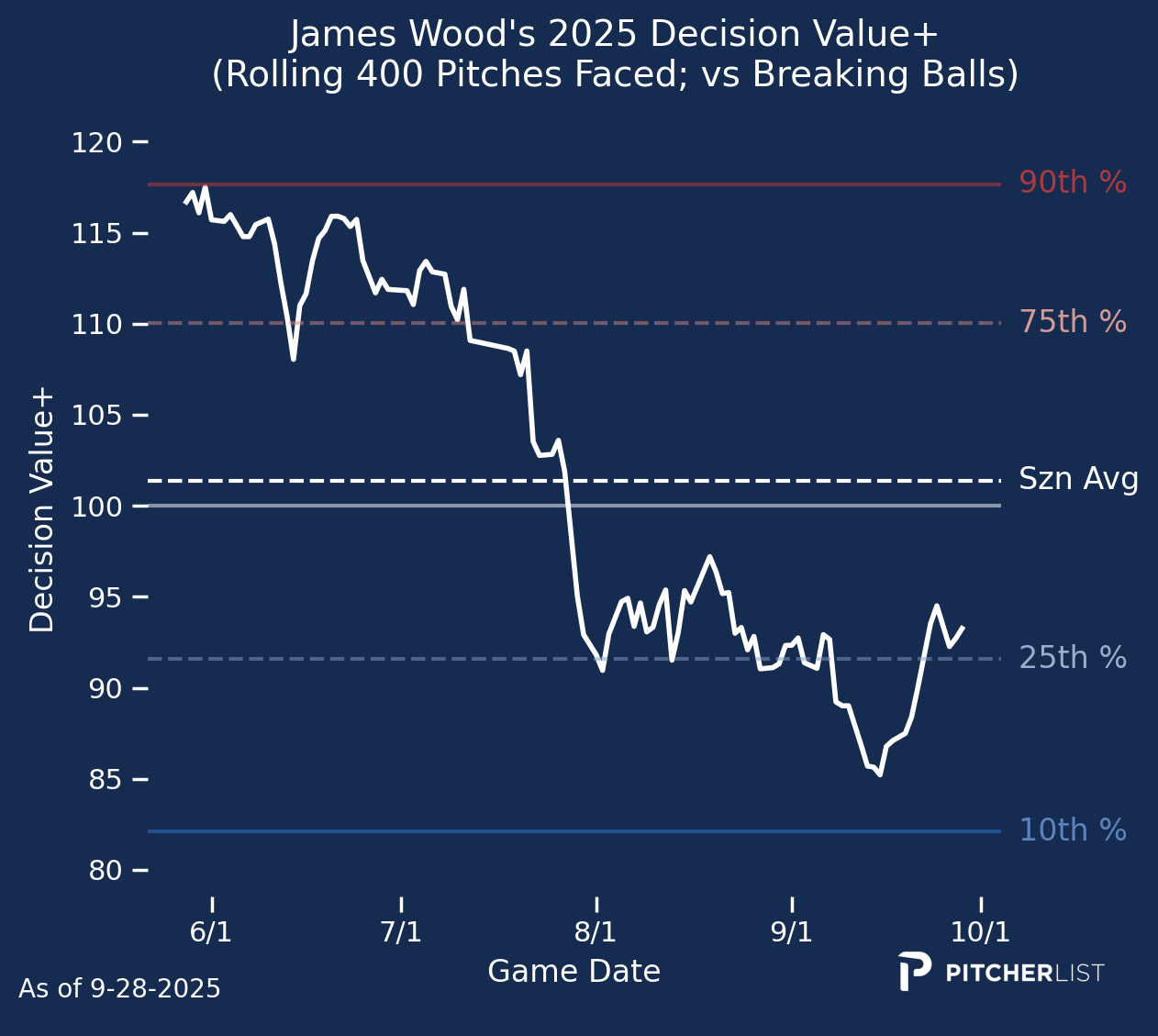
On the bright side, Wood has demonstrated his ability to make good decisions against breaking balls and hit any type of pitch with extreme power. He’s even pretty good at laying off breakers that are out of the zone. The problem is his extreme passiveness against breakers in the zone, and if you can’t hit a breaker for a strike, then you’re gonna have a bad time. This isn’t an easy fix, by any means, but the mountain Wood needs to climb to find his early-season form isn’t as high as his raw numbers suggest, and his ceiling is that of a top-10 player.
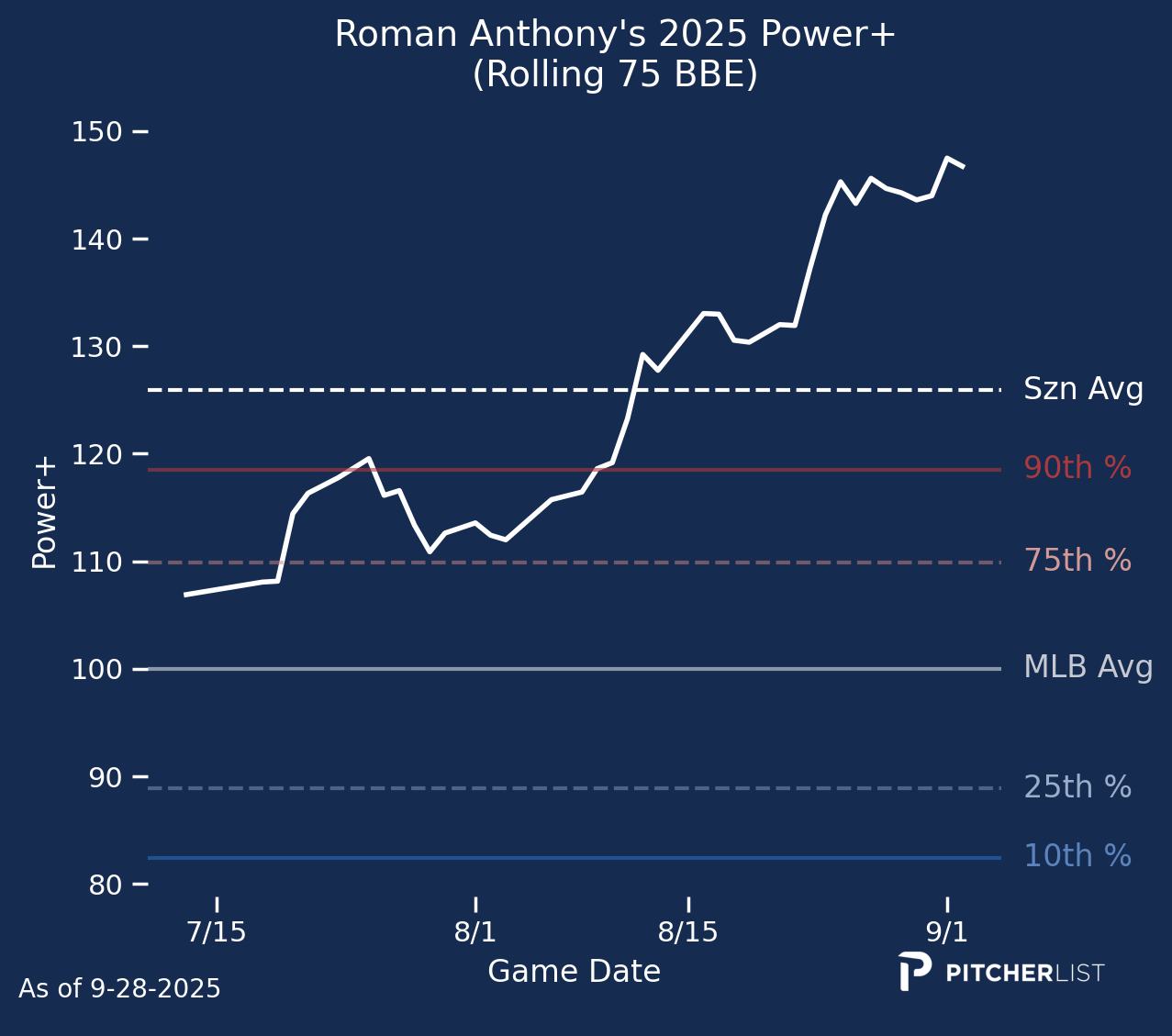
27. Roman Anthony (OF/DH, BOS) — Roman Anthony got off to a slow start, but when he found his groove, we saw why he was considered one of the top prospects in the game. The growth in power was especially noticeable, and our stats confirm it was no mere fluke. We’ve noticed some fluctuation in his ability to make contact, which is typical for a young player, but the tools are all there, and it’s time to start getting excited. In 2026, as a regular at or near the top of the order for Boston, we could be looking at a player who hits 22-25 home runs, swipes 10-12 bags, and scores 100 runs with elite ratios.
28. Gunnar Henderson (SS/DH, BAL) — Over the first 80 games of 2024, Gunnar Henderson hit a whopping 26 home runs with a 1.002 OPS. That’s a full-season pace of over 50 home runs. In the 233 games that followed, Henderson had 28 home runs, but with a .786 OPS. That’s a full-season pace of about 19 home runs. The change in power is dramatic, though the fact that he still hits for a good average and that he swiped 30 bags in 2025 while staying healthy is fantastic news. It’s not impossible that Gunnar finds the plus power he showed in 2023 and the first half of 2024, giving him a top-10 overall ceiling, but even if he doesn’t, Gunnar’s floor is still a top-50 hitter who contributes in all five categories.
29. Geraldo Perdomo (SS, ARI) — Perdomo finished as a top-15 hitter in most formats (even higher in many points leagues), which is a challenge for a player like Perdomo who rarely hits the ball hard. In fact, Perdomo had only 14 home runs in 401 games in the majors coming into 2025, and never more than six in any single season in the minors or majors. His home runs weren’t cheap either, as Statcast credited him with 19.2 expected home runs. Perdomo’s success stems entirely from his elite contact and decision-making, making him a player with a very high floor and a ceiling closely tied to his ability to get the ball out of the yard. The high ratios, excellent plate discipline, and buckets of runs scored will be there in 2026, as will 25-30 stolen bases. That’s a good player, even if it only comes with 10 home runs, and if he somehow taps into the 17-20 home run power again, then this ranking is about two tiers too low.
30. Riley Greene (OF/DH, DET) — If you’re familiar with my work, you know I’m a huge Riley Greene fan. Being a Tigers fan is part of it, and the other part is that Greene makes very loud contact and has developed an extreme uppercut swing that can get balls out of the yard in a hurry, even in spacious Comerica Park. That uppercut swing has a downside, though, and it’s the pesky holes it puts in his plate coverage. Greene made adjustments throughout the year, but the high strikeout rates persisted. He’s managed to keep the strikeouts to reasonable levels in years past, and I believe he can make the necessary adjustments in 2026, either as quickly or more quickly than he did in 2025. I expect 30+ home runs and 100 RBI, and should he find a little more patience and cover those holes a little better, Riley will be in the top 20 before you know it.
31. Matt Olson (1B, ATL) — Olson looked much the same in 2025 as he did in 2024, albeit with a better batting average. Olson’s true strength, apart from the 30-ish home run power, is his durability. He’s played in all 162 games for four straight seasons and has only missed more than six games one time since his first full season in 2018. His incredible 54 home runs in 2023 are unlikely to be repeated, but 30 home runs and decent (or possibly even good) ratios will be there in 2026, and if the Atlanta offense is even just slightly better and/or healthier than they were in 2025, we should see 200 combined runs and RBI as well.
32. Zach Neto (SS, LAA) — Neto’s season started and ended on the IL, but in the 128 games in between, we saw an excellent fantasy shortstop. His average exit velocity, barrel rate, and hard-hit rate were all up significantly, with no real loss in contact ability and a minimal uptick in strikeouts. Neto is a threat for a 30-30 season if he stays healthy in 2026, especially if the across-the-board improvements to his quality of contact stick around.
33. Brent Rooker (OF/DH, OAK) — Rooker fell a bit short of my expectations in 2025 as I hoped the high batting average and gawdy home run totals would continue as he played half his games in a minor league park, but alas, it was not to be. That said, we did see a meaningful drop in his strikeout rate (from 28.8% in 2024 to 22.2% in 2025), and with his raw power, there’s a very good chance he improves upon his home power numbers with a second season in Sacramento. The healthy floor is 30 home runs with strong counting stats and a decent batting average, and I still believe there’s another 38-40 home run campaign in his bat.
34. Hunter Goodman (C/DH, COL) — The only ray of sunshine that pierced through the cold, hostile mountains of Colorado, at least from a baseball perspective. Goodman started 2025 hot and stayed productive the entire season, playing 144 games (104 at catcher) and producing both at home and on the road – a rare feat for a Rockies hitter. Goodman’s power plays in every park, evidenced by the 18 home runs he hit on the road, though the thin air and spacious outfield grass in Colorado allows Goodman to hit over .300 on the road (59 points higher than how he hit on the road). Goodman is the easy C2 for me in 2026, and hey, maybe the Rockies front office will try harder to find players who can hit in 2026.
35. Cody Bellinger (1B/OF/DH, FA) — If I knew Bellinger was going back to the Yankees next season (which he likely isn’t), this ranking might be a bit higher as the park played extremely well to his skill set. Despite hitting the most home runs he’s had since 2019, Bellinger’s barrel rate and hard-hit rate remained consistently below average. Should he land in a larger home ballpark, it may be tough for him to clear 20 home runs (something he has failed to do twice in the last four seasons), though whoever signs him likely does so with the intention of batting him in the heart of the order, making 90-100 RBI realistic just about anywhere. That, combined with the low strikeout rate and solid ratios, makes Bellinger a player to keep an eye on in the early-middle rounds, especially if he finds a good landing spot.
36. William Contreras (C/DH, MIL) — Contreras dealt with an injury in his left hand all season, though he looked a bit more like his old self later in the season. It’s not easy to determine precisely how much this sort of injury impacted a hitter, but even with the injury, Contreras finished as a top-five catcher and as a top-40 hitter, so it feels silly to rank him any lower than that heading into what will presumably be a healthy 2026. Despite his power, Contreras has never hit more than 23 home runs due to his high ground-ball and low fly-ball rates, though he did make some improvements in that regard in 2025 (they turned into liners instead of fly balls, though, so it may have merely been a bit of a fluke).
37. Ben Rice (C/1B/DH, NYY) — He’s got to be a fixture in the lineup in 2026. Right? RIGHT?! Ben Rice is a Statcast darling, finishing as a top-five hitter in terms of xwOBA and hard-hit rate with a 99th percentile xSLG. In addition, he’s above average at taking walks and avoiding strikeouts and does a good job making contact. That said, the Yankees have shown an easy willingness to sit Rice against many lefties (he can hit them for power, but not for average, while striking out much more often and walking less), there’s some risk that he’ll get capped at 135-140 games. Still, with Paul Goldschmidt and Cody Bellinger (not that they used him at first base) off the roster and no other obvious competition for first base at-bats, Rice ought to get the full-season chance he deserved.
One quick quirk to point out, though: in back-to-back seasons, Rice has seen a prolonged slump despite consistently strong batted ball quality. I’m not sure if it’s because he enjoys walking under ladders or gets a kick out of spilling salt at meals, but it’s happened twice now, and in both cases, it’s led to reduced playing time for a while.
Tier 6
38. Brice Turang (2B, MIL) — Folks drafted Turang in 2025 to hold down the stolen base category after he swiped 50 bags in 2024, but unfortunately, that number fell all the way to 24 in 2025. On the bright side, Turang had a bit of a power breakout, going from seven homers in ’24 to 18 in ’25 (including 10 in August), and became a fixture in the heart of the order, boosting his counting stats in a big way. Also, Turang still has the wheels to swipe 30 bases. While I am slightly skeptical of any dramatic increase in power from a slap-hitter like Turang (at least the ’23 and ’24 editions), it’s hard to argue with the fact that he went from a ninth percentile hard-hit rate to a 76th percentile while retaining one of the shorter swing lengths in the game and adding only a modest boost to his swing speed. It’s a weird story, but one worth re-watching in 2026 at a position starved for upper-echelon talent.
39. Pete Crow-Armstrong (OF, CHC) — It was a tale of two halves for Pete Crow-Armstrong, going from one of the best hitters in the game through July to one of the worst from August to the end of the season. Oddly enough, plate discipline didn’t seem to play a massive role in his demise, as his second-half strikeout rate of 25.6% wasn’t that much higher than it was in the first half (22.9%). Our process and metrics also didn’t show significant improvement in the areas I expected: he struggled with decision-making throughout the season and with contact for most of the time. What our metrics end up showing is a massive power spike starting in April and hitting its peak near the end of June before beginning a slow, steady descent until it was merely average by the end of the season.
There’s obviously a dynamic player in here who can hit 30 home runs and steal 30 bases, even if it comes with poor ratios. The question is whether he can tap into that explosion of power and hit ability again, and whether he can pick himself out of the horrible slumps a bit quicker. If either is true, he may come close to matching his 2025 numbers. It’s a gamble, but not a stupid one.
40. Corey Seager (SS, TEX) — As per usual, the question for Seager is health. When healthy, we see elite production and elite quality of contact. Seager hasn’t played in 120 games since 2022, though that didn’t stop him from hitting 30 home runs in three consecutive seasons prior to 2025. If you haven’t taken on too much injury risk by this stage of the draft, Seager represents an opportunity to get a player with the potential to outproduce his cost vastly. If you’ve already taken on a lot of risk (such as Yordan Alvarez or Ronald Acuña Jr. Jr.), then you probably need to shove Seager down a tier (which will effectively remove him from your board).
41. Maikel Garcia (2B/3B/SS/OF/DH, KCR) — Garcia’s 16 home runs in 2025 were five more than he had in all of 2023-2024 combined, and he did it with a better batting average than ever before. Garcia doesn’t have a gawdy barrel rate thanks to his propensity to hit ground balls, but his average exit velocity of 91.3 mph shows he does have some thunder in his bat if he can get it up in the air to the pull side, which is precisely what he improved on in 2025. These changes can sometimes be fluky, but with a guy who can play several premium positions, enough raw power to make it believable, and the ability to steal over 20 bases in his back pocket, Garcia is a solid choice for managers who need speed and batting average boosts without sacrificing power entirely.
42. Christian Yelich (OF/DH, MIL) — Yelich isn’t getting younger (he’ll be 34 when we kick off the 2026 season), but he did just manage to play in over 140 games for the third time in four seasons while putting up the most home runs he’s had since the rabbit-ball era. Banking on Yelich to be fully healthy and fully productive for back-to-back seasons is an aggressive gambit, but it was nice to see Yelich put everything together. He still has a propensity to hit too many grounders, and he lost his outfield eligibility in leagues that require 20 appearances (he fell one short). The Brewers should be a potent offense again in 2026, and Yelich will be a central part of it, giving him ample opportunities to pile up counting stats while hitting at least 20 home runs (if not 25+) and swiping 15-20 bags with good ratios.
43. Bryce Harper (1B/DH, PHI) — Harper missed a decent chunk of the summer on the IL with inflammation in his wrist, and it was something he dealt with for at least a large portion of the season. I’m treating 2025 as more of a floor than the new norm, and even if I expect him to miss 15-20 games for whatever reason (he hasn’t played in more than 145 games since 2019), Harper should still be able to hit 30 home runs with excellent ratios. The path to something like a top-20 finish for Harper is all about staying healthy, as thanks to his routine absences from the lineup, he’s failed to reach 90 runs or 90 RBI in any of the last four seasons. Still, it’s hard to ignore the upside of a healthy Harper, and it’s not as though the remainder of this tier is without risk.
44. Bo Bichette (SS/DH, TOR) — After years of declining production, Bichette finally reversed the trend and improved as the season went on. Sure, the stolen bases are likely never to return, and he fell short of 20 home runs, but he did manage to hit .311 and drive in 94 runners thanks to the Blue Jays’ offense finding its groove. Bichette did miss over 20 games for the third straight season, but there’s no reason he couldn’t pitch in a full one in 2026 with another .300 batting average, 17-20 homers, and plenty of runs and RBI.
45. Trevor Story (SS, BOS) — 2025 was Story’s first full-ish season since 2021, when he was still with the Rockies, and he did not disappoint, hitting 35 homers and swiping 31 bases with a .263 average and 187 combined runs and RBI. Story is under contract for one more season, and if anyone had any faith he’d be healthy for more than 120-130 games, I’d probably have Story ranked higher. Unfortunately, even with a full season to add to the math, Story is averaging just 80 games per season for the Red Sox, and we have to take that into consideration. Furthermore, Story’s plate discipline screams streaky profile. It’s worth wondering whether he can make this kind of magic (he finished as a top-25 hitter in 2025) again in his age-33 season, considering all of the things working against him. There will be plenty of hemming and hawing in the offseason, trying to figure out exactly when is the right time to call his name at the draft.
46. Wyatt Langford (OF/DH, TEX) — On one hand, Langford hit more home runs and stole more bases in his sophomore season while taking more walks. He also improved his average exit velocity by almost two ticks and added about five points to his hard-hit and barrel rates. Sadly, he also added 5.8 points to his strikeout rate and finished outside the top-75 hitters, thanks in large part to inconsistency, as he gave us two months with a wRC+ above .160 and two other months with a wRC+ below 75. He also had three months where he slugged under .400. Still, we did see signs that the tools we got excited about when he was a top-three prospect are in there, and his steadily improving plate discipline throughout the season suggests that maybe the consistency is coming soon. Langford has plus power, plus speed, and tons of upside heading into his age-24 season, and that’s more than enough to consider scooping him as a second or third outfielder.
47. Eugenio Suárez (3B/DH, FA) — Sure, he’s 34 and hit under .240 for the third time in four seasons, but there will be plenty of interest in Suárez coming off a 49 home run season and back-to-back campaign with at least 100 RBI and 90 runs scored. Suárez is an extreme pull hitter and puts a lot of balls in the air, so I have no doubt that 30 home runs is a hard floor, and if he lands in the right park or offense, he could even make another run at 40+. As an odd quirk, had Eugenio played all of his games in T-Mobile Park (normally a pitcher’s haven), he could have hit 52 home runs instead of 49.
48. Shea Langeliers (C/DH, OAK) — I definitely believe in the improved batting average for Langeliers due to the much-improved strikeout rate (just 19.7%, a full 7.5 points lower than his previous career-best rate), but the question is how much we believe in the absolutely insane run Langeliers went on following the All-Star Break. In 36 games following the break, Langeliers hit 17 home runs, drove in 34 runners, and slashed .331/.360/.748. He returned to earth a bit after that run, hitting just two home runs and driving in just seven baserunners in his final 21 games, though the batting average remained strong. Langeliers should hit 25-30 home runs again in 2026, though the batting average may dip just a bit due to normal variance, and the counting stats will be dependent on how much offense can happen around him. Also, while the strikeout rate improvement was consistent over the season, there’s still a risk he reverts to something closer to his old self, which could shave even more off his batting average.
49. Ketel Marte (2B/DH, ARI) — Ketel Marte missed about a month with a foot injury and hurt his hand late in the season, but none of that stopped him from hitting for a high average and smacking 28 home runs, though he wasn’t as explosive as his 36 home runs in 2024. There are plenty of questions about the state of the Diamondbacks’ offense heading into 2026 (albeit mainly in the second half of the lineup). Still, Marte should be a consistent contributor at second base who can hit 25 or more home runs and rack up counting stats in the heart of the order with a batting average north of .280.
50. Freddie Freeman (1B, LAD) — For the first time in seemingly forever, Freddie Freeman did not finish as a top-five first baseman. An injury slowed him down over the summer, and it’s also possible that Father Time has started to come for Freeman. That all being said, this was still a top-40 hitter in 2025 thanks to a .295 average, 24 home runs, and 171 combined runs and RBI hitting in the heart of the most dangerous lineup in the National League. Freeman should keep that role for one more season at least. With the Dodgers’ hitting core of Ohtani, Mookie Betts, Freeman, and Will Smith remaining intact for 2026, another season with elite ratios, 20+ home runs, and tons of counting stats is likely on the horizon. The ceiling isn’t what it used to be, but it’s hard to find a more reliable floor at this point in the draft (or even the point before it).
51. Nico Hoerner (2B/SS, CHC) — Hoerner’s ceiling and floor aren’t that far apart, which can be a bit boring. He’s going to hit fewer than 10 home runs, and he’s going to steal more than 25 bases while batting something close to .280. At this stage in the draft, you should have a good idea of whether Hoerner is a good fit for your roster: if you need a second baseman and/or steals and/or batting average, and have plenty of power already plugged in, then he makes a lot of sense. Alternatively, if you’re in a points league that penalizes strikeouts and gives more than one point for a stolen base, Hoerner is also a good fit. If these don’t apply, then he can be pushed down your board.
52. Michael Busch (1B/DH, CHC) — Michael Busch got a full season of action, including starts against lefties, and the results were overwhelmingly positive as he slashed .261/.343/.523 with 34 home runs and 90 RBI. He also hit at least five home runs in five of six months and consistently drove in runners. Busch also ended the season on quite a heater, hitting eight home runs over his last 15 games, and then carried that heat right into the playoffs to hit four more in his eight playoff starts.
53. Seiya Suzuki (OF/DH, CHC) — Crow-Armstrong wasn’t the only Cubs hitter to have a hot start followed by a disappointing second-half, as Seiya Suzuki was the 16th-best hitter for fantasy in the first half per the FanGraphs Player Rater, thanks to a whopping 25 home runs and 77 RBI. Unfortunately, his second half was very pedestrian as he slashed .213/.336/.351 with just seven home runs (and five of those seven came in the last four games of the season, meaning many head-to-head managers did not get to benefit from them). Even with that bummer of a second half, Suzuki set or tied career highs in home runs (32), runs scored (75), and RBI (103). I don’t think there’s another gear in Suzuki’s bat in terms of power, but his .245 batting average was well below his norm, and there’s plenty of potential to see that number go up, which would also lead to better runs scored totals, likely a more consistent season.
54. George Springer (OF/DH, TOR) — Springer finished as a top-10 hitter in most formats in 2025, and while few expect him to find that kind of power again (he hadn’t hit more than 25 home runs since 2019 before his 32 last season), it’s not as though his results were based on luck. Springer had the best barrel rate, hard-hit rate, and average exit velocity of his career in his age-35 season, a rare feat in baseball history. I don’t think Springer will go entirely back to his 2021-2024 form, and he should continue to be an excellent source of runs scored at the top of the order, but some regression to his career norms has to be baked in, as does the fact that he’s played in more than 145 games just once since 2016.
55. Jackson Merrill (OF, SDP) — Merrill hit the IL early on in April, and never really found his power stroke prior to hitting the IL again in August. It was quite a disappointment for the second-year outfielder, as his impressive 2024 had given us high hopes for the future. Merrill finished outside the top-120 hitters due to missed time and an underwhelming performance, but he finds himself ranked this high thanks to the return to form we saw following that second IL stint. Merrill smashed seven home runs in September, and also hit well in his tiny postseason sample, giving us a ray of hope that perhaps the downturn in production was more injury-related than anything else. If that’s the case, Merrill will easily outperform this ranking, though there’s still a risk that Merrill won’t consistently find power (it wasn’t really part of his scouting profile, and he didn’t show much of it in the minors).
56. Austin Riley (3B, ATL) — It’s been back-to-back disappointing and injury-shortened seasons for Riley, who from 2021 to 2023 hit at least 33 home runs each year with a high batting average and boatloads of counting stats. There are plenty of reasons to be hopeful: Riley will only be 29 next season and showed high barrel rates and strong quality of contact despite the less-than-expected outputs for the last two seasons. Still, it’s tough to shake two straight seasons finishing outside the top-150 hitters. Mild-to-moderate injury and performance risk have pushed Riley down draft rankings, but there’s still top-25 potential if he finds his old form.
Tier 7
57. Will Smith (C, LAD) — Smith only appeared in 110 games in 2025, leading to suppressed counting stat totals, and he also struggled mightily in the second half before he hit the IL, hitting just .237 over 36 games. That being said, Smith showed the best ratios of his career last season, slashing an impressive .296/.404/.497, and should he remain healthy in 2026 while carrying over his improved hard-hit and barrel rates, Smith should finish as a top-five catcher with way more than the 64 runs scored and 61 RBI he gathered this season.
58. Vinnie Pasquantino (1B/DH, KCR) — I never thought Vinnie Pasquantino would be a 30-home run hitter after seeing what he brought to the table in his first three seasons, but here we are. Vinnie P’s power appeared in full force over a relatively short time frame, where he hit nine home runs in a 14-game stretch in mid-August. Outside of that stretch, the Pasquantino we saw was more like the 20-25 home run guy we expected. I’m not bringing that up to say that it was all a fluke and that we should ignore the power uptick, but I do want to recommend caution on projecting another 30 home runs for a player who didn’t really hit the ball harder or in the air or to the pull side much more than he did in past years.
Twenty-five homers feels like a more reasonable projection with 90-100 RBI if he can stay healthy, though notably, he missed significant time in 2023 and 2024 due to injury, which can’t be ignored. For points leaguers, and particularly those dealing with a strikeout penalty, go ahead and boost Pasquantino up a tier, as he is excellent at avoiding strikeouts, especially when compared to his first base peers.
59. Jarren Duran (OF, BOS) — Duran predictably fell short of his breakout 2024 season, but hitting 16 home runs with 24 steals is nothing to sneeze at, and there were plenty of counting stats to go around. Duran finished as a top-60 hitter in 2025, and that feels about right for what he brings to the table. There’s some upside for more runs scored and batting average, and even more importantly, the floor should be something like a top-75 hitter.
60. Byron Buxton (OF/DH, MIN) — Buxton was a top-20 hitter in 2025, which is precisely what we’d expect if we knew Buxton would play in more than 125 games (he appeared in 126 games last season). Of course, this was the first time since his first full season in 2017 that he played in more than 125 games, and just the second time he played in over 100 games. Picking Buxton is all about risk management. If you’ve played it safe in the first several rounds, you can move him up your board a tier or two. If you’ve already taken on some health risks (Acuña, Alvarez, Seager, etc.), you don’t want to consider Buxton unless you feel extremely confident about your depth and ability to cover the days he’s on the IL.
61. Jacob Wilson (SS, OAK) — Wilson was on a collision course with the ROY award before a slump and an injury took him out of consideration. Wilson is a slap hitter through and through, as you can tell from his sub-30% hard-hit rate in the majors and minors, so expecting 20 home runs from him is likely to bring disappointment. If you’re asking for a .290-.300 batting average with solid counting stats, though, it should be there.
62. Alex Bregman (3B, FA) — Bregman was stuck on the IL for a large portion of the summer, but he did manage to hit 18 home runs in 114 games (roughly a 24 home run pace) while getting back to his double-digit walk rate ways. Bregman is an extreme pull hitter, particularly on fly balls, so his upside is somewhat dependent on his landing spot. A park like Fenway pulled his home run upside down while propping his ratios up due to the doubles he could hit off that wall, while a park like Comerica would be a lot more neutral. A return to Fenway with a new deal is probably best for his overall value.
63. Jeremy Peña (SS, HOU) — Peña missed about 30 games due to injury, costing him all of July, and also lost some time at the end of the season, but when healthy, we saw a new level of production from Peña as he locked himself into the leadoff role in Houston. He was on track to clear 20 home runs and 25 steals had he played a full season, and a career-high hard-hit rate helped him achieve a .304 batting average. Even this improved form of Peña isn’t going to hit .300 for a full season (probably), but there’s a very real chance he hits 20 home runs, scores 85 runs, and swipes over 20 bags if he can stay healthy and if the Astros offense can find its groove with the return of Yordan.
64. Mookie Betts (SS, LAD) — Through his first 453 plate appearances of 2025 (103 games), Mookie Betts was objectively a disappointment. He was slashing just .231/.302/.355 with just 11 home runs, and for quite some time, we openly questioned whether Mookie was in the twilight of his career. He must have heard us, because for the remaining 47 games, he hit nine home runs with a fantastic .317/.376/.516 line. In terms of earning his first round value, it was too little too late, and he finished outside the top-50 hitters for the first time in recent memory when playing a full season, but in terms of giving us hope for the future, we have it. Betts has hit well in the playoffs as well, and there’s likely hope that he can hit 25 home runs and score 100 runs with excellent ratios heading into his age-33 season. However, between injury and ineffectiveness, he’s failed to hit more than 20 home runs in either of the last two seasons, and slumps like the one he had throughout the first half of 2025 can be a real dream killer, even if he goes off for 50 games afterward.
Tier 8
65. CJ Abrams (SS, WSN) — You’ll get about 20 home runs, 30 steals (they’ll come in bunches, then disappear), a mediocre average, a bad OBP, and 80-90 runs scored. I feel confident that the guy we’ve seen is the guy we will continue to get, and whether he flirts with the top-50 or just misses the top-75 will be mainly based on how lucky he gets spinning the BABIP wheel.
66. Brandon Nimmo (OF/DH, NYM) — The final season totals give the impression of a steady, consistent player, but on a week-to-week basis, Nimmo is quite the opposite, showing dizzying highs and terrifying lows throughout the season, with multiple weeks providing deeply negative values and about as many with hugely positive values. Still, he’ll play a full season and get to 23-25 home runs and double-digit steals with decent ratios at the end of it all and earn a value inside the top-75 with a ceiling of a top-40 to top-50 guy.
67. Randy Arozarena (OF/DH, SEA) — Arozarena set a new career-high in home runs in his age-30 season with 27 while also stealing 31 bases and scoring 95 runs, finishing inside the top-50 hitters in most formats. Arozarena’s career-long struggles with making contact in the zone (career rate of 77.9%) cause him to be particularly streaky, making it tough to trust Arozarena to consistently be more than the baseline we’ve seen over his career, which is a 20 home run, 20 stolen base guy with plenty of runs scored due to his place at the top of the order and a batting average that can fluctuate anywhere between .230 and .250. There’s upside for more, of course, but the floor can be pretty disappointing, especially in head-to-head leagues when you’re trying to endure his brutal slumps.
68. Andy Pages (OF, LAD) — It was an impressive breakout for Pages, who hit 27 dingers with 14 steals and a .272 batting average in his first full season in the majors. Pages is not the type of hitter who takes walks, and that .272 batting average is not likely to be repeated (.250-.260 is more realistic). Also, the 14 steals were a shock, as he had never stolen more than 10 in a single season in the minors (and that was in rookie ball back in 2018 as a 17-year-old), and he wasn’t particularly efficient in his attempts, getting caught seven times in 21 attempts. Even if we accept that the batting average will take a dip and the stolen bases will be cut in half, Page’s pop and the fact that he plays for a high-powered offense mean he should be a valuable source of home runs and RBI without hurting you in other places.
69. Salvador Perez (C/1B/DH, KCR) —It’s insane how this guy keeps catching over 80 games a season, isn’t it? Sal got off to a slow start in 2025, hitting just four total home runs over the first two months, but for the rest of the season, he hit at least five home runs per month, including a nine-dinger July. Perez still swings at everything and manages to barrel more than his fair share of baseballs, though the ratios tend to suffer because he puts bad pitches in play a lot and wasn’t fast even in his prime. Sal will hit 25 home runs and drive in 100 again, somehow, though the slumps will likely be just as brutal as they were in 2025.
70. Iván Herrera (C/DH, STL) — Iván Herrera is one of the few hitters who, by our PLV metrics, is consistently above average in Contact Ability, Power, and Decision Value, which makes his breakout 2025 campaign feel legitimate. Injuries have been a bit of an issue, as he hit the IL twice in 2025 with left leg issues (knee and hamstring) and also spent almost a month on the IL in 2024 with back tightness. Sure, he doesn’t have the track record of a guy like Sal Perez, but everything under the hood suggests Iván Herrera is a 25-home run bat with plus ratios if he stays healthy all season, though he’s struggled to do just that, and of course, he’ll have to keep the ball in the air, which also was an issue at times in 2025 and in the minors.
71. Kyle Stowers (OF/DH, MIA) — Stowers was one of the best hitters in baseball back in July, smacking 10 home runs in 24 games and slashing .364/.41/.818 with an impressive blend of discipline, contact, and power. There’s no question that Stowers has the thump to slug over .500 for a season, but issues with contact in the zone and strikeouts have popped up over his short career, and those issues often spell volatility for power hitters. If he maintains the double-digit walk rate we saw in 2025 and keeps that zone contact rate north of 80% more often than he doesn’t, this is a guy who can hit .260-.270 with 30-35 home runs. If he can’t do those things, he’s more like a 30-35 home run guy that hits .220-.230.
72. Taylor Ward (OF/DH, LAA) — Taylor Ward stayed healthy for a full season for a second consecutive year, and while the .228 batting average and streakiness were a bit annoying, it was a small price to pay for 36 home runs, 86 runs scored, and 103 RBI. As an extreme fly-ball hitter, Ward’s batting average is never going to be high, but the power is more than real enough to get him back to 30+ home runs in 2026, and if he can make those slumps just a little less painful by managing the strikeout spikes, and if the Angels can be just a little better on offense in 2026 (which isn’t impossible), he could quickly push into the top-50.
73. Tyler Soderstrom (1B/OF, ATH) — Soderstrom is the type of hitter who produces in large spikes with long lulls in between (two separate 25+ game stretches with no home runs, for example), but because he burns so hot when he’s on, the final numbers work out in his favor. Soderstrom’s strikeout rate improvement was a significant positive and helped him post a .276 batting average, though the high ground ball rates force me to hesitate on his power ceiling, as hitting 30 home runs with so few fly balls is difficult even when your home park is a bandbox. Soderstrom is a solid back-end first baseman in 12-teamers, but make sure you’re aware of his particularly volatile on-again, off-again nature and are ready to deal with that emotionally.
74. Jo Adell (OF, LAA) — We’ve held on to hope for a Jo Adell breakout because we knew 37 home runs and 98 RBI were a real possibility, and lo and behold, we finally got it. Yes, it came with a .236 average and some deep slumps, but the light finally shone through the clouds on Adell’s upside. He’ll likely always be a batting average drag due to his contact and discipline issues, and the counting stats might be tough to repeat in a streaky-at-best Angels offense, but you won’t find a lot of guys after the first two or three rounds who could hit 40 home runs, and if you’ve fallen behind in the category, this is the premier place to catch up.
Tier 9
75. Jordan Westburg (2B/3B/DH, BAL) — Injuries limited Westburg to just 85 games in 2025, and while we didn’t see a ton of consistency in his time on the field, we did see similar (though slightly muted) results to his breakout 2024 season, suggesting that a healthy Westburg can be a 23-25 home run hitter with a .265 average with plus counting stats. Unfortunately, this was the second straight season that injuries cost Westburg more than 50 games, and his ceiling isn’t so high that you can easily brush that aside. It’s also worth noting that Westburg is one of the most aggressive hitters in the league early in the count, and that approach, while successful for him, does lead to those inconsistencies in production as he will often go through stretches where he swings at too many bad pitches and puts them in play. That aspect of his game, combined with the injury risk, makes Westburg a risk-reward play that isn’t compatible with some roster constructions, though if you can take that risk on, you could get excellent value on a guy who can cover two key positions.
76. Jose Altuve (2B/OF/DH, HOU) — Altuve apparently played through a painful injury on his right foot this season, though it didn’t stop him from a top-70 hitter finish with 26 home runs, 157 combined runs and RBI, and solid (if lower than we expected) ratios. Altuve will turn 36 next May and will be entering his 15th full season in the big leagues, so it’s more than fair to wonder how much tread is left on these tires. Since turning 30, Altuve has become a pull-heavy hitter who gets his home runs by targeting the shortest part of the field, so as long as he has his timing and swing, he should be able to hit 23-25 home runs with plenty of counting stats (especially if the Stros can get the offensive wheels turning more effectively than they did in 2025).
77. Oneil Cruz (OF/DH, PIT) — At the end of play on August 1, Cruz had 18 home runs and 34 steals thanks to a much-improved walk rate and, of course, the fact that he’s one of the hardest hitters in baseball. The end of the season was unfortunately much more sour, as he hit just two more home runs and stole just four more bases over his final 37 games with a soul-crushing .140/.234/.228 line. While Cruz still hit the ball hard and his plate discipline was essentially the same as it was in the first several months, his ground-ball rate spiked to 56.2%. His weakness against lefties was also entirely on display as he hit just .102 against them on the season with a single home run in 125 plate appearances.
The poor finish pulled him out of the top-100 hitters on the season, but I’m still not ready to give up on a guy who can hit the ball 122.9 mph and has 93rd percentile sprint speed. If he can keep that walk rate in the double-digits and find a way to keep the ball off the ground, he can still tap into the 30 home run, 30 stolen base upside, and even if he can’t, he could still crack the top-50 hitters. The floor is depressingly low, though the ceiling is as tantalizing as just about anyone in the league.
78. Isaac Paredes (3B/DH, HOU) — Paredes’ season was limited to 102 games due to an injury over the summer, but what we saw from him appeared to be a return to his 31-home run form from 2023 as he smacked 20 home runs with excellent plate discipline. Paredes isn’t going to jump off the page with his batted ball quality, but the master of the pulled fly ball should find a way back to 30 home runs, should he stay healthy in 2026 (though he’s missed 19 or more games in three of the last four seasons).
79. Christian Walker (1B, HOU) — Walker got off to an incredibly slow start as an Astro, winding up on many waiver wires by the All-Star Break as he hit just .229/.26/.374. He looked much more like himself in the second half, though, especially in the power department, as his .488 slugging was 114 points higher than it was in the first half. While that strong finish helped Walker squeeze into the top-100 hitters on the FanGraphs Player Rater for 2025, I can’t shake the concerns that volatility and extended slumps may be more common for Walker than in the past as he enters his age-35 season, especially with the below-average walk rate he showed throughout the season. Walker could be a 30-home run hitter with 85+ RBI in 2026, though, between the falling walk rate and rising strikeout rate, the floor for Walker is a guy who finishes outside the top-200.
80. Ian Happ (OF/DH, CHC) — For a third consecutive season, Ian Happ hit at least 20 home runs while scoring at least 85 runs and driving in at least 79 runners with a batting average between .240 and .250 and an OBP between .340 and .360. His ceiling is something like a top-60 hitter, and his floor is something like a top-100 hitter. Happ is a very bankable contributor, and if you’re in an OBP or points league, feel free to bump him up to somewhere in Tier 8.
81. Steven Kwan (OF/DH, CLE) — Steven Kwan’s hit tool is the story here, as he’s one of the best in the league at making contact. He doesn’t walk a ton, so the OBP isn’t as valuable as his batting average, but even on a subpar offense like Cleveland, Kwan should score 80-90 runs with double-digit home runs and about 20 steals with a batting average that could be as high as .300. In points leagues, he can be bumped a tier, but in OBP, he should be dropped a tier.
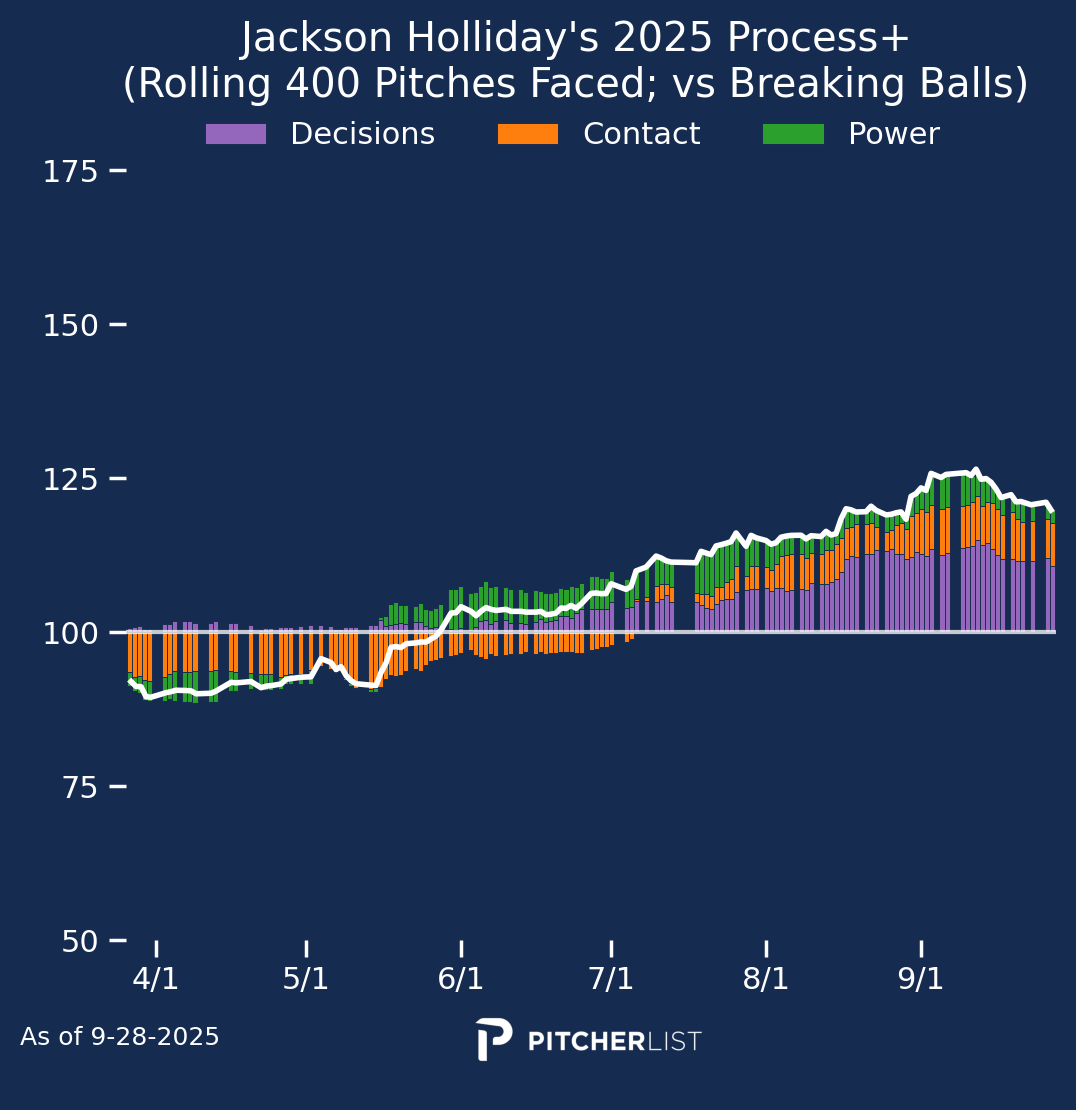
82. Jackson Holliday (2B/SS/DH, BAL) — Not every top prospect breaks out immediately, and Holliday represents one of those guys who has flopped a bit but who might still find success over a slower burn. While Holliday’s power faded hard at the end of the season, there was a light at the end of the tunnel in that his decision-making and contact numbers dramatically improved, and critically, an improvement across the board against breaking pitches (see below). If he can maintain even half of these improvements in 2026, we should be looking at an excellent leadoff hitter who can hit 22-25 home runs, swipe 20 bags, and score 90+ runs with good ratios; however, it’s a tall order that is as likely to produce varying results in 2026 as it is to work out.
83. Yandy Díaz (1B/DH, TBR) — Yandy Díaz took full advantage of his temporary home park, hitting 18 of his 25 home runs at home. A return to the Trop is likely to suppress a lot of those numbers (he’s never hit more than 12 home runs in that park in any single season), but Díaz should remain an incredibly consistent producer of ratios and counting stats as an everyday player for the Rays. He’ll hit around .290 to .300 with 150 or more combined runs and RBI, though those home run totals will be closer to 16-18 than 23-25. Díaz gets a boost in points leagues due to his low strikeout rate and the fact he hits high in the order on a daily basis, but his boost in OBP leagues isn’t what it was earlier in his career (though he walked nearly 20% of the time at the end of the season, so perhaps a return to double-digit walk rates is on the horizon).
Tier 10
84. Willy Adames (SS, SFG) — At the end of May, Adames was slashing .210/.297/.339, had sunk to the bottom half of the order, and was looking like a bust by the Bay outside of an outstanding series in Colorado. In shallow leagues, Adames had hit the wire all over the place, but July changed all that as he posted a 1.096 OPS that month with seven home runs and as many RBI as he’d driven in for all of May and June combined (21). While the batting average was ugly for the rest of the season (as it had been before July), the power stuck around as he his a total of 18 home runs in the second half, as many as Aaron Judge, Eugenio Suárez, teammate Rafael Devers, and Julio Rodríguez (and others).
The ratios will likely remain terrible, and there may be extended periods where Adames is hugely frustrating to roster, but he continues to finish inside the top-100 hitters, no matter how poorly he starts. He’ll likely finish better than this ranking (he was hitter #70 in 2025), but that’s what happens when you have horrific two-month slumps in two of the last three seasons (his extended slump in 2024 wasn’t quite as painful as 2023 and 2025).
85. Brandon Lowe (2B/DH, TBR) — Lowe’s injury issues and struggles against lefties persist, but despite that, he managed to hit 31 home runs with 161 combined runs and RBI with a .256 average. It’s unclear if the Rays will pick up Lowe’s option for 2026, though his power and the role he’d likely play are more or less the same no matter where he ultimately lands. You’ll get one of the top power hitters and run producers at second base, who will likely also spend time on the IL and on the bench during the season due to the injury and platoon risk (he’s missed at least 50 games due to these troubles in three of the last four seasons). Don’t worry about a return to the Trop, either, as he hit more home runs on the road than at home.
86. Jonathan Aranda (1B/DH, TBR) — Aranda was everything we hoped for and more when he was healthy, posting a robust 93.0 mph average exit velocity and hitting well against both righties and lefties (which is especially critical in Tampa, where they love to platoon their hitters). Injuries have been an issue in back-to-back seasons, though, and strikeouts became an issue as pitchers got more looks at Aranda (31.8% over his last 288 games). Our PLV metrics also found him to be a merely average decision-maker and subpar at making contact. Those risks force me to rank Aranda just a little lower than I’d like based on the quality of his contact skills, but if he can make some minor adjustments, we could see him rise through the ranks quickly. As a final note, moving back to the Trop shouldn’t change his power output, as he hit most of his home runs on the road.
87. Drake Baldwin (C/DH, ATL) — Drake Baldwin had an incredibly successful rookie campaign, hitting 19 homers with just a 15.2% strikeout rate and a .274 batting average while driving in 80 runners. Baldwin should have an easier time getting to 500 plate appearances in 2026, assuming Ozuna is out of the picture, and if he can continue to fight off the ground ball issues he had at times in 2026, he has a chance to be a top-six catcher.
88. Agustín Ramírez (C/DH, MIA) — The ratios were uglier than Baldwin’s, but Ramírez had quite the rookie year himself, hitting 21 home runs and swiping 16 bases, albeit with a .231 batting average and .287 OBP. Despite missing the first few weeks of the season, Ramírez finished with 136 games (585 plate appearances) under his belt and is poised to get to 150 games in 2026, assuming he stays healthy. Ramírez’s spotty decision-making will likely keep his batting average somewhat low. Still, if he adds just a touch of patience (he posted double-digit walk rates in the majors), he could find a bit more consistency and provide solid value as an everyday player eligible at catcher.
89. Matt Chapman (3B, SFG) — Chapman hit the IL twice in 2025, spraining a bunch of fingers in June and then again in August for discomfort in the same hand. Perhaps that’s the reason the power output was lower than we hoped, as the chart below suggests his power was sapped and did not improve. If it were merely the hand injury, then this ranking likely has Chapman about a tier too low. Still, Chapman hasn’t driven in 80 runners in a season since 2019, and while his runs scored totals used to be a strength, it’s unlikely the Giants will have him hitting second as he did in prior seasons.
90. Michael Harris II (OF, ATL) — Harris was dropped in just about every standard 12-team league by the start of June, and even the most patient fans were ready to bail when he was hitting a .205/.229/.310 line after play ended on July 10. Starting on July 11, though, Harris was a new man, as he clubbed 14 home runs and slashed .302/.317/.531 from then on. If you’ll recall, this late-season resurgence was also his story in 2024, though that one came even later. Maybe Harris turned a more permanent corner this time and is something resembling the top-20 hitter we saw in the second half. I just can’t shake the fact that we’ve seen three-month slumps in back-to-back seasons where he’s nearly the worst-hitting regular in the league, though, as there is just no way you can hold that in a 12-teamer. With that kind of heavy risk, I feel forced to rank him much lower than I expect many of my colleagues will.
91. Ozzie Albies (2B, ATL) — Albies was an enormous dud, based on his draft position, in the first half, finishing as the 34th-best second baseman, and it made even more devastating by the fact he had the second-most volume at the position, being out-earned by players with at least 100 fewer plate appearances, and in some cases 150+ fewer. Like his teammate Harris, though, Albies found a groove at the All-Star Break and then some, going on to be the third-best second baseman in the second half and looking almost like the unstoppable force we saw back in 2021 and 2023 (though not quite).
That said, our PLV metrics still think he has below-average pop even at his best, and his decision-making skills are bad far more often than they are good. It’s hard to get too excited about a guy whose profile suggests he’ll finish with fewer than 18 home runs and 15 steals with a middling batting average and counting stats with a floor a tier lower than that. Still, Albies was once much more than that and looked, if only for a moment, like he might be more than that again.
92. Alec Burleson (1B/OF/DH, STL) — Burleson is best deployed in points leagues due to his low strikeout rate and his role in the middle of the order, and his ability to make contact keeps his floor very high when healthy. He should hit at least .280 in 2026, and there’s a chance he boosts his power a bit to something like 23-25 home runs. The lack of depth in the Cardinals’ lineup makes him a liability in runs scored, though, and his RBI totals will be more decent than good, but this is a good hitter who will help your bottom line.
93. Jakob Marsee (OF, MIA) — Marsee exploded on the scene when the Marlins promoted him late in the summer, and his 189 wRC+ in August was the second best in the majors among qualified hitters. Marsee excels at making contact, and unlike many contact-oriented hitters, he does a great job avoiding offerings out of the zone. I’m skeptical of the power, as he never slugged better than .428 in any full season in the minors, but the hit tool and speed are for real, and Marsee showed that he’s more than capable of handling same-sided pitching.
Marsee will hit at or near the top of the order in Miami this season. While 15 home runs is probably the ceiling for his power (and under 10 is a very realistic possibility based on the issues he’s had with popping out). The counting stats might be less than desirable, but he could also steal 40 bases with a solid OBP. In those OBP formats or in cases where you need a significant boost in steals, you can move Marsee to the top of this tier or even the bottom of the next one.
Tier 11
94. Dansby Swanson (SS, CHC) — If you didn’t get a shortstop earlier in the draft, Dansby Swanson is here to be your perfectly cromulent placeholder. He’s durable and hasn’t finished outside the top 20 at the position since 2019, usually finishing somewhere between 12th and 15th. You can pretty much bank 20 home runs, 80 runs, 75 RBI, and 15 steals with a .240-ish batting average with a ceiling that is only slightly better across the board and a floor that’s only marginally worse. He’s a great addition to teams who have taken on a ton of risk and need at least one position they can set-and-forget for a while.
95. Chandler Simpson (OF, TBR) — Simpson came to the bigs with a lot of fanfare about stealing 104 bases in 110 games across Low-A and Double-A last season, and his 44 steals in 104 games put him on a pace to fall just short of 70 steals in a full season. Simpson is all speed and batting average, to put it mildly, as he did not have a single barrel across his 376 batted ball events and ranked dead last in the majors in average exit velocity.
There’s some risk with a platoon, because despite Simpson hitting .299 against lefties, all 32 of his hits were singles, and despite his speed, he’s been quite bad in the field, but even with 120-130 starts, he should get to 70 steals (with the upside for 80+) and continue to hit .290 with some runs scored. Just keep in mind that he will likely sit once or twice a week and that he’ll be a big negative in RBI and power. I’d drop him a tier in points and OBP leagues, too.
96. Teoscar Hernández (OF, LAD) — Heading into Hernández’s age-33 season, we have a pretty good idea of what he is and what to expect. He’ll have at least one month where he carries your roster, like his March and April, where he was tied for the league lead in RBI with 32 to go with his nine homers, and at least one month where he’s one of the worst guys on it, like his June when he slashed .189/.243/.347.
Still, despite his inconsistency (which stems from his struggles with making contact), Hernández piles up RBI because he gets to bat in the middle of the order for the Dodgers, and the last time the Dodgers were not a top-five offense in RBI was 2018 (they were sixth). You’ll be desperate to cut him at times in 2026, but if you hold firm, you’ll get 25 home runs and 90 RBI, though he won’t score that many runs, and the ratios will be a bit painful (especially in OBP).
97. Trent Grisham (OF/DH, FA) — Grisham is coming off a late-career breakout season, hitting 34 home runs in 143 games while scoring 87 runs with a career-best 14.1% walk rate and 23.6% strikeout rate. Under the hood, everything looks kosher as the home runs came from pulling more fly balls and hitting the ball harder while making excellent swing decisions. It’s a perfect time to hit free agency, though it does add a level of uncertainty to his fantasy profile.
Grisham probably won’t hit 30 home runs again unless he lands in a very hitter-friendly park (Philly, for instance), and while he was once an elite center fielder defensively, his range and defensive value has degraded significantly over the last few seasons as his speed has declined (from a 90th+ percentile from 2019-2022 to a 32nd percentile sprint speed in 2025). Grisham will be a starter somewhere and should hit in the top half of a lineup. If he’s leading off for a good offense in a good park (such as the Yankees or Phillies), he could move up a tier. If he’s on a more average offense in a tougher park (such as the Tigers or Rangers), he might move down to the bottom of this tier.
98. Luis Arraez (1B/2B/DH, FA) — You should know all about what Luis Arraez is and what he can do by this point: he has a highly compact swing that he uses to pepper line drives all over the field. He’s had the lowest strikeout rate among qualified hitters for four straight seasons, and his worst single-season batting average is .292 (which is what he hit in 2025).
Someone is going to give Arraez a deal. However, he’s a unicorn in terms of actual value for a club because he’s a below-average defender, and the only above-average skill Arraez brings to the table is bat-to-ball, at which he is the best in the league. He’ll provide an elite batting average, and if he’s on a decent team, he ought to score 80 runs and drive in 60, and if you’re in a points league, you can bump him up a tier (two if your league penalizes strikeouts). If you’re in an OBP league, you should drop him down a tier since he gives much less of a boost, and if you don’t need a boost in batting average, you can probably cross his name out entirely.
99. Spencer Torkelson (1B/DH, DET) — Tork was much better in the first half than the second half, but he remained a functional back-end first baseman and corner infielder for the whole season, and he should return to a full-time role and hit another 30 home runs for the Tigers in 2026. I’m a bit concerned about the strikeout rate spikes and overall volatility, and I’m not convinced he’ll ever truly buck those trends, but the elevated walk rate helps a little. If you need plus power and not-bad counting stats and don’t care about a low batting average, Torkelson is your guy.
100. Matt Shaw (3B, CHC) — Shaw struggled mightily in April, posting a .535 OPS before being sent back to Triple-A for a month to recalibrate, and it wasn’t really until the All-Star Break that we saw Shaw start to morph into a fantasy-relevant batter. In the first 22 games following the Break, Shaw whacked 13 extra-base hits (including eight home runs) with 30 combined runs and RBI, plus four steals and a 1.147 OPS, and gave us a glimpse of the type of upside he could achieve. He had an average exit velocity of 89.0 mph in that stretch while pulling boatloads of fly balls. Unfortunately, this power surge didn’t last long, and Shaw reverted to a hitter who struggled to hit with any authority until the final week or so of the season.
These ups and downs aren’t uncommon for a player making their debut, and Shaw did put on a good show in the final seven games of the season, but the volatility means his floor and ceiling are extremely far apart. Whether or not Shaw finds consistent power in 2026, I’m pretty sure Shaw will provide about 20 steals with mediocre counting stats on account of him batting ninth. If Shaw can find his power more regularly, we could be looking at a guy who hits 22-24 home runs and usable ratios, but if the inconsistency continues, you’ll get a player with a home run total in the mid-teens and bad ratios. The ceiling is worth chasing, but make sure to draft at least one other player who can handle third in case it doesn’t work out.
101. Ceddanne Rafaela (2B/OF, BOS) — Rafaela was the second-best second baseman in the first half as he hit 14 home runs, swiped 13 bags, and hit a robust .271 with much-improved metrics under the hood. Unfortunately, following the All-Star Break, things fell apart for Rafaela. He hit just two more home runs the rest of the way with a .218 average. It was encouraging that we didn’t see a spike in strikeout rate, as his contact ability remained strong (as it needs to be due to his aggressive nature), but his power fell off a cliff, particularly against fastballs.
Rafaela is a classic low-floor/high-ceiling sort of play, and to me, it hinges on whether he can punish fastballs. If Rafaela can bring back even average power against heaters, he’ll outperform this ranking and have a shot to be in the top 75. If he doesn’t, his floor is unfortunately very low, and he may not even be roster-worthy in 12-teamers.
102. Otto Lopez (2B/SS, MIA) — Lopez is a jack-of-all-trades as a fantasy contributor, evidenced by his 2025, where he provided mostly neutral values in all five categories. While he doesn’t give you a big boost anywhere, he also doesn’t really hurt you anywhere, and that’s more valuable than you might think. Lopez’s batted ball quality and distribution suggest he should hit better than .246 in 2026 (more like .260-.270), and I expect the rest of his stats to be more or less repeated next season as the Marlins’ starting shortstop (though in fantasy, he’ll more likely be your second baseman).
103. Lawrence Butler (OF, ATH) —Butler was a second-half breakout in 2024 and can’t be considered a total bust in 2025 as he did finish with 21 homers and 22 steals along with 83 runs scored. Still, Butler was basically unusable for fantasy against lefties (.570 OPS) and on the road (.633 OPS), and those limitations cap Butler’s ceiling in a big way. The road woes were likely just a bit of a random sample, but the plate discipline against lefties was atrocious with nearly ten strikeouts per walk (4.9% BB%, 39.8% K%). Butler should have better ratios and production in 2026 as he gets more experience, but unless he figures out how to tame left-handed pitching, he might wind up in a platoon.
104. Kerry Carpenter (OF/DH, DET) — Carpenter has missed time throughout his career due to injury and being platooned against lefties, and both of those things are likely to happen again in 2026. Still, when healthy and in the lineup, Carpenter has 30-35 home run pop and will be in a prime lineup position to take advantage of it. He’s a frustrating player at times, but if you need power and can afford to use a bench spot on a hitter, Carpenter, plus a replacement-level outfielder, can be a strong combination. In those scenarios, I’d bump Kerry Bonds up a tier, but recognize that in many 12-teamers, your bench is mostly reserved for streaming pitchers.
105. Wilyer Abreu (OF/DH, BOS) — Injuries and platoons cut Abreu’s season short, which is a bummer because when we saw flashes of a solid player, especially in his first 42 games, where he hit .281/.375/.555 with 11 home runs and four steals. Injuries and strikeout issues plagued him over the rest of the season, though, and over his final 73 games, he hit just .225 with a .278 OBP, though he did manage to hit another 11 home runs. Abreu is likely to find himself on the large side of another platoon this season, though the upside if he can find a full-time role is that of a streaky top-75 hitter who provides plus power and counting stats and inconsistent ratios.
106. Alejandro Kirk (C/DH, TOR) — Kirk set a new career high in home runs with 15, edging out his original breakout in 2022 when he hit 14, and this version is a bit more believable than the first. In his 2022 campaign, Kirk exploded with power for about a month and a half, then reverted to being a line-drive machine who hit for average and no power. In 2025, showed above-average power at several points in the season. For a catcher, 15 home runs isn’t too bad a ceiling, and the floor, thanks to the contact ability and decision-making, is high. Throw in plenty of RBI (again, for a catcher), and you’ve got a solid back-end piece.
107. Xavier Edwards (2B/SS, MIA) — Edwards only stole bases at about half the rate he did in his electric 2024, but he did all the other things we expected, hitting very few home runs, showing solid plate discipline, and providing a strong batting average. I expect those things again in 2026, as he should steal 30-35 bases and hit fewer than five home runs while hitting .280-.290. Not everyone will require his services, but he’s a locked-in, everyday player with speed and solid ratios that can fill both middle-infield roles.
108. Alec Bohm (1B/3B, PHI) — After back-to-back seasons of 97 RBI, Bohm disappointed by delivering just 59 in 2026 due to a combination of injury and poor performance throughout the season. He had been carved into the cleanup role for the last few seasons, but due to a slow start and never really finding his groove until late in the year, Bohm spent quite a bit of time hitting in the bottom half of the order, and it showed us that his value is tied to his lineup position. Bohm doesn’t have the power or speed to make an impact unless there is a steady stream of runners on base for him to drive home with singles and doubles (and the occasional home run). If he returns to the four spot (as he did by the end of the year), he can outperform this rank, but the risk if Bohm doesn’t hold that spot is a hitter who can’t quite crack the top 100 even on his good days.
109. Heliot Ramos (OF/DH, SFG) — Ramos ended the season as the leadoff man for the Giants despite a very pedestrian second half, and if I felt like he would keep that role, he would likely be ranked higher. Most of Ramos’s good times came in May and June, and for the rest of the season, he was mostly average or worse. If he were to find more consistency, this would be a top-75 bat with 25 home runs, 160 combined runs and RBI, and ratios that don’t hurt you, but I get the feeling he’ll be more of a top-50 player for two or three months and outside the top 150 the rest of the time. In roto, that works out just fine, but in head-to-head, it causes a bit of heartburn.
Tier 12
110. Jorge Polanco (2B/3B/DH, FA) — At time of this writing, Polanco has a player option to stay with the Mariners in 2026, but coming off a resurgent 2026 where he put up the best numbers we’ve seen from since 2021, he might try to find greener pastures in the form of a boosted contract (though those greener pastures may still be in Seattle).
The injury risk is the primary concern, as he spent time on the IL in 2025 and hasn’t played at least 140 games in a season since 2021, and he’s only played close to a full season three times in his career (with one of those being the shortened 2020 season). From 2022 to 2024, he missed over 40 games each year, though when he was healthy, he did hit for power. A healthy Polanco can be a top-75ish player with power who can cover at least one tricky position (he had five starts at third base, which qualifies him for the position in Yahoo leagues and almost nowhere else), but there remains significant risk that he misses a large chunk of the season at a spot where the replacement level is far from ideal.
111. Mike Trout (OF/DH, LAA) — Mike Trout played in 130 games for the first time since 2019, and unfortunately, the results weren’t quite what we hoped for as he finished outside the top-120 hitters in standard leagues due to a career-high 32% strikeout rate and a career-low .439 slug. Trout’s strikeout rate really spun out of control at the end of the season, and while an elevated strikeout rate and lower batting average aren’t a huge surprise, I expect Trout to clean this up a bit heading into 2026. Obviously, this is still Mike Trout, a guy with 87.2 fWAR over his career and who still can put up excellent barrel and hard-hit rates, so there’s still a ceiling that a 120+ game season provides a top-80 hitter, and if you’re going to take a shot, why not in the outfield and why not with one of the best hitters of this generation?
112. Giancarlo Stanton (OF/DH, NYY) — Stanton missed half the season due to injury, which was even more than usual, but sure enough, he hit his way to 24 home runs and 66 RBI with a .273 batting average. Stanton is going to miss time, that much is certain, but when healthy, he’s an elite power contributor and was even a top-20 hitter overall in the second half. Given more plate appearances, the bad side of Giancarlo would likely have reared its ugly head (tons of strikeouts, too many pop-ups) to level out his numbers a bit, but if you’ve got space to take on some risk in 12-teamers, this is not a bad lotto ticket to pick up. In deeper leagues, though, the certainty of missed time due to injury has a much greater impact, and you might drop him a tier or so.
113. Bryson Stott (2B/SS, PHI) — Stott struggles to break his slumps, and in 2025, that led to a miserable 63-game stretch where he slashed .196/.266/.274 and was not rosterable in mixed leagues. Annoyingly, Stott was quite excellent in the month leading up to that slump and in the two months that followed, and it’s not the first time Stott has performed in this manner. The final results of the 2026 season will likely have him somewhere in the top-80 to top-120 hitters, depending on how long the inevitable slump lasts, and if you need a second baseman and/or speed, Stott is a fine gamble to take in the late rounds.
114. Jasson Domínguez (OF/DH, NYY) — Is this the year Domínguez breaks through? We hoped it would be 2025, but inconsistency and a poor second half dashed those dreams. Lefties present a problem to Domínguez, as he has a paltry .530 OPS against them so far in his brief career, with a strikeout rate over 30%. However, we saw him take a meaningful step forward in his decision-making against southpaws, which could be the path to staying in the lineup every day as a switch-hitter. Domínguez can absolutely clear 20 home runs and 25 steals in 2026 with an everyday role, but he’ll need a few adjustments (patience against lefties, pulling more balls in the air, etc.) to unlock his potential. It’s a risk I’m interested in taking, as he’s made positive adjustments so far in several areas, but I can’t put him in my top-100 hitters just yet.
115. Luke Keaschall (2B/DH, MIN) — Keaschall exploded onto the scene, swiping five bases in seven games with three doubles and an almost instant promotion to batting third before hitting the IL for the next three months. On his return, he again exploded, notching 10 hits in five games with two home runs and 10 RBI. While the speed and batting average stayed strong over the rest of the season, the power evaporated as he put up just an 85.1 mph average exit velocity and 3.4% barrel rate over his final 37 games. Power has never really been a big part of Keaschall’s game as he’s more of a hit tool and speed guy, and I think he can make some positive steps forward in 2026.
Keaschall should steal at least 20-25 bags next season and have excellent plate discipline and ratios, but whether he can hit more than 10 home runs remains up in the air. The risk associated with a player who has just 49 games in the majors (and who struggled more and more as he got more reps) has me hesitant to push Keaschall higher in these ranks.
116. Daylen Lile (OF/DH, WSN) — What a debut for Daylen Lile, who crushed his way through the high minors and earned a spot in the Nationals’ plans by hitting .299/.346/.498 in his rookie season and being a top-40 hitter in the second half. Lile brings a line-drive heavy approach with fantastic contact ability, and while that approach and swing plane limit his home run upside, it provides a path to repeating that .299 batting average, and he should have enough pop and speed to get to double digits in both categories. Lile wasn’t a very efficient base stealer, converting just 8 of 14 attempts, but that could improve a bit with experience. Counting stats will be a question mark, as this offense is not exactly high-octane, but Lile could quickly become one of the premier batting average contributors by the end of 2026. Those in OBP leagues, though, should probably drop him due to his below-average walk rate.
117. Gleyber Torres (2B/DH, FA) — Torres faded in the second half due to a sports hernia, but put together solid counting stats with excellent plate discipline thanks to his role hitting second for the Tigers. The Torres we saw in 2024 and 2025, who can hit 15-16 home runs and bat .255-.260, is likely the one we see again in 2026, no matter where he lands.
Without knowing which team he will be on and where in that lineup he’ll hit, it’s hard to get a good read on his overall value, as the higher in the lineup he hits, the better his fantasy output will be. This ranking assumes that he’ll either hit first or second for a middling-to-bad offense or in the latter half of the order for a good offense, but if that situation changes, his ranking will be adjusted accordingly. In points and OBP leagues, you can consider bumping him up a bit.
118. Jurickson Profar (OF/DH, ATL) — Profar missed half the season with a suspension, and in the half-season we saw, we got a very inconsistent performance. In July and September, Profar wasn’t really worth mentioning in 12-team leagues as he hit below .240 and slugged below .400 in both months with just a handful of home runs and steals and sub-par counting stats. In August, though, Profar was a star, hitting nine home runs, swiping six bags, and putting up a 1.026 OPS.
That one month basically made his entire stat line look like the late-season breakout from 2024, but I can’t shake that it was just one month, and I’m not convinced he can go back to the well and bring out that version of himself all that often. Points leaguers will likely get more mileage out of Profar due to his low strikeout and high walk rates, but those in standard leagues should see him as a high-risk, high-reward play in the outfield as opposed to a steady contributor.
119. Bryan Reynolds (OF/DH, PIT) — Reynolds was pretty awful in the first half, but performed more like the guy we thought he was in the second half, hitting for a solid average with a decent number of home runs. He doesn’t run, and the Pirates don’t have a strong enough offense to provide good runs scored or RBI totals consistently, but if Reynolds can be the guy we saw in the second half more often than he isn’t, this is a top-80 hitter. Unfortunately, the floor is quite awful even if he stays healthy, as we just saw him finish as the 139th-best hitter in fantasy. A trade likely boosts his fantasy value, but we’ve expected that to come for years, and it’s never been more than an “ought to” rumor.
120. Ramón Laureano (OF/DH, SDP) —Laureano was remarkable in 2025, setting new career highs in exit velocity, barrel rate, and hard-hit rate by considerable margins, especially considering it was his age-30 season and already had more than 600 games in the majors when the season began. I’m often skeptical of late-career out-of-nowhere breakouts, though the strong expected stats and consistency he showed in 2025 make this one slightly more believable. Injuries have always been an issue for Laureano, as he hadn’t played in more than 105 games since 2019 and averaged just 96.5 games played per season from 2021-2024. Asking Laureano to repeat a career year in both performance and health is a tall order, though if he does, this ranking would be 50 spots too low.
121. Sal Frelick (OF, MIL) — Frelick improved dramatically in 2025, adding 10 home runs, 31 RBI, and 39 points of batting average to his 2024 totals to finish as a top-75 hitter. Oddly, Frelick basically stopped running in the second half, and almost all of his production came when he was leading off (except, weirdly, the steals). If Frelick were to be the leadoff man on Opening Day, I’d move him up a tier or so, but unfortunately, I think he’s destined to return to the bottom half (or even bottom third) of the order, which will push his counting stats down in a big way. That, combined with my suspicion that 12 home runs were more fluky than real, pushes Frelick down these rankings, though points leaguers can bump him up a bit.
122. Daulton Varsho (OF, TOR) — When healthy, Varsho was hitting better than we’d ever seen him hit, smacking 20 dingers in just 71 games, albeit with his typical poor batting average and even worse OBP. Varsho has always been a streaky hitter, though this spike was even hotter than any of his prior ones, and they did well to prevent the steep slumps that have often come with those spikes. Steals aren’t a big part of Varsho’s game anymore, but if he can keep flashing power and continue to hit fifth for the Blue Jays heading into 2026, we could be looking at a solid fantasy outfielder.
Again, this performance was well outside of the norm for Varsho, and it’s not as though we can reasonably expect a guy who hits this many fly balls to keep a 21.3% home-run-to-fly-ball rate, but even keeping just some of these improvements would be a big win. Otherwise, he goes back to being a low-end streamer.
123. Luis Robert Jr. (OF/DH, CHW) — Will he hit for a low average? Yes. Will he have weeks where you wonder how he’s an everyday player? Yes. Will he miss time with an injury? Yes. But hear me out…he’s also super talented. Those 14 home runs and 33 steals in 110 games (in a full season, that’s nearly 20 home runs and 50 steals) were no fluke, and it’s worth noting that for the final month of the season, he had been posting sub-20% strikeout rates for a month. If you can survive the roller coaster and squeeze 140 games out of him, you’ll have a shot at a top-60 hitter despite his flaws. Of course, the floor is pretty awful between the injuries and poor performance, and if you don’t need stolen bases, it’s not an attractive package.
124. Ezequiel Tovar (SS, COL) — On the bright side, Tovar cleaned up the strikeout rate a bit and improved in most batted ball quality metrics when healthy in 2025. Unfortunately, Tovar wasn’t healthy all that often, appearing in just 95 games, and his actual production lagged behind the improved expected stats. Tovar’s ceiling is a top-80 hitter in standard leagues, who despite a sub-.300 OBP and playing for the worst team in the league can pile up 23-25 home runs with decent counting stats and a .260-.270 batting average (or in other words, what he did in 2024 but with a better strikeout rate to balance out the good luck he had that season), but the floor is much lower due to the at times ugly plate discipline and horrendous team around him.
125. Kyle Manzardo (1B/DH, CLE) — Manzardo has one last opportunity to establish himself as an everyday first baseman coming off a 27 home run season. Sure, it was marred with inconsistency and he has a heck of a time trying to make contact against lefties (though when he does, he hits it hard), but the Guardians desperately need their young slugger to add pop and depth to this offense to continue to compete for playoff spots, and I think they’ll head into the year hoping 162 games of Manzardo creates that lift. The ratios won’t be useful in any format, but a repeat of his 27 home runs plus 85 RBI is in the cards if he can earn that role, and the runs scored should be better than the insanely low 43 he picked up in 2025.
126. Addison Barger (3B/OF, TOR) — Barger was a revelation over the summer, hitting 15 home runs with a 133 wRC+ over 76 games across May, June, and July. That promise faded, though, as he posted just a 75 wRC+ over the remaining 49 games. There’s a pretty good chance Barger is platooned next season if he struggles at all, as Barger will likely cover a corner outfield spot in 2026 as opposed to being the everyday third baseman, and it remains to be seen if Barger can find that power he displayed in the middle of the season again.
127. Yainer Diaz (C/1B/DH, HOU) — Like most of the Astros offense, Diaz got off to a miserably slow start, but did manage to hit 20 home runs in 2025. The batting average took a 43-point step backward, though under the hood, it looks like he was more a victim of bad luck than skill regression. Between the volume and counting stats, Diaz should finish as a top-10 catcher as long as he doesn’t bottom out for a month like he did in 2025.
128. Royce Lewis (3B/DH, MIN) — You know the drill: Lewis is a player with explosive upside and who has never stayed healthy. He missed the first month of 2025 due to injury and struggled for the entire first half before finding a groove mid-way through August, hitting eight home runs and stealing 11 bases in his final 38 games – a 33 home run, 46 steal pace if he somehow played a full season. Odds are this won’t be the case, but third base is a challenging position to fill, and if you want to play the upside game, there are few players this far down the list who have flashed the skills we’ve seen from a healthy Royce Lewis.
Tier 13
129. Noelvi Marte (3B/OF/DH, CIN) — When Marte is good, he’s excellent. He was raking before being slapped with an 80-game PED suspension (three home runs and four steals in 14 games with 16 RBI) and also showed his upside when he returned, slashing .288/.328/.508 for 48 games in July and August. When Marte is bad, though, he’s horrendous. For the final 23 games of the season, Marte had a .502 OPS with 32 strikeouts to just three walks and five total extra-base hits. We’ve seen this narrative throughout his career, from his exciting 2023 debut to his incredibly disappointing 2024 and what I just described in 2025.
If we were talking about upside alone, this is a guy who could hit 25 home runs, steal 15 bases (it would have been higher, but Francona is much less aggressive than the prior manager), and hit .270 (albeit with a crummy OBP because he doesn’t walk). Unfortunately, the floor is especially low based on what we’ve seen, and he’s not yet shown he can break out of those slumps in-season.
130. Brett Baty (2B/3B, NYM) —Baty should get one more look to win a full-time job for the Mets after a not-terrible season in 2025. Grounders remain the primary weakness as he hits them over 50% of the time, but if he shows any signs that he can get just a few more of those balls in the air, he could be a sneaky breakout candidate who can hit 25 home runs and steal double-digit bases without hurting your ratios.
131. Caleb Durbin (2B/3B, MIL) — Durbin is a line-drive focused hitter who puts a ton of balls in play while hitting in the bottom third of the Brewers’ lineup. Durbin should return to a similar role in 2026, and what we saw in those 136 games is more or less what I’d expect from a player with his tools. There will be times that the BABIP wheel spins in his favor more than usual and gets folks talking about him, but ultimately, this is a guy who will just barely clear 10 home runs per year, steal 16-20 bases, and have poor counting stats and a slightly positive batting average (but a poor OBP). You can bump him up in points leagues, though, as he rarely strikes out.
132. Lenyn Sosa (1B/2B/DH, CHW) — Like most White Sox batters, Sosa doesn’t take any walks and can be very streaky, but he does bring second base eligibility, 20 home run pop, and a team that doesn’t really have anyone to challenge him for everyday at-bats. You’ll get those 20 home runs and 70-80 RBI with an average that won’t hurt you, but everything else will.
133. Colson Montgomery (SS, CHW) — Montgomery was one of the best power hitters in the second half, whacking 21 home runs in 71 games by yanking a bunch of fly balls down the right field line. Pulling the ball is definitely part of Montgomery’s profile. Still, I’m struggling to understand how Montgomery took such a massive leap forward when making it to the big leagues on a team that, let’s be honest, has shown no real ability to develop players at the major league level. The most home runs Montgomery had ever hit in a full season were 18, and it took 130 games for him to do it. Then, in 2025, he hits 32 total dingers by completely selling out for power (lowered his walk rate, raised his strikeout rate, and popped out a ton in triple-A).
Is there a chance this is all real, and that he could hit 30 home runs with crummy ratios? Yes. Is there a chance that teams use the offseason to figure out how to stop Montgomery, and we have to drop him by May? Also yes. If you’re chasing power upside, you should star Montgomery on your board. If you need stability and scooped plenty of power early, you can let someone else take the risk.
134. Carlos Correa (3B/SS, HOU) — Correa stayed healthy in 2025, but wasn’t really fantasy relevant until he went back to Houston, hitting .290/.355/.430 over 51 games with six homers and 44 combined runs and RBI. Correa should be the starting third baseman for the Astros on Opening Day, hitting somewhere between Alvarez, Altuve, and Paredes, giving him a lot of counting stat upside to go with his strong ratios. Of course, health is always a concern with Correa, and he hasn’t exactly been the model of consistency over the last three seasons.
135. Spencer Horwitz (1B/DH, PIT) — It took a while for Horwitz to turn it on after missing the first few months with injury, but he gave a strong performance in the second half, finishing as the sixth-best second baseman for the half and showing he can provide some pop and strong ratios, albeit on a bad offense. Horwitz loses his second-base eligibility in 2026, though, and while he was the sixth-best second baseman, he was only the 15th-best first baseman. Horwitz is a solid addition late in drafts if you need a corner infielder who boosts your ratios, or if you’re in a points or OBP league, but otherwise, you might want to chase upside elsewhere.
136. Dylan Crews (OF, WSN) — In his first 116 major league appearances, Dylan Crews has shown some power (13 home runs), speed (29 steals), and major struggles with getting the ball in the air (52.7% ground-ball rate). Injuries cut his 2025 much shorter than we hoped, and likely played a role in his volatility last season, but assuming he can stay healthy, Crews could hit 15 home runs with 35 steals (but poor ratios and counting stats). That’s an exciting ceiling, but keep in mind that the Nationals may not be entirely willing to give Crews everyday work for long if he continues to slash .211/.282/.352, even if his glove is strong.
137. TJ Friedl (OF, CIN) — Friedl put up a full healthy season for the first time in his career, and while the runs scored, plate discipline, and ratios were solid, we were left a bit disappointed with the overall output based on what we had seen from him in the past. Under their new manager, Francona, the Reds were much less aggressive on the basepaths than in years past, which suggests that a return to 20 steals may not be in the cards for Friedl. However, it seems clear that Friedl is the locked-in leadoff man for the Reds, meaning a ton of plate appearances in one of the most hitter-friendly parks in the league.
It’s entirely possible that Friedl’s second-half slump was just a blip on the radar, as he was a top-70 hitter in the first half while stealing 10 bases, and perhaps that’s his 2026 ceiling. Unfortunately, I can’t understate how rough that second-half slump was, as he was the 186th-best hitter for the second half, and the 27 steals from 2023 are unlikely to return. I’m hedging here, obviously, but I don’t mind Friedl as a late pick to clean up your runs scored, steals, and ratios, and if it doesn’t work out, at least it’s just in the outfield where there are options aplenty.
138. José Caballero (2B/3B/SS/OF, NYY) — Caballero should start the season as a starting infielder for the Yankees, with Anthony Volpe slated to start the year on the IL. While they aren’t as aggressive on the basepaths as the Rays, he should be able to swipe 40 bags if given 120-130 games. He won’t hit many home runs, and his career batting average is just .228, but Caballero is a high-end speedster if you’re in need of steals or infield coverage.
139. Ryan O’Hearn (1B/OF, FA) — O’Hearn is going to wind up on the large side of a platoon somewhere, and in that role, he’ll hit just short of 20 home runs with solid ratios and decent counting stats on a per-game basis. His ceiling and floor are pretty close together, something like a top-100 hitter for the ceiling and just outside the top 150 as the floor, but the platooning can be a pain and requires you to have a bench hitter to ensure you’re getting maximum production, so I’ve ranked him closer to his floor than his ceiling.
140. Luis García Jr. (2B/DH, WSN) — The Nats seem to prefer to platoon García, which makes sense given his career 59 wRC+ against same-sided pitching. We know what García brings to the table at this point: 16-18 homers, double-digit steals, and a decent batting average with a low strikeout rate. Points leaguers probably appreciate what García can do more than anyone else, and OBP leaguers likely appreciate him the least as he has a career .299 OBP. He’s a replacement-level second baseman, though one with a fairly solid floor.
141. Tommy Edman (2B/3B/OF, LAD) — Injuries and poor performance quickly took the shine off Edman’s incredibly hot start in 2025, though by the end, he managed to tie a career high in home runs (13) in just 97 games. Edman enters 2026 with what appears to be an everyday job at second base, and even batting seventh for the Dodgers can help a guy pile up runs and RBI. He doesn’t run anymore, but when healthy, Edman should be useful to fantasy managers thanks to his positional flexibility, and based on the Statcast data, I anticipate much better ratios than he provided in 2025.
142. Colton Cowser (OF, BAL) — Cowser had a miserable second half, which may very well be because he apparently played through two fractured ribs. Cowser could still give us a repeat of his 2024, where he finished as a top-30 outfielder with plus power and counting stats, but the strikeout issues have gotten worse over his career and threaten to keep him stuck in a platoon. If you’re chasing some power late in the draft, Cowser can provide that for you, and I’m willing to believe that the ribs were the real cause of his problems, but if he can’t get that strikeout rate below 30% in short order, he’ll be a streamer.
143. Lars Nootbaar (OF, STL) — Nootbaar finally played in more than 120 games, and while he was excellent to start the season, posting a 140 wRC+ in April with more walks than strikeouts and 21 runs scored, he faded as the season wore on, slumping a bit in May and June before hitting the IL for several weeks and then completely falling off the wagon, hitting just .216/.304/.270 over his final 30 games with just five extra-base hits and zero home runs.
Nootbaar has flashed the tools of a top-100 hitter at times in his injury-marred career, and it wouldn’t be much of a shock to see him make his way back to the top of the Cardinals’ lineup and hit 16-18 home runs with a strong OBP and plenty of runs scored. It’s an uphill climb to that relatively unexciting ceiling, though, especially in standard leagues. In points and OBP leagues, though, he’s a solid late-round flyer.
144. Lourdes Gurriel Jr. (OF/DH, ARI) — Gurriel is incredibly streaky, but by the end of the season, he winds up finishing as a top-100 to top-120 hitter every time. Gurriel should once again provide solid RBI numbers and hit about 20 home runs, but the ratios could be all over the place, and he does have a tendency to miss time with injury.
145. Brenton Doyle (OF/DH, COL) — Doyle didn’t give us the season we hoped for after this strong 2025, but he picked it up in the second half, slashing .282/.307/.462 with power and speed. The slumps are horrible, and he’s impossible to trust away from Coors, but Doyle should be a bit stronger in 2026 and could provide 20 home runs and 25 steals. The ratios will be poison, and he’s not an automatic start even when he’s hot if he’s away from home, but there is production and upside to be had from Doyle.
146. Gabriel Moreno (C/DH, ARI) — Moreno missed about two months over the summer due to injury, and injuries have been a common occurrence for the young catcher. When healthy, Moreno excels at hitting for average and providing excellent ratios for his position, and in 2025, we saw Moreno get more balls in the air, leading to a career high of nine home runs in 83 games. If he can keep up the fly balls and stay healthy, Moreno will be a steal at a pick anywhere close to these rankings, but to date, we’ve never really seen him sustain either of those things. Even if he doesn’t, though, the ratios and counting stats should make him a useful backend backstop.
147. Jac Caglianone (1B/OF/DH, KCR) — Caglianone showed elite power in the minor leagues and did well to keep his strikeout rate in the majors at a respectable 22.4%. While we saw very little in the way of production due to his poor decision-making (which more often led to weakly hit balls rather than strikeouts), I’m ready to believe that Cags can make the adjustment and improve his pitch recognition over the offseason and show us more of that prodigious power in 2026. This is an upside play for a guy with 35+ home run upside, recognizing that it may still be a journey to unlock that pop, and it may be a bumpy ride.
148. Jung Hoo Lee (OF, SFG) — Lee started strong, but was more mediocre than good for the majority of the season in standard leagues. He should get another shot to establish himself as a leadoff man due to his contact-oriented approach. Lee is at his best in points leagues as he puts a ton of balls in play, and the batting average should be closer to .280 or .290 next season, but he won’t offer much in the way of homers or steals, and if he doesn’t hold on to that leadoff role, the counting stats will go from decent to terrible.
149. Francisco Alvarez (C, NYM) — So you waited on catcher and want to chase upside? Well, here it is. Alvarez has serious power, evidenced by his 54.3% hard-hit rate in 2025, but injuries, contact issues, and ground balls have kept him from blossoming into the home run hitter we think he can be. A healthy Alvarez has the upside to be a top-six catcher who hits 27+ home runs with a .250 batting average, but it does require a few planets to align to realize that potential.
150. Spencer Steer (1B/OF/DH, CIN) — Steer hit 20 home runs for a third consecutive season, though the stolen bases dropped off, and the ratios stayed poor. I’m not a huge fan of the skill set overall, but the role and home park will make Steer relevant whenever he’s healthy. Don’t expect the stolen base totals to come back, though: Terry Francona isn’t nearly as aggressive as his predecessor and even 10 steals for Steer would be a boon.
Tier 14
151. Andrew Vaughn (1B/DH, MIL) — Vaughn’s stunning demotion and move to Milwaukee are the story of his 2025, but there are reasons to believe his 2026 could be a little less bumpy. Vaughn should get the chance to win an everyday role next spring (despite Vaughn’s fairly poor showing to end the season and in the playoffs) with Hoskins out of the picture, and an offseason with the Brewers could help him take a step forward in a way the White Sox never could. To really unlock his power, Vaughn would need to get a lot better at pulling balls in the air (or even just pulling the ball at all), and I don’t expect that to happen, but if it did, he’d be a very solid fantasy first baseman.
152. Xander Bogaerts (SS/DH, SDP) — Xander Bogaerts has appeared in 1,666 games in his career, and all of that mileage means his best days are behind him. At this stage of his career, Xander can reliably keep a strikeout rate below 20%, steal 15 bases, and hit double-digit home runs with a .260 average. I don’t think the ceiling is much higher than that, and the floor is much lower, but in deep leagues, there’s comfort in bankable stats, and that’s something Xander does provide.
153. Jordan Beck (OF/DH, COL) — If Beck didn’t play half his games in Coors, he might not be on this list (though in fairness, had a better organization developed him, he might be a more well-rounded hitter). Beck has the power to reach 20 home runs if he plays his cards right and the wheels to swipe 20 bases, though, like most Rockies hitters, he’s more or less unusable on the road. He also struggles with strikeouts, and it got worse as the season wore on, as he was called out on strikes 31.9% of the time in the second half, with an average walk rate. Limiting the strikeouts would make Beck more interesting as he’d be less prone to volatility, but either way, he’ll be a very streamable outfielder who provides power and speed with decent ratios as long as you don’t start him on the road.
154. Samuel Basallo (C, BAL) — Basallo will start the season with the big league club as a second catcher and DH, though a platoon looks pretty likely (at least to start the year). There’s upside for 30 home runs (his average exit velocity in Triple-A was 94.2 mph), though he’ll need to figure out how to chase a lot less in the majors and avoid falling behind in the count so often.
155. Matt McLain (2B/SS, CIN) — Expectations were high for McLain coming into 2025, but unfortunately, he fell quite short of them despite staying healthy. McLain just wasn’t able to overcome his high strikeout rate and saw his home-run-to-fly-ball ratio nearly cut in half. Put those things together and you get a .220 hitter who failed to reach 20 home runs or 20 steals. The ink isn’t totally dry on McLain quite yet, as an offseason to adjust could help him find the consistency he needs to hit 20 homers, steal 20 bags, and get out of the bottom of the order, and the Reds will give him every chance to make that happen. I wouldn’t be banking on a McLain resurgence to power my team, but in the reserve rounds of a draft where you need some upside and support in the middle infield, McLain might make sense.
156. Triston Casas (1B, BOS) — We’ve seen 251 games from Casas, and they’ve mostly been good, with a .241/.348/.452 line and a 119 OPS. Of course, injuries have spread those 252 games across four seasons, and he slumped through 29 games in 202 before being lost for the season. The Red Sox have not committed to Casas as their starting first baseman in 2026, bringing back memories of where Spencer Torkelson was at this point last offseason (though Tork’s demotion was based on production alone, not production and health). Casas may never be the 30 home run, .380 OBP monster we dreamed about when he made it to the big leagues, but given the opportunity, he has the upside to be a useful fantasy first baseman. Unfortunately, whether he gets that opportunity is very much up in the air, and that, combined with the injury risk and inconsistent production, makes Casas an enormous gamble at this stage.
157. Colt Keith (1B/2B/3B/DH, DET) — Colt Keith will be a starter for the Tigers on Opening Day somewhere in the infield, and that versatility is his primary asset for fantasy. As a prospect, we expected Keith to blossom into 22-25 home run power if things broke right, but Keith has clubbed just 13 in each of his two first mostly full seasons. Keith’s improved walk rate and batted ball quality were nice to see, and he’s only 24 years old, but unless Keith shows he can hit 20 or more home runs, he’ll be a replacement-level contributor to fantasy squads. On the bright side, if he DOES do those things, he’ll be a solid infielder who can cover a lot of positions with decent counting stats to boot.
158. Nolan Schanuel (1B, LAA) — Schanuel can be bumped up a tier or two in points leagues, as his contact skills and control of the strike zone are fantastic. His upside in categories leagues is minimal due to the poor run environment around him and his swing dynamics (which resemble hitters like Jung Hoo Lee, Nico Hoerner, and Ernie Clement), but the floor is more or less what we’ve seen so far in his career, and that’s not without its uses.
159. J.P. Crawford (SS, SEA) — Crawford should have at least one more season as the Opening Day shortstop for the Mariners, and while the production is far from exciting, the volume and solid ratios will likely see him finish as a top-150 hitter again. You probably don’t need to draft him in a 12-teamer unless you forgot to get a shortstop in the first 10 rounds, but at the very least, make sure he’s on your radar if you ever need a fill-in.
160. Austin Hays (OF/DH, CIN) — If Hays isn’t with the Reds in 2026, he’ll likely fall out of the top 200 as he needs a team with a hitter-friendly park to feed him a starting role in the heart of their order, and there aren’t many teams that would do that for Hays.
161. Brendan Donovan (2B/SS/OF, STL) — Brendan Donovan faded hard down the stretch, mostly due to injury, but when healthy, he was a solid, if unspectacular, hitter who could hit .280 or better and score runs while leading off due to an elite ability to make contact. He doesn’t do much else, though, and injuries have been an issue in two of the last three years.
When healthy, look for 13-15 home runs, decent counting stats, and excellent ratios from a guy who can cover second base in all formats and shortstop in some others, and in points leagues, Donovan should be moved up a tier.
162. Miguel Vargas (1B/3B, CHW) — Miguel Vargas doesn’t have the plus power or OBP we thought he could achieve back in his prospect days, but he does have an everyday role in the middle of a lineup (a bad one), and he offers eligibility at both corner infield positions. There’s potential for Vargas to find a little more power in his second full season and push for 20 home runs, and the counting stats should be decent. Still, the batting average and OBP will be pretty low, and his extreme patience at the dish might drive you nuts when he lets too many hittable pitches pass him by.
163. Jake Mangum (OF, TBR) — Mangum is a slap-hitting speedster who plays excellent defense and can hit from both sides of the plate. The skills are there for him to win an everyday role over the extremely mercurial Christopher Morel and Everson Pereira, and if that happens, look for a guy who hits .280-.290 with 35 steals, though the counting stats and home runs won’t really be there. If you’re in a points league, Mangum should be in your top 150. If you don’t need speed or ratios, you can essentially remove him from your board unless he wrestles the leadoff job from Simpson.
Tier 15
164. Marcell Ozuna (DH, FA) — If you believe the 2025 struggles were entirely related to his core injury (which is not an unreasonable belief), you could justify him two tiers higher than this. That being said, Ozuna was mostly terrible in 2025, save for a few brief moments in May and early August, turns 25 in a few weeks, and is a free agent. If he were to land back with Atlanta as the full-time DH, or perhaps on another offense in need of a DH-only hitter (spoiler alert: there are not many teams with this specific need), we could get a better gauge of his potential 2026 value. Still, a return to his 2023-24 glory is one of the more unlikely plausible scenarios.
165. Anthony Santander (OF/DH, TOR) — After three straight strong seasons for the Orioles, Santander gave us a huge dud in 2025. Injuries are the obvious culprit, though he was seemingly healthy for the first two months before hitting the IL. Santander is worth a scoop if you want to throw a dart and see if you can hit a top-60 player (which is what a healthy Santander definitely can be) with tons of power, but if you’re looking for a stable presence with a clear role in 2026, it’s not here, as even a healthy Santander is a classically streaky power hitter.
166. Kazuma Okamoto (3B, FA) — Okamoto is a big unknown coming into 2026, but he was posted and will definitely be given a shot to be someone’s starting third baseman in 2026. Okamoto hit a bunch of home runs in Japan, and if all goes extremely well, he could find his way to 20 homers here in the big leagues with ratios that won’t hurt you. That transition to America is far from an easy one, though, and many hitters from Japan with stronger resumes than Okamoto have tried and failed.
(I could just as easily have talked about Munetaka Murakami here, who has more power but less hit tool, and I hope at least one of them is interesting in March)
167. Dillon Dingler (C, DET) — In a two-catcher league, I’d be a lot more excited about Dingler, who is coming off his first full season and surprised many by hitting .278 with 13 home runs in 126 games. There’s not a whole lot more upside than what we saw, maybe 15-17 home runs with similar ratios, and the reason he ranks so low is that I’ve already ranked a bunch of catchers, so in a single-catcher league, there’s a very good chance Dingler goes undrafted. Don’t forget about him, as he will be a solid streamer should the need arise, but there isn’t quite enough juice here to say he demands a draft pick in a 12-team, single-catcher format.
168. J.T. Realmuto (C, PHI) — Realmuto was fine in 2025, though the dropoff in power was significant as he popped just 12 home runs in 134 games (for reference, he had 14 in 99 games in 2024). In deeper formats where volume is a premium, Realmuto might be a tier higher, but for standard leagues, the declining Realmuto is more of a stopgap with a high floor than a locked-in starter.
169. Coby Mayo (1B, BAL) — Mayo was a much more highly regarded prospect in the low minors, but issues with breaking balls have held him back as the competition improved. Mayo has plenty of raw power and could hit 25 home runs or more in the majors if he gets over this issue with breakers, but we haven’t really seen any signs of that happening yet. Still, Mayo will get the chance to work on it over the offseason and go into camp as the presumptive starting first baseman. If he can run with this opportunity, there’s a bright future in store, but if figuring out MLB breaking balls was easy, MLB pitchers wouldn’t be throwing them more and more.
170. Austin Wells (C, NYY) — Wells hit 21 home runs with 71 RBI as a primary catcher, though in true catcher fashion, it came with poisonous ratios and just 51 runs scored in 126 games. The vast majority of that production came in the first half, though, and his .208/.259/.403 line in the second half, with a 30.8% strikeout rate, was a tough pill to swallow and likely sent many managers running to the wire. If he can find some consistency, Wells could be a sneaky backend starting catcher in 12-teamers, though even a more consistent Wells would likely post bad ratios.
171. Marcus Semien (2B, TEX) — For the first time since 2017, Semien missed more than seven games in a season. Semien has immense mileage on his tires, and now has back-to-back seasons with a batting average below .240 and a slugging percentage below .400. While Semien did show sparks of life at times in the summer, he only managed a single month with a wRC+ above 100. I’m not too excited about jumping back in on a player who, since the middle of 2024, has a single good month of baseball to his name. Still, I won’t deny that the career track record is fantastic, and that he was legitimately excellent in June of 2025. He’s someone I could see as a backend middle infielder in leagues that use a CI/MI spot, or as a last-round “I forgot to draft a second baseman” play.
172. Willson Contreras (1B/DH, STL) — Historically, when Willson Contreras plays more than 100 games, he finishes as a top-seven catcher, and 2025 was no exception. Contreras set a career-high mark in plate appearances, runs, and RBI, though the real story here is that he’s no longer a catcher. As purely a first baseman, Contreras fills a role when healthy by hitting near the heart of a lineup and probably driving in 70-80 runners if he gets into 130 games with decent ratios (for a guy in this portion of the player pool). Contreras is a floor guy for deeper leagues and might even spend some time on your roster if you get hit with injuries or are chasing ribbies.
173. Masyn Winn (SS, STL) — Winn has low upside and lost his grip on the leadoff role, leaving very little to get excited about. Double-digit homers and steals will be there by a hair, but the counting stats will be bad, and the ratios will be mediocre at best. Still, he should play every day, and volume has value.
174. Adley Rutschman (C/DH, BAL) — In what has been roughly a full season for Rutschman since July 1, 2024, he’s hit .209/.294/.332 with just 13 home runs and 114 combined runs and RBI. In contrast, in the 346 games before July 1, 2024, Rutschman was an elite hitter at his position, with a 130 wRC+ and an average of 22 home runs, 91 runs scored, and 82 RBI over 160 games. I couldn’t tell you why or how he fell off so steeply, but it’s the reality we’ve faced for over a year now. I rank Rutschman because I do think he could bounce back and be a top-five catcher again, though the path to that outcome isn’t very clear to me. He’s worth a scoop as a second catcher with upside in two-catcher formats and as a watchlist candidate in 12-teamers, but I can’t endorse him as a standard league play just yet.
175. Ernie Clement (1B/2B/3B/SS, TOR) — Clement finished inside the top-100 hitters in the second half of 2025 and was a sneaky stabilizing presence on many fantasy rosters who had to deal with injuries in the infield. In many formats, he’ll retain eligibility at all infield positions (he loses first base in 20-game formats), which is quite useful as he enters 2025 with a starting role for the Jays. Still, Clement’s soft-hitting ways are brutal to bank on for fantasy value, and repeating his 83 runs scored while hitting in the bottom third of the order seems like an impossible task. He should provide favorable ratios and flexibility, but being a counting stat producer doesn’t seem likely, and double-digit steals and homers aren’t a given either (he fell short on both counts in 2025).
176. Heriberto Hernández (OF/DH, MIA) — Heriberto Hernández is already on his third team, but he did finally make his debut in 2025, and he was actually a little better than we thought, as he kept the strikeout rate below 30% and put up an 118 wRC+ over 87 games. As a right-handed corner outfield bat on a team with a lot of guys fighting for those spots, it’s hard to imagine Heriberto being a locked-in part of the lineup, but we’ll keep an eye on him to see if he can get a job and hit 20 home runs with decent ratios.
Tier 16
177. Matt Wallner (OF/DH, MIN) — Big power and big contact issues combined with an inability to hit lefties means that Wallner is likely someone you’ll scoop on the wire when he’s hot and dream about what he’d do with a full season, and then be given a reminder as to why he hasn’t been given that opportunity when he goes 0-20 in a week with 15 strikeouts.
178. Victor Robles (OF, SEA) —The good news is that Robles stole bases when he was on the field, swiping six in 32 games. It’s certainly not close to the same pace as he had in 2024, but it would still get close to 30 total if he played a full season. Unfortunately, injuries again cut his season short, and when he returned, he struggled to make consistent contact or generate any power. A healthy Robles might be able to hit 7-9 home runs and swipe 30 bases with a useful batting average, but to get there, he’ll need to make better decisions at the dish and find a way back to being an everyday player, and also get near the top of the order.
179. Brooks Lee (2B/3B/SS, MIN) — In a peak year, Brooks Lee might hit 20 home runs while hitting .250 with mediocre counting stats. His eligibility at key positions makes him a streamable hitter, especially in deeper formats, but the low ceiling and lack of speed make him an uninteresting option in most circumstances.
180. Romy González (1B/2B/DH, BOS) — Gonzalez was quite good when on the lineup card in 2025, hitting .305 and slugging .483 in 96 games with nine homers and six steals. It’s a huge improvement over anything we had seen from Gonzalez over parts of five seasons prior to 202, which begs the question of whether it’s at all repeatable. It’s also unclear what role Gonzalez will play for the Red Sox in 202, as there’s no obvious place for him to start. I can’t endorse him as a draft pick in most 12-teamers for that reason, but he’s a name to keep an eye on if something were to open up this spring.
181. Tyler Stephenson (C/DH, CIN) — Injuries took away the first month of the season and a few weeks in August, but when healthy, he was a mostly-everyday catcher who plays in an extremely hitter-friendly park. Stephenson isn’t a sleeper or anything, and the big strikeout spike is concerning, but as a volume-based second catcher or streamer, he does have value (especially at home).
182. Blaze Alexander (2B/3B/SS, ARI) — It appears Blaze has played his way into a starting job somewhere in Arizona’s infield, and he could provide a smattering of home runs and steals with the role. The ratios won’t be pretty, and the counting stats will be lackluster, but he’ll play a lot and be eligible in the toughest positions to fill on the wire, so I can’t completely ignore him.
183. Jesús Sánchez (OF/DH, HOU) — Despite a few moments of showing promise, Jesús Sánchez finished yet another season as a replacement-level outfielder both in fantasy and reality. He could hit 15 home runs and steal 15 bases, but he’ll do it with mediocre-to-bad ratios. A full-time job in Houston would make him mildly intriguing, but he’s more likely to be a platoon bat.
184. Garrett Mitchell (OF/DH, MIL) — Mitchell was a bit of a deep sleeper heading into 2025 due to his power and speed combo, but we only got to see him for 25 not-very-good games before he was lost for the season on the IL. If he has a starting role heading into next season, he’ll be back on the deep sleeper radar, but there’s plenty of competition for at-bats now in Milwaukee, and as a guy who strikes out over 30% of the time, it may be tough to fight them off.
185. Bo Naylor (C, CLE) — Naylor was once a top catching prospect, but has struggled to find his footing in the majors. On the bright side, Naylor looked fantastic at the end of the season, featuring a .290/.324/.548 line in September with 26 combined runs and RBI.
186. Gavin Sheets (1B/OF/DH, SDP) — Sheets is a streaky lefty with power who will give us one or two good months and three or four bad ones. Keep him on your streaming radar, but don’t fool yourself into thinking this is a full-season option.
187. Josh Jung (3B/DH, TEX) — Jung managed to keep the strikeout rate below 30% for the full season, which is good, but the power hasn’t been the same since his 2023 breakout, and injuries have kept Jung out of the lineup for significant chunks of the season throughout his career. Jung was somewhat useful at times in 2025, particularly in July and August, and there’s still a non-zero chance that a fully healthy Jung is a difference-maker in 2026. At a position as challenging as third base, it’s not the worst bet to make, but it’s definitely a bit of a long shot.
188. Kyle Teel (C/DH, CHW) — Kyle Teel had a strong second half for the White Sox, showing the potential to hit 16-18 home runs with good ratios for a catcher. I’m pretty concerned about the strikeout rate spike at the end of the season and the fact that the White Sox have shown no ability to develop talent in the bigs. Still, those in OBP leagues could bump Teel up a tier or two and/or tag him as their last round catcher (if you’re into that sort of thing).
189. Mark Vientos (1B/3B/DH, NYM) — We saw a flash of the 2024 Vientos for a few weeks late in the summer, but otherwise, we saw a guy who struggled to make quality contact and who could not keep a hold on the third base job. If he looks strong in spring and has a secure role, he could break into the top-150, but right now it feels like that’s not in the cards.
Tier 17
I do not expect all, or even most, of these guys to be in the top 200 when this comes back out in the spring, but these 11 prospects are the ones I believe we will hear about and dream about the most this offseason as potential top-200 hitters in March drafts.
190. Konnor Griffin (OF, PIT) — The top prospect in the game is a worthy stash, though the Pirates don’t have an excellent track record of development in the majors. Griffin has power and speed for days and dominated immediately in Low-A, High-A, and Double-A despite being just 19 years old, so when he’s close to a call, it’s going to be big news.
191. Kevin McGonigle (2B, DET) — As of this writing, there’s an opening in the Tigers’ infield with Torres hitting the market, though Detroit is likely to start the season with Keith and Vierling in the starting spots. McGonigle will be a stud in points leagues right away, as he has walked more than he’s struck out at every level in the minor leagues, but his contributions in category leagues will be up to how often he can pull fly balls. There’s 20+ home run upside if he gets to that quickly.
192. JJ Wetherholt (SS, STL) — Wetherholt has a real chance to be the second baseman when the season begins, and if he does, he’ll break into the top-150. Wetherholt hit the ball well in Triple-A and should hit for a high average with 17-20 home runs and 15-20 steals with that kind of opportunity.
193. Colt Emerson (SS, SEA) — With Polanco and Suarez hitting the market, Emerson has two chances to make the roster out of camp. Emerson doesn’t have a single stand-out tool, like Basallo’s power or McGonigle’s plate discipline. Still, Emerson is very well-rounded, and based on the 17 batted-ball events tracked in Triple-A, perhaps the 20-year-old infielder is growing into more power.
194. Max Clark (OF, DET) — Clark may be the ultimate solution to the Tigers’ issue with finding a leadoff man, though his chance to win that role may not appear until the second half. Clark has fantastic plate discipline, slaps the ball around, and runs fast, and while the Tigers don’t steal bases much, he’d have the chance to be a high-level run scorer thanks to their extreme aggression when running the bases and his ability to get on base often using his bat or his eyes.
195. Walker Jenkins (OF, MIN) — Minnesota has a poor track record of developing left-handed corner guys, though Jenkins has a better shot to break out than the last batch. Jenkins struggled in 23 games at Triple-A last season and hasn’t quite developed the power folks hoped for, but his hit tool should carry him to the majors and give him a shot in the middle of the order.
196. Bryce Eldridge (DH, SFG) — Strikeouts will be an issue, but he’s got the most raw power of anyone in the minors, and his 95.6 mph average exit velocity was also present in the majors.
197. Sal Stewart (1B/3B, CIN) —Stewart doesn’t have nearly the same prospect pedigree as the others in this tier, but he does have an exceptional minor league track record, including a 152 wRC+ across double-A and triple-A in 2025 and five home runs in his first 18 major league games with a bunch of balls that he hit really hard. He should be on the shortlist to win the DH job out of camp, and as long as they don’t stick him on the short side of a platoon, he could storm out of the gate and be in the top-150 in no time.
198. Travis Bazzana (2B, CLE) — The Guardians should realize they need offensive firepower in the worst way, and that their current middle infielders aren’t going to provide it. He has decent power, but his plate discipline and speed are the tools that are most likely to stand out in the majors.
199. Moisés Ballesteros (DH, CHC) — Ballesteros hit .333/.435/.564 in September, and though he lost his catcher eligibility, there should be plenty of DH at-bats for him in 2026. There’s power here, but the rest is a bit up in the air.
200. Carson Williams (SS, TBR) — The glove should give him some staying power in this lineup, but his zone contact rates in the minors and majors are terrifying and deeply threaten his long-term outlook. In the event he figures out a way to hit .220 with a double-digit walk rate, he could hit 20 home runs and steal 30 bases.
Adapted by Kurt Wasemiller (@kurt_player02 on Instagram & Threads
@kuwasemiller.bksy.social on BlueSky)
